


Hiring today looks very different from what it did a few years ago. Businesses are growing faster, teams are becoming more flexible, and finding the right people is often more challenging than posting a vacancy. As a result, many employers are exploring new ways to build and manage their workforce.
Terms like outsourcing, staffing agencies, Employer of Record (EOR), and HR partners are becoming more common, but they also bring plenty of confusion. One term that often leaves business owners scratching their heads is co-employment.
So, what exactly is co-employment? Is it the same as outsourcing? Does it mean another company becomes your employees' employer? And is it even relevant for businesses in Nepal?
If you've asked yourself any of these questions, you're in the right place. This guide breaks the concept down into simple, practical language, helping you understand what co-employment really means and when it makes sense.
In this blog
What Is Co-Employment?
Co-employment is a working arrangement where two organizations share certain employer responsibilities for the same employees. Instead of one company handling everything, each organization takes care of different parts of the employment relationship.
In most co-employment arrangements, the business where employees work every day remains responsible for running the workplace. It assigns tasks, manages projects, evaluates performance, and builds the company culture. Meanwhile, an HR partner, such as a Professional Employer Organization (PEO), looks after many administrative responsibilities, including payroll, employee benefits, HR documentation, and compliance with employment laws.
Although both organizations have employer responsibilities, employees typically work at the business that hired them. They report to its managers, follow its policies, and contribute to its goals. The HR partner works behind the scenes, making sure HR processes run smoothly and legal requirements are met.
How Does Co-Employment Work?
Co-employment works by dividing employer responsibilities between the business and an HR partner. While the business focuses on running its operations and managing employees, the HR partner takes care of many HR-related administrative tasks. This allows both organizations to do what they do best.
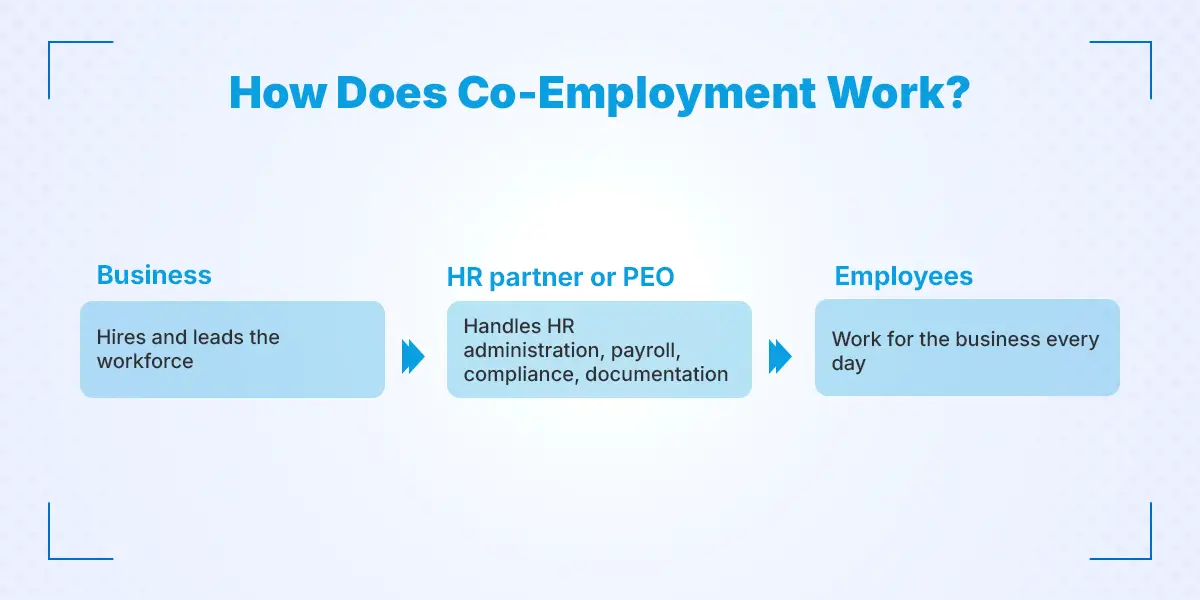
1. The Business
This is the core entity. The business remains responsible for leading its workforce and achieving its goals. Its responsibilities typically include:
- Hiring employees
- Assigning daily tasks and responsibilities
- Managing performance and productivity
- Providing training and feedback
- Building company culture
2. The HR Partner or PEO
The HR partner supports the business by managing many administrative employment functions, such as:
HR administration
Employee documentation
Employment law compliance
Benefits administration (where applicable)
3. The Employees
Although two organizations share employer responsibilities, employees usually:
- Work at the business every day
- Report to the business's managers
- Follow the business's workplace policies
- Receive HR and payroll support through the HR partner
Simply put, the business focuses on growing the company and managing its people, while the HR partner helps keep HR processes accurate, organized, and compliant.
Think of it this way: one organization manages the people's work, while the other manages much of the people administration. This shared approach allows businesses to focus on growth while experienced HR professionals handle many of the time-consuming administrative tasks.
Who is Responsible in a Co-Employment Relationship & How?
One of the biggest misconceptions about co-employment is that the HR partner takes over all employer responsibilities. In reality, that's not how it works. The business continues to lead its employees and make operational decisions, while the HR partner manages many HR and administrative functions. Depending on the agreement, some responsibilities may also be shared.
Here’s a set of the major duties of both parties, and the most common type of agreements:
| Responsibility | Business | HR Partner / PEO | Typical Role Split / Details |
|---|---|---|---|
| Recruitment & Hiring | ✓ | ✓ | Business hires; partner supports recruitment. |
| Payroll Processing | — | ✓ | Processes payroll and statutory deductions. |
| Benefits Administration | — | ✓ | Manages employee benefits and enrollments. |
| Performance Management | ✓ | — | Sets goals and reviews performance. |
| Daily Supervision | ✓ | — | Directs employees' daily work. |
| Leave Management | ✓ | ✓ | Business approves; partner maintains records. |
| Employment Compliance | ✓ | ✓ | Shared responsibility for legal compliance. |
| Employee Training | ✓ | ✓ | Business trains roles; partner trains policies. |
| Workplace Safety | ✓ | — | Maintains a safe work environment. |
| Employee Termination | ✓ | ✓ | Business decides; partner handles paperwork. |
The exact division of responsibilities varies from one co-employment agreement to another. However, the general principle remains the same: the business manages its people and operations, while the HR partner supports payroll, compliance, documentation, and other administrative HR functions. This shared approach helps businesses reduce HR workload without giving up control of their workforce.
Is Co-Employment Common in Nepal?
In short, not really. While co-employment is widely used in some countries, particularly through Professional Employer Organizations (PEOs), it is not yet a common business practice in Nepal. Most Nepalese businesses do not enter into formal co-employment agreements where employer responsibilities are legally shared between two organizations.
Instead, companies typically rely on workforce solutions that are more familiar and practical for the local market. These include:
- Recruitment agencies
- Staffing providers
- Employee outsourcing companies
- Payroll service providers
- HR consulting firms
In many cases, businesses choose to outsource specific functions rather than establish a formal co-employment relationship. For example, a company may partner with a recruitment agency to find qualified candidates, use a staffing provider to supply temporary workers, or engage an outsourcing company to manage certain workforce requirements.
As a result, businesses can reduce administrative work and access specialized expertise while still maintaining control over their daily operations, employees, and business goals. This approach is often more straightforward and better aligned with how workforce management is commonly handled in Nepal.
Advantages of the Co-Employment Model for Businesses in Nepal
The co-employment model helps businesses save time, reduce HR work, and manage employees more efficiently. By sharing employer responsibilities with an HR partner, businesses can focus more on daily operations and long-term growth. Here are some of the biggest benefits of co-employment.
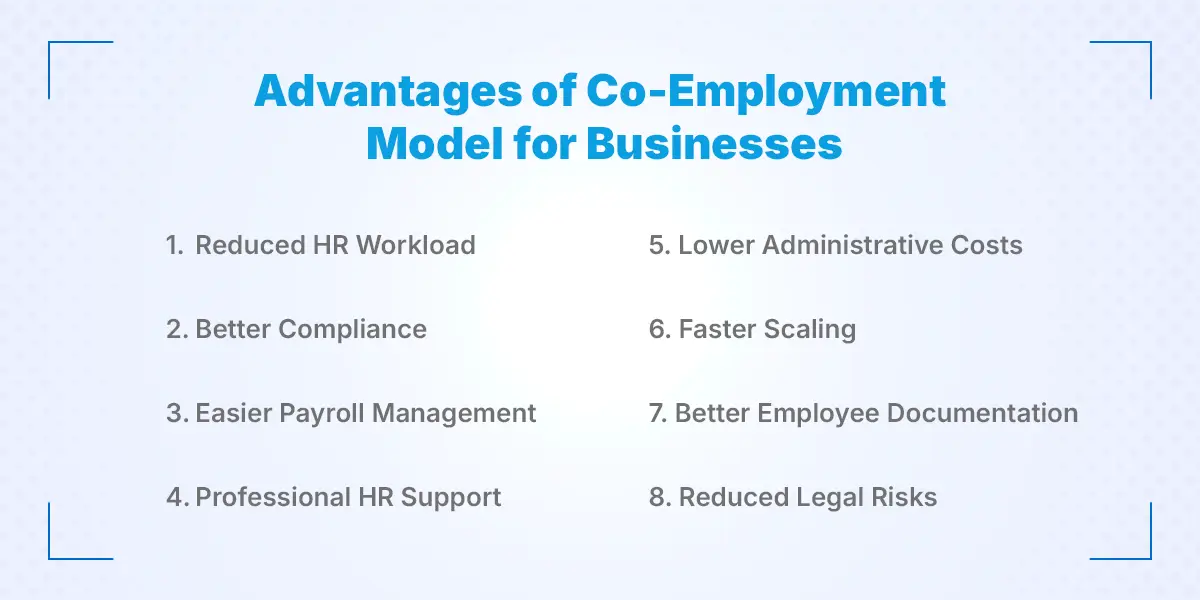
1. Reduced HR Workload
Managing HR tasks every day takes time and effort. With co-employment, the HR partner handles many routine responsibilities like payroll, employee records, and compliance. This gives your team more time to focus on business operations and employee growth. As a result, work becomes more organized and productive.
2. Better Compliance
Employment laws and workplace rules can change over time. An HR partner helps your business follow these requirements and keeps important records up to date. This reduces the risk of mistakes and helps your business stay legally compliant. It also gives employers more confidence when making HR decisions.
3. Easier Payroll Management
Payroll is more than paying salaries each month. It also includes deductions, recordkeeping, and timely salary payments. An HR partner manages these tasks accurately and consistently. This reduces payroll errors and helps employees receive their salaries on time.
4. Professional HR Support
Many small and growing businesses do not have a full HR team. Co-employment gives them access to experienced HR professionals whenever they need support. They can help with policies, documentation, and everyday HR questions. This makes it easier to manage employees with confidence.
5. Lower Administrative Costs
Hiring and maintaining a large HR department can be costly. Co-employment allows businesses to share HR resources instead of handling everything internally. This helps reduce administrative expenses without sacrificing HR support. The savings can be used to invest in other business priorities.
6. Faster Scaling
Growing businesses often need to hire more employees quickly. As the workforce grows, so do HR responsibilities. An HR partner helps manage the extra administrative work, making expansion much smoother. This allows businesses to grow without putting too much pressure on internal teams.
7. Better Employee Documentation
Keeping employee records organized is important for every business. An HR partner manages documents like contracts, leave records, and other HR files. This makes information easier to find whenever it is needed. Good documentation also supports smoother HR processes.
8. Reduced Legal Risks
Simple HR mistakes can sometimes lead to legal problems. Co-employment helps businesses maintain proper records and follow employment requirements more consistently. This lowers the chances of compliance issues and workplace disputes. In turn, businesses can manage their workforce with greater peace of mind.
Potential Disadvantages of Co-Employment
Like any business arrangement, co-employment has its challenges. Co-employment can create problems in shared responsibilities, service costs, reduced HR control, contract complexity, communication gaps, and oftentimes, choosing the wrong HR partner. Most of these issues can be avoided with a clear agreement and a reliable provider.
Let's take a closer look at each potential disadvantage:
Shared Responsibilities Can Cause Confusion: Unclear roles may lead to misunderstandings if responsibilities are not well defined.
Service Costs: Partnering with an HR provider comes with additional fees that businesses should factor into their budget.
Less HR Control: Some HR functions are handled externally, which may reduce direct control over certain processes.
Contract Complexity: Co-employment agreements should clearly outline each party's responsibilities to avoid disputes.
Choosing the Wrong Provider: An inexperienced or unreliable HR partner can create compliance and operational challenges.
Communication Challenges: Regular coordination is essential to ensure both organizations stay aligned.
For co-employment to work well, both parties need clear responsibilities, open communication, and a well-defined agreement. Choosing a trusted HR partner is just as important as choosing the right hiring model.
Which Businesses Benefit Most from Co-Employment?
Co-employment can benefit businesses of all sizes, but it delivers the most value to organizations with growing teams or increasing HR responsibilities. If your business spends more time managing paperwork than driving growth, this model may be worth exploring.
1. Growing Startups
Rapid hiring often leaves startups with little time to manage HR tasks. Co-employment helps founders spend less time on administration and more time building the business. It also provides HR expertise without hiring a full HR team.
2. Small and Medium Enterprises (SMEs)
Many SMEs don't have dedicated HR departments. Co-employment offers professional HR support while keeping costs manageable.
3. Seasonal Businesses
Hiring demand can change throughout the year. Co-employment makes it easier to manage temporary employees and HR processes during busy seasons. It also helps maintain accurate payroll and employee records.
4. Retail Chains
Managing employees across multiple stores can be challenging. Co-employment keeps HR processes more organized and consistent across locations. This reduces administrative work for store managers.
5. Hospitality Businesses
Hotels, restaurants, and travel businesses often hire frequently. Co-employment simplifies onboarding, payroll, and workforce administration. As a result, managers can focus more on delivering great customer service.
6. Healthcare Organizations
Healthcare providers need reliable workforce management and accurate documentation. Co-employment supports HR compliance while reducing administrative workload.
7. Manufacturing Companies
Large workforces often require significant HR support. Co-employment helps manage payroll, documentation, and compliance more efficiently. This creates a smoother experience for both employers and employees.
8. IT Companies
Technology companies compete for skilled talent in a fast-moving market. Co-employment reduces HR administration so teams can focus on innovation and business growth. It also supports a better employee experience.
9. NGOs and Nonprofits
Nonprofits often work with limited resources and lean teams. Co-employment provides professional HR support without significantly increasing overhead.
10. Educational Institutions
Schools and colleges manage both academic and administrative staff. Co-employment helps organize HR processes and employee records more effectively. This creates a more efficient working environment for everyone.
Is Co-Employment Right for Your Business?
The answer depends on your business goals, workforce needs, and how much HR support you require. If you want to reduce administrative work while keeping control of your employees, co-employment can be a practical solution. However, if your primary need is to hire talent, manage contract staff, or outsource specific HR functions, recruitment, staffing, or outsourcing services may be a better fit, especially in Nepal, where formal co-employment arrangements are still uncommon.
Before making a decision, consider your current HR challenges, future hiring plans, budget, and the level of support your business needs. Choosing the right workforce model today can save time, reduce risk, and support long-term growth.
How Kumari Job Helps Nepalese Businesses
Most Nepalese businesses do not need a formal co-employment arrangement to build a strong workforce. Instead, they need reliable hiring, outsourcing, and HR support that fits their business goals. That's exactly where Kumari Job helps, with flexible hiring, HR, & workforce solutions designed for businesses of all sizes.
1. Recruitment Services
Finding the right employee takes more than posting a vacancy. Kumari Job helps businesses identify, screen, and hire qualified candidates for a wide range of roles. Whether you're looking for a single specialist or building an entire team, our recruitment experts simplify the hiring process from start to finish.
Our recruitment services include:
- Permanent Hiring
- Executive Hiring
- Mass Recruitment
2. Vacancy Announcement Services
A great job opening only works if the right people see it. Kumari Job helps employers promote vacancies to one of Nepal's largest communities of active job seekers, increasing the chances of attracting qualified applicants. Better visibility leads to more relevant applications and a faster hiring process.
With our vacancy announcement services, you can benefit from:
- Access to Nepal's Largest Job Seeker Audience
- Better Job Visibility
- Faster Hiring
3. Employee Outsourcing
Managing employees involves much more than recruitment alone. Kumari Job supports businesses with workforce management solutions that reduce administrative work while keeping daily operations running smoothly. This allows employers to stay focused on growing their business instead of managing HR paperwork.
Our employee outsourcing services include:
- Workforce Management
- Payroll Assistance
- HR Documentation
- Contract Staffing
Although formal co-employment is still uncommon in Nepal, businesses can achieve many of the same operational benefits through professional recruitment and outsourcing services. Kumari Job provides practical, flexible solutions that help employers hire, manage, and grow their workforce with confidence.
Conclusion
Co-employment is a shared employment model where a business and an HR partner divide employer responsibilities. While it offers several benefits, it is different from recruitment and outsourcing, which remain the more common workforce solutions in Nepal. Choosing the right model depends on your hiring needs, operational goals, and HR requirements.
If you're looking to hire top talent, promote your vacancies, or simplify workforce management, Kumari Job is here to help. Our recruitment, vacancy announcement, and employee outsourcing services provide practical solutions that help Nepalese businesses hire faster, manage employees efficiently, and focus on long-term growth.
Frequently Asked Questions
Submit your comments

Get Our App On



SEO Training for Freshers in Nepal: Skills, Career & Job Opportunities
VIEW DETAILS
SEO Training vs. Self-Learning: Which Is Right for You?
VIEW DETAILS
How to Choose Between Two Job Offers
VIEW DETAILS
Digital Marketing Training Interview Questions and Answers for Freshers
VIEW DETAILS


Loading Comments...