



Finding qualified candidates has become more challenging as businesses receive hundreds of applications for a single job opening. Manually reviewing resumes, organizing candidate information, and coordinating interviews can slow the hiring process, increase recruitment costs, and make it easier to overlook strong applicants.
An Applicant Tracking System (ATS) helps employers simplify and automate recruitment from application to hiring. This guide explains the benefits of using an ATS, how it improves recruitment, which organizations benefit the most, and the features that make it an essential hiring tool.
In this blog
What Is an Applicant Tracking System (ATS)?
An Applicant Tracking System (ATS) is recruitment software that helps employers collect, organize, screen, and manage job applications in one centralized platform. It automates hiring tasks by gathering resumes, extracting candidate information, and tracking applicants throughout the recruitment process. ATS tools also integrate with job boards, career pages, and communication systems, making hiring faster, more organized, and more efficient while improving overall decision-making and candidate experience.
Benefits of Using an ATS
Using an Applicant Tracking System (ATS) helps organizations streamline recruitment, save time, improve hiring accuracy, and manage candidates more efficiently. By automating repetitive hiring tasks and centralizing applicant information, an ATS enables recruiters and hiring managers to make faster, more informed hiring decisions while delivering a better candidate experience.
1. Faster Resume Screening
An ATS significantly reduces the time required to review job applications by automatically scanning resumes and identifying candidates who match the job requirements. Instead of manually reading every resume, recruiters can focus on applicants who meet the required qualifications.
The system evaluates resumes based on predefined criteria such as skills, work experience, education, certifications, and relevant keywords. This automated screening process allows hiring teams to shortlist qualified candidates much faster while maintaining consistency across all applications.
Organizations that receive hundreds or thousands of applications particularly benefit from automated resume screening because it reduces repetitive manual work and accelerates recruitment timelines.
2. Improved Candidate Management
An ATS provides a centralized database where all candidate information is stored and easily accessible. Recruiters no longer need to search through emails, spreadsheets, or paper files to locate resumes or application details.
The system records communication history, interview feedback, application status, resumes, and supporting documents in one location. This organized approach makes it easier to monitor candidate progress throughout the recruitment process.
Centralized candidate management also improves the candidate experience because recruiters can respond more quickly and maintain consistent communication throughout hiring.
3. Better Hiring Accuracy
An ATS helps employers identify candidates whose qualifications closely match job requirements through structured screening criteria. Rather than relying solely on manual reviews, recruiters can compare applicants using consistent evaluation standards.
Keyword matching, skills assessments, and customizable filters improve candidate selection by highlighting applicants with the most relevant experience. Recruiters can then spend more time evaluating top candidates instead of sorting through unsuitable applications.
This structured hiring approach reduces unconscious bias during initial screening and supports more objective hiring decisions.
4. Time and Cost Savings
An ATS automates many repetitive recruitment activities that would otherwise require significant administrative effort. Tasks such as resume collection, candidate tracking, interview scheduling, status updates, and reporting become faster and more efficient.
Reducing manual work allows HR professionals to focus on interviewing, relationship building, and strategic hiring initiatives rather than administrative tasks.
Faster hiring also reduces vacancy periods, minimizes productivity losses, and lowers overall recruitment costs by shortening the time needed to fill open positions.
5. Enhanced Team Collaboration
An ATS allows recruiters, HR teams, hiring managers, and department heads to collaborate using a shared recruitment platform. Everyone involved in hiring can review resumes, leave comments, provide interview feedback, and track candidate progress in real time.
This centralized collaboration improves communication and ensures all stakeholders have access to the latest hiring information. Team members can make informed decisions without relying on lengthy email chains or disconnected documents.
Collaborative hiring also creates a more consistent recruitment process because everyone follows the same workflow and evaluation criteria.
6. Stronger Compliance and Record Keeping
An ATS helps organizations maintain accurate recruitment records while supporting compliance with employment regulations and company hiring policies. Every application, communication, interview note, and hiring decision is securely stored within the system.
Maintaining detailed recruitment records simplifies audits, reporting, and future reference when needed. It also helps organizations demonstrate fair and consistent hiring practices by documenting each stage of the recruitment process.
Secure record management reduces the risk of lost documents while protecting sensitive candidate information through controlled access and data security features.
Who Can Benefit from Using an ATS?
Organizations of all sizes can benefit from using an Applicant Tracking System (ATS) because it simplifies recruitment, improves organization, and helps employers hire qualified candidates more efficiently. Whether a company hires occasionally or recruits throughout the year, an ATS reduces manual work and creates a more consistent hiring process. Different organizations use ATS software in different ways depending on their recruitment needs.
1. Small Businesses
Small businesses often have limited HR resources, making it difficult to manage recruitment manually. An ATS helps automate routine tasks such as collecting resumes, screening applicants, and scheduling interviews, allowing small teams to hire more efficiently.
By organizing all applications in one place, business owners and HR personnel can quickly identify qualified candidates without spending hours reviewing resumes. This improves hiring speed while reducing administrative workload.
2. Large Enterprises
Large organizations typically receive hundreds or even thousands of applications for multiple job openings. Managing this volume manually can lead to delays, inconsistent evaluations, and missed opportunities to hire top talent.
An ATS enables large enterprises to standardize recruitment processes across departments and locations. Automated workflows, candidate tracking, and reporting tools make it easier to manage high-volume hiring while maintaining consistency and compliance.
3. Recruitment Agencies
Recruitment agencies handle multiple clients, job openings, and candidate databases at the same time. An ATS helps agencies organize candidate profiles, match applicants to suitable positions, and monitor recruitment progress for each client.
The software also improves communication with both employers and candidates, helping agencies deliver faster and more efficient recruitment services.
4. HR Teams
Human resource teams use ATS software to reduce repetitive administrative tasks and improve overall recruitment efficiency. Instead of manually tracking applications through emails or spreadsheets, HR professionals can manage every stage of the hiring process from a single platform.
An ATS also supports collaboration by allowing HR staff to share candidate information, interview feedback, and hiring decisions with other team members in real time.
5. Hiring Managers
Hiring managers play a key role in selecting the right candidates, but often have limited time to review every application. An ATS provides access to shortlisted candidates, interview notes, and recruiter feedback, making it easier to evaluate applicants.
This streamlined process helps hiring managers make informed decisions more quickly while improving collaboration with HR teams.
How Does an ATS Improve the Recruitment Process?
An Applicant Tracking System improves the recruitment process by automating repetitive hiring tasks, organizing candidate information, and helping employers make faster and more informed hiring decisions. It reduces manual work while creating a structured workflow that benefits recruiters, hiring managers, and job applicants. From receiving applications to making job offers, an ATS supports every stage of recruitment.
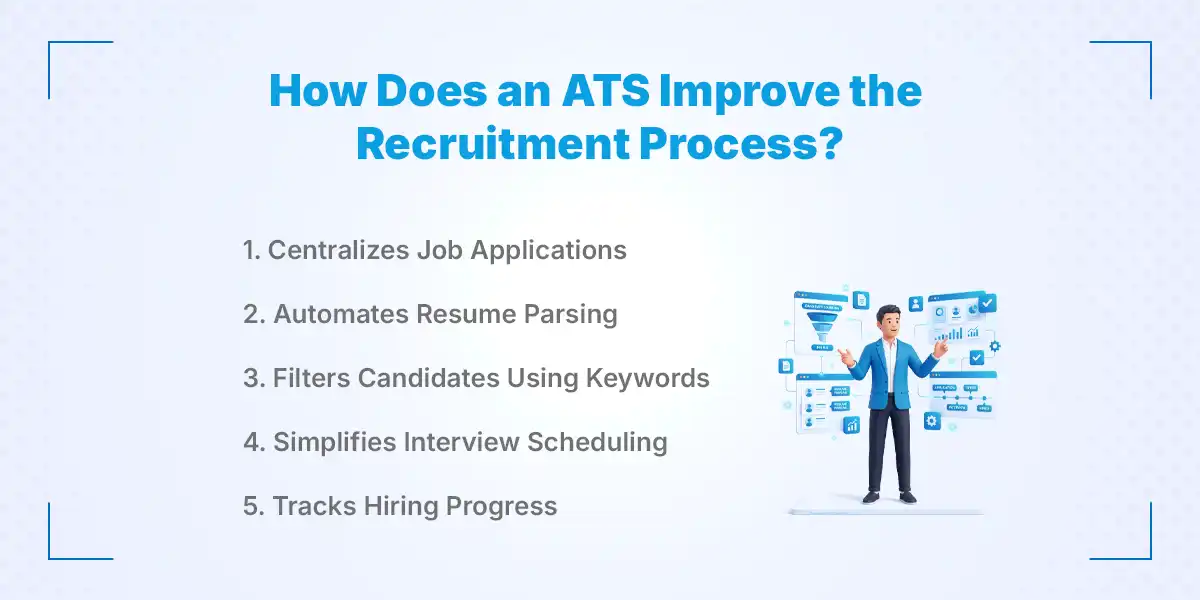
1. Centralizes Job Applications
An ATS collects applications from multiple sources, including company career pages, online job portals, and recruitment websites, into one centralized database. Recruiters no longer need to search through emails or different platforms to locate candidate information.
Having all applications in one system improves organization and ensures no applicant is overlooked during the hiring process. It also allows recruiters to access candidate profiles quickly whenever needed.
2. Automates Resume Parsing
Resume parsing automatically extracts important information from resumes, including names, contact details, education, work experience, technical skills, and certifications. This information is then organized into searchable candidate profiles.
Automated parsing eliminates the need for manual data entry and significantly reduces administrative work. Recruiters can review standardized candidate profiles instead of manually reading every resume from start to finish.
3. Filters Candidates Using Keywords
An ATS uses keyword matching to compare resumes against the requirements listed in a job description. Candidates whose skills, qualifications, and experience closely match the position are ranked higher in recruiter searches.
Keyword filtering helps recruiters identify qualified applicants more efficiently, especially when managing large numbers of applications. It also creates a more consistent screening process based on predefined hiring criteria.
4. Simplifies Interview Scheduling
Coordinating interviews can become time-consuming when multiple candidates and interviewers are involved. Many ATS platforms simplify this process by allowing recruiters to schedule interviews, send invitations, and manage calendars directly within the system.
Automated reminders reduce scheduling conflicts and help candidates stay informed throughout the recruitment process. This creates a smoother experience for both employers and applicants.
5. Tracks Hiring Progress
An ATS provides real-time visibility into every stage of the recruitment process, from application submission to final hiring decisions. Recruiters can easily monitor candidate status, interview outcomes, and pending tasks without maintaining separate tracking spreadsheets.
Hiring managers also gain better visibility into recruitment progress through dashboards and reports. This transparency improves decision-making, reduces delays, and helps organizations fill positions more efficiently.
Key Features That Make an ATS Valuable
An Applicant Tracking System includes a range of features designed to simplify recruitment, improve collaboration, and help employers make better hiring decisions. These tools automate repetitive tasks, organize candidate information, and provide valuable insights throughout the hiring process.
- Resume Parsing: Automatically extracts candidate information such as contact details, work experience, education, and skills from resumes. This reduces manual data entry and creates standardized candidate profiles for faster review.
- Candidate Tracking: Monitors every stage of the hiring process, from application submission to the final hiring decision. Recruiters can easily view each candidate's status and manage recruitment workflows from a single dashboard.
- Keyword Matching: Compares resumes with job descriptions to identify candidates whose qualifications best match the role. This helps recruiters quickly shortlist applicants who meet the required criteria.
- Job Posting Automation: Publishes job openings across multiple job boards and career websites simultaneously. This saves time while increasing the visibility of job vacancies.
- Interview Scheduling: Simplifies interview coordination by allowing recruiters to schedule interviews, send invitations, and manage calendars within the system. Automated reminders help reduce missed interviews and scheduling conflicts.
- Reporting and Analytics: Generates reports on recruitment performance, hiring timelines, application sources, and other key metrics. These insights help organizations identify opportunities to improve their hiring strategies.
- Collaboration Tools: Enable recruiters, HR professionals, and hiring managers to share feedback, review candidate profiles, and make hiring decisions together. This improves communication and ensures everyone involved has access to the latest recruitment information.
ATS vs Traditional Recruitment Methods
The following comparison highlights the key differences between using an Applicant Tracking System and managing recruitment through traditional manual methods
| Feature | Applicant Tracking System (ATS) | Traditional Recruitment |
|---|---|---|
| Recruitment Speed | Automates resume screening, candidate tracking, and interview scheduling for faster hiring. | Relies on manual processes, making recruitment slower and more time-consuming. |
| Candidate Organization | Stores all resumes, communication, and hiring records in one centralized system. | Applications are often spread across emails, spreadsheets, and paper files. |
| Hiring Accuracy | Uses keyword matching and structured screening to identify qualified candidates consistently. | Manual screening increases the risk of overlooking suitable applicants and inconsistent evaluations. |
| Cost Efficiency | Reduces administrative work, shortens hiring time, and lowers recruitment costs. | Requires more staff time and resources to manage recruitment manually. |
| Overall Productivity | Automates repetitive tasks so recruiters can focus on candidate engagement and hiring decisions. | HR teams spend significant time on administrative work, reducing overall productivity. |
For organizations that hire regularly, an ATS provides greater efficiency, consistency, and scalability than traditional recruitment methods. While manual hiring may work for very small recruitment needs, an ATS becomes increasingly valuable as application volumes grow.
Conclusion
An Applicant Tracking System has become an essential recruitment solution for organizations looking to hire more efficiently and improve the quality of their hiring decisions. By automating resume screening, organizing candidate information, simplifying collaboration, and providing valuable recruitment insights, an ATS helps employers reduce hiring time while creating a more structured recruitment process.
Whether you are a small business, a growing company, or a large enterprise, investing in the right ATS can streamline every stage of recruitment and improve the overall candidate experience. If you're looking for a smarter way to manage hiring and connect with qualified talent across Nepal, Kumarijob offers modern recruitment solutions that help employers simplify hiring and find the right candidates faster.
Frequently Asked Questions
Submit your comments

Get Our App On



SEO Training for Freshers in Nepal: Skills, Career & Job Opportunities
VIEW DETAILS
SEO Training vs. Self-Learning: Which Is Right for You?
VIEW DETAILS
How to Choose Between Two Job Offers
VIEW DETAILS
Digital Marketing Training Interview Questions and Answers for Freshers
VIEW DETAILS


Loading Comments...