


Expanding your business internationally can be stressful and risky. Companies often struggle with local labor laws, tax rules, payroll, and employment compliance, which can cause delays, fines, or even legal problems. Many business owners and HR teams feel overwhelmed when trying to hire remote employees in other countries.
This is where an EOR (Employer of Record) helps. An EOR legally hires and manages employees on your behalf, handling payroll, taxes, and compliance while you focus on daily operations. In this blog, you will learn what an EOR is, how it works, its benefits, and the top providers that can simplify global hiring.
In this blog
What is EOR?
An Employer of Record (EOR) is a third-party organization that legally hires and manages employees on behalf of another company, taking responsibility for all employment-related obligations such as payroll, taxes, benefits, and compliance with local labor laws.
The EOR handles administrative and legal tasks, while your business directs daily work and oversees employee performance. This arrangement simplifies international hiring, reduces legal risks, and allows companies to expand globally without setting up a local entity.
How EOR Works?
An Employer of Record (EOR) works by legally employing staff on behalf of another company while taking care of all administrative, legal, and compliance responsibilities.
The EOR manages contracts, payroll, taxes, and benefits, ensuring employees are fully compliant with local labor laws. Meanwhile, your company focuses on managing daily tasks, performance, and business operations. This clear separation of responsibilities allows companies to hire globally without setting up a local entity.
Key Steps in How EOR Works:
- The EOR signs employment contracts with employees on behalf of the client company.
- Handles payroll, taxes, social security, and other legal compliance requirements.
- Provides benefits administration and HR support.
- The client company directs employees’ daily work and monitors performance.
- Regular reporting and communication keep both the EOR and the client aligned.
Benefits of Using an EOR
Using an EOR provides businesses with a legal and efficient way to hire employees internationally while handling all compliance and administrative responsibilities. It simplifies global expansion and reduces risks associated with foreign employment.
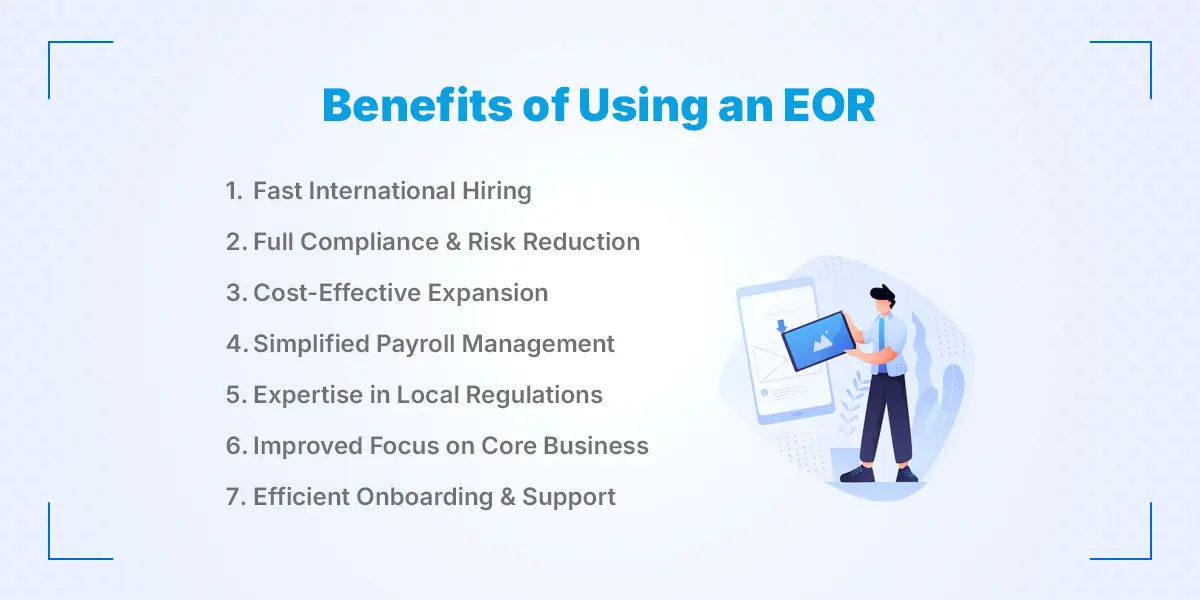
1. Fast International Hiring
An EOR allows companies to hire employees in new countries quickly without needing to set up a local legal entity. This saves months of time and bureaucracy. Employees can start working almost immediately once contracts are signed. The EOR already has the local infrastructure and compliance processes in place. This is ideal for businesses looking to scale globally without delays.
2. Full Compliance & Risk Reduction
One of the biggest benefits of using an EOR is ensuring full compliance with local labor laws. The EOR manages taxes, social security, benefits, and employment regulations. This reduces the risk of fines, legal issues, or disputes with employees. Companies can hire internationally without worrying about violating local rules. It gives peace of mind for long-term expansion.
3. Cost-Effective Expansion
Hiring employees through an EOR is often more affordable than establishing a local branch or entity. It eliminates costs related to legal registration, office setup, and local HR staff. Businesses only pay for the employees and the EOR service fees. This model is especially beneficial for startups and SMEs. It allows companies to test new markets with minimal investment.
4. Simplified Payroll Management
The EOR handles payroll for all employees, including salary payments, tax deductions, and benefits contributions. This ensures employees are paid on time and correctly. Companies don’t have to worry about currency conversions or local banking regulations. Payroll reports are usually provided regularly, keeping finances transparent. It significantly reduces HR workload and administrative errors.
5. Expertise in Local Regulations
EORs have in-depth knowledge of local employment laws, tax rules, and labor regulations. They guide companies on contracts, employee rights, and compliance requirements. This expertise prevents costly mistakes or legal disputes. Companies benefit from local knowledge without hiring full-time legal or HR teams. It makes international hiring safer and more predictable.
6. Improved Focus on Core Business
By letting the EOR manage HR, payroll, and compliance, companies can focus on core operations and strategic goals. Teams can concentrate on growth, sales, product development, and customer service. Administrative tasks no longer consume valuable management time. This improves efficiency and productivity. Companies can scale faster without overloading internal HR departments.
7. Efficient Onboarding & Support
EORs handle the entire employee onboarding process, including contracts, benefits enrollment, and training support. Employees receive guidance on local policies, payroll, and benefits. This ensures a smooth start and higher satisfaction. Ongoing HR support is also provided for any questions or disputes. It creates a professional and consistent employee experience across countries.
EOR vs Traditional Outsourcing
EOR (Employer of Record) and traditional outsourcing are two approaches businesses use to expand operations or manage remote teams, but they function differently. While an EOR legally employs staff on behalf of a company, traditional outsourcing typically involves hiring a third-party provider to complete specific tasks without formal employment. Understanding the differences helps businesses choose the right model for compliance, control, and long-term growth.
| Feature / Aspect | EOR (Employer of Record) | Traditional Outsourcing |
|---|---|---|
| Employment | EOR legally hires employees on behalf of the client company. | The outsourcing provider manages tasks; employees are not legally hired by the client. |
| Payroll & Benefits | EOR handles payroll, taxes, social security, and employee benefits. | No payroll or benefits provided; the client usually cannot offer employment perks. |
| Control over Employees | The client company directs daily tasks and the performance of employees. | Limited control; the outsourcing provider manages the workflow and output. |
| Legal Compliance | EOR ensures compliance with local labor laws, tax rules, and employment regulations. | Compliance is handled by an outsourcing provider, not directly by the client. |
| Ideal Use Case | Best for long-term, remote, or international teams where legal employment is required. | Suitable for short-term projects or specific tasks without long-term employment needs. |
| Risk Management | Reduces legal and financial risks of international hiring. | Some legal and operational risks remain with the client if issues arise. |
Who Should Use EOR Services?
EOR services are ideal for businesses that want to hire employees internationally without setting up a local legal entity or managing complex compliance issues. Using an EOR allows companies to expand globally, manage remote teams efficiently, and stay fully compliant with local employment laws. It reduces administrative burdens and legal risks while enabling faster onboarding of international talent.
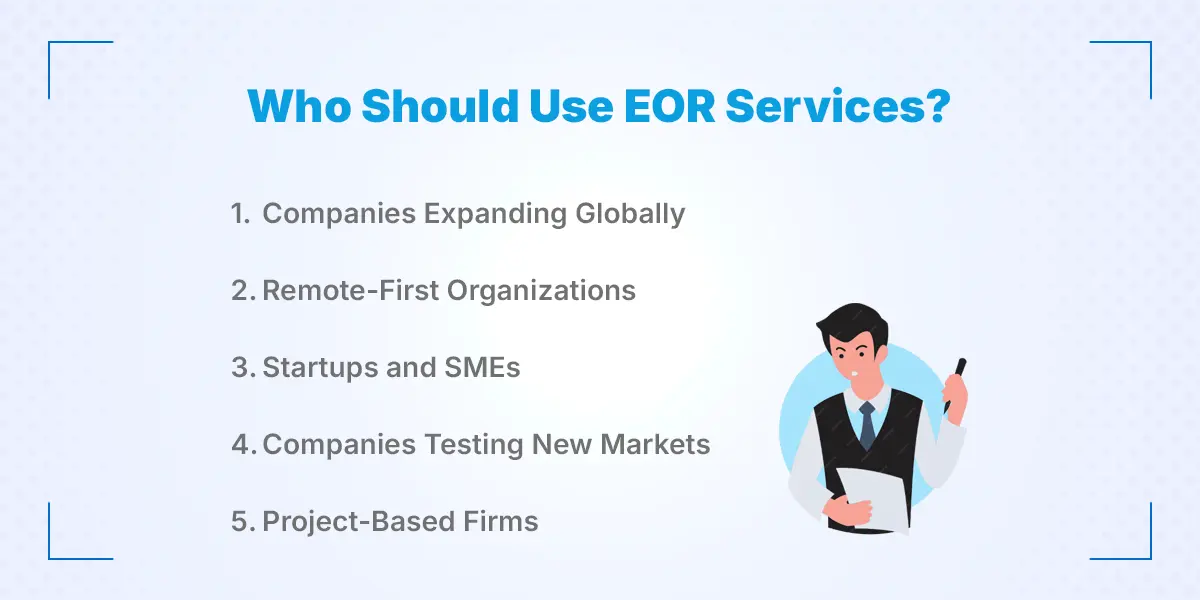
1. Companies Expanding Globally
Businesses entering new countries can face challenges with local labor laws, taxes, and HR requirements. An EOR handles all legal employment responsibilities, allowing companies to focus on operations. This helps in faster market entry without creating a local subsidiary. Companies can hire talent immediately while staying compliant with local regulations. Global expansion becomes safer, smoother, and more cost-effective.
2. Remote-First Organizations
Remote-first companies often hire employees from multiple countries. Managing payroll, taxes, and benefits in different regions can be complicated. An EOR takes care of all compliance, allowing teams to work seamlessly across borders. Employees receive proper contracts and benefits, which improves retention and satisfaction. Companies can scale their remote workforce without administrative headaches.
3. Startups and SMEs
Smaller businesses and startups often lack legal or HR teams for international employment. An EOR provides expertise in compliance, payroll, and benefits without hiring in-house staff. It allows startups to focus resources on growth, product development, and customer acquisition. Startups can test new markets quickly and efficiently. This approach is cost-effective and reduces legal risks.
4. Companies Testing New Markets
Businesses exploring new regions may not want to establish a legal entity immediately. An EOR enables them to hire local talent legally and gain market insights. Companies can assess the viability of the market without heavy upfront investment. Compliance and payroll are fully managed by the EOR. This minimizes risk while providing flexibility to scale up or down.
5. Project-Based Firms
Firms with temporary international projects need skilled employees quickly. An EOR allows them to hire staff legally for the project duration. Payroll, taxes, and benefits are handled, ensuring compliance. Clients maintain control over work quality and project outcomes. This approach is efficient and avoids long-term administrative overhead.
Key Considerations When Choosing an EOR
Choosing the right EOR is essential to ensure compliance, smooth operations, and cost-effective international hiring. Businesses must evaluate providers carefully to avoid hidden risks, ensure proper legal coverage, and select a partner that meets payroll, HR, and operational needs. The right EOR simplifies global hiring and supports long-term business growth.
1. Legal Coverage & Compliance
The EOR must fully comply with local labor laws and regulations in your target countries. This ensures your employees are legally employed and reduces risk of fines or legal issues. Check if the provider has expertise in the countries where you plan to hire. Compliance should include payroll, tax, social security, and employee benefits. Legal coverage is the foundation of a trustworthy EOR service.
2. Transparent Pricing
Understand all fees, including setup, monthly charges, and additional costs. Hidden fees can quickly make the service expensive. A good EOR clearly communicates pricing upfront. Compare pricing models between providers before deciding. Transparency ensures predictable costs and budget management.
3. Countries & Regions Served
Confirm which countries the EOR can legally hire employees in. Not all providers cover every market. Make sure your target countries are supported. Consider both current needs and future expansion plans. Broad coverage adds flexibility for global growth.
4. Payroll & HR Support
Check whether payroll, benefits administration, and HR support are included. Some EORs only handle employment compliance but not benefits or payroll. Full-service support reduces administrative workload for your team. Ensure reports, salary disbursement, and employee assistance are reliable. This ensures smooth operations and employee satisfaction.
5. Integration with HR Systems
The EOR should integrate with your internal HR and payroll systems. This allows seamless reporting, tracking, and management. Integration avoids duplication of work and improves accuracy. Ask for demos or API support options. Proper integration ensures efficient collaboration between your team and the EOR.
Which is the Best EOR Service Provider?
Kumari Job is one of the best EOR service providers, offering legal employment, payroll management, benefits administration, and full HR compliance for companies hiring internationally. With Kumari Job, businesses can expand globally without setting up a local entity. They handle contracts, taxes, social security, and HR administration, while companies manage daily work and employee performance. This ensures safe, efficient, and scalable international hiring.
How to Choose the Right EOR for Your Business?
Choosing the right EOR is essential to ensure smooth global hiring, full compliance, and reliable payroll and HR support. A good EOR like Kumari Job can help your business expand internationally without legal or administrative hurdles. The right EOR ensures your employees are legally employed, paid on time, and receive benefits, while you focus on daily operations. Evaluating providers carefully helps you avoid hidden risks and select a partner that fits your business goals.
1. Identify Business Goals and Target Countries
Determine why you need an EOR and which countries you plan to hire in. Your business goals will guide your choice of provider. Consider both immediate hiring needs and future expansion plans. Ensure the provider can legally operate in your target markets. Proper planning reduces risks and ensures smooth hiring.
2. Compare Services, Pricing, and Coverage
Look at the full range of services provided, including payroll, benefits, compliance, and HR support. Compare pricing models to avoid unexpected fees. Check if the provider supports all regions where you want to hire. Transparent fees and broad coverage are crucial for cost-effective expansion. This helps you pick a provider that meets both budget and operational needs.
3. Check Compliance Expertise and Legal Support
Ensure the EOR has deep knowledge of local labor laws, tax regulations, and employment rules. Strong legal support reduces risks and protects your company from fines or disputes. Ask about their experience in your target countries. Compliance expertise is one of the most important factors in choosing a provider. It ensures safe, legal hiring across borders.
4. Read Reviews and Request Demos or Consultations
Check customer reviews and testimonials to see how reliable the provider is. Request a demo or consultation to understand their processes and support. This helps you evaluate usability, responsiveness, and service quality. Hearing real client experiences ensures you make an informed decision. It reduces uncertainty before committing to a provider.
5. Ensure Smooth Integration with Your HR Systems
The EOR should integrate with your existing HR, payroll, and reporting systems. Integration avoids duplicate work and ensures data accuracy. Check if they provide API or software support for seamless management. Proper integration simplifies operations and reporting. It ensures collaboration between your team and the EOR is efficient and reliable.
Conclusion
EOR simplifies global hiring by handling compliance, payroll management, and HR administration while reducing legal and financial risks for companies. Choosing the right EOR is essential for smooth outsourcing and successful international expansion. Businesses should carefully evaluate providers to find the best fit for their workforce needs.
Looking for more global hiring and outsourcing solutions? Explore Kumari Job, a trusted EOR service provider that helps businesses hire internationally with full compliance and hassle-free HR support.
Frequently Asked Questions
Submit your comments

Get Our App On



SEO Training for Freshers in Nepal: Skills, Career & Job Opportunities
VIEW DETAILS
SEO Training vs. Self-Learning: Which Is Right for You?
VIEW DETAILS
How to Choose Between Two Job Offers
VIEW DETAILS
Digital Marketing Training Interview Questions and Answers for Freshers
VIEW DETAILS


Loading Comments...