


Kumarijob understands that many job seekers feel frustrated after submitting dozens of resumes without receiving interview invitations. It is common to wonder whether recruiters have even opened your application or if your resume was rejected before a human ever saw it. In many cases, the first review is completed by an Applicant Tracking System (ATS), making it essential to understand how this technology works.
This guide explains how an Applicant Tracking System (ATS) works, why employers rely on it, and how it evaluates resumes during the hiring process. You'll also learn what ATS software looks for, how candidates are ranked, and what practical steps you can take to create an ATS-friendly resume that improves your chances of reaching a recruiter.
In this blog
What Is an ATS?
An Applicant Tracking System (ATS) is recruitment software that helps employers collect, organize, screen, and manage job applications throughout the hiring process. It automatically scans resumes, matches candidate qualifications with job requirements, and ranks applicants based on relevant skills, experience, and keywords.
Companies use an ATS to simplify recruitment, reduce manual screening, and improve hiring efficiency. By storing applications in a centralized database, the system enables recruiters to quickly search, filter, and review qualified candidates, making the hiring process faster and more organized.
How Does an Applicant Tracking System (ATS) Work?
An Applicant Tracking System works by collecting resumes, extracting important information, matching candidate qualifications with job requirements, ranking applicants, and presenting the most relevant profiles to recruiters.
Rather than reading resumes like a person, ATS software analyzes structured information such as keywords, skills, education, work experience, certifications, and formatting. Understanding each stage of this process helps job seekers prepare resumes that are easier for ATS software to interpret.
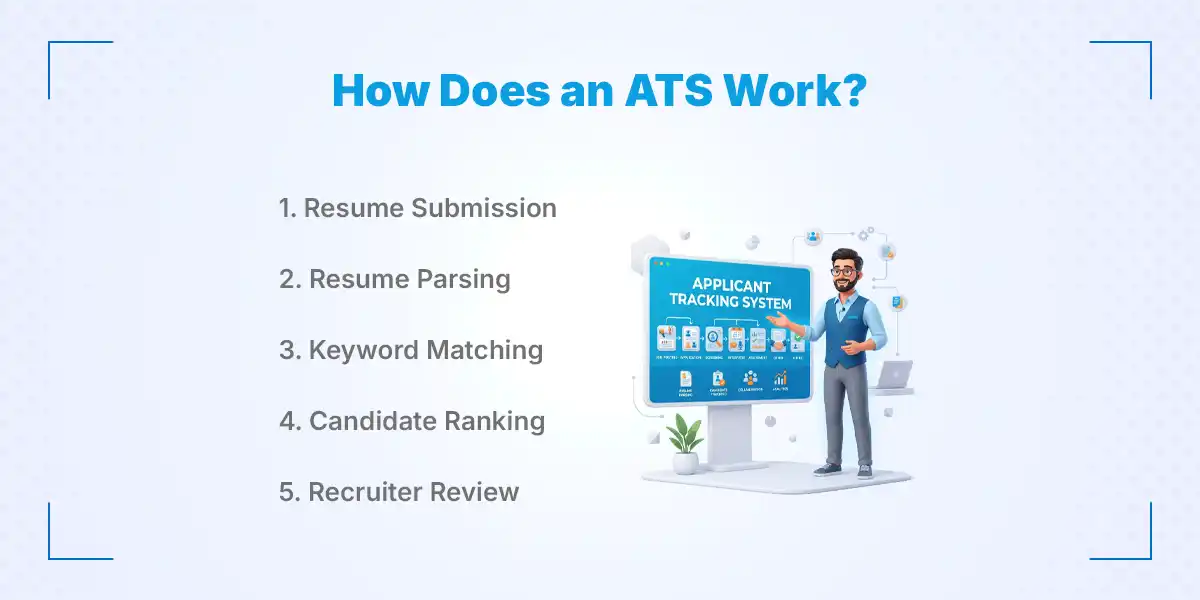
1. Resume Submission
The process begins when a candidate submits a resume through a company's careers page, job portal, or recruitment platform. The ATS securely stores the application along with supporting documents such as cover letters and certificates. Each application receives a unique record that recruiters can access throughout the hiring process. Using complete and accurate information during submission helps ensure the ATS captures all relevant details.
2. Resume Parsing
After submission, the ATS parses the resume by extracting information from different sections into a structured database. It identifies personal details, job titles, skills, education, certifications, employment history, and other important information. Clear formatting with standard section headings allows the system to recognize this information more accurately. Complex graphics, tables, and unusual layouts can reduce parsing accuracy and hide valuable qualifications.
3. Keyword Matching
The ATS compares the parsed resume with the keywords included in the employer's job description. It searches for relevant skills, software knowledge, certifications, responsibilities, industries, and experience that match the advertised role. Candidates whose resumes naturally include these terms are more likely to receive higher relevance scores. Using job-specific keywords honestly and appropriately increases the chances of matching employer requirements.
4. Candidate Ranking
Once keyword matching is complete, the ATS assigns a relevance score based on how closely each application aligns with the hiring criteria. Different ATS platforms use different scoring methods, but most evaluate qualifications, experience, education, required skills, and keyword relevance together. Recruiters often review higher-ranked candidates first because they appear to meet more job requirements. A strong, well-organized resume improves visibility during this ranking stage.
5. Recruiter Review
The final hiring decision is always made by a recruiter or hiring manager rather than the ATS itself. Recruiters review shortlisted resumes, compare candidates, schedule interviews, and evaluate qualities that software cannot accurately measure, such as communication skills, cultural fit, and career potential. The ATS simply helps recruiters identify the most relevant applications more efficiently. Creating an ATS-friendly resume increases the likelihood that your application reaches this important human review stage.
Why Do Companies Use an ATS?
Companies use an Applicant Tracking System (ATS) to automate recruitment, speed up hiring, and efficiently identify qualified candidates. It screens resumes, matches applicants with job requirements, and organizes candidate information in one centralized system, making the hiring process faster and more efficient. An ATS also reduces manual screening by automatically filtering resumes based on relevant skills, qualifications, and experience. This allows recruiters to focus on the most suitable candidates, improve hiring accuracy, and manage large volumes of applications with greater consistency.
What Factors Does an ATS Look For?
An Applicant Tracking System (ATS) looks for relevant keywords, skills, qualifications, work experience, education, and resume formatting to determine how well a candidate matches a job opening. It compares the information in your resume with the employer's job description and identifies applicants who meet the required criteria.
To improve your chances of passing ATS screening, include job-specific keywords naturally, highlight relevant skills and achievements, list your work experience clearly, and provide accurate education details. Using a simple resume format with standard headings also helps the ATS read and process your resume more accurately.
How to Make Your Resume ATS-Friendly?
Making your resume ATS-friendly means creating a resume that an Applicant Tracking System can easily read, understand, and match with a job description.
A well-optimized resume improves your chances of passing the initial screening stage and reaching a recruiter for further evaluation. By following a few best practices, you can increase your resume's visibility without compromising readability.
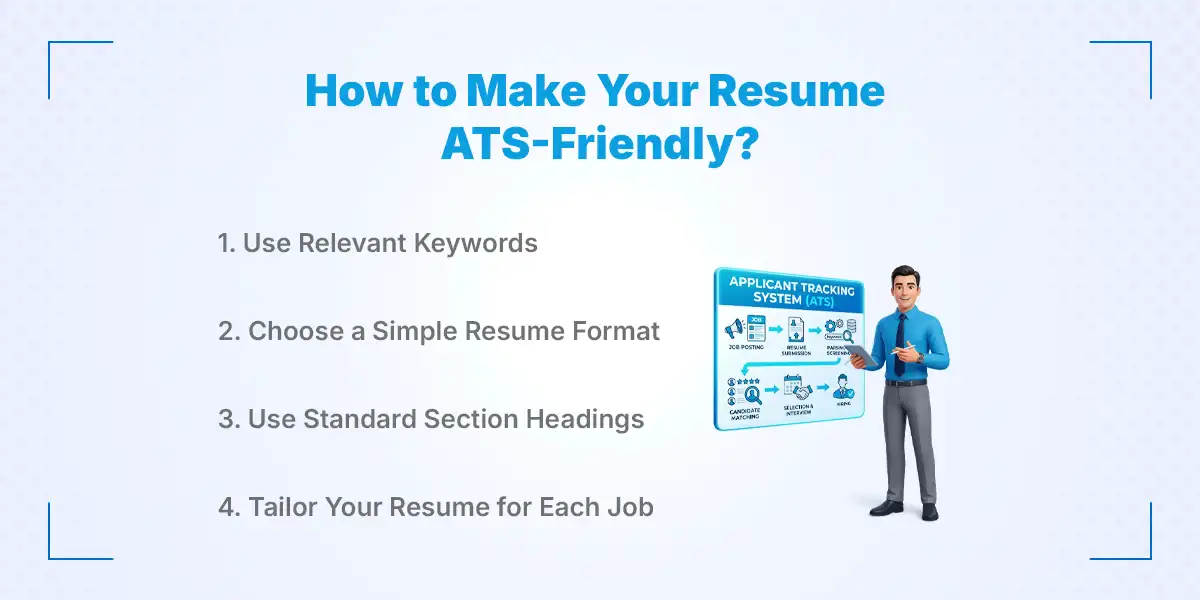
1. Use Relevant Keywords
Read the job description carefully and identify the skills, qualifications, certifications, and responsibilities the employer emphasizes. Include these keywords naturally throughout your professional summary, work experience, skills, and education sections where they accurately reflect your background. Avoid adding keywords that do not match your actual experience, as recruiters will verify your qualifications during later hiring stages. A customized resume for each application usually performs better than using the same resume for every job.
2. Choose a Simple Resume Format
Use a clean, professional layout with standard fonts such as Arial, Calibri, or Times New Roman. Organize your information using clear headings, bullet points, and consistent spacing so the ATS can parse your resume accurately. Avoid tables, text boxes, columns, graphics, icons, and images because some ATS platforms may struggle to read them correctly. Saving your resume in the file format requested by the employer also improves compatibility.
3. Use Standard Section Headings
Use common section titles such as Professional Summary, Work Experience, Education, Skills, and Certifications. Standard headings help ATS software identify and categorize your information without confusion. Creative titles like "Career Journey" or "What I Bring to the Table" may not be recognized correctly by every ATS. Keeping section names simple benefits both the software and the recruiter reviewing your resume.
4. Tailor Your Resume for Each Job
Every job posting includes different requirements, so update your resume to match the position you are applying for. Adjust your skills, achievements, and experience to highlight the qualifications that best fit the role while remaining truthful. Focus on measurable accomplishments that demonstrate your value instead of listing general responsibilities. A targeted resume is more likely to receive a higher relevance score during ATS screening.
ATS vs Human Recruiter: What's the Difference?
An Applicant Tracking System and a human recruiter work together during the hiring process, but each has a different role.
The ATS performs the initial screening by organizing and filtering applications, while recruiters make the final hiring decisions based on experience, communication, and overall suitability. Understanding this difference helps job seekers prepare resumes that satisfy both technology and human evaluation.
| Feature | Applicant Tracking System (ATS) | Human Recruiter |
|---|---|---|
| Primary Role | Screens and organizes applications | Evaluates and selects candidates |
| Decision Making | Uses predefined criteria and keyword matching | Uses professional judgment and interviews |
| Resume Review | Analyzes structured information | Reviews qualifications, achievements, and career growth |
| Communication Skills | Cannot evaluate | Assesses during interviews and interactions |
| Cultural Fit | Cannot determine | Evaluates based on conversations and experience |
| Speed | Processes hundreds of resumes quickly | Reviews shortlisted candidates individually |
| Final Hiring Decision | Does not hire candidates | Makes hiring recommendations and final selections |
Although ATS software plays an important role in recruitment, it does not replace recruiters. Employers rely on ATS technology to reduce manual work, while recruiters evaluate qualities that software cannot measure, such as problem-solving ability, interpersonal skills, motivation, and long-term potential. Creating an ATS-friendly resume increases your chances of reaching the recruiter, but preparing for interviews remains equally important for securing a job opportunity.
Conclusion
Understanding how an Applicant Tracking System (ATS) works gives you a significant advantage in today's competitive job market. Instead of trying to outsmart the software, focus on creating a clear, relevant, and well-structured resume that accurately reflects your skills, experience, and qualifications while matching the requirements of each job posting.
If you're looking for new career opportunities and want to improve your chances of getting hired, Kumarijob can help. Explore the latest job vacancies, access career resources, and connect with leading employers through Kumarijob to take the next step toward your professional goals.
Frequently Asked Questions
Submit your comments

Get Our App On



SEO Training for Freshers in Nepal: Skills, Career & Job Opportunities
VIEW DETAILS
SEO Training vs. Self-Learning: Which Is Right for You?
VIEW DETAILS
How to Choose Between Two Job Offers
VIEW DETAILS
Digital Marketing Training Interview Questions and Answers for Freshers
VIEW DETAILS


Loading Comments...