


Finding the perfect job match in Nepal is frustrating for everyone right now.
If you are a job seeker, your CV feels like it falls into a deep black hole.
On the other side, if you are a business owner, you are likely drowning in hundreds of applications for a single opening.
As recruitment service providers, we get it at Kumari Job. It is a massive headache on both sides of the table. The real problem actually lies in how we screen these applications.
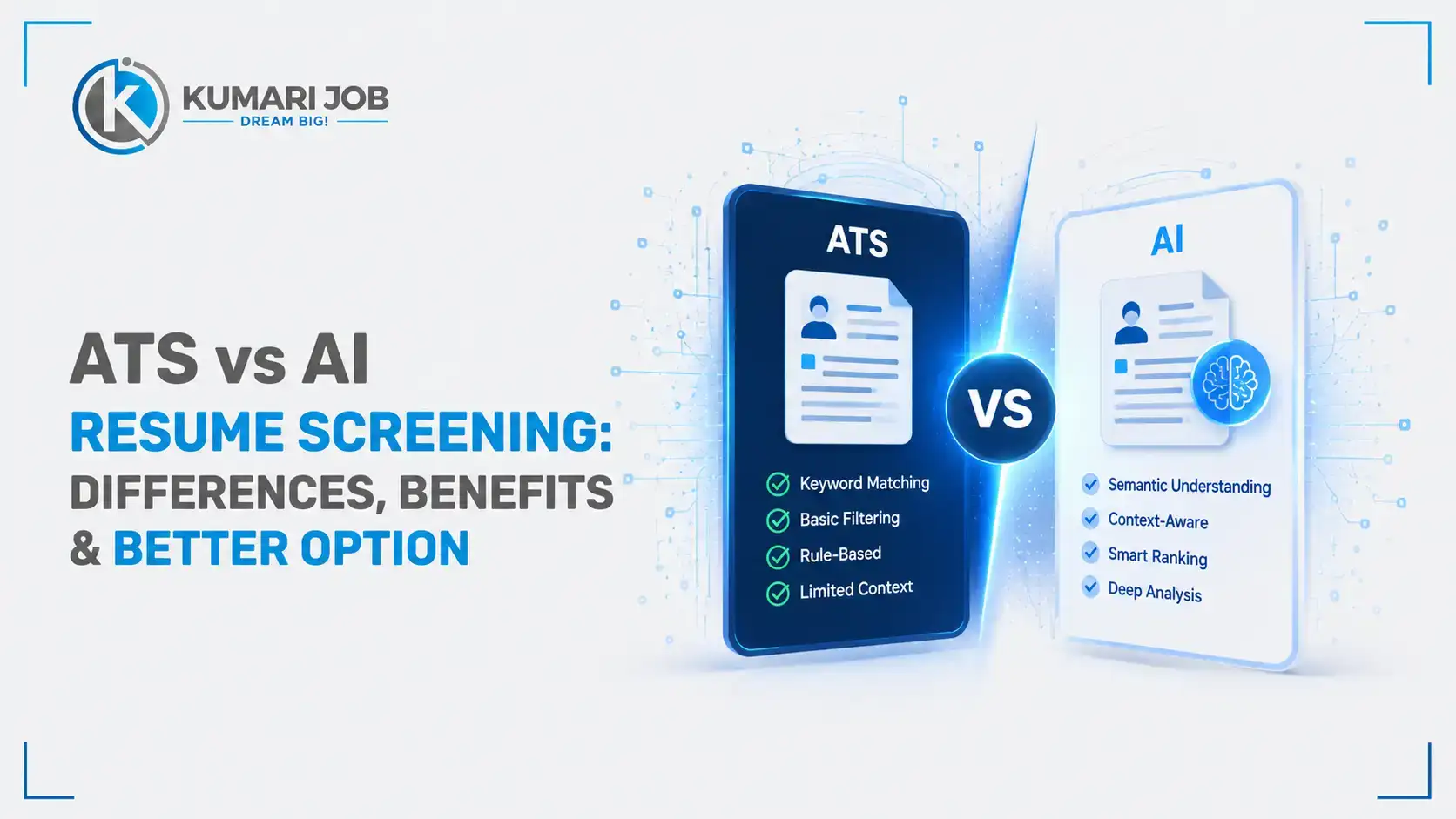
ATS and AI Resume Screening are two popular hiring software solutions for the purpose. Understanding ATS (Applicant Tracking System) vs AI Resume Screening is absolutely critical.
Whether you want to hire top talent or land your next dream role, you must know how these digital CV filters work. This guide will clear up the confusion so you can win at recruitment.
In this blog
What Is an ATS (Applicant Tracking System)?
An Applicant Tracking System (ATS) is a tool that helps employers manage job applications and organize the hiring process. Instead of sorting through resumes manually, recruiters use an ATS to collect applications, store candidate information, track hiring progress, and keep everything in one place. It is especially useful for companies that receive a large number of applications and need a simple way to stay organized throughout the recruitment process.
What Is AI Resume Screening?
AI resume screening is a smarter way of reviewing job applications using artificial intelligence. Instead of only looking for specific keywords, AI can analyze a candidate's skills, experience, and qualifications to identify how well they match a role. This helps recruiters find suitable candidates faster, spend less time on manual screening, and focus more on connecting with top talent.
How ATS and AI Resume Screening Work
ATS screens resumes by matching keywords and predefined criteria, while AI resume screening evaluates skills, experience, and context to determine candidate suitability. Although both technologies help recruiters process applications faster, they use fundamentally different approaches to analyze resumes and shortlist candidates. Understanding how each system works can help recruiters choose the right screening method and help job seekers optimize their applications accordingly.
How ATS Screens Resumes
An Applicant Tracking System relies on strict, predefined templates to manage and categorize incoming applications. It processes documents through simple rules and filters to narrow down the pool of candidates quickly. This highly structural step-by-step process explains why so many traditional resumes fail to reach human eyes.
1. Keyword-Based Filtering
This step compares the words on your resume to the exact phrases listed in the job description. The software scans for specific hard skills, certifications, and job titles to determine your compatibility score. If you use a synonym instead of the exact phrase, the filter might completely miss your qualification and reject your profile automatically.
2. Resume Parsing Process
The parser acts as a data translator, breaking down your PDF or Word document into structured plain text. It extracts your contact details, work history dates, and educational degrees to sort them into standardized database fields. Standard layouts are vital here, as complex designs or tables can easily scramble the parsed data.
3. Candidate Shortlisting
Once the parsing and keyword matching are complete, the system automatically grades and ranks every application. Recruiters then filter candidates based on these automated scores to decide who moves forward to the interview round. This means only a tiny percentage of high-scoring resumes are actually opened and reviewed by human recruiters.
Example of ATS Evaluation
Imagine an employer is hiring a Digital Marketing Specialist and sets "SEO Strategy" as a required keyword in the ATS. When a candidate's resume contains the exact phrase "SEO Strategy," the system recognizes the match and may rank the application higher or move it to the next screening stage.
However, if another candidate writes "Search Engine Optimization expert" instead of "SEO Strategy," the ATS may not recognize the two terms as equivalent. As a result, a qualified applicant could receive a lower score or be filtered out, even though they have the relevant skills and experience for the role.
How AI Resume Screening Works
Artificial intelligence introduces semantic understanding and predictive analytics to the screening phase. Instead of treating your CV as a checklist of isolated keywords, the AI reads your career history as a cohesive narrative. Let's look at how these smart engines evaluate candidate potential without relying on rigid parameters.
1. Contextual Skill Analysis
Natural Language Processing allows the AI to understand the meaning behind different phrases and professional experiences. It recognizes that "devel words differ. This allows the system to appreciate the depth of your actual skill set and professional background.
2. Candidate Matching
The algorithm compares the overall profile of the applicant against the historical performance and responsibilities of the role. It assesses how well your past projects, company environments, and career progression fit the open position. This holistic matching helps identify candidates who are genuinely qualified, rather than just good at writing resume keywords.
3. Predictive Hiring Insights
By analyzing historical hiring data, the AI attempts to predict how successful a candidate will be in the actual role. It flags patterns such as promotion intervals, tenure stability, and skill growth over time. These smart insights help employers make proactive decisions and discover hidden talent in the database.
Example of Working of AI Resume Screening
Imagine an employer is hiring a Public Health Officer. A candidate's resume mentions "disease tracking", while the job description uses the term "epidemiological monitoring." An AI screening system can understand that both refer to similar work and recognize the candidate's relevant experience.
Instead of looking only for exact keywords like ATS, AI Screening considers the overall meaning of the resume. This means a qualified candidate can still be ranked highly, even if they use different words than those used in the job posting.
What Makes ATS and AI Resume Screening Different?
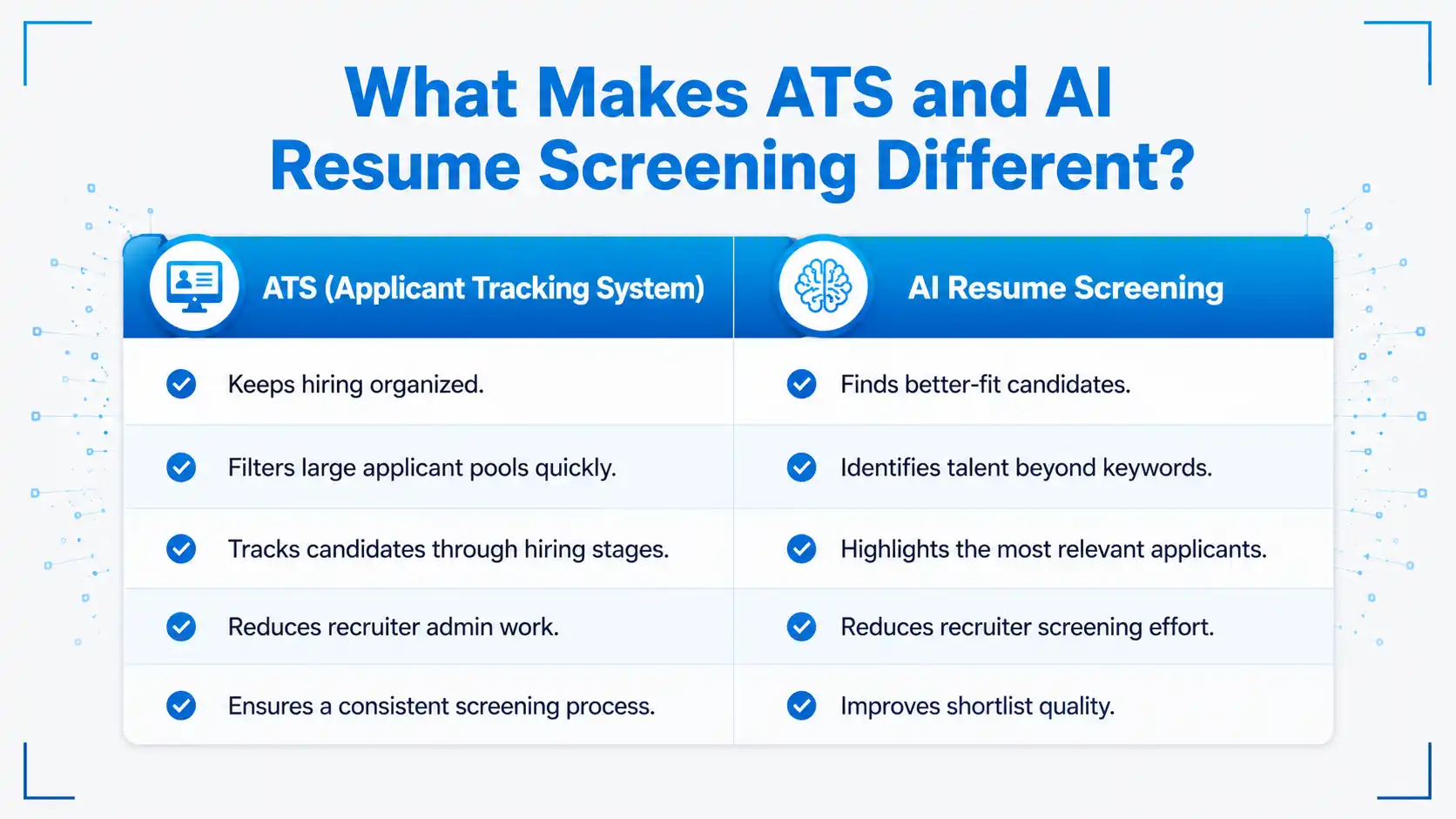
The key difference is that ATS focuses on matching keywords, while AI focuses on understanding skills and experience. As a result, ATS is effective for quickly filtering large numbers of applications, whereas AI can identify qualified candidates even when their resumes don't use the exact wording found in the job description.
This makes ATS valuable for organizing and managing recruitment at scale, while AI helps improve screening accuracy and uncover strong candidates who might otherwise be overlooked.
In simple terms, ATS focuses on making recruitment more manageable, while AI focuses on making candidate selection more effective.
ATS vs AI Resume Screening: Side-by-Side Comparison
ATS screens resumes using keywords and sets rules, while AI evaluates skills, experience, and overall fit. Both help recruiters handle applications faster, but AI can better understand candidate qualifications. The table below compares the key differences between the two.
Here’s a detailed side-by-side comparison:
| Feature / Aspect | Applicant Tracking System (ATS) | AI Resume Screening |
|---|---|---|
| Keyword Matching | Looks for exact keywords from the job description. | Understands related keywords and similar terms. |
| Evaluation Focus | Focuses mainly on keyword presence. | Understands the meaning behind skills and experience. |
| Candidate Evaluation | Scores candidates based on predefined criteria. | Ranks candidates based on overall job fit. |
| Skill Recognition | Recognizes skills explicitly listed on the resume. | Identifies related, transferable, and implied skills. |
| Processing Logic | Follows fixed rules and filters. | Can improve recommendations using data and feedback. |
| Automation Level | Automates application tracking and initial filtering. | Automates screening, matching, and candidate prioritization. |
| Primary Strength | Best for managing large applicant volumes. | Best for identifying the most suitable candidates. |
| Strategic Value | Supports recruitment workflows and tracking. | Supports smarter hiring decisions. |
Advantages and Limitations of ATS Resume Screening
ATS helps recruiters handle large numbers of applications efficiently by organizing candidates and automating the initial screening process. However, because it relies heavily on predefined rules and keywords, it may overlook qualified candidates who don't match the exact criteria. Understanding the features of the best applicant tracking system can help employers choose a solution that balances efficiency, organization, and hiring effectiveness.
Advantages
- Speeds up application screening.
- Keeps the hiring process organized.
- Handles large applicant volumes efficiently.
- Provides consistent screening criteria.
Limitations
- Relies heavily on keyword matching.
- May overlook qualified candidates.
- Has limited understanding of skills and context.
Benefits and Challenges of AI Resume Screening
AI resume screening helps recruiters identify suitable candidates more accurately by considering skills, experience, and context rather than relying solely on keywords. While it can improve hiring quality, it still requires careful oversight to ensure fair and reliable decisions.
Benefits
- Identifies better-fit candidates.
- Recognizes skills beyond exact keywords.
- Improves shortlist quality.
- Reduces manual screening effort.
Challenges
- Results depend on data quality.
- May introduce bias if not monitored.
- Requires human review and oversight.
ATS vs AI Resume Screening, Which Is Better for Recruiters?
Choosing between standard tracking databases and intelligent screening engines depends heavily on your company's size, budget, and hiring goals. There is no one-size-fits-all solution when it comes to modern recruitment technology. By evaluating your specific organizational needs, you can select the platform that delivers the highest return on investment.
Let’s find out the most suitable fit between ATS or AI resume screening based on business sizes:
1. Small Businesses
For small businesses with tight budgets and occasional hiring needs, a traditional ATS is usually the most practical and cost-effective choice. These businesses rarely have the high volume of applicants or the massive datasets required to make an expensive AI screening tool work effectively. A basic, organized system is perfect for tracking a few dozen applications for a local vacancy. Investing in advanced algorithms is simply unnecessary when a simple, structured database can keep your hiring pipeline neat and manageable without breaking the bank.
2. Growing Companies
Growing companies that are actively scaling their teams across different departments often find themselves in a transitional sweet spot. While they still require the solid organizational foundation of an ATS, they also begin to suffer from resume fatigue as their brand gains traction in the market. For these businesses, choosing a hybrid system that combines traditional tracking with lightweight AI modules is often the best strategy. This allows them to scale their operations smoothly and implement modern techniques.
3. High-Volume Recruiters
High-volume recruiters who manage thousands of applications across multiple entry-level roles absolutely require the speed and analytical power of artificial intelligence. Standard keyword-based systems often struggle under the weight of massive applicant pools, leading to recruiter burnout and missed talent.
4. Enterprise Organizations
Enterprise organizations and multinational bodies operate under complex global guidelines that demand a highly sophisticated, secure, and accurate hiring workflow. For these organizations, a fully integrated enterprise suite that combines a robust ATS with advanced AI modeling is the gold standard. This powerful combination allows them to maintain strict administrative data control while simultaneously using predictive analytics to forecast long-term employee success and build future-proof leadership teams.
Conclusion
ATS and AI resume screening are designed to solve different recruitment challenges. ATS helps recruiters organize applications, manage hiring workflows, and quickly filter large numbers of candidates, while AI focuses on identifying the most suitable applicants by analyzing skills, experience, and context.
Neither solution is inherently better than the other. The right choice depends on an organization's hiring needs, application volume, and recruitment goals.
For most recruiters, the greatest value comes from combining both technologies. ATS provides structure and efficiency, while AI improves screening accuracy and candidate matching, resulting in a more effective hiring process.
If you're looking to attract qualified candidates and simplify your hiring process, explore Kumari Job's Vacancy Announcement tool to publish job openings, reach a wider talent pool, and manage applications more effectively.
Frequently Asked Questions
Submit your comments

Get Our App On



SEO Training for Freshers in Nepal: Skills, Career & Job Opportunities
VIEW DETAILS
SEO Training vs. Self-Learning: Which Is Right for You?
VIEW DETAILS
How to Choose Between Two Job Offers
VIEW DETAILS
Digital Marketing Training Interview Questions and Answers for Freshers
VIEW DETAILS


Loading Comments...