

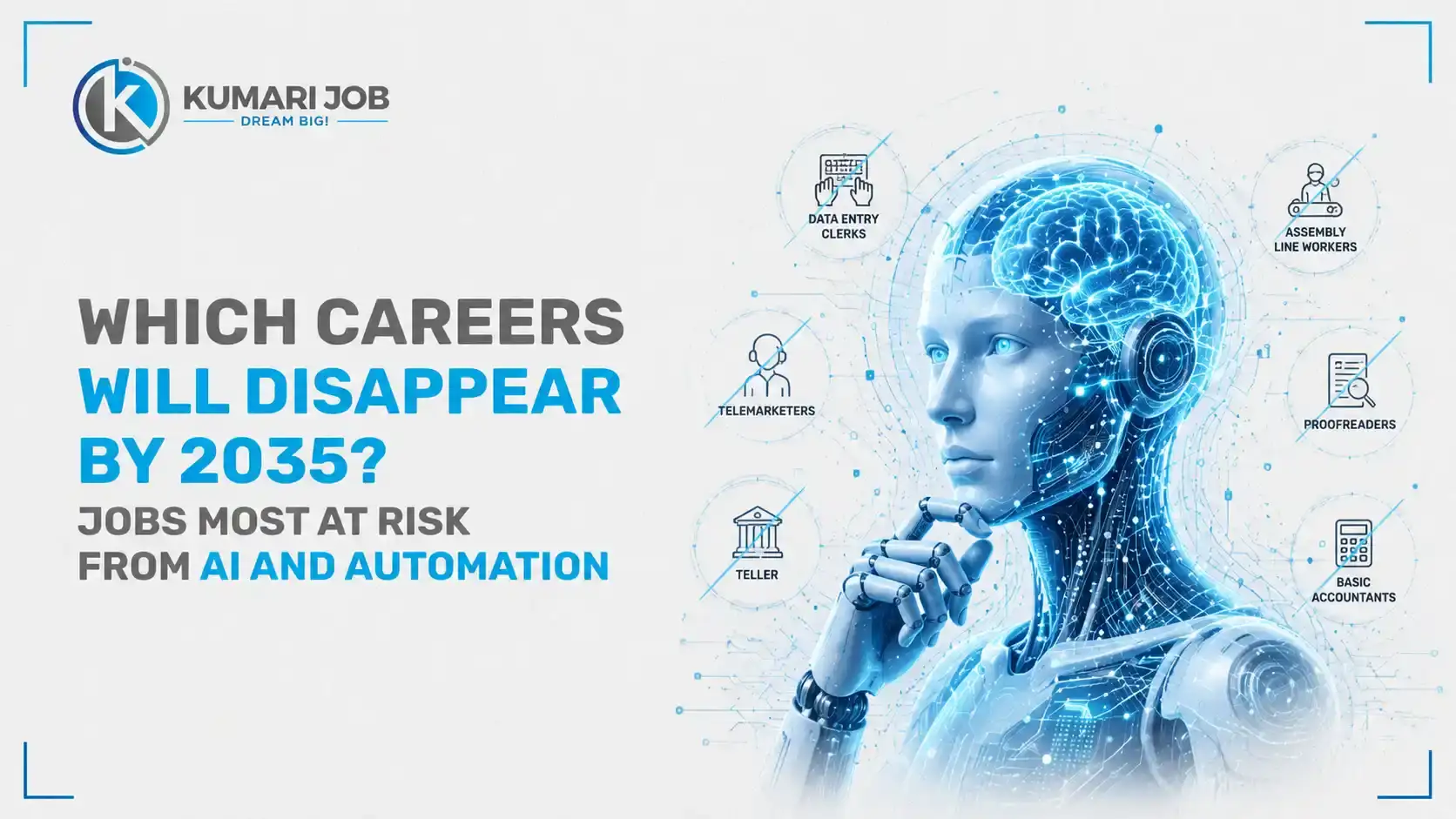

Many people spend years preparing for a career, only to discover that technology is changing the job market faster than expected. Artificial intelligence (AI), automation, robotics, and digital tools are transforming industries, causing some traditional roles to shrink while creating demand for entirely new skills.
This guide explains which careers are most likely to disappear by 2035, why these changes are happening, and what you can do to stay competitive. You'll also learn which industries face the biggest workforce changes, the careers expected to grow, and the skills employers will continue to value in the years ahead.
In this blog
Careers That Will Disappear by 2035
Many careers that involve repetitive and routine tasks are expected to decline as AI, automation, and digital technologies become more advanced. While these jobs may not disappear completely, demand for them is likely to decrease over the next decade.
- Data Entry Clerks – AI software can enter, organize, and process data faster and with fewer errors than manual workers.
- Cashiers – Self-checkout machines and cashless payment systems are reducing the need for traditional cashier roles.
- Telemarketers – Automated calling systems, AI voice assistants, and digital marketing have replaced many outbound sales tasks.
- Bank Tellers – Online banking, mobile apps, and smart ATMs allow customers to complete most banking services without visiting a branch.
- Travel Agents – Travelers can now book flights, hotels, and vacation packages directly through online travel websites and mobile apps.
- Postal Workers – Email, digital documents, and online communication continue to reduce the amount of traditional mail.
- Toll Booth Operators – Electronic toll collection systems automatically charge vehicles without requiring manual payment.
- Assembly Line Workers – Robots and automated machines now perform many repetitive manufacturing tasks with greater speed and accuracy.
- Printing Press Operators – The shift toward digital media and online publishing has reduced demand for printed newspapers, magazines, and other materials.
- Retail Sales Associates – Online shopping and AI-powered customer support have changed how people purchase products.
- Customer Service Representatives – AI chatbots and virtual assistants now handle many common customer questions and support requests.
- Bookkeeping Clerks – Modern accounting software can automatically record transactions, generate reports, and manage financial records.
- Receptionists – Digital check-in systems, virtual reception services, and online appointment booking have replaced many front-desk duties.
- Warehouse Pickers – Automated warehouses use robots and smart inventory systems to pick, pack, and move products more efficiently.
- Taxi Drivers (in Autonomous Vehicle Markets) – In countries where self-driving vehicles become widely available, demand for traditional taxi drivers may gradually decline.
What Are the Careers Most Likely to Disappear by 2035?
Careers most likely to disappear by 2035 are those built around repetitive, rule-based tasks that machines can perform faster, cheaper, and with fewer errors. AI and automation continue to improve, making it practical for businesses to replace routine work with technology. Jobs requiring creativity, complex decision-making, and human interaction remain far more resilient.
1. What makes a job vulnerable to automation?
Jobs become vulnerable when daily responsibilities follow predictable patterns that software or machines can easily repeat. Repetitive administrative work, manual data processing, and standardized customer interactions are common examples. Businesses often automate these tasks to improve efficiency, reduce operating costs, and minimize human error. Careers that require little creativity or emotional intelligence generally face the highest automation risk.
2. Industries facing the biggest workforce changes
Retail, manufacturing, banking, transportation, and administrative services are undergoing major digital transformation. Companies in these sectors continue investing in AI-powered systems to improve productivity and reduce repetitive manual work. Online platforms also reduce the need for many traditional customer-facing positions. Workers in these industries benefit from learning digital and analytical skills that complement automation rather than compete with it.
3. Key technologies replacing traditional jobs
Artificial intelligence can analyze information, answer customer questions, and automate business decisions within seconds. Robotics now performs manufacturing, warehouse management, and packaging tasks with remarkable accuracy. Cloud computing connects business systems, allowing organizations to automate operations across multiple locations. Machine learning continues to improve these technologies by helping systems become more accurate through experience.
4. Factors that determine whether a career survives
Jobs involving creativity, leadership, critical thinking, and human relationships remain difficult to automate. Careers requiring complex problem-solving often need judgment that technology cannot fully replicate. Industries that depend on trust, empathy, and personal communication continue to rely heavily on skilled professionals. Employees who continuously develop new skills increase their chances of remaining valuable in a changing workforce.
Which Industries Will Experience the Biggest Job Losses?
The industries expected to experience the biggest job losses by 2035 are retail, banking and finance, manufacturing, transportation, customer support, and administrative services because AI, automation, and digital technologies are replacing many repetitive and routine tasks.
- Retail – Self-checkout systems and online shopping reduce the need for in-store staff.
- Banking and Finance – Digital banking and AI automate many everyday banking services.
- Manufacturing – Robots and automated machines replace repetitive factory work.
- Transportation – Autonomous vehicles and smart logistics reduce manual driving and operational roles.
- Customer Support – AI chatbots and virtual assistants handle common customer questions.
Administrative Services – Business software automates scheduling, data entry, and document management.
Why Are These Careers Disappearing?
Careers are disappearing because artificial intelligence (AI), automation, robotics, self-service technologies, digital transformation, and changing consumer behavior are making many routine jobs faster, cheaper, and more efficient to perform without human involvement.
- Artificial Intelligence (AI) – AI can analyze data, answer customer questions, and complete repetitive tasks with high accuracy, reducing the need for manual work.
- Automation and Robotics – Machines and robots now perform manufacturing, packaging, and other repetitive tasks more efficiently than humans.
- Self-Service Technologies – Self-checkout kiosks, online banking, ticket machines, and mobile apps allow customers to complete tasks without employee assistance.
- Digital Transformation – Businesses are replacing paper-based and manual processes with digital systems, cloud software, and automated workflows.
- Changing Consumer Behavior – More people prefer online shopping, digital payments, and instant customer support, encouraging businesses to automate their services.
How Can You Prepare for Careers That Will Disappear by 2035?
Preparing for future workforce changes starts with continuous learning and skill development. People who embrace new technologies instead of resisting them are more likely to find long-term career success. Building adaptable skills helps professionals remain valuable regardless of industry changes.
1. Learn Future-Proof Skills
Future-proof skills are difficult for AI and automation to replace because they rely on human judgment and creativity. Critical thinking, leadership, communication, collaboration, and innovation remain valuable across nearly every profession. Technical knowledge should be combined with interpersonal abilities to maximize career opportunities. Developing both hard and soft skills creates greater long-term career stability.
2. Upskill Through Certifications
Professional certifications help employees demonstrate practical knowledge in growing industries. Courses in cloud computing, cybersecurity, digital marketing, project management, and artificial intelligence continue gaining value. Employers often view recognized certifications as evidence of commitment to continuous improvement. Regular learning also helps professionals stay current with changing industry standards.
3. Build Digital Literacy
Digital literacy has become a core requirement in almost every profession. Employees should understand productivity software, cloud platforms, data management, online collaboration tools, and AI-assisted workflows. Comfort with technology improves efficiency and increases adaptability in changing workplaces. Strong digital skills also make career transitions much easier.
4. Develop Soft Skills Employers Value
Soft skills continue to separate people from machines in many professional environments. Emotional intelligence, negotiation, leadership, teamwork, adaptability, and communication cannot easily be automated. Employers consistently seek professionals who can solve problems while working effectively with others. Strengthening these abilities improves both career growth and long-term employability.
5. Stay Updated with Industry Trends
Industries continue evolving as new technologies reshape business operations every year. Following market trends, attending webinars, reading industry reports, and participating in professional communities help workers prepare for future changes. Early awareness allows professionals to identify growing opportunities before demand increases. Lifelong learning remains one of the most effective career strategies.
Future-Proof Careers Expected to Grow Beyond 2035
The careers expected to grow beyond 2035 are AI and machine learning specialists, cybersecurity professionals, data scientists, software developers, renewable energy technicians, healthcare professionals, digital marketing specialists, cloud engineers, robotics engineers, and UX/UI designers because they require advanced technical skills, creativity, problem-solving, and human expertise that are difficult to automate.
- AI and Machine Learning Specialists – Develop intelligent systems that help businesses automate tasks and improve decision-making.
- Cybersecurity Professionals – Protect organizations from cyberattacks, data breaches, and online security threats.
- Data Scientists – Analyze large datasets to help businesses make smarter decisions and identify future trends.
- Software Developers – Design and build websites, mobile apps, and software solutions for different industries.
- Renewable Energy Technicians – Install, maintain, and repair solar, wind, and other clean energy systems.
- Healthcare Professionals – Provide medical care, diagnosis, treatment, and patient support that require human expertise and compassion.
- Digital Marketing Specialists – Help businesses grow online through SEO, content marketing, social media, and digital advertising.
- Cloud Engineers – Build and manage cloud infrastructure that supports modern business operations.
- Robotics Engineers – Design, develop, and maintain robots used in manufacturing, healthcare, and logistics.
- UX/UI Designers – Create user-friendly digital products and improve the overall experience of websites and mobile applications.
Skills That Will Stay Valuable in the Future Job Market
The most valuable skills in the future job market are those that combine human intelligence with the ability to work alongside technology. Employers will continue hiring professionals who can solve problems, communicate effectively, and adapt to changing business needs.
- Critical Thinking – Evaluate information, identify problems, and make informed decisions that technology cannot always replicate.
- Problem-Solving – Find practical solutions to complex business and customer challenges.
- Communication – Share ideas clearly through speaking, writing, and collaboration with teams and clients.
- Leadership – Motivate people, manage projects, and guide organizations through change.
- Creativity – Generate original ideas, improve processes, and design innovative products or services.
- Adaptability – Learn new technologies, adjust to workplace changes, and remain productive in evolving environments.
- Emotional Intelligence – Understand emotions, build trust, resolve conflicts, and strengthen workplace relationships.
- Data Analysis – Interpret business data and turn insights into better decisions.
- AI Literacy – Understand how AI tools work and use them responsibly to improve productivity.
- Digital Skills – Work confidently with cloud platforms, collaboration tools, business software, and digital workflows.
The Impact of AI and Automation on Employment
AI and automation are transforming employment by reducing repetitive jobs, improving business efficiency, and creating new career opportunities that require advanced digital and human skills.
- Benefits for Businesses: AI helps businesses increase productivity, reduce operating costs, improve accuracy, and make faster, data-driven decisions.
- Challenges for Employees: Many workers need to learn new skills and adapt to changing technologies as some traditional jobs become automated.
- New Job Opportunities Created by AI: AI is creating demand for careers such as AI specialists, machine learning engineers, cybersecurity professionals, data scientists, cloud engineers, and AI ethics experts.
- How Workplaces Are Evolving: Workplaces are becoming more technology-driven, with employees using AI tools alongside their skills to improve productivity and innovation.
Careers That Are Safe from Automation
The careers that are safest from automation are healthcare roles, education professionals, skilled trades, creative careers, management positions, and human-centered service jobs because they require human judgment, creativity, emotional intelligence, and personal interaction that technology cannot fully replace.
- Healthcare Roles – Doctors, nurses, therapists, and caregivers provide personalized care, diagnosis, and treatment that depend on human expertise.
- Education Professionals – Teachers, trainers, and professors help students learn through communication, guidance, and critical thinking.
- Skilled Trades – Electricians, plumbers, carpenters, and mechanics perform hands-on work that often requires problem-solving in different environments.
- Creative Careers – Writers, designers, artists, and filmmakers use originality and imagination to create unique content and ideas.
- Management Positions – Managers and business leaders make strategic decisions, lead teams, and solve complex organizational challenges.
- Human-Centered Service Jobs – Counselors, social workers, HR professionals, and coaches rely on empathy, communication, and relationship-building to support people.
Conclusion
The future of work is not about technology replacing every employee but about technology changing the skills employers expect. Careers built around repetitive tasks face the greatest risk, while roles requiring creativity, emotional intelligence, leadership, and advanced technical knowledge will continue to grow.
The best way to prepare for 2035 is to invest in continuous learning, build digital skills, and stay informed about industry trends. If you're looking for future-ready career opportunities, career guidance, or the latest job openings across Nepal, Kumarijob can help you discover roles that match today's market demands while preparing you for tomorrow's workforce.
Frequently Asked Questions
Submit your comments

Get Our App On



SEO Training for Freshers in Nepal: Skills, Career & Job Opportunities
VIEW DETAILS
SEO Training vs. Self-Learning: Which Is Right for You?
VIEW DETAILS
How to Choose Between Two Job Offers
VIEW DETAILS
Digital Marketing Training Interview Questions and Answers for Freshers
VIEW DETAILS


Loading Comments...