



Starting a career in banking can be confusing when you do not know what you can realistically earn. If you are considering a loan officer role in Nepal, salary is only one part of the decision because your experience, education, employer, location, loan portfolio, and performance can all affect your total earnings.
A loan officer evaluates applications, checks financial documents, assesses repayment capacity, and helps customers choose suitable loan products. In this guide, you will learn the expected loan officer salary in Nepal, monthly and experience-based pay, required qualifications and skills, career growth opportunities, and practical ways to increase your earning potential.
In this blog
What is the salary of a loan officer in Nepal?
A loan officer in Nepal can typically earn around NPR 25,000 to NPR 70,000 per month, depending on experience, institution, location, qualifications, and responsibilities. Entry-level officers may earn around NPR 20,000–30,000, while experienced professionals handling larger portfolios or senior credit responsibilities can earn NPR 60,000–100,000 or more.
What Does a Loan Officer Do in Nepal?
A loan officer in Nepal evaluates loan applications and helps financial institutions decide whether applicants can safely repay borrowed money. The role combines customer service, financial analysis, documentation, credit assessment, and repayment monitoring. Loan officers may work with personal, business, housing, vehicle, agricultural, or other types of loans.
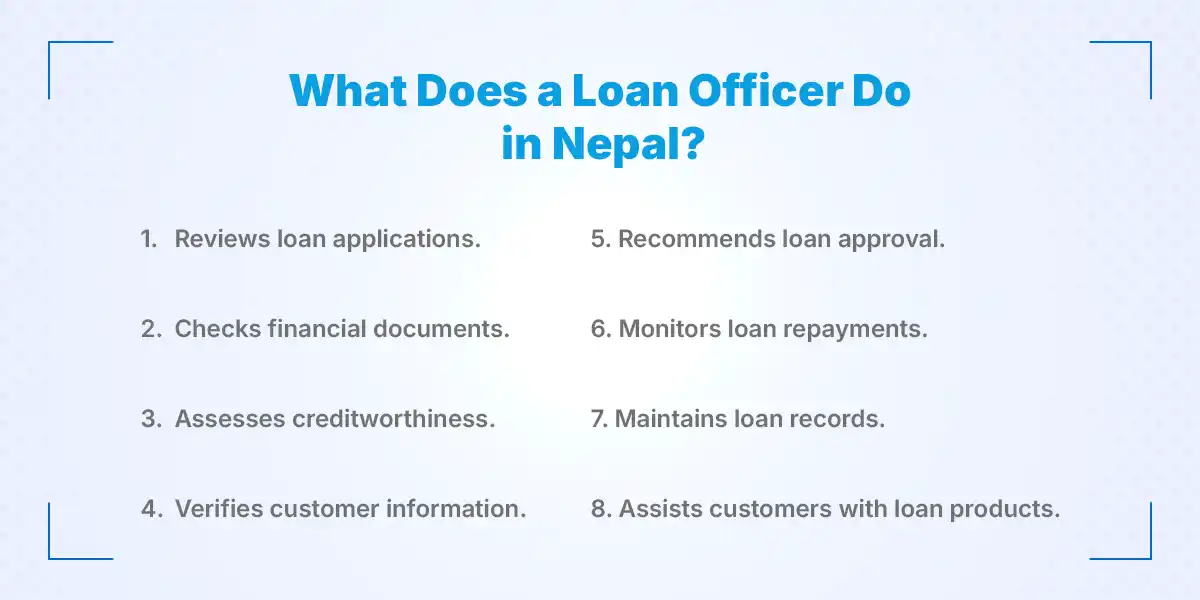
Common responsibilities include:
- Reviewing loan applications and supporting documents.
- Checking income, expenses, assets, liabilities, and financial records.
- Assessing a customer's creditworthiness and repayment capacity.
- Verifying customer information and submitted documents.
- Evaluating collateral where applicable.
- Recommending loan approval, modification, or rejection.
- Explaining loan terms, interest rates, fees, and repayment schedules.
- Maintaining accurate loan and customer records.
- Monitoring repayments and following up on overdue accounts.
- Coordinating with credit, risk, operations, and management teams.
- Building relationships with existing and potential borrowers.
- Following internal lending policies and applicable banking procedures.
A loan officer therefore does more than simply approve loans. The officer must balance customer needs with the financial institution's credit and risk requirements.
What Is the Average Loan Officer Salary in Nepal?
The average loan officer salary in Nepal can be estimated at around NPR 30,000 to NPR 60,000 per month, although actual compensation varies significantly by employer, experience, location, and responsibility. Commercial banks and larger financial institutions may offer stronger compensation packages, while smaller institutions and entry-level positions may start at lower salaries. Performance incentives, allowances, bonuses, and portfolio-based responsibilities can also affect total earnings.
Estimated Loan Officer Salary Range
| Career Level | Estimated Monthly Salary | Estimated Annual Salary |
|---|---|---|
| Entry-level/Fresher | NPR 20,000–30,000 | NPR 2.4–3.6 lakh |
| Junior Loan Officer | NPR 25,000–40,000 | NPR 3–4.8 lakh |
| Mid-level Loan Officer | NPR 35,000–55,000 | NPR 4.2–6.6 lakh |
| Senior Loan Officer | NPR 50,000–75,000 | NPR 6–9 lakh |
| Experienced Credit Professional | NPR 60,000–100,000+ | NPR 7.2–12 lakh+ |
These figures are estimated market ranges rather than fixed salary scales. Actual offers can differ between commercial banks, development banks, finance companies, microfinance institutions, cooperatives, and other lending organizations.
The total package may also include:
- Basic salary
- Transport allowance
- Communication allowance
- Medical benefits
- Provident fund or retirement benefits
- Performance incentives
- Annual bonuses
- Other institution-specific benefits
When comparing vacancies, check the complete compensation package instead of looking only at the advertised basic salary.
How Much Does a Loan Officer Earn Per Month in Nepal?
A loan officer in Nepal generally earns around NPR 20,000 to NPR 75,000 per month, depending on career level, employer, experience, and responsibilities. Freshers usually start near the lower end, while senior officers and experienced credit professionals can earn substantially more. Allowances, incentives, bonuses, and performance-based payments can increase the total monthly compensation.
Typical monthly salary levels include:
- Entry-level/Fresher: NPR 20,000–30,000
- Junior Loan Officer: NPR 25,000–40,000
- Mid-level Loan Officer: NPR 35,000–55,000
- Senior Loan Officer: NPR 50,000–75,000
- Experienced Loan/Credit Professional: NPR 60,000–100,000+
It is important to distinguish basic salary from total compensation. For example, an employee with an NPR 35,000 basic salary may receive additional allowances and performance incentives that increase the actual monthly value of the job.
What Is the Loan Officer Salary Based on Experience in Nepal?
Loan officer salary generally increases as professionals gain experience in credit assessment, customer management, portfolio handling, and risk evaluation. However, experience alone does not guarantee a higher salary because promotion also depends on performance, qualifications, institution type, and the level of responsibility you take on.
1. 0–2 Years of Experience
Entry-level loan officers usually focus on application processing, document verification, customer communication, and basic credit assessment. Employers may offer approximately NPR 20,000–30,000 per month at this stage. New professionals can improve their prospects by learning financial statement analysis, loan documentation, spreadsheet skills, and basic credit-risk concepts.
2. 2–5 Years of Experience
Professionals with two to five years of experience generally handle more complex applications and larger customer portfolios. Salary can reach approximately NPR 30,000–50,000 per month, depending on the institution and performance. Strong repayment tracking, customer acquisition, credit analysis, and portfolio management skills can help employees qualify for senior positions.
3. 5–10 Years of Experience
Loan officers with five to ten years of experience may take responsibility for larger loan portfolios, higher-value customers, credit decisions, or team coordination. Their earnings can reach around NPR 45,000–75,000 or more per month depending on their role. At this stage, professionals can also move toward credit analysis, credit risk, relationship management, or branch-level responsibilities.
4. 10+ Years of Experience
Professionals with more than ten years of relevant experience may move into senior credit, branch management, lending management, or specialized financial roles. Compensation can exceed NPR 70,000–100,000+ per month in higher-level positions, although the exact amount depends heavily on the employer and job scope. Advanced financial knowledge, leadership ability, portfolio performance, and strong risk-management experience can support progression into management.
What Factors Affect Loan Officer Salary in Nepal?
Loan officer salary depends on a combination of qualifications, experience, employer, location, responsibilities, and performance. Two professionals with the same job title can receive different salaries because financial institutions use different pay structures and incentives.
The major factors include:
- Education: A relevant bachelor's degree can improve eligibility for banking positions.
- Professional qualifications: Additional banking, finance, accounting, or credit training can
- strengthen your profile.
- Experience: Practical experience generally increases your ability to handle complex lending cases.
- Institution type: Commercial banks, development banks, finance companies, microfinance institutions, and cooperatives may have different salary structures.
- Location: Major employment markets such as Kathmandu may offer more opportunities and different salary levels.
- Loan portfolio: Handling larger or more complex portfolios can increase responsibility and earning potential.
- Credit skills: Strong credit analysis and risk assessment skills make professionals more valuable.
- Performance incentives: Some positions provide bonuses or incentives based on performance and portfolio results.
- Certifications and training: Relevant professional development can support promotion and specialization.
- Career progression: Moving from an officer role into senior credit or management positions can create larger salary increases.
The most important point is that salary growth usually comes from increasing responsibility and business value, not simply staying in the same position for more years.
What Qualifications Do You Need to Become a Loan Officer in Nepal?
A bachelor's degree in management, finance, accounting, economics, business administration, or a related field is commonly useful for becoming a loan officer in Nepal. Employers also look for financial knowledge, analytical ability, communication skills, computer skills, and an understanding of lending procedures. Requirements can differ between institutions and individual vacancies.
Relevant educational backgrounds include:
- Bachelor's degree in Management
- Bachelor's degree in Finance
- Bachelor's degree in Accounting
- Bachelor's degree in Economics
- Bachelor's degree in Business Administration
- Other related business or finance programs
You should also understand:
- Basic banking products
- Loan and lending procedures
- Interest and repayment calculations
- Financial statement analysis
- Credit assessment
- Risk management
- Customer verification
- Loan documentation
- Spreadsheet and computer applications
- Customer service and communication
Previous banking experience is not always mandatory for entry-level vacancies. Some employers recruit fresh graduates for junior banking or credit-related roles and provide practical training after hiring.
How Can You Become a Loan Officer in Nepal?
You can become a loan officer by completing a relevant degree, developing banking and credit skills, gaining practical experience, and applying for suitable banking or lending vacancies. The strongest candidates combine academic knowledge with practical understanding of financial analysis, customer service, documentation, and risk assessment.
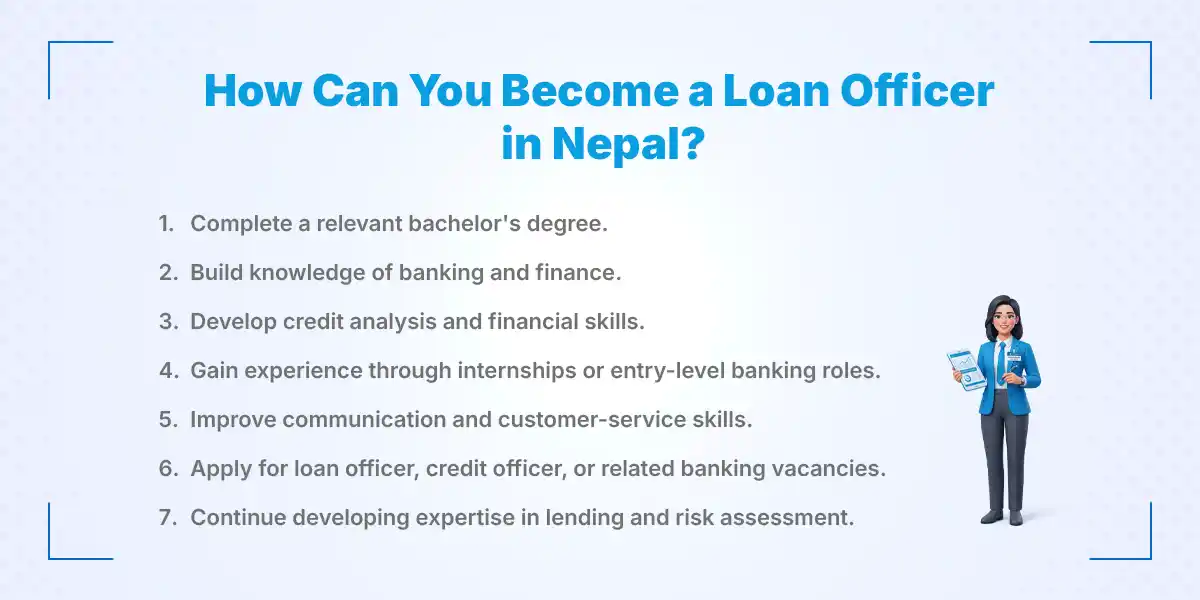
- Complete a relevant bachelor's degree: Build a foundation in management, finance, accounting, economics, or business administration.
- Learn banking fundamentals: Understand deposits, loans, interest rates, repayment structures, collateral, and basic banking operations.
- Develop credit analysis skills: Practice reviewing income, expenses, financial statements, debt obligations, and repayment capacity.
- Gain practical experience: Internships and entry-level banking positions can help you understand real lending processes.
- Improve communication skills: Loan officers regularly explain financial products and communicate with customers.
- Learn spreadsheet tools: Become comfortable with Excel or similar tools for financial calculations and data analysis.
- Apply for relevant vacancies: Search for loan officer, credit officer, junior credit, relationship officer, and similar positions.
- Continue professional development: Learn more about credit risk, financial analysis, banking regulations, and lending practices as you progress.
What Skills Are Required for a Loan Officer?
Loan officers need a combination of financial, analytical, communication, customer-service, and documentation skills. Strong attention to detail is especially important because inaccurate financial information or poor credit assessment can create significant risks for a lending institution.
Important skills include:
- Credit assessment: Evaluate whether customers can repay their loans.
- Financial analysis: Understand income statements, balance sheets, cash flow, and financial ratios.
- Risk assessment: Identify potential repayment and credit risks.
- Communication: Explain loan products and requirements clearly.
- Negotiation: Discuss suitable loan structures and repayment arrangements.
- Customer relationship management: Build professional relationships with borrowers.
- Numerical ability: Work accurately with financial figures and calculations.
- Attention to detail: Identify missing, inconsistent, or incorrect information.
- Problem-solving: Find practical solutions to lending and repayment issues.
- Documentation: Maintain complete and accurate loan records.
- Regulatory knowledge: Follow relevant banking and lending procedures.
- Computer skills: Use spreadsheets, banking systems, and digital documentation tools.
A loan officer who combines strong technical knowledge with good customer communication can often progress faster than someone who relies on only one skill set.
Where Can Loan Officers Find Jobs in Nepal?
Loan officers can find employment in commercial banks, development banks, finance companies, microfinance institutions, cooperatives, and other lending organizations. Online job portals can make it easier to monitor new vacancies and compare roles based on qualifications, location, experience, and responsibilities.
Potential employers include:
- Commercial banks
- Development banks
- Finance companies
- Microfinance institutions
- Cooperatives
- Lending organizations
- Other financial institutions
When searching online, do not search only for "loan officer." Also use related job titles such as:
- Credit Officer
- Junior Credit Officer
- Credit Analyst
- Loan Officer
- Relationship Officer
- Credit Assistant
- Banking Officer
- Recovery Officer
You can use Kumari Job to monitor banking and finance vacancies and search for loan officer and related credit positions that match your qualifications.
What Is the Career Growth of a Loan Officer in Nepal?
A loan officer can progress from entry-level lending work into senior credit, credit analysis, risk management, relationship management, branch management, and other banking leadership roles. Career advancement usually depends on experience, portfolio performance, technical skills, qualifications, and the ability to handle increasing responsibility.
A possible career path is:
Loan Officer → Senior Loan Officer → Credit Officer/Credit Analyst → Senior Credit Officer → Credit or Branch Management
Experienced professionals can also move into areas such as:
- Credit risk management
- Relationship management
- Corporate lending
- SME lending
- Recovery and collections
- Credit analysis
- Branch operations
- Banking management
- Risk and compliance
The career path is not identical at every institution. Some organizations use different titles for similar responsibilities, so applicants should compare the actual job description rather than relying only on the position name.
How Can You Increase Your Loan Officer Salary in Nepal?
You can increase your loan officer salary by developing advanced credit skills, taking on greater responsibility, improving performance, gaining relevant experience, and moving into higher-level banking or credit roles. The goal should be to become capable of handling more valuable and complex lending decisions rather than simply accumulating years of experience.
Practical ways to increase your earning potential include:
- Gain experience with different loan products.
- Learn advanced financial statement analysis.
- Improve credit-risk assessment skills.
- Understand cash-flow-based lending.
- Develop stronger Excel and financial modelling skills.
- Learn more about banking regulations and lending procedures.
- Build a strong record of responsible portfolio management.
- Take responsibility for larger loan portfolios.
- Improve customer relationship and negotiation skills.
- Complete relevant banking or finance training.
- Develop leadership and team-management abilities.
- Apply for senior credit or banking positions when qualified.
One useful strategy is to track your professional achievements. Instead of simply stating that you have worked for five years, demonstrate the type of loan portfolio you handled, the complexity of cases you managed, the skills you developed, and the responsibilities you gained.
Loan Officer Salary vs Credit Officer Salary in Nepal
Loan officers usually have more direct interaction with borrowers, while credit officers often focus more heavily on credit evaluation, risk assessment, and lending decisions. However, responsibilities and salary structures vary between financial institutions, so the title alone cannot determine which position pays more.
| Area | Loan Officer | Credit Officer |
|---|---|---|
| Main Focus | Loan processing and customer support | Credit evaluation and risk |
| Customer Interaction | Usually high | Moderate to high |
| Credit Analysis | Required | Usually more advanced |
| Risk Assessment | Important | Often a major responsibility |
| Documentation | High | High |
| Portfolio Management | Common | Common depending on role |
| Career Progression | Senior lending or banking roles | Senior credit, risk, or management roles |
| Earning Potential | Depends on institution and performance | Depends on institution, specialization, and responsibility |
In smaller institutions, the same employee may perform both loan and credit functions. Therefore, candidates should read the complete job description before comparing salary offers.
Conclusion
A loan officer career can provide a clear path into Nepal's banking and financial sector, but salary should be viewed as a progression rather than a fixed number. Your earning potential can improve as you build credit-analysis expertise, manage larger portfolios, take on greater responsibility, and move toward senior credit or management roles.
If you are starting your banking career, focus first on building practical lending and financial-analysis skills and then use that experience to target better opportunities. Explore loan officer, credit officer, and other banking vacancies on Kumari Job to find opportunities that match your career goals.
Frequently Asked Questions
Submit your comments

Get Our App On



How to Become an Auditor in Nepal
VIEW DETAILS
What Is the Salary of a Spa Therapist in Nepal?
VIEW DETAILS
How to Start a Career as a Game Developer in Nepal
VIEW DETAILS
What Is the Salary of a Brand Manager in Nepal?
VIEW DETAILS


Loading Comments...