



A student in Kathmandu opens a laptop, picks a random YouTube tutorial on Unity, and gives up after twenty minutes because nothing on the screen matches the video. This is a common starting point for aspiring game developers in Nepal: too many scattered tutorials, no clear learning order, and no local roadmap to follow. The confusion is often not about talent but about not knowing which skill to learn first, which tool to use, or where to find work after gaining the necessary skills.
This guide provides a clear path to becoming a game developer in Nepal, covering the skills to learn, tools to use, courses to consider, salary expectations, portfolio building, and job-search strategies. By the end, beginners will have a practical roadmap instead of a browser full of unfinished tutorials.
In this blog
What Is Game Development and What Does a Game Developer Do?
Game development is the process of designing, programming, testing, and improving interactive digital games for platforms such as mobile, PC, console, browser, and VR. A game developer writes code that controls movement, physics, scoring, saving, interactions, and other game functions while working with artists, designers, and sound professionals to create a playable product.
Game development is often confused with game design. Game design focuses more on game rules, mechanics, level structure, and player experience, while game development focuses on building and implementing the software that makes those elements work.
Game developers can specialize in different areas, including:
- Mobile games: Games developed for Android and iOS devices.
- PC games: Games developed for computers with more complex systems and hardware requirements.
- Console games: Games developed for platforms such as PlayStation and Xbox.
- Browser-based games: Games that run directly in web browsers using technologies such as JavaScript and WebGL.
- Virtual reality games: Immersive games designed for VR headsets and interactive environments.
Why Choose Game Development as a Career in Nepal?
Game development can be an interesting career option in Nepal because it combines programming, creativity, problem-solving, and digital design. Developers can work on local projects, freelance for international clients, or publish their own games online.
The local game development market is smaller than the broader software and IT sector, so beginners may need to explore freelance, remote, independent, and related software development opportunities alongside dedicated game development roles.
Some reasons to consider this career include:
- Combines programming and creative skills.
- Offers opportunities for freelance and remote work.
- Allows developers to create and publish their own games.
- Provides transferable programming and software development skills.
- Supports portfolio-based learning and career development.
- Offers opportunities to work in related areas such as animation, simulation, and interactive media.
What Skills Do You Need to Become a Game Developer in Nepal?
Game development requires a combination of programming, technical, creative, and problem-solving skills. Beginners should focus on building these skills gradually rather than trying to learn everything at once.
1. Programming Skills
- Learn variables, loops, functions, conditions, and data structures.
- Understand object-oriented programming (OOP).
- Learn C# for Unity development.
- Learn C++ if you plan to work with Unreal Engine.
- Practice programming by building small projects.
2. Game Engine Knowledge
- Learn a game engine such as Unity, Unreal Engine, or Godot.
- Understand scenes, game objects, physics, and animation systems.
- Learn the basics of 2D and 3D game development.
- Learn how to build and export games for different platforms.
- Understand how to work with game assets and engine tools.
3. Game Design and Creativity
- Understand basic game mechanics and level design.
- Develop ideas for engaging gameplay.
- Learn basic storytelling and character development.
- Understand game difficulty and balancing.
- Focus on creating clear and enjoyable player experiences.
4. Additional Technical Skills
- Learn basic 2D and 3D design.
- Understand animation and sound integration.
- Learn Git and version control.
- Develop testing and debugging skills.
- Improve teamwork and project management skills.
- Build a portfolio of completed game projects.
How to Become a Game Developer in Nepal Step by Step?
Becoming a game developer in Nepal generally involves seven steps: learning programming fundamentals, choosing a specialization, learning a game engine, building small projects, creating a portfolio, practicing through game jams and communities, and applying for jobs or freelance projects.
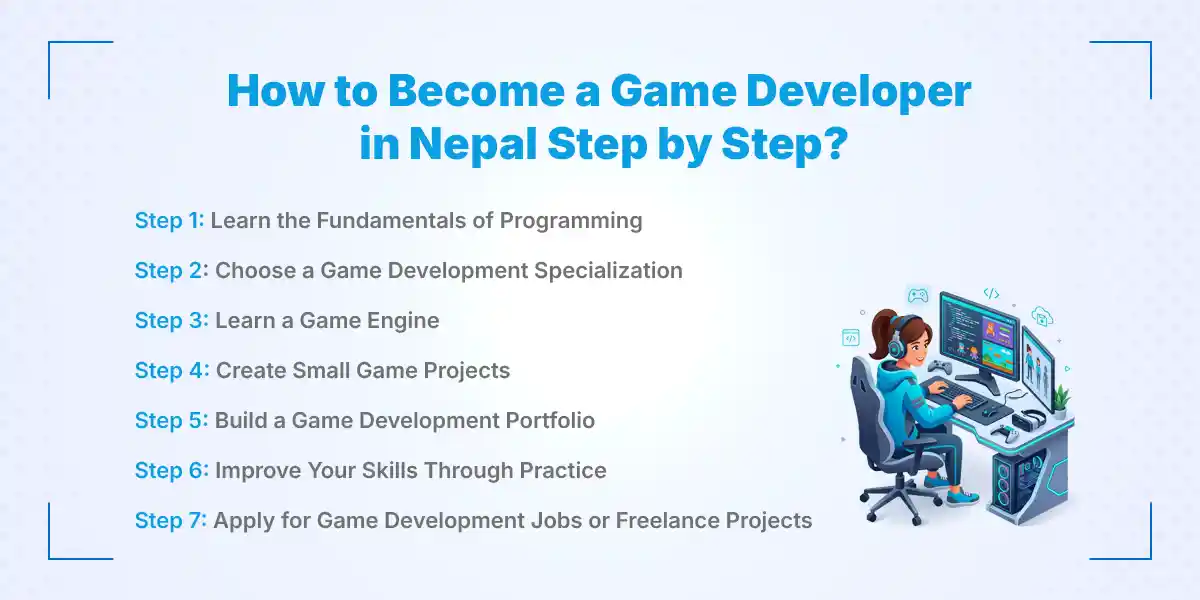
Step 1: Learn the Fundamentals of Programming
Start with general programming concepts before moving into advanced game development. Python or C# can be useful starting languages for beginners. Focus on problem-solving, logic, variables, functions, loops, conditions, and basic data structures.
Once you understand the basics, learn object-oriented programming concepts such as classes, objects, and inheritance. These concepts are useful when working with many modern game development frameworks and engines.
Step 2: Choose a Game Development Specialization
After learning programming fundamentals, choose an area of game development that matches your interests and available hardware.
You can focus on 2D games, 3D games, mobile games, PC games, game programming, or a combination of game design and development.
Starting with a specific area can make your learning process more focused and manageable.
Step 3: Learn a Game Engine
Choose a game engine such as Unity, Unreal Engine, or Godot and learn its basic workflow.
Start by understanding scenes, objects, components, physics, collisions, animation, scripting, and asset management. Using pre-made assets initially can help you focus on programming and game mechanics before spending time creating your own artwork.
Step 4: Create Small Game Projects
Start with small projects that you can actually finish. Examples include:
- 2D platformer
- Puzzle game
- Endless runner
- Simple shooting game
- Basic racing game
- Mobile arcade game
Small projects allow you to practice important concepts such as movement, collision detection, scoring, timing, UI, and game logic.
Step 5: Build a Game Development Portfolio
Your portfolio shows employers and clients what you can actually build.
Include playable projects, screenshots, gameplay videos, source code where appropriate, and short descriptions of your role. GitHub can be used to showcase code, while platforms such as itch.io can be used to share playable projects.
A good portfolio should clearly explain the technologies used and what you personally contributed to each project.
Step 6: Improve Your Skills Through Practice
Continue improving through regular practice, game jams, developer communities, and personal projects.
Game jams can help you practice creating small games within a limited timeframe. You can also study existing games, experiment with different mechanics, and ask other developers for feedback on your projects.
Step 7: Apply for Game Development Jobs or Freelance Projects
Once you have a portfolio, start looking for internships, junior roles, freelance projects, and related software development opportunities.
Search for positions involving Unity, Unreal Engine, gameplay programming, mobile development, or interactive applications. Developer communities and networking can also help you discover opportunities that may not appear on traditional job portals.
Which Programming Languages Are Best for Game Development?
The best programming language depends on the game engine and type of project you want to build
| Programming Language | Common Use in Game Development |
|---|---|
| C# | Unity game development |
| C++ | Unreal Engine and performance-focused development |
| GDScript | Godot game development |
| JavaScript | Browser-based games |
| Python | Programming fundamentals and selected tools or scripting |
C# is a practical choice for beginners interested in Unity. C++ is commonly associated with Unreal Engine and advanced game programming. GDScript is designed for Godot, while JavaScript can be used for browser-based games.
Python is useful for learning programming fundamentals, although it is not typically the primary language for developing complete commercial games.
Which Game Development Tools Should Beginners Learn?
Beginners can start with a few essential game development tools rather than trying to learn every available software.
1. Game Engines
- Unity: Used for 2D and 3D game development.
- Unreal Engine: Commonly used for advanced 3D and high-quality game projects.
- Godot: An open-source game engine suitable for 2D and 3D development.
2. Design and Development Tools
- Blender: Used for 3D modeling and game assets.
- Visual Studio or Visual Studio Code: Used for writing and editing code.
- Git and GitHub: Used for version control and code management.
- Audacity: Used for editing audio and sound effects.
- 2D design tools: Used for creating characters, backgrounds, interfaces, and other visual assets.
3. Project Management and Collaboration Tools
- Trello: Helps organize development tasks.
- Notion: Useful for project planning and documentation.
- Discord: Supports communication with development communities and teams.
- Task management platforms: Help developers track project progress and deadlines.
Do You Need a Degree to Become a Game Developer in Nepal?
No, a degree is not always required to become a game developer in Nepal. A computer science, IT, or software engineering degree can provide a strong technical foundation, but practical skills, completed projects, internships, and a strong portfolio can also support a game development career.
- Computer Science or IT degree: Builds programming and computer fundamentals.
- Software Engineering: Develops skills in coding, software design, testing, and development.
- Self-learning: Allows beginners to learn through courses, tutorials, and projects.
- Programming skills: C#, C++, or other relevant languages are useful.
- Practical projects: Help demonstrate real development experience.
- Portfolio: Shows employers what you can build.
- Internships: Provide exposure to professional workflows.
- Certifications: Can support relevant technical knowledge.
- Employer requirements: Requirements vary between companies and roles.
Which Courses Can You Study to Become a Game Developer in Nepal?
There are several academic and non-academic learning paths that can help you build skills relevant to game development.
- Bachelor of Computer Applications (BCA)
- Bachelor of Computer Science and Information Technology (BSc CSIT)
- Bachelor of Computer Engineering
- Software Engineering degree programs
- Game development courses
- Unity and Unreal Engine training
- Online game development courses
- Programming courses
- 3D modeling and animation courses
Before enrolling in a course, check the current curriculum, practical projects, software training, instructor experience, and total cost.
How Much Does It Cost to Learn Game Development in Nepal?
The cost of learning game development varies depending on whether you choose a university degree, professional training, online courses, or self-learning.
Common expenses include:
- University tuition fees for computer science or IT programs.
- Game development or programming course fees.
- A laptop or computer capable of running your chosen game engine.
- Optional game assets, plugins, and software.
- Internet costs for tutorials, downloads, and online collaboration.
- Learning resources and online courses.
Beginners can also start with free or low-cost resources. Tools such as Blender and some game engines offer free options or versions, while many programming tutorials and learning resources are available online.
How Much Is the Salary of a Game Developer in Nepal?
Game developer salaries in Nepal can vary significantly based on experience, technical skills, company, project type, and whether the developer works with local or international clients. The following figures should be treated as general estimates rather than fixed salary benchmarks.
| Experience Level | Estimated Monthly Salary |
|---|---|
| Entry-level Game Developer | NPR 25,000–40,000 |
| Junior Game Developer | NPR 35,000–60,000 |
| Mid-level Game Developer | NPR 60,000–100,000 |
| Senior Game Developer | NPR 100,000–150,000+ |
| Freelance Game Developer | Varies by project and client |
| Remote Game Developer | Varies by employer, role, and international market |
Factors That Affect Game Developer Salary
Several factors can influence how much a game developer earns in Nepal, including:
- Programming skills, especially C# and C++.
- Years of professional experience.
- Knowledge of Unity, Unreal Engine, or Godot.
- Quality and complexity of the game development portfolio.
- Company size and type.
- Complexity of the project.
- Role and level of responsibility.
- Experience working with international clients or teams.
Where Can You Find Game Development Jobs in Nepal?
Game development opportunities in Nepal may come from software companies, mobile application companies, startups, freelance projects, and organizations working on interactive digital products.
You can look for opportunities through:
- Software development companies.
- Mobile application development companies.
- IT startups.
- Freelance marketplaces.
- LinkedIn and online job portals.
- Company career pages.
- Internship listings.
- Developer communities and networking groups.
What Job Titles Should Beginners Search For?
When searching for game development opportunities, consider related job titles such as:
- Junior Game Developer
- Unity Developer
- Unreal Engine Developer
- Game Programmer
- Gameplay Programmer
- 2D Game Developer
- 3D Game Developer
- Game Design Intern
- Technical Artist
- Game QA Tester
How Can You Build a Strong Game Development Portfolio?
A strong game development portfolio should contain two or three playable projects that demonstrate different technical and creative skills.
Each project can include:
- A short project description.
- The game engine and technologies used.
- Screenshots or gameplay videos.
- A playable demo where possible.
- Source code where appropriate.
- Your specific contribution if it was a team project.
- Links to GitHub or other relevant profiles.
- Updated contact information.
Instead of creating one very large unfinished game, focus on completing smaller projects that demonstrate different mechanics and development skills.
What Is the Future of Game Development as a Career in Nepal?
Game development can provide career opportunities in areas such as mobile games, independent game development, remote work, interactive media, animation, VR, and AR. Developers can also build skills that transfer to other software and digital technology roles.
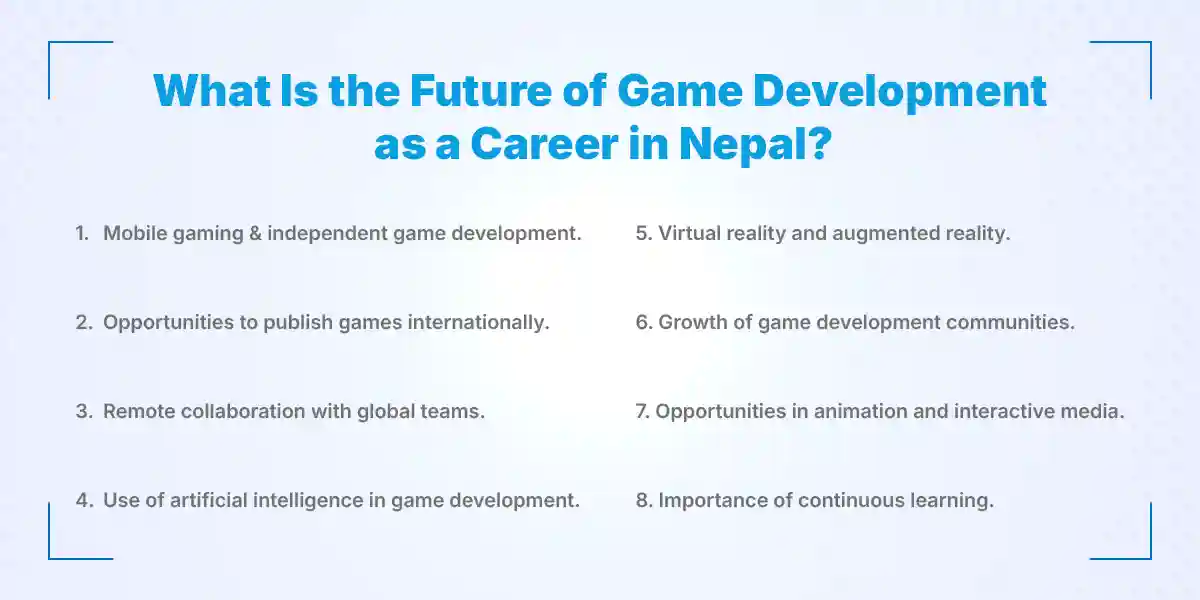
1. Mobile and Indie Game Development
Nepali developers can create mobile and independent games with small teams and distribute them through digital platforms.
2. International Game Publishing
Developers can publish games through global distribution platforms and make their projects available to players in different countries.
3. Remote Game Development
Remote work allows developers to collaborate with international companies, studios, and clients without relocating.
4. Artificial Intelligence in Game Development
AI tools can support tasks such as idea generation, asset creation, prototyping, testing, and development workflows.
5. Virtual and Augmented Reality
VR and AR can create opportunities for developers interested in immersive games, simulations, training applications, and interactive experiences.
6. Game Development Communities
Developer communities, online groups, events, and game jams can help beginners learn from others, share projects, and build professional connections.
7. Animation and Interactive Media
Game development skills can also be useful in areas such as animation, 3D design, simulations, and interactive digital media.
8. Continuous Learning
Game developers need to keep learning new engines, programming techniques, development tools, and industry practices as technology changes.
Conclusion
The path to becoming a game developer in Nepal does not require finding one perfect course or one perfect game engine. A practical approach is to learn programming fundamentals, choose an engine, build small projects, and gradually create a portfolio that demonstrates your skills.
Instead of spending months collecting tutorials, beginners can focus on completing one small game and learning from the process. Once you have projects to show, you can use your portfolio to explore internships, game development roles, freelance projects, and related IT opportunities.
For those ready to explore employment opportunities, KumariJob provides IT and software development job listings in Nepal that can help you find roles related to programming and other technical skills.
Frequently Asked Questions
Submit your comments

Get Our App On



How to Become an Auditor in Nepal
VIEW DETAILS
What Is the Salary of a Spa Therapist in Nepal?
VIEW DETAILS
What Is the Salary of a Brand Manager in Nepal?
VIEW DETAILS
How to Become a Motion Designer in Nepal ?
VIEW DETAILS


Loading Comments...