



If you just finished +2 and want to build a career in auditing, you've probably run into the common myth: It’s either CA or bust.
In reality, Nepal's financial sector relies on a spectrum of roles from audit assistants building practical experience with a bachelor's degree to licensed Registered Auditors (RA) and Chartered Accountants leading statutory reviews.
In this blog
What Does an Auditor Do in Nepal?
An auditor examines an organization's financial statements, records, and internal controls to verify accuracy, detect errors, and confirm compliance with accounting standards. Auditors do not simply check numbers they assess whether financial reporting reflects reality and whether an organization's internal systems are strong enough to prevent fraud or mismanagement. Their findings are documented in formal audit reports and communicated to management, boards, or regulatory bodies depending on the type of audit.
Core responsibilities typically include:
- Examining financial statements and accounting records for accuracy.
- Checking financial transactions against supporting documents.
- Identifying accounting errors and potential financial risks.
- Evaluating the strength of internal financial controls.
- Preparing formal audit reports with findings and recommendations.
- Ensuring compliance with applicable accounting and auditing standards.
- Communicating results clearly to management and stakeholders.
Types of Auditors in Nepal
- Internal Auditor
- External Auditor
- Government Auditor
- Tax Auditor
- Information Systems Auditor
What Qualifications Do You Need to Become an Auditor in Nepal?
Becoming an auditor in Nepal generally requires a +2 in Management or an equivalent stream, followed by a bachelor's degree in accounting or finance, with professional certification like Chartered Accountancy needed for higher-level, statutory audit roles. A degree alone can qualify someone for audit-support or internal audit positions, but it does not automatically grant the legal authority to sign off on statutory audits. That authority is reserved for professionals who have completed the required licensing process through the relevant professional body.
Common qualification routes include:
- Completion of +2 in Management or an equivalent stream.
- A bachelor's degree in accounting, finance, or a related field.
- BBS, BBA, or comparable academic backgrounds.
- Professional accounting qualifications, such as CA, for advanced or statutory audit careers.
- Relevant audit training and hands-on practical experience.
- Solid working knowledge of accounting standards and audit procedures.
It is worth being clear about one distinction beginners often miss: working in an accounting or audit-support role only requires relevant education and experience, while conducting statutory audits and signing audit reports requires formal professional authorization, typically through the Institute of Chartered Accountants of Nepal (ICAN).
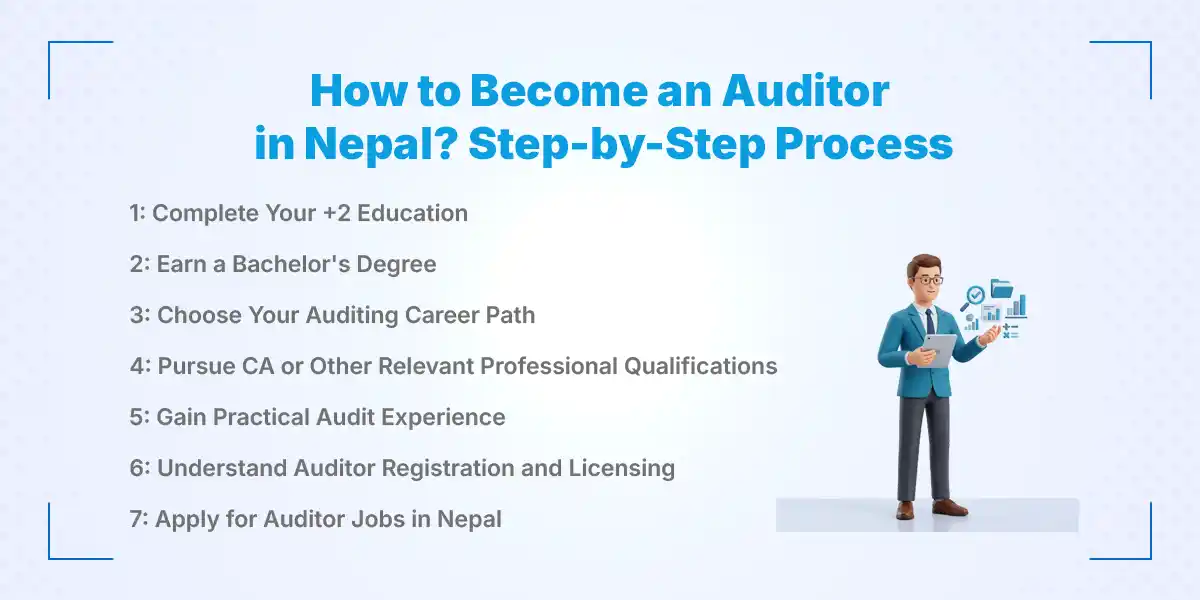
How to Become an Auditor in Nepal? Step-by-Step Process
Becoming an auditor in Nepal typically follows seven steps, starting with +2 education and ending with a job application, though the exact timeline depends on whether a candidate pursues CA certification along the way. Each step below builds toward either an audit-support career or, for those pursuing CA, full statutory audit authorization.
1. Complete Your +2 Education
The starting point for almost every auditing career in Nepal is completing +2 in Management or an equivalent stream. Subjects like accounting, mathematics, and business studies at this level build the numerical and conceptual foundation the rest of the path depends on. Students who take this stage seriously tend to find bachelor's-level accounting and finance courses far easier to follow. This stage does not require any final career decision yet, but it does require a genuine grounding in financial concepts.
2. Earn a Bachelor's Degree
After +2, most aspiring auditors pursue a bachelor's degree such as BBS, BBA, or another accounting and finance-focused program. These programs cover financial accounting, taxation, auditing principles, and business law in more depth than +2 alone. This stage is also where analytical and numerical skills sharpen through case studies and coursework rather than theory alone. A completed bachelor's degree opens the door to entry-level accounting and audit-support roles even before any professional certification is finished.
3. Choose Your Auditing Career Path
At this point, a graduate needs to decide broadly between internal auditing, external auditing, or pursuing a professional qualification like CA. Internal auditing tends to lead to roles inside a single organization, while external auditing usually means working for an audit firm across multiple clients. Understanding the difference between simply being employed in an audit function and being professionally licensed to conduct statutory audits is critical here. This choice shapes whether the next step involves CA training or moving straight into practical audit work.
4. Pursue CA or Other Relevant Professional Qualifications
Those aiming for statutory audit authority or senior audit roles typically pursue Chartered Accountancy through the Institute of Chartered Accountants of Nepal (ICAN). This path includes structured coursework, a period of practical articleship training under a licensed CA firm, and a series of professional examinations. Articleship in particular gives candidates real audit exposure long before they are fully certified. Completing this pathway is what ultimately grants the professional authorization needed for statutory audit sign-off, not the bachelor's degree alone.
5. Gain Practical Audit Experience
Regardless of which qualification path is chosen, hands-on experience is what actually builds audit competence. This usually starts with internships or entry-level roles as an audit assistant or accounting assistant at a firm. On the job, a beginner learns financial statement analysis, audit documentation practices, and how to use accounting software in a real workflow. This practical exposure is frequently what separates candidates who move up quickly from those who stay in entry-level roles longer than necessary.
6. Understand Auditor Registration and Licensing
Before taking on statutory audit responsibilities, it is important to understand Nepal's registration and licensing requirements for auditors. These requirements are set and enforced by the relevant regulatory and professional authorities, and they vary depending on the specific type of audit work involved. Statutory auditors, in particular, must meet formal registration criteria before they can legally sign audit reports. Skipping this step or misunderstanding it is one of the more costly mistakes a growing auditor can make.
7. Apply for Auditor Jobs in Nepal
The final step is turning qualifications and experience into an actual job. This starts with preparing an accounting-focused CV that highlights relevant coursework, software skills, and any practical audit exposure. From there, candidates search for audit assistant and internal auditor vacancies and build professional connections with audit firms and accounting networks. Applying consistently to both entry-level and experienced-level postings, depending on current qualifications, is what ultimately moves a candidate from student to working auditor.
Which Courses Can You Study to Become an Auditor in Nepal?
Several academic and professional courses in Nepal support an auditing career, and most successful auditors combine more than one of these rather than relying on a single course.
- Chartered Accountancy (CA)
- Bachelor of Business Studies (BBS)
- Bachelor of Business Administration (BBA)
- Master's degree in accounting or finance
- Professional accounting and auditing training programs
- Internal audit and risk management courses
- Accounting software training
Skills to Develop Alongside Your Course
- Financial accounting
- Auditing and assurance
- Taxation
- Financial reporting
- Excel and accounting software proficiency
- Analytical thinking
- Communication and report writing
- Attention to detail
What Skills Are Required to Become a Successful Auditor in Nepal?
Successful auditors in Nepal need a combination of strong accounting knowledge, sharp attention to detail, and clear professional communication to translate financial findings into usable reports. Technical skill alone is not enough, since auditors regularly explain complex financial issues to non-technical stakeholders. Ethical judgment also matters heavily in this field, since auditors are frequently the ones responsible for flagging financial irregularities that others may prefer to overlook.
Key skills include:
- Strong accounting knowledge
- Financial analysis skills
- Solid understanding of auditing standards
- Problem-solving ability
- Attention to detail
- Ethical decision-making
- Time management
- Professional communication
- Knowledge of taxation and regulatory requirements
- Comfort working with accounting software
How Much Does an Auditor Earn in Nepal?
Auditor salaries in Nepal vary significantly by qualification level, employer type, and location, and reliable public salary data for this specific field remains limited, so the figures below should be treated as general estimates rather than fixed benchmarks.
| Level | General Estimate |
|---|---|
| Entry-level / Audit Assistant | Lower end of general accounting/finance entry-level pay |
| Internal Auditor | Moderate, tied to organization size and sector |
| External Auditor (firm-based) | Varies by firm size and client base |
| CA-Qualified Professional | Significantly higher, especially in senior or partner-track roles |
Pay tends to differ noticeably between audit firms and corporate in-house roles, with firms often offering more variable pay tied to client workload and corporate roles offering more stability. Experience, professional qualifications, and location particularly Kathmandu versus smaller cities all influence earnings, and CA-qualified professionals typically see the clearest jump in both salary and career growth opportunities compared to non-certified accounting staff.
Where Can You Find Auditor Jobs in Nepal?
Auditor job opportunities in Nepal are spread across several sectors rather than concentrated in one type of employer.
- Audit and accounting firms
- Banks and financial institutions
- Corporate organizations
- NGOs and INGOs
- Government offices
- Manufacturing and trading companies
- Consulting firms
Job Search Platforms
- KumariJob
- Company career pages
- Professional networking platforms
- Accounting and finance professional networks
What Is the Difference Between an Internal Auditor and an External Auditor?
| Factor | Internal Auditor | External Auditor |
|---|---|---|
| Main Role | Reviews internal controls and business processes | Independently examines financial statements |
| Work Environment | Usually works within one organization | Often works for an audit firm across clients |
| Main Focus | Risk management and internal controls | Financial statement auditing |
| Career Opportunities | Banks, companies, NGOs, and other organizations | Audit firms and professional practices |
| Professional Requirements | Depend on the specific role and organization | Depend on the audit type and applicable regulations |
It is worth noting that statutory audit responsibilities and the legal authority to sign off on audited financial statements require specific professional qualifications and formal authorization, regardless of whether the role is internal or external.
What Career Opportunities Are Available for Auditors in Nepal?
Auditors in Nepal can progress into a wide range of roles, from entry-level audit-support positions to senior finance leadership, depending on their qualifications and experience. Career progression is closely tied to professional certification, with CA-qualified auditors generally reaching senior roles faster than those without it. Specialization, such as focusing on tax auditing or risk and compliance, can also open more specific and often better-paying career tracks.
Common career paths include:
- Audit Assistant
- Internal Auditor
- Audit Officer
- Senior Auditor
- Tax Consultant
- Risk and Compliance Officer
- Financial Analyst
- Audit Manager
- Chartered Accountant
- Finance Manager
What Mistakes Should Beginners Avoid When Pursuing an Auditing Career?
Several avoidable mistakes tend to slow down beginners in this field.
- Choosing an accounting course without a clear sense of long-term career goals.
- Focusing only on theoretical knowledge without seeking practical exposure.
- Ignoring opportunities to gain real audit experience through internships.
- Neglecting Excel and accounting software skills, which are used daily in the job.
- Misunderstanding professional qualification and licensing requirements.
- Overlooking communication and report-writing skills, which matter as much as technical accuracy.
- Failing to keep up with tax law and accounting standard updates.
- Applying for jobs with a generic CV instead of an accounting-focused one.
Tips to Build a Successful Auditing Career in Nepal
- Start gaining accounting experience early, even through small internships.
- Develop strong financial reporting skills alongside coursework.
- Learn commonly used accounting software before entering the job market.
- Build relationships with accounting professionals and mentors.
- Follow updates from relevant professional institutions like ICAN.
- Continuously improve problem-solving and analytical abilities.
Conclusion
Becoming an auditor in Nepal is less about picking one "correct" course and more about understanding which stage of the path a person is actually on. A completed degree opens the door to audit-support roles, while statutory audit authority requires the full CA licensing process through ICAN. The biggest factor separating a slow start from a fast one is practical experience gained early, through internships or audit-assistant roles, rather than qualifications collected in isolation.
For readers ready to apply their accounting or audit qualifications to real opportunities, KumariJob regularly lists auditor, accounting, and finance job openings across Nepal, making it a practical place to start the job search once the right qualifications are in place.
Frequently Asked Questions
Submit your comments

Get Our App On



What Is the Salary of a Spa Therapist in Nepal?
VIEW DETAILS
How to Start a Career as a Game Developer in Nepal
VIEW DETAILS
What Is the Salary of a Brand Manager in Nepal?
VIEW DETAILS
How to Become a Motion Designer in Nepal ?
VIEW DETAILS


Loading Comments...