



A marketing executive in Kathmandu spends three hours writing a single ChatGPT prompt, only to get a generic, unusable response back. A university graduate in Pokhara reads job postings asking for "prompt engineering experience" and has no idea where that skill is even taught. These are the two most common starting points for anyone exploring this field in Nepal right now, and neither one requires a computer science degree to fix.
This guide breaks down exactly what an AI prompt engineer job do, the skills and tools worth learning first, and a practical step-by-step roadmap to build a career in this field from Nepal, whether the goal is a full-time role, a freelance income stream, or simply better AI skills for an existing job.
In this blog
What Is an AI Prompt Engineer?
An AI prompt engineer designs, tests, and refines the instructions given to AI models so the models produce accurate, relevant, and consistent output. This role sits at the intersection of clear communication and applied AI knowledge, rather than deep software engineering. It has grown alongside tools like ChatGPT, Gemini, and Claude, as businesses realized that the quality of an AI's output depends heavily on the quality of the input it receives.
- Role of a prompt engineer: Translate a business or personal need into instructions an AI model can act on reliably.
- How they work with generative AI: They iterate on wording, structure, and examples until the model's output matches the intended goal.
- Difference from an AI/ML engineer: An AI/ML engineer builds and trains the underlying models; a prompt engineer works with existing models to get better results without touching the model's architecture.
- Common tasks: Writing prompt templates, testing variations, documenting what works, and troubleshooting inconsistent outputs.
- Real-world examples: A content team using structured prompts to generate first-draft blog outlines, or a customer support team building a prompt library that keeps chatbot answers on-brand.
What Does an AI Prompt Engineer Do?
An AI prompt engineer's daily work centers on creating, testing, and improving instructions that guide AI models toward useful, accurate results. This is an iterative process, not a one-time task, because a prompt that works well for one use case often needs adjustment for another. The role also involves evaluating whether AI outputs are trustworthy enough to use without heavy editing.
- Create and improve prompts for specific AI models and use cases
- Test different instructions, phrasing, and prompt structures side by side
- Evaluate AI-generated responses for accuracy, tone, and relevance
- Improve consistency so the same type of request produces reliable results
- Build reusable prompt templates for teams or clients
- Work hands-on with tools such as ChatGPT, Gemini, and Claude
- Help businesses apply AI to content, marketing, customer service, and research workflows
What Skills Do You Need to Become a Prompt Engineer in Nepal?
The core skills needed for prompt engineering are strong writing ability, critical thinking, and a working understanding of how AI models process instructions. None of these require years of formal training, which is why this field is accessible to career-switchers. Technical skills like Python and API knowledge matter more as a person moves into advanced or developer-facing prompt engineering roles.
- AI fundamentals: Understand generative AI, large language models, tokens, context windows, and common AI limitations.
- Prompt writing: Learn to give clear instructions, add context, provide examples, set constraints, and specify output format.
- Critical thinking: Analyze AI responses to catch errors, bias, or inconsistencies before they reach a client or employer.
- Communication skills: Write precise, unambiguous instructions that leave little room for misinterpretation.
- Problem-solving: Break large, complex tasks into smaller instructions an AI model can handle one step at a time.
- Research skills: Verify AI-generated facts and figures against reliable, independent sources.
- Basic technical skills: Build familiarity with APIs, JSON, and simple automation as the role advances.
- Domain knowledge: Develop expertise in a specific field such as marketing, finance, education, or software, since domain context makes prompts far more effective.
How to Become an AI Prompt Engineer in Nepal
Becoming an AI prompt engineer in Nepal follows a clear sequence: learn AI fundamentals, practice prompting daily, build technical skills, then apply that work toward real projects and jobs. Each stage builds on the last, so skipping straight to advanced techniques without the fundamentals usually slows progress rather than speeding it up. The eight steps below outline that path in order.
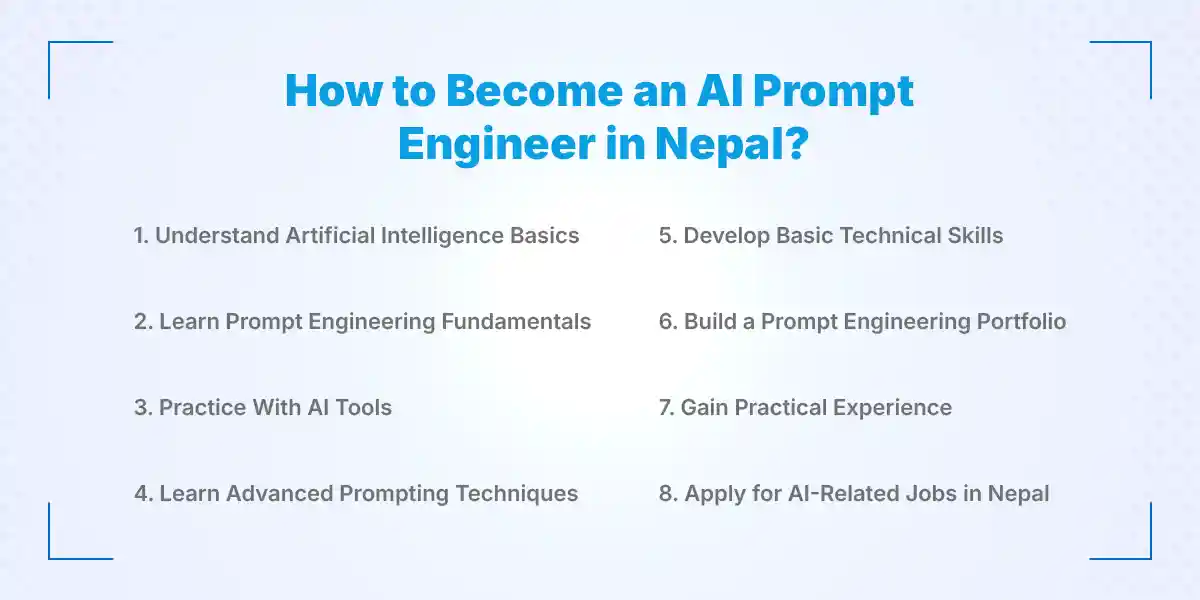
1. Understand Artificial Intelligence Basics
Every prompt engineer needs a working mental model of how generative AI actually produces a response. This starts with learning what AI, machine learning, generative AI, and large language models are in plain terms. It also means understanding how tools like ChatGPT predict and generate text based on patterns in training data. Just as important is learning AI's limitations, including hallucinations and outdated information, since no prompt can fully eliminate these risks.
2. Learn Prompt Engineering Fundamentals
Once the basics are clear, the next step is learning how to structure an effective prompt. This means starting with clear, specific instructions instead of vague requests, and learning how to add relevant context so the model understands the situation. It also involves specifying the desired output format and using examples when a task is complex or unfamiliar to the model. Beginners should experiment with different prompt structures on the same task to see how small wording changes affect the result.
3. Practice With AI Tools
Reading about prompt engineering only goes so far; consistent hands-on practice is what builds real skill. This means using ChatGPT and other generative AI tools regularly, testing the same task with multiple different prompts. Comparing the outputs side by side reveals which instructions produce more accurate or useful results. From there, the goal is to refine each prompt based on what the comparison shows.
4. Learn Advanced Prompting Techniques
After the basics feel comfortable, advanced techniques help handle more complex tasks. These include few-shot prompting, role-based prompting, and chain-of-thought-style task decomposition, which breaks a big task into smaller reasoning steps. Structured output prompting, prompt chaining, and context management become important once outputs need to feed into other systems or documents. Learning to separate system instructions from user instructions also becomes essential at this stage, since it changes how consistently a model behaves.
5. Develop Basic Technical Skills
Technical skills are not required to start, but they open the door to higher-paying and more advanced roles. Learning basic Python allows a prompt engineer to automate repetitive tasks and connect prompts to real applications. Understanding APIs and learning JSON and structured data formats makes it possible to work with AI tools programmatically rather than only through a chat interface. Exploring AI automation platforms and understanding how AI applications connect to external systems rounds out this technical foundation.
6. Build a Prompt Engineering Portfolio
A portfolio is what turns practice into proof of skill for employers and clients. This means creating practical prompt examples and documenting clear before-and-after results, showing how a prompt was improved and why. Building prompt templates for different industries, such as marketing or customer service, demonstrates versatility. The strongest portfolios also include small AI workflow projects, published on a personal website, GitHub, or a professional profile where employers can review them directly.
7. Gain Practical Experience
Real experience closes the gap between a portfolio and a job offer. This means taking on freelance AI projects or seeking internships involving AI, automation, content, or technology. Using AI to solve genuine business problems, rather than only practicing on hypothetical tasks, builds far more credible experience. Collaborating with developers, marketers, and business teams also teaches how prompt engineering fits into a larger workflow, which is a skill on its own.
8. Apply for AI-Related Jobs in Nepal
The final step is turning skills and a portfolio into an actual job or client base. This means searching specifically for prompt engineer and generative AI roles, but also staying open to adjacent titles. Roles like AI content specialist, AI automation specialist, AI trainer, AI consultant, and AI-assisted marketing positions often use the same core skill set under a different name. Platforms like KumariJob are a practical place to search for these AI and technology roles as they appear in the Nepali job market.
Do You Need Coding Skills to Become a Prompt Engineer?
Advanced programming is not required to start as a prompt engineer, though coding, API, and automation skills become increasingly valuable for technical AI roles. Beginners can enter the field purely through strong writing, critical thinking, and structured experimentation with AI tools. Coding becomes more relevant once the work involves connecting prompts to applications, databases, or automated workflows.
- What non-technical beginners can learn first: Clear prompt writing, output formatting, and structured testing, all without touching code.
- When Python becomes useful: Once a prompt engineer needs to automate repeated tasks or process AI outputs at scale.
- Why APIs and automation matter: They let prompt engineers connect AI models directly into business tools instead of copy-pasting responses manually.
- Non-technical vs. technical career paths: Non-technical prompt engineering leans toward content, marketing, and support use cases, while technical prompt engineering leans toward product, engineering, and AI application development.
AI Prompt Engineer Career Roadmap in Nepal
The path from complete beginner to employed prompt engineer generally moves through four stages, with skills compounding at each level.
AI Basics → Prompt Engineering → AI Tools → Advanced Prompting → Technical Skills → Projects → Portfolio → Freelance/Internship → AI Job
- Beginner stage: AI fundamentals and basic prompting techniques
- Intermediate stage: Advanced prompting methods and multi-step AI workflows
- Advanced stage: APIs, Python, automation, and LLM-based applications
- Career stage: Portfolio building, networking, internships, freelancing, and job applications
Where Can Prompt Engineers Work in Nepal?
Prompt engineering skills apply across a wide range of industries in Nepal, not just AI-specific companies.
- IT companies and software companies
- Digital marketing agencies
- Startups
- E-commerce businesses
- Education and EdTech companies
- Financial and business organizations
- Media and content companies
- Freelancing and remote work
- AI-focused companies and technology teams
How Much Can an AI Prompt Engineer Earn in Nepal?
Prompt engineering salaries in Nepal vary widely depending on technical skill level, industry, and whether the work is local, remote, or freelance. Entry-level roles that combine prompt engineering with content or marketing responsibilities typically pay less than dedicated technical AI positions. Freelance and remote international clients often offer the highest earning potential for skilled prompt engineers based in Nepal.
| Level | Typical Focus | Relative Earning Potential |
|---|---|---|
| Entry-level | Prompting for content, support, or marketing tasks | Lower, often blended with an existing role |
| Mid-level | AI workflow design, prompt libraries, cross-team AI support | Moderate, reflects added technical scope |
| Senior/technical | API integration, automation, LLM application work | Higher, closer to technical AI salaries |
| Freelance/remote | International clients, project-based AI work | Variable, often the highest ceiling |
Salary in this field is shaped by several factors: technical skill level, years of experience, industry, the strength of a public portfolio, depth of AI tool expertise, and access to freelance or remote clients.
What Tools Should an AI Prompt Engineer Learn?
The most important tools for beginner prompt engineers are the major generative AI chat platforms, since daily practice on these builds the core skill before expanding into technical tools. ChatGPT, Google Gemini, and Claude each have different strengths and response styles worth understanding. Once comfortable there, automation platforms and AI APIs extend prompt engineering into real applications.
- ChatGPT
- Google Gemini
- Claude
- Microsoft Copilot
- AI image-generation tools
- AI research tools
- Automation platforms
- AI APIs and developer tools
Best Practices for Becoming a Successful Prompt Engineer
Consistent habits matter more than any single technique in this field.
- Start with simple AI tasks and gradually increase complexity.
- Always provide relevant context in a prompt.
- Define the expected output format clearly.
- Test multiple prompt variations before settling on one.
- Evaluate AI responses critically rather than accepting them at face value.
- Maintain a library of reusable prompt templates.
- Keep learning as AI tools and models continue to evolve.
- Combine prompt engineering with another professional skill, such as marketing or finance.
- Build projects that demonstrate measurable, documented results.
Is Prompt Engineering a Good Career in Nepal?
Prompt engineering is a promising skill in Nepal's growing AI-adoption landscape, though candidates should build broader AI, technical, communication, and domain-specific skills rather than relying on prompting alone. Generative AI adoption is increasing across marketing, customer service, and content industries in Nepal, creating steady demand for people who can use these tools effectively. Many opportunities exist beyond the exact "Prompt Engineer" job title, under roles like AI specialist or AI-assisted marketer.
- Growing adoption of generative AI across Nepali businesses
- Rising demand for AI-assisted workflows in content, support, and marketing
- Opportunities beyond the exact "Prompt Engineer" job title
- Importance of combining AI skills with another professional discipline
- Strong potential for remote and freelance opportunities with international clients
How Can Beginners Start a Prompt Engineering Career in Nepal?
Beginners can start a prompt engineering career in Nepal by learning AI fundamentals, practicing prompt writing regularly, building practical AI projects, creating a portfolio, and applying for internships or entry-level AI-related jobs. Developing complementary skills such as content creation, programming, data analysis, or digital marketing can also improve career opportunities.
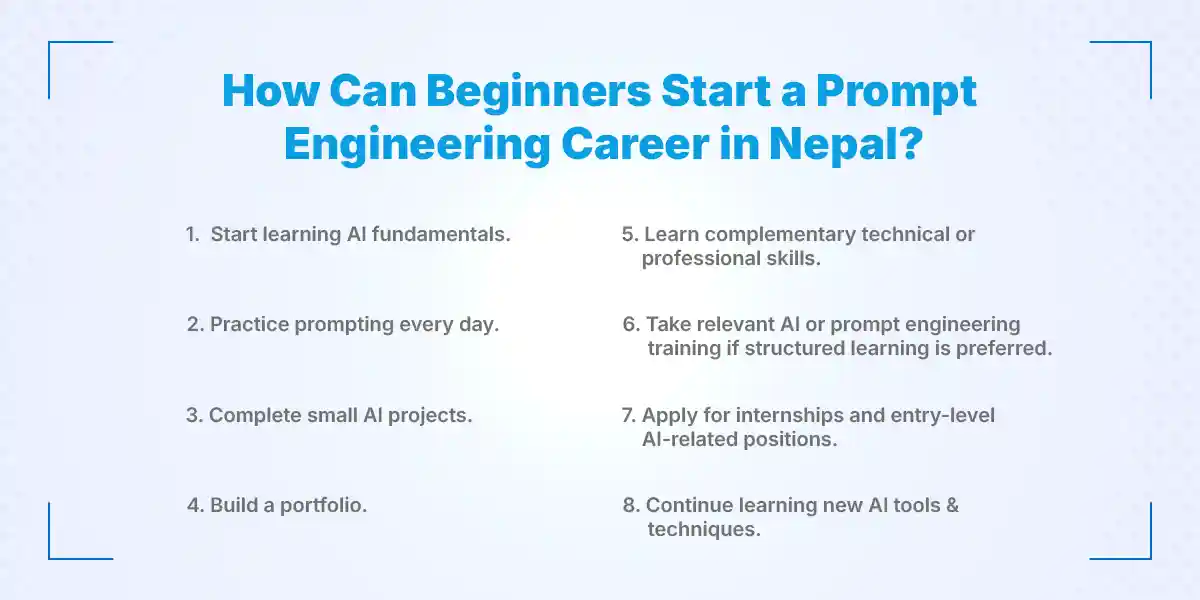
1. Learn AI Fundamentals
Start by understanding basic AI concepts, generative AI, large language models, and how tools such as ChatGPT work. A strong foundation makes it easier to create effective prompts and understand AI outputs.
2. Practice Prompting Every Day
Practice writing different types of prompts for tasks such as content creation, research, summarization, coding, and data analysis. Regular practice helps beginners understand how clear instructions, context, examples, and desired outputs can improve AI responses.
3. Build Small AI Projects
Create simple projects using AI tools, such as chatbots, content workflows, research assistants, or automated business tasks. Practical projects help you demonstrate your prompt engineering skills and gain real-world experience.
4. Create a Prompt Engineering Portfolio
Showcase your best prompts, AI projects, before-and-after results, and problem-solving examples in an online portfolio. A strong portfolio can help employers understand your practical abilities even if you have limited professional experience.
5. Develop Complementary Skills
Learn additional skills such as Python, content writing, SEO, data analysis, automation, or digital marketing based on your career goals. Combining prompt engineering with another professional skill can create more job opportunities in Nepal.
6. Take Relevant AI Training
Beginners who prefer structured learning can take AI or prompt engineering training to learn systematically through guided lessons and practical exercises. Training can also help learners understand how AI is being used in different industries.
7. Apply for Internships and Entry-Level Jobs
After developing your skills and portfolio, start applying for AI internships, content automation roles, AI-assisted marketing positions, and other entry-level opportunities. Internships can provide practical experience and help you understand how AI skills are used in real workplaces.
8. Keep Learning New AI Tools
AI technology changes quickly, so prompt engineers should continuously learn new AI tools, models, prompting techniques, and automation methods. Regular learning can help beginners stay competitive and grow their careers over time.
Conclusion
Prompt engineering rewards people who combine clear writing, structured testing, and a specific domain of expertise, not just familiarity with AI chat tools. The real differentiator between a hobbyist and a hireable prompt engineer in Nepal is a documented portfolio of tested, refined prompts that show measurable improvement in AI output quality over time.
Anyone ready to move from practicing prompts to applying for real roles should start searching now. Explore current AI, prompt engineering, and technology job openings in Nepal on KumariJob to find the next step in this career path.
Frequently Asked Questions
Submit your comments

Get Our App On


How to Become an Auditor in Nepal
VIEW DETAILS
What Is the Salary of a Spa Therapist in Nepal?
VIEW DETAILS
How to Start a Career as a Game Developer in Nepal
VIEW DETAILS
What Is the Salary of a Brand Manager in Nepal?
VIEW DETAILS


Loading Comments...