




Sitting across from an interviewer, hearing "I see a gap here on your CV; can you walk me through it? is one of the most common moments of panic in a Nepali job interview. Candidates freeze, over-explain, or apologize repeatedly for time that was often spent studying, caregiving, freelancing, or simply searching for the right opportunity.
The good news is that a career gap rarely disqualifies a candidate on its own. This guide breaks down exactly how to explain a career gap using a simple, repeatable structure, with real example answers for the most common situations Nepali job seekers face.
In this blog
What Is a Career Gap in an Interview?
A career gap is a period of time on your CV, usually one month or longer, when you were not working, studying, or actively building your career in a structured way. Gaps can happen for many reasons, from job searching and family responsibilities to further education or a planned break. Recruiters in Nepal encounter career gaps regularly, and most do not treat a gap as a red flag on its own.
Common types of career gaps include:
- Short breaks between jobs
- Extended periods of unemployment
- Planned career breaks
- Education or training periods
- Career transitions between industries
Why Do Interviewers Ask About Career Gaps?
Interviewers ask about career gaps to understand your work timeline and to confirm that your skills are still current for the role. The question is rarely meant to catch you off guard; it usually reflects genuine curiosity about what you did with your time. Most interviewers use your answer to judge your communication style and readiness to start, not just the gap itself.
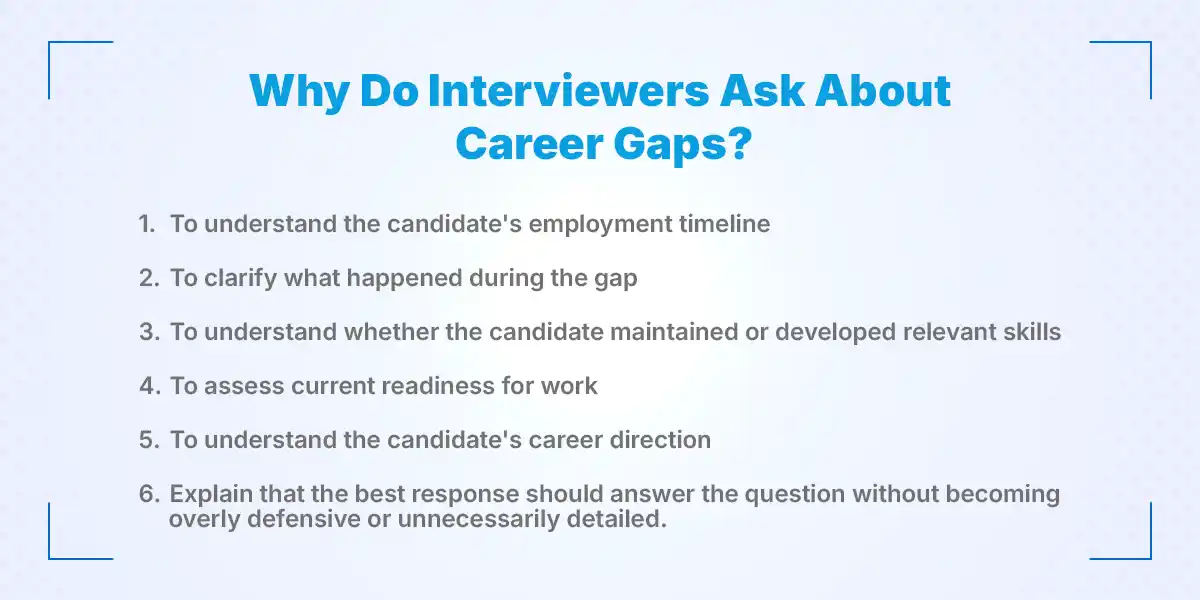
Interviewers typically want to know:
- What happened during the gap
- Whether you maintained or developed relevant skills
- How the gap fits into your overall career direction
- Whether you are currently ready to commit to a full-time role
How Do You Explain a Career Gap in an Interview?
The clearest way to explain a career gap is to use a simple three-part structure: state the reason, describe what you did, and confirm you are ready for the job now. This Reason-Action-Readiness framework keeps your answer short and focused, which is exactly what interviewers want to hear. It also prevents you from over-explaining or sounding defensive about time away from work.
1. State the Reason Clearly
Start your answer with one clear sentence about why the gap happened, such as a layoff, further study, or a family situation. Keep this part short and factual instead of turning it into a long personal story. Interviewers respond better to a direct reason than to a vague statement like I was just figuring things out." Once you state the reason, move quickly to what you did next, since dwelling on the cause alone makes the gap feel larger than it is.
2. Explain What You Did During the Gap b requires.
A candidate who completed a digital marketing course during a gap, for example, can tie that directly to a marketing role's requirements. This step turns the gap from a blank space on your CV into evidence that you kept developing. Skipping this connection is the most common mistake candidates make, since it leaves the interviewer to guess why the gap matters for the job.
3. Show You Are Ready Now
Close your answer by confirming, in one sentence, that you are available and prepared to start the role. Then shift the conversation back toward your qualifications, experience, or enthusiasm for the position. This redirect signals confidence and moves the interview away from dwelling on the past. A short, forward-looking close leaves a stronger impression than an answer that ends on the gap itself.
What Are the Common Reasons for a Career Gap?
Common reasons for a career gap include further education, job searching, layoffs, family responsibilities, relocation, freelancing, and career changes. Each reason calls for a slightly different explanation, but all of them are common enough that interviewers in Nepal encounter them regularly. None of these reasons should be treated as something to hide or apologize for repeatedly.
- Preparing for or completing higher education
- Professional training or certifications
- An extended job search
- Layoff or company closure
- A deliberate career transition
- Family responsibilities
- Relocation to a new city or country
- Freelancing or independent project work
- A planned personal break or travel period
How Should You Answer Different Career Gap Situations?
How you answer depends on the specific situation, but each explanation should follow the same reason-action-readiness pattern. The table below gives a short example response for six common situations. Use these as a starting point, then adjust the wording to match your own experience.
| Career Gap Reason | Sample Interview Answer |
|---|---|
| Further Education | I took a year to complete a diploma in [field], which gave me practical skills in [relevant area] that I'm ready to apply in this role. |
| Job Search | I spent several months searching for the right opportunity while completing an online course to keep my skills current, and this role is exactly the fit I was looking for. |
| Layoff | My previous company downsized my department, so I used the time to sharpen my skills through freelance work, and I'm now ready to fully commit to a new team. |
| Family Responsibility | I took time off to manage a family responsibility that has since been resolved, and I'm now able to commit fully to a full-time position. |
| Career Change | I decided to move from [old field] into [new field], so I spent the gap completing relevant training and small projects to build the right foundation. |
| Freelancing | During that period, I worked independently on [type of projects], which kept my skills active and taught me to manage deadlines and clients directly. |
How Long Should a Career Gap Explanation Be?
A career gap explanation should take about 20 to 40 seconds to say out loud, roughly three to five sentences. Anything longer starts to sound like an apology or a justification rather than a simple answer. Keeping it brief also leaves room for the interviewer to ask a follow-up question if they want more detail.
- Answer the question directly before adding context
- Avoid giving a long personal history
- Save additional detail for follow-up questions
- Practice the answer so it sounds natural, not memorized
How Can You Turn a Career Gap Into a Positive Interview Answer?
You can turn a career gap into a positive answer by focusing on what you learned or built during that time instead of treating it as lost time. Certifications, freelance projects, volunteer work, and searching all count as evidence of growth. Framing the gap this way shows the interviewer a candidate who stayed active rather than idle.
- Highlight newly developed or refreshed skills.
- Mention relevant certifications or training completed.
- Include freelance, volunteer, or independent project work
- Show how the experience shaped your current career direction
- End on your present readiness to contribute
What Should You Avoid When Explaining a Career Gap?
The biggest mistakes to avoid are lying about dates, inventing activities, and giving an overly long or apologetic explanation. Small inconsistencies between your CV and your spoken answer raise more doubt than the gap itself. Staying factual and brief protects your credibility far more than trying to make the gap sound impressive.
- Lying about employment dates
- Inventing jobs, projects, or qualifications
- Sharing unnecessarily personal information
- Becoming defensive or blaming former employers
- Saying only I was unemployed" with no context
- Apologizing repeatedly for the gap
- Letting the gap dominate the entire answer instead of your skills
How to Explain a Career Gap on Your CV Before the Interview
On your CV, explain a career gap by keeping the dates accurate and adding a short, factual line if the gap needs context. Consistency between your CV and your spoken interview answer matters more than clever wording. A one-line note, such as "career break for further study," is usually enough.
- Keep all dates accurate and consistent across documents
- Mention relevant education, training, or freelance work where useful
- Add a brief explanation for extended gaps only when it adds clarity
- Prepare your spoken explanation so it matches your CV exactly
What If You Did Nothing Career-Related During the Gap?
If you did nothing career-related during the gap, give a truthful and concise explanation instead of inventing activities to fill the space. Interviewers can usually tell when an answer sounds fabricated, and an invented story creates more risk than an honest one. Focus instead on what you are doing right now to prepare for the role.
- Give a simple, honest reason without embellishment
- Mention any genuine transferable experience, even informal
- Emphasize your current preparation and job-search effort
- Close by confirming your readiness to start immediately
How Can You Prepare for Career Gap Questions Before an Interview?
Prepare for career gap questions by reviewing your CV dates, deciding what details to share, and practicing a short spoken answer before the interview. Rehearsing out loud helps the explanation sound natural instead of memorized. It also helps you anticipate common follow-up questions so you are not caught off guard.
- Review the exact dates listed on your CV
- Identify the one main reason behind the gap
- Decide in advance what details are relevant to share
- Prepare a 20- to 40-second response and practice it aloud
- Anticipate follow-up questions such as: What were you doing during this time? Why are you returning to work now? What have you done to keep your skills current?
Conclusion
A career gap only becomes a problem when the explanation is inconsistent, overly long, or dishonest. A short, structured answer that states the reason, shows what you did, and confirms your readiness resolves nearly every concern an interviewer has, and it works regardless of whether the gap was caused by education, a layoff, family responsibilities, or a career change.
The best way to walk into an interview confident about this question is to prepare your answer in advance and practice saying it out loud. Explore current openings and career resources on KumariJob to find a role that matches your skills and take the next step in your career today.
Frequently Asked Questions
Submit your comments

Get Our App On


What Should I Do After Being Rejected for a Job?
VIEW DETAILS
How Do I Ask My Boss for a Promotion?
VIEW DETAILS
How to Write Work Experience on a CV for Freshers
VIEW DETAILS
How to Handle Your First Mistake at Work: A Step-by-Step Recovery Guide
VIEW DETAILS


Loading Comments...