



Every October, thousands of Nepali employees do the same math on their fingers: one month's salary, landing right before Dashain, like clockwork. But ask most of them or their employers why that money shows up, and you'll get vague answers. "It's tradition." "It's company policy." "It's just what happens." Almost no one can point to the actual law behind it, which is exactly how bonuses get miscalculated, delayed, or quietly skipped for contract and part-time staff who assume they don't qualify.
Here's the truth: the Dashain Bonus isn't a tradition or a favor it's a legal entitlement under Section 37 of Nepal's Labour Act, 2074, and it comes with specific rules on who qualifies, how it's calculated, when it must be paid, and what happens if it isn't. This guide breaks down exactly what the law says, in plain language, backed by the actual statute so whether you're an employee checking if you're owed money or an employer trying to stay compliant, you'll know precisely where you stand.
In this blog
Key Facts at a Glance
| Detail | Answer |
|---|---|
| Legal basis | Labour Act, 2074 (2017), Section 37 |
| Amount | One month's basic salary (not gross) |
| Frequency | Once per fiscal year |
| Default payment time | At Dashain, unless the employee requests otherwise in writing |
| Who qualifies | All employees — regular, contract, part-time, probationary, domestic |
| Less than 1 year of service? | Paid on a pro-rata (proportional) basis |
| Is it profit-dependent? | No — it's owed even if the company makes a loss |
| Taxable? | Yes, as part of employment income |
What Is the Dashain Bonus (Festival Allowance) in Nepal?
The Dashain Bonus is a statutory "festival expense" equal to one month's basic salary, paid once a year so employees can cover festival costs. It is a legal entitlement, not a discretionary gift from the employer.
The Labour Act's own language is broader than "Dashain" alone: the entitlement is tied to whatever main festival an employee celebrates based on their own religion, culture, and tradition, and by default it is paid at Dashain unless the employee requests otherwise in writing for a different festival. Because roughly 80% of Nepal's population is Hindu and Dashain is the country's biggest festival, most employers simply pay it during Dashain which is why it's popularly nicknamed the "Dashain Bonus," even though its formal name in law is "festival expense."
Is the Dashain Bonus a Legal Requirement in Nepal?
Yes. It is not optional, not a favor, and not contingent on company performance;e it is a binding statutory right under national law.
Section 37(1) of the Labour Act states that every labourer is entitled to an amount equal to one month's basic remuneration as festival expense each year. The Act also removed the old 10-employee threshold that used to limit which businesses had to comply; the current Labour Act applies to every entity, regardless of how many workers it employs. So a two-person startup and a 2,000-person corporation face the exact same obligation.
Who Is Eligible for the Dashain Bonus?
Every employee is eligible full-time, part-time, contract, temporary, and probationary with no minimum tenure required to start earning the entitlement.
There is no carve-out by job type. Even domestic workers are covered: the Labour Act specifically requires employers to let domestic workers celebrate festivals according to their own culture, religion, or tradition. The only variable eligibility affects is the amount:t someone who worked the full year gets the full month's basic salary; someone who joined or left partway through the year gets a proportional share (see the calculation section below).
How Is the Dashain Bonus Calculated?
Festival Allowance = (Basic Monthly Salary × Months Worked in the Year) ÷ 12.
An employee who has not completed one full year of service by the time of payment is entitled to the festival expense in proportion to the period of service actually completed. The calculation always uses basic salary, not gross salary (which may include allowances, overtime, or other add-ons).
Worked examples:
| Scenario | Basic Salary | Months Worked | Festival Allowance |
|---|---|---|---|
| Full-year employee | NPR 30,000 | 12 | NPR 30,000 |
| Joined mid-year | NPR 30,000 | 8 | NPR 20,000 |
| Short-term/probation hire | NPR 30,000 | 3 | NPR 7,500 |
An employee who resigns in, say, month 9 of the fiscal year is still owed 9/12 of their basic salary as festival expense; leaving the job doesn't erase the entitlement for time already worked.
When Must Employers Pay the Dashain Bonus?
By default, the payment is due at Dashain each year,r but an employee can redirect the timing in writing to their own main festival instead.
If an employee submits a written request, the festival expense is paid once a fiscal year at the time of the main festival they celebrate according to their religion, culture, or tradition; if no such request is made, it defaults to being paid at Dashain every year. In practice, almost all employers simply run it as a single Dashain-season payroll cycle for everyone.
Dashain Bonus vs. Annual Profit Bonus: What's the Difference?
They are two completely different legal entitlements. The Dashain Bonus is fixed and guaranteed regardless of profit, while the "annual bonus" is a separate, profit-linked payment under a different law.
Nepal has a second bonus law entirely: the Bonus Act, 2030 (1974), which is often confused with the Dashain Bonus but works very differently:
| Detail | Dashain Bonus (Festival Expense) | Annual Profit Bonus |
|---|---|---|
| Governing law | Labour Act, 2074, Section 37 | Bonus Act, 2030 |
| Based on | One month's basic salary | Company's net profit |
| Guaranteed even in a loss year? | Yes | No — can be nil |
| Amount | Fixed formula | 10% of net profit set aside for employee distribution |
| Timing | Once yearly, usually at Dashain | After annual accounts/AGM are finalized |
As one Nepal HR reference summarizes it plainly: festival expense is a fixed entitlement paid regardless of profit, while the annual bonus under the Bonus Act 2030 is a share of net profit and is nil when there is no profit to distribute. Many employees only hear about "bonus" news around bank profit announcements;s that's the Bonus Act payment, not the Dashain festival allowance, and companies owe both where applicable.
Is the Dashain Bonus Taxable in Nepal?
Yes. Festival allowance is treated as part of an employee's assessable income from employment and is taxed alongside regular salary under Nepal's progressive income-tax slabs.
It isn't a tax-free gift. Payroll systems typically add the festival allowance to annual estimated income the same way any additional income,e like the Dashain allowance,ce is factored into an employee's yearly tax estimate, and standard payroll/tax worksheets include the Dashain allowance directly in the calculation of assessable income from employment, alongside salary and other benefits. Employers generally withhold tax on it through payroll (TDS) just like a normal month's pay.
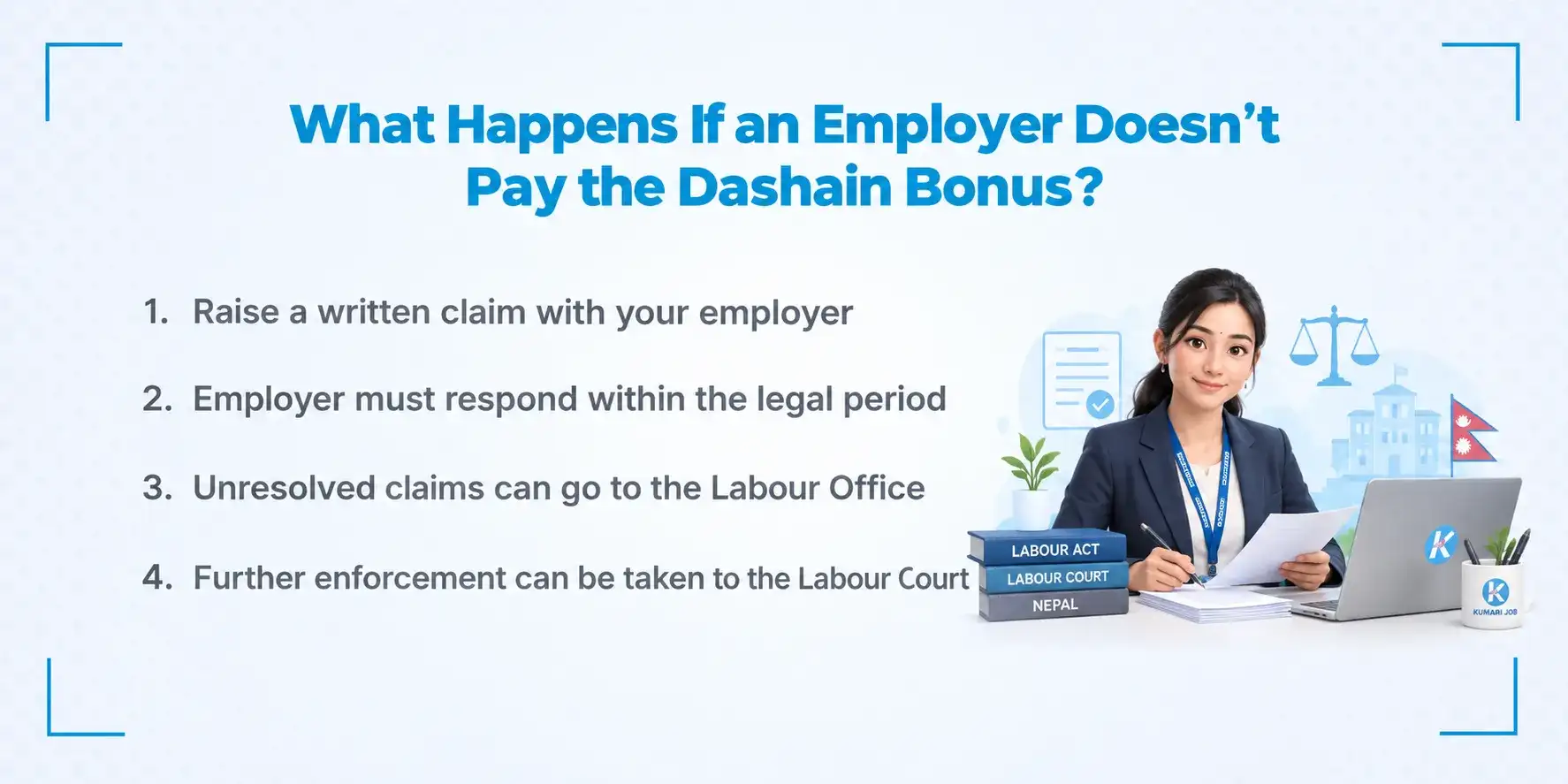
What Happens If an Employer Doesn't Pay the Dashain Bonus?
The employee can file a written claim with the employer first, and escalate to the government Labour Office if it isn't resolved.
Nepal's Labour Act gives a structured dispute path: an employee submits a written claim to the employer, who must respond within a set period; if unresolved, the employee can take the matter to the local Labour Office, and ultimately the Labour Court, for enforcement. Since the entitlement is a fixed legal right rather than a discretionary bonus, non-payment is a compliance violation, not a business decision the employer is free to make.
When Is Dashain 2026 in Nepal?
Dashain 2026 begins with Ghatasthapana on October 11, 2026, and runs through Vijaya Dashami (the main Tika day) in the following two weeks, ending with Kojagrat Purnima.
Nepal's 2026 public holiday calendar lists Ghatasthapana on October 11, Fulpati on October 17, Maha Ashtami on October 18, Maha Navami on October 19, and Vijaya Dashami on October 20, continuing through Kojagrat Purnima on October 24 (a few calendars place the main Tika day on October 21 instead, since the exact date depends on the lunar tithi; Nepal's official Panchang committee confirms the precise auspicious day and time closer to the festival). Employers typically process the festival allowance payroll run in the days just before this window opens.
Key Takeaways
- The Dashain Bonus is a legal right, not a favor — Labour Act, 2074, Section 37.
- It equals one month's basic salary, prorated for partial years of service.
- It's separate from the profit-based Bonus Act, 2030 payment.
- It's taxable as regular employment income.
- Non-payment can be escalated to the Labour Office.
Conclusion
The Dashain Bonus is a fixed legal entitlement under Section 37 of the Labour Act — one month's basic salary, owed to every employee regardless of company profit, and separate from the Bonus Act's profit-based payout. Getting the pro-rata math, timing, and tax treatment right every Dashain season is where most employers slip up.
Let Kumarijob handle it for you. Our HR outsourcing team manages accurate festival allowance calculations, on-time payroll runs, and full compliance documentation so you never risk a Labour Office complaint. Talk to our HR team today.
Frequently Asked Questions
Submit your comments

Get Our App On



What Skills Do Employers Look for in Freshers in Nepal?
VIEW DETAILS
How to Become a Public Health Officer in Nepal?
VIEW DETAILS.webp)
What Is the Document Controller Salary in Nepal?
VIEW DETAILS
What is the Public Relations Officer Salary in Nepal
VIEW DETAILS


Loading Comments...