




Most people rehearse the promotion conversation a dozen times in their head and still walk into their boss's office empty-handed. They know they deserve more responsibility and better pay, but the moment arrives, and the request comes out vague, apologetic, or tangled up in a routine check-in where it gets lost. The problem usually isn't confidence. It's that they never built a case; they just built a feeling.
This guide fixes that. It walks through how to know you're ready, how to structure the actual conversation, what to say word-for-word, and how to respond if the answer is no, so you can turn a nervous ask into a documented, evidence-backed case for advancement.
In this blog
What Does It Mean to Ask for a Promotion?
Asking for a promotion means formally requesting advancement into a higher-level role with greater responsibility, authority, or compensation, based on demonstrated performance and readiness. It's different from asking for a raise, which usually only changes your pay without changing your title, scope, or duties. Employers typically evaluate a promotion request against performance history, leadership behavior, business need, and whether the role you're asking for actually exists or can be created.
A few factors consistently shape whether a request lands well:
- Performance — consistent results against your current role's expectations
- Scope — responsibilities that already exceed your job description
- Leadership — how you influence peers, projects, or outcomes without formal authority
- Business need — whether the company has room, budget, or workload to justify the new role
- Timing — whether the ask lands during a review cycle, restructuring, or a quiet period
How Do I Know If I Am Ready to Ask for a Promotion?
Readiness isn't about tenure; it's about evidence. Before requesting a meeting, check yourself against this list honestly, because a mismatch between what you believe and what you can prove is the fastest way to get a "not yet."
- You consistently meet or exceed your current responsibilities
- You've taken on work beyond your job description, and it's stuck
- You have measurable achievements or completed projects to point to
- You solve problems independently, without needing to be walked through them
- You already have some of the skills the next-level role requires
- You've received specific positive feedback from managers or peers, not just general praise
- You're already doing pieces of the higher role's job in practice
If you can check four or more of these honestly, you have enough to build a case. If you're checking two or three, spend the next quarter closing the gap before you ask.
How to Ask Your Boss for a Promotion?
The process has eight steps: review your performance, research the next role, pick the right timing, request a private meeting, present your achievements, state your request directly, request feedback, and confirm next steps. Each step builds on the last, so skipping one, especially research or timing, weakens the whole conversation. Treat it as a short project with a deliverable, not a single spontaneous conversation.
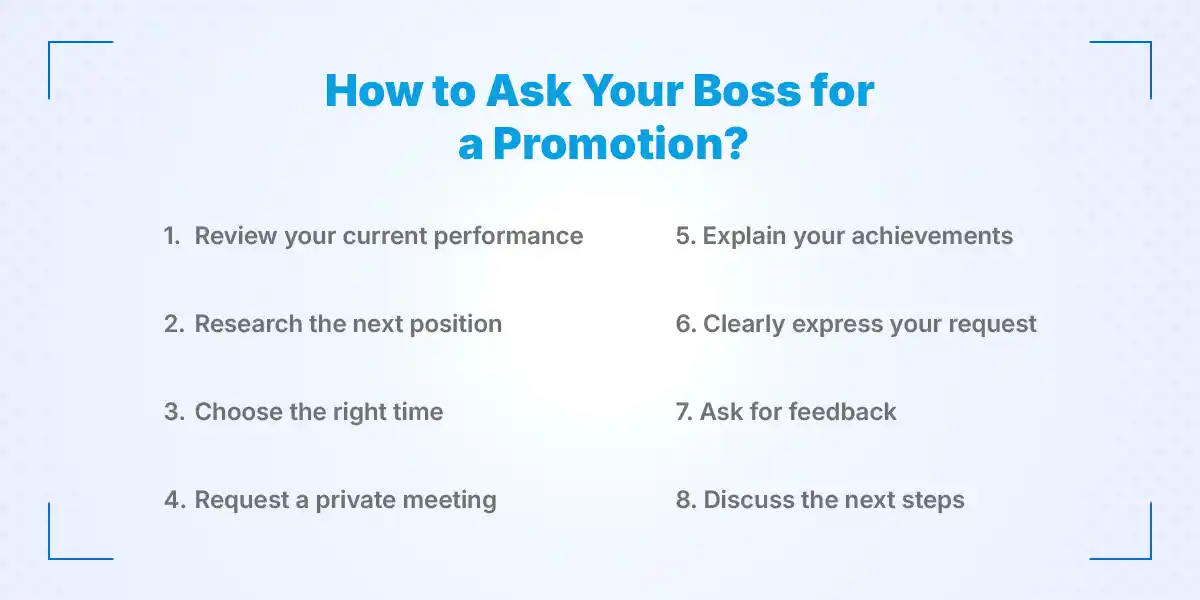
1. Review Your Current Performance
Start by pulling together a factual record of what you've actually delivered over the last review period. List your strongest accomplishments first, then work backward to smaller wins that support the pattern. Wherever possible, attach a number: revenue, time saved, error rate reduced, team size managed, because vague accomplishments don't move decisions. This review becomes the raw material for everything else in the conversation.
2. Research the Next Position
Before you ask for a role, understand exactly what that role requires day-to-day, not just its title. Read the job description if one exists, or ask a colleague already in a similar position what their week actually looks like. Map your current skills against those requirements and be honest about where the gaps are. This step turns your request from "I want more" into "I understand what this job needs, and here's how I match it."
3. Choose the Right Time
Timing changes how a request is received, even when the content is identical. The best windows are performance reviews, right after a successful project wraps, or during periods when the company is actively discussing growth or restructuring. Avoid bringing it up during an obvious crisis, a hiring freeze, or when your manager is visibly buried; the answer you get in that moment reflects the moment, not your case. A well-timed ask gets a considered answer; a badly-timed one gets a reflexive one.
4. Request a Private Meeting
Don't raise a promotion request inside a status update, a hallway conversation, or a group meeting. Ask your manager directly for dedicated time, and say why: "I'd like to set up 30 minutes to talk about my role and where it's heading. This signals that the conversation deserves focus rather than being squeezed into whatever time is left over. It also gives your manager time to prepare instead of reacting on the spot.
5. Explain Your Achievements
Open the meeting by walking through your strongest results, using the material you gathered in step one. Stick to specific examples instead of general statements like "I've been working really hard; specificity is what makes a case memorable and defensible. Frame each achievement in terms of impact on the team or business, not just effort. This section should feel like evidence, not a personal pitch.
6. Clearly Express Your Request
After laying out the evidence, state the task plainly: tell your boss you'd like to be considered for a promotion, and name the role or level if you can. Vague hints ("I feel like I'm ready for more") are easy to nod along to and easy to forget. Connect the request directly to the readiness you just demonstrated, so the ask and the evidence sit next to each other. Clarity here removes any ambiguity about what you actually want.
7. Ask for Feedback
Once you've made the ask, invite your manager's honest read on where you stand. Ask specifically what skills, results, or milestones they'd want to see before recommending you for the next level. This turns a single conversation into an ongoing checklist, even if the answer today is not yet. It also shows your manager you're oriented toward growth, not just a title.
8. Discuss the Next Steps
Close by asking what the actual promotion process looks like at your company, who approves it, what timeline is realistic, and whether there are budget or headcount factors involved. Get a sense of whether this is a decision your manager can make alone or one that needs approval further up. Leaving with a rough timeline, even an informal one, turns the meeting into a plan instead of a one-off task. Follow up in writing afterward to confirm what was discussed.
What Should I Say When Asking My Boss for a Promotion?
Start the conversation with genuine appreciation for your current role and the opportunities it's given you, then move into your case. Summarize your achievements briefly, explain how your responsibilities have grown beyond your original job description, and name the position or level you're interested in. Close by asking for your manager's honest perspective, and keep the whole exchange professional and evidence-based rather than emotional.
A few talking points that work well in practice:
- Over the past year, I've taken on [specific responsibility] and delivered [specific result].
- "One result I'm particularly proud of is [project/outcome], which led to [measurable impact].
- "I'd like to discuss the possibility of moving into [role/level].
- "What would you like to see from me to be ready for that role?
How Should I Prepare Before Asking for a Promotion?
- Build a list of measurable accomplishments, not general impressions
- Compare your current responsibilities against the next-level role, line by line
- Collect positive feedback, project outcomes, or performance data as backup
- Note any additional responsibilities you've taken on informally
- Prepare answers to the questions your manager is likely to ask back
- Decide what outcome you actually want from the meeting: a title, a timeline, or a plan
- Practice your key points as a rough structure, not a memorized script
When Is the Best Time to Ask for a Promotion?
The best time to ask is right after a completed win, during a scheduled performance review, or when your responsibilities have clearly outgrown your title. Timing matters because managers make better decisions when they're not distracted by unrelated pressure. A request made at the right moment gets evaluated on its merits; the same request made at the wrong moment often gets deferred by default.
Good windows to watch for:
- After completing a successful, visible project
- During a scheduled performance review
- When your responsibilities have significantly increased
- After receiving strong, specific performance feedback
- When your organization is actively discussing career development
- When a relevant higher-level position opens up
Preparation matters just as much as timing. Pairing a well-timed task with a documented career development plan gives you a stronger case than either one alone.
What Should You Do If Your Boss Says No?
A no to a promotion request usually means not yet, not never; it typically signals a gap in results, timing, or budget rather than a permanent limit. The right response is to ask specific, direct questions rather than walking away discouraged. Use the conversation to build a concrete plan for the next attempt instead of treating it as a closed door.
- Ask directly why the promotion isn't possible right now
- Request specific, actionable feedback rather than general reassurance
- Ask what goals or results you'd need to hit
- Set measurable milestones with your manager, not vague intentions
- Agree on when the topic can be revisited
- Keep documenting achievements between now and then
- Use everything you learned to build a structured plan for next time
Promotion vs. Salary Increase: What Is the Difference?
A promotion and a salary increase solve different problems, and mixing them up in your task can weaken both requests.
| Factor | Promotion | Salary Increase |
|---|---|---|
| Changes title/level | Yes | No |
| Changes responsibilities | Yes, typically expanded | Usually unchanged |
| Requires new role/budget approval | Often yes | Sometimes, depending on policy |
| Best framed around | Readiness for next-level scope | Market rate or performance value |
| Can be requested together | Yes, if justified separately | Yes, if justified separately |
Employees can request both in the same conversation, but each one needs its own evidence: a promotion case built on scope and readiness, a salary case built on market data and performance value. Before combining them, check your company's internal policy, since some organizations separate title changes and compensation reviews into different cycles entirely.
Expert Tips for a Successful Promotion Conversation
- Lead with value delivered, not entitlement to more
- Use numbers and measurable outcomes wherever they exist
- Frame every point around business impact, not personal effort
- Demonstrate you're already operating at the next level, not just capable of it
- Keep the tone confident but respectful, never confrontational
- Listen carefully to feedback, even when it's not what you hoped to hear
- Follow up in writing on any goals or milestones you agree to
Conclusion
A promotion request succeeds or fails based on the evidence behind it, not the courage it takes to ask. The employees who get promoted aren't the ones who ask the loudest; they're the ones who show up with a documented pattern of results, a clear understanding of the next role, and a specific, well-timed task that connects the two.
Start building that record now, even if your next review is months away. Explore more career growth strategies and browse current openings that match your next move on KumariJob.
Frequently Asked Questions
Submit your comments

Get Our App On


What Should I Do After Being Rejected for a Job?
VIEW DETAILS
How to Explain a Career Gap in an Interview in Nepal
VIEW DETAILS
How to Write Work Experience on a CV for Freshers
VIEW DETAILS
How to Handle Your First Mistake at Work: A Step-by-Step Recovery Guide
VIEW DETAILS


Loading Comments...