



A new employee sends the wrong file to a client. A fresher misses a deadline during their second week. Someone forgets to loop in a manager on a decision that needed approval first. The moment the error is discovered, the reaction is almost always the same: a racing heart, a dry mouth, and a flood of questions about whether this one mistake has undone weeks of good impressions.
It has not. Every employee, no matter how experienced, makes a first mistake, and how that moment is handled matters more than the mistake itself. This guide walks through the exact process to acknowledge, communicate, correct, learn from, and prevent workplace errors, so the next mistake becomes a career lesson instead of a career setback.
In this blog
What Should You Do After Making Your First Mistake at Work?
The right first response to a workplace mistake is to stay calm, understand exactly what went wrong, and report it to the right person before it grows into a bigger problem. Reacting with panic or silence almost always makes the situation worse than the original error. A clear, honest response signals maturity and gives a manager time to help fix things before deadlines or relationships are affected.
- Stay calm and get a clear picture of exactly what happened.
- Check whether the mistake is minor or whether it affects customers, money, data, deadlines, or coworkers.
- Avoid the urge to hide the issue or wait for someone else to notice it.
- Inform the right person, usually a direct manager, as soon as possible.
- Take ownership without piling on excuses.
- Shift the conversation toward solutions, not just explanations.
- Write down what happened and what action was taken, for future reference.
Why Is It Important to Admit a Mistake at Work?
Admitting a mistake at work matters because it protects trust, prevents small problems from becoming large ones, and shows a level of professional maturity that managers notice quickly. Employees who hide errors often turn a fixable issue into a much bigger one once it surfaces on its own. Owning a mistake early, on the other hand, tends to build more credibility than never making one at all.
- It demonstrates accountability and professional maturity.
- It gives managers the chance to fix problems before they escalate.
- It builds trust through honest, direct communication.
- It reduces the chance of the same error happening again.
- It turns a stressful moment into a genuine learning opportunity.
There's an important distinction here between taking responsibility and excessive self-blame. Owning a mistake means stating facts and fixing the problem; it does not mean spiraling into guilt or assuming the error defines someone's competence.
How Do You Tell Your Manager About a Mistake?
Tell your manager about a mistake quickly and honestly. Explain what happened, its impact, how you are fixing it, and what you will do to prevent it from happening again.
1. Explain What Happened
- Clearly describe what went wrong.
- Keep the explanation short and factual.
- Avoid blaming coworkers or making excuses.
2. Explain the Impact
- Tell your manager how the mistake affected the task or team.
- Mention any important consequences you have identified.
3. Explain How You Fixed It
Describe the steps you have taken to correct the mistake.
Ask for help if the issue is beyond your knowledge or authority.
4. Explain What You Will Do Next
Share how you will avoid making the same mistake again.
Mention practical steps such as double-checking your work or using a task checklist.
How Can You Fix a Mistake at Work Professionally?
Fixing a mistake at work professionally means identifying what went wrong, correcting it quickly, and taking steps to prevent it from happening again. Stay honest, communicate clearly, and focus on solving the problem rather than hiding the mistake.
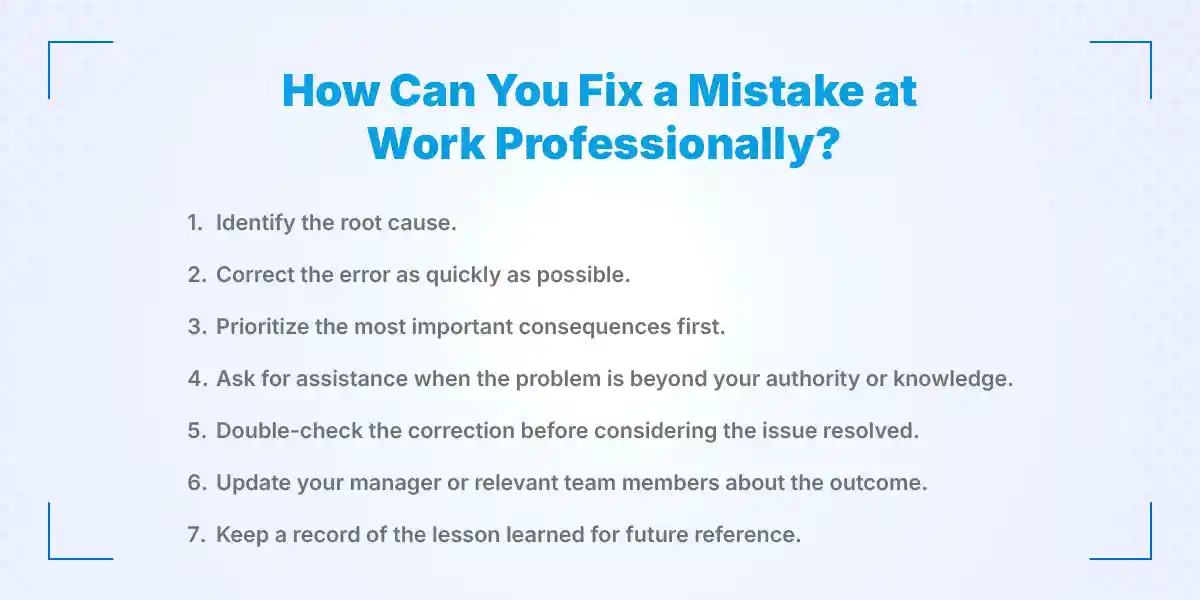
1. Identify the Root Cause
First, understand what caused the mistake. Check whether it happened because of a misunderstanding, lack of information, missed instructions, or another reason.
2. Correct the Mistake Quickly
Take action as soon as you notice the error. Fixing a mistake early can reduce its impact and show that you take responsibility for your work.
3. Prioritize the Consequences
Focus on the part of the mistake that could cause the most serious problem. Handle urgent issues first before moving to smaller corrections.
4. Ask for Help When Needed
If the mistake is beyond your knowledge, authority, or experience, ask your manager or an experienced team member for help. Getting support early can prevent the problem from becoming bigger.
5. Double-Check the Correction
After fixing the mistake, review your work carefully. Make sure the original problem has been solved and that the correction has not created another error.
6. Inform Your Manager or Team
Tell the relevant person what happened, what you did to fix it, and whether any further action is needed. Clear communication helps maintain trust at work.
7. Learn From the Mistake
Think about what you can do differently next time. Keep a simple note of the lesson learned and use it to improve your future work.
What Should You Say When You Make a Mistake at Work?
When you make a mistake at work, be honest, take responsibility, and explain how you plan to fix it. Avoid making excuses or blaming others. A simple and professional response can be: “I’m sorry for the mistake. I understand the issue, and I’m taking steps to correct it. I’ll make sure to double-check this in the future.
- Acknowledge the mistake: Clearly admit what went wrong instead of hiding the issue.
- Take responsibility: Use direct language such as “I made a mistake” rather than making excuses.
- Explain the solution: Tell your manager or team member what you are doing to correct the problem.
- Stay professional: Apologize sincerely, but avoid repeatedly saying sorry.
- Do not blame others: Focus on solving the problem instead of pointing fingers.
- Learn from the mistake: Explain what you will do differently to avoid repeating the same error.
Examples of What to Say
- Missing a deadline: I missed the deadline because I underestimated the time needed. I have completed the task and will plan my time more carefully next time.”
- Sending incorrect information: I noticed that I sent incorrect information. I apologize for the error and will send the corrected information immediately.
- Making a data-entry error: I found an error in the data I entered. I have corrected it and will double-check the information before submitting it again.”
- Forgetting an assigned task: “I apologize for missing this task. I have completed it now and will use a task list to make sure I do not miss similar assignments.”
- Making a communication mistake: “I realize my message was unclear. I apologize for the confusion and will communicate the information more clearly.”
Common Mistakes to Avoid When Handling a Workplace Error
- Hiding the mistake instead of reporting it.
- Waiting too long before telling anyone.
- Blaming coworkers or circumstances outside your control.
- Making excuses instead of taking ownership.
- Panicking, which often causes additional errors.
- Repeating the same mistake without changing the underlying process.
- Overexplaining a simple, easily fixable error.
- Getting defensive when receiving feedback about it.
- Assuming one mistake will permanently damage a career.
How Can You Learn From Your First Workplace Mistake?
- Identify the actual cause lack of knowledge, poor communication, low attention, time pressure, or unclear instructions.
- Build a simple checklist or process specifically designed to prevent that cause from repeating.
- Ask a manager or experienced coworker for direct feedback on what could have been done differently.
- Strengthen the specific skill or knowledge gap that contributed to the error.
- Apply the lesson to similar tasks going forward, not just the exact one that went wrong.
- Track visible improvement over time instead of fixating on the original error.
When Should You Ask for Help After Making a Mistake?
- When the mistake affects a customer or client directly.
- When financial or confidential information is involved.
- When the error puts a major deadline at risk.
- When the correct fix isn't clear or safe to attempt alone.
- When another department is affected by the mistake.
- When a decision or approval from a manager is required to move forward.
Asking for help isn't the same as escalating every minor issue. Small, low-impact errors can usually be corrected independently the goal is recognizing which mistakes genuinely need another person's judgment.
First Mistakes New Employees Commonly Make
New employees commonly make mistakes while adjusting to new responsibilities, workplace expectations, and communication styles.
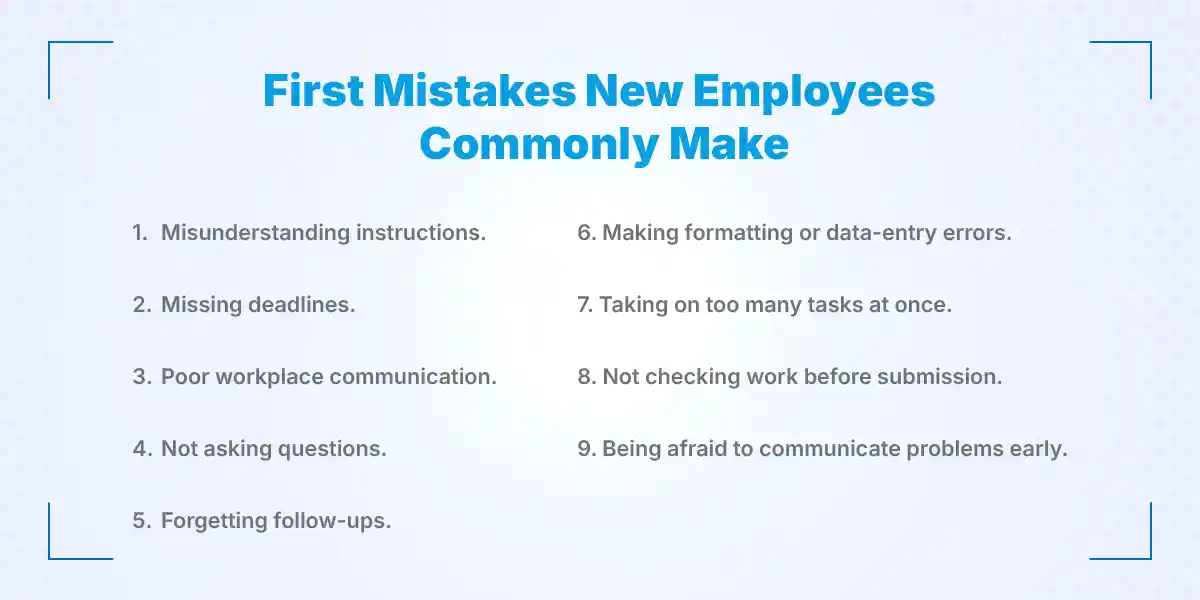
1. Misunderstanding Instructions
New employees may misunderstand instructions when they are unfamiliar with the work process or hesitate to ask for clarification.
2. Missing Deadlines
Missing deadlines can happen when new employees are still learning how to prioritize tasks and manage their workload.
3. Poor Workplace Communication
New employees may struggle with workplace communication, especially when they are unsure how or when to share updates with their team.
4. Not Asking Questions
Some new employees avoid asking questions because they fear appearing inexperienced, which can lead to preventable mistakes.
5. Forgetting Follow-Ups
Forgetting to follow up on assigned tasks, emails, or requests can cause delays and misunderstandings.
6. Making Formatting or Data-Entry Errors
Small formatting, typing, or data-entry errors are common when employees are still learning company systems and processes.
7. Taking on Too Many Tasks
New employees may accept too many tasks at once without considering their workload, priorities, or deadlines.
8. Not Checking Work Before Submission
Submitting work without reviewing it can result in simple errors that could have been corrected beforehand.
9. Being Afraid to Communicate Problems Early
New employees sometimes hesitate to report problems, but communicating issues early can help prevent small mistakes from becoming bigger problems.
Best Practices for Handling Mistakes at Work
Handling mistakes professionally means taking responsibility, communicating early, fixing the problem, and learning from the experience. Follow these simple practices:
- Own the mistake: Accept responsibility for your part instead of making excuses or blaming others.
- Communicate early: Inform your manager or team as soon as possible so the problem does not become bigger.
- Fix the problem: Focus on practical steps to correct the mistake quickly and carefully.
- Learn from it: Identify what caused the error and understand what you can do differently.
- Prevent repetition: Improve your work process, use checklists, or double-check important tasks.
- Stay professional: Remain calm, honest, and respectful when discussing the mistake.
- Move forward: Learn from the experience and continue your work with confidence.
Conclusion
The single most useful shift a new employee can make isn't learning to avoid every mistake that's not realistic in any job. It's building a reliable, repeatable response for when a mistake does happen: acknowledge it quickly, communicate it clearly, fix what can be fixed, and adjust the process so it doesn't repeat. That response is what managers actually remember, far more than the mistake itself.
New employees who are still building this kind of workplace confidence don't have to figure it out alone. KumariJob's career resources and job listings connect freshers with employers and roles suited to where they are in their professional growth. Explore current opportunities on KumariJob to take the next step.
Frequently Asked Questions
Submit your comments

Get Our App On



Dashain Bonus in Nepal: Festival Allowance Rules, Calculation & Legal Rights (2026 Guide)
VIEW DETAILS
What Skills Do Employers Look for in Freshers in Nepal?
VIEW DETAILS
How to Become a Public Health Officer in Nepal?
VIEW DETAILS.webp)
What Is the Document Controller Salary in Nepal?
VIEW DETAILS


Loading Comments...