

If your latest payslip looks different, it's likely due to the new salary tax slab 2083/84 introduced through the Finance Act. The biggest changes include extending the 1% tax slab to Rs. 10 lakh, reducing the maximum tax rate to 29%, and replacing separate tax slabs for single and married individuals with a unified system.
Whether you're an employee, HR professional, employer, or job seeker, this guide explains everything you need to know. You'll find the official salary tax slab, a simple breakdown of how salary tax is calculated, eligible deductions, and answers to common questions, all in one place.
In this blog
Salary Tax Slab 2083/84 at a Glance
If you are looking for a quick summary of the Nepal government latest salary tax slab, here is a handy cheat sheet. This snapshot gives you the essential facts right away.
| Item | Details |
|---|---|
| Fiscal Year | 2083/84 (FY 2026/27 AD) |
| Effective Date | Shrawan 1, 2083 (Mid-July 2026) |
| Applies To | All Resident Salaried Employees in Nepal |
| Maximum Tax Rate | 29% (Down from 39%) |
| Lowest Tax Rate | 1% (Social Security Tax) |
| Issuing Authority | Inland Revenue Department (IRD), Ministry of Finance |
Latest Salary Tax Slab 2083/84 in Nepal (2026)
Here is the official Nepal salary income tax slab structure applicable for the entire fiscal year 2083/84. You can use this table to check where your annual salary falls and how much tax you owe.
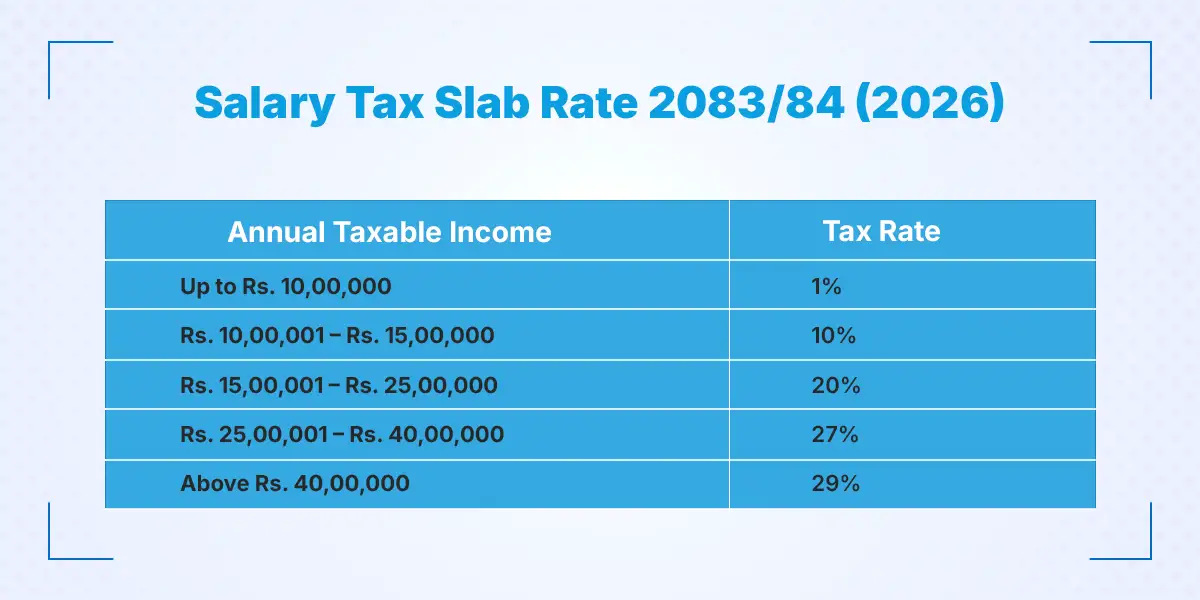
This visual gives you a quick overview of the FY 2083/84 salary tax rates based on your annual taxable income.
This overview is ideal for a quick reference. Keep in mind that Nepal follows a progressive income tax system, so the tax rate shown for a bracket applies only to the income within that range, not to your entire annual salary.
Complete Salary Tax Slab Table for FY 2083/84
Use the table below to identify your tax bracket and estimate your salary tax. It includes the annual income range, monthly equivalent, applicable tax rate, tax payable within each slab, and the cumulative tax carried forward to the next bracket.
How to use this table
Find your annual taxable income in the first column, then follow the corresponding tax rate for each applicable bracket. The cumulative tax column helps you calculate your total tax liability more accurately, especially if your income falls in the higher tax slabs.
| Annual Taxable Income (NPR) | Monthly Equivalent (NPR) | Tax Rate | Tax Payable in Slab (NPR) | Cumulative Tax (NPR) |
|---|---|---|---|---|
| Up to 10,00,000 | Up to 83,333 | 1% | Rs. 10,000 | Rs. 10,000 |
| 10,00,001 – 15,00,000 | 83,334 – 1,25,000 | 10% | Rs. 50,000 | Rs. 60,000 |
| 15,00,001 – 25,00,000 | 1,25,001 – 2,08,333 | 20% | Rs. 2,00,000 | Rs. 2,60,000 |
| 25,00,001 – 40,00,000 | 2,08,334 – 3,33,333 | 27% | Rs. 4,05,000 | Rs. 6,65,000 |
| Above 40,00,000 | Above 3,33,333 | 29% | 29% of income above Rs. 40,00,000 | Varies by income |
Note: The 1% Social Security Tax is waived for eligible Social Security Fund (SSF) contributors as per the Finance Act 2083.
How Progressive Taxation Works
It is very important to remember that Nepal uses a progressive tax system. This means higher tax rates apply only to the specific portion of your income that falls into that higher bracket, not to your entire salary.
For example, if your annual taxable income is Rs. 12 Lakhs, you do not pay 10% on the entire Rs. 12 Lakhs. Instead, you pay 1% on the first Rs. 10 Lakhs, and 10% only on the remaining Rs. 2 Lakhs. This ensures that earning more money never leaves you worse off!
What's New in the Salary Tax Slab for FY 2083/84?
The new salary tax slab in Nepal brings long-awaited relief to middle-income workers and high earners alike. Let's look at the four major changes introduced in this budget year.
1. 1% Tax Slab Extended
In previous years, the 1% basic tax rate applied only up to Rs. 5 Lakhs for single individuals (and Rs. 6 Lakhs for couples). Under the new FY 2083/84 rules, this limit has been doubled to Rs. 10 Lakhs. As a result, middle-class professionals earning up to Rs. 83,333 per month now pay just 1% in tax on their baseline salary.
2. Maximum Tax Reduced
In FY 2082/83, high-income earners faced a top marginal tax rate of 39% (including surcharges). In FY 2083/84, the government reduced the top rate to 29%. This change encourages top talent and senior professionals to stay and work in Nepal while keeping tax rates competitive with neighboring countries.
3. Same Tax Slab for Everyone
Previously, taxpayers had to declare whether they were filing as "Single" or "Couple." Married couples had slightly higher thresholds. Today, the tax slabs are 100% unified. Everyone follows the same straightforward income brackets regardless of marital status, which makes payroll processing much easier for HR teams.
4. Other Budget Highlights
Along with tax rate cuts, the Finance Act simplified tax returns for salaried employees. Employers now deduct Tax Deducted at Source automatically each month. This means most salaried workers who earn only remuneration income do not need to file complex end-of-year tax returns.
How Is Salary Tax Calculated in Nepal?
Salary tax in Nepal is calculated on your annual taxable income, not your monthly salary alone. To determine your tax liability for FY 2083/84, you need to calculate your total annual income, subtract eligible deductions, apply the progressive tax slabs, and divide the total tax into monthly TDS deductions. Follow these five steps to understand how the calculation works.
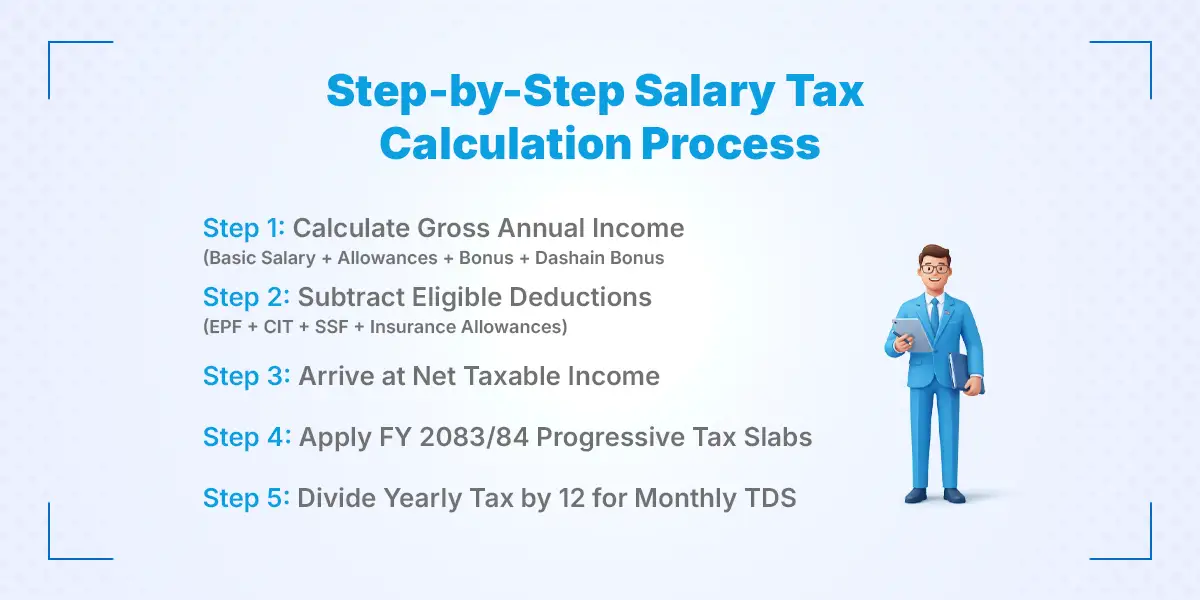
Step 1: Calculate Your Gross Annual Income
Begin by adding all taxable income you receive during the fiscal year. This includes your basic salary, allowances, bonuses, Dashain allowance, and any other taxable employment benefits. Your gross annual income serves as the foundation for the entire salary tax calculation, so ensure every taxable component is included.
Step 2: Subtract Eligible Tax Deductions
Deduct all tax-saving contributions and allowances permitted under Nepal's income tax laws. Common deductions include contributions to the Employees Provident Fund (EPF), Citizen Investment Trust (CIT), Social Security Fund (SSF), and eligible insurance premiums. Claiming these deductions correctly reduces your taxable income and prevents you from paying more tax than necessary.
Step 3: Determine Your Net Taxable Income
After subtracting all eligible deductions, the remaining amount is your net taxable income. This figure determines which tax brackets apply to your earnings under the FY 2083/84 salary tax slab. Before moving to the next step, verify that all deductions have been accurately accounted for.
Step 4: Apply the FY 2083/84 Progressive Tax Slabs
Calculate your tax by applying the prescribed rate to each portion of your taxable income within the relevant tax bracket. Do not apply a single tax rate to your entire income, as Nepal follows a progressive taxation system. Add the tax calculated from each bracket to determine your total annual income tax.
Step 5: Calculate Your Monthly TDS
Once your annual tax liability is calculated, divide it by twelve to estimate your monthly Tax Deducted at Source (TDS). Employers generally deduct this amount from your salary each month and deposit it with the Inland Revenue Department. Reviewing this calculation helps you verify that the tax deducted from your salary is accurate.
Calculate Your Salary Tax in Minutes!
Download the Kumari Job App and use the Salary Tax Calculator to get an instant estimate of your annual tax, monthly deductions, and net salary.
Salary Tax Slab for FY 2083/84 vs 2082/83
The Government of Nepal has simplified the income tax structure for FY 2083/84. The biggest changes include a higher 1% tax threshold, a lower maximum tax rate, and a single tax slab for all resident individuals. Here's how the new salary tax slab compares with FY 2082/83.
| Feature | FY 2082/83 | FY 2083/84 | What's Changed? |
|---|---|---|---|
| 1% Tax Slab | Up to Rs. 5 lakh (Single) Up to Rs. 6 lakh (Couple) | Up to Rs. 10 lakh | Threshold increased to Rs. 10 lakh. |
| Highest Tax Rate | 39% | 29% | Maximum tax rate reduced by 10 percentage points. |
| Tax Slab Structure | Separate for single and married taxpayers | Same for all resident individuals | Single and married tax slabs merged into one. |
| Number of Tax Slabs | 6 | 5 | Tax structure simplified. |
| Overall Tax Impact | Higher tax liability | Lower tax liability for most taxpayers | Most employees pay less income tax than before. |
Key Takeaways:
Middle-income earners benefit the most: Earning between Rs. 5 Lakhs and Rs. 10 Lakhs now incurs only 1% tax instead of 10%.
Payroll process is simplified: Employers no longer need to track marital status changes to compute monthly TDS.
High earners keep more income: The top tax rate drop from 39% to 29% significantly reduces the tax burden on executives and specialized professionals.
What Salary Tax Deductions Can You Claim in Nepal?
Many salaried employees in Nepal pay more income tax than necessary because they don't claim all the deductions they're eligible for. Contributions to approved retirement funds and certain insurance policies can reduce your taxable income before your salary tax is calculated. Knowing these deductions can help you lower your tax liability while staying fully compliant with Nepal's tax laws.
1. Employees Provident Fund (EPF)
Contributions made to the Provident Fund in Nepal or Social Security Fund (SSF) are tax-deductible. Employees can contribute 10% of their basic salary (matched by 10% from the employer). This total amount is subtracted directly from your gross salary before tax is calculated.
2. Citizen Investment Trust (CIT)
Voluntary contributions to a Citizen Investment Trust (CIT) Guide account are fully deductible. You can contribute up to 1/3rd of your total annual assessable income or Rs. 3,00,000 per year (whichever is lower) across retirement accounts to lower your taxable income.
3. Life Insurance Premium
You can claim a tax deduction on life insurance premiums paid for yourself or your family up to a maximum limit of Rs. 40,00,000 (or actual premium paid, whichever is lower). Always submit your insurance premium receipts to your HR department before the fiscal year ends.
4. Medical Insurance Premium
If you pay for health or medical insurance policies from licensed Nepalese insurance companies, you can claim an additional deduction of up to Rs. 20,00,000 per year.
5. Approved Retirement Funds
Contributions made to Social Security Fund (SSF) or approved pension funds qualify for direct income tax relief, offering higher exemption limits than standard individual plans.
Important Reminder: Only contributions made to government-approved funds and licensed institutions in Nepal qualify as tax deductions. Keep your original payment receipts safe to present to your employer or the IRD.
What Are the Most Common Salary Tax Mistakes to Avoid?
The most common salary tax mistakes include using outdated tax slabs, calculating tax on monthly salary instead of annual income, missing eligible deductions, and misunderstanding how progressive tax rates work. These mistakes can lead to incorrect TDS deductions or paying more tax than required. Here's a closer look at each mistake and how you can avoid it.
1. Calculating Tax Based on Monthly Salary
Salary tax in Nepal is calculated on your total annual taxable income, not your monthly salary alone. Estimating tax using a fixed monthly rate often produces inaccurate results because it ignores annual earnings, bonuses, and eligible deductions.
2. Not Claiming Eligible Tax Deductions
Many employees miss out on deductions because they fail to declare contributions such as EPF, CIT, SSF, or eligible insurance premiums. Submitting the required documents to your employer on time ensures these deductions are considered before your taxable income is calculated.
3. Using an Outdated Tax Slab
Income tax rates and thresholds can change with each fiscal year's budget. Calculating your salary tax using an older tax slab may result in incorrect TDS deductions or inaccurate tax estimates. Always refer to the latest FY 2083/84 salary tax slab.
4. Confusing Gross Income with Taxable Income
Your gross income includes your salary, allowances, bonuses, and other taxable benefits. Taxable income is the amount remaining after eligible deductions have been applied. Understanding this difference is essential for calculating your salary tax correctly.
5. Applying One Tax Rate to Your Entire Income
Nepal follows a progressive income tax system, where each portion of your income is taxed at the rate assigned to its respective tax bracket. Applying a single tax rate to your entire income will overestimate your tax liability and lead to incorrect calculations.
Where Can You Verify the Official Salary Tax Slab?
The salary tax slab and tax rates in this guide are based on the Finance Act 2083, the Ministry of Finance's budget documents, and updates published by the Inland Revenue Department (IRD). Since income tax rules may change with each fiscal year's budget, it's always a good idea to verify the latest information through official government sources:
Ministry of Finance (MoF): The primary government body responsible for formulating fiscal policy and introducing the annual budget speech.
Inland Revenue Department (IRD): The official tax administrative body in Nepal that issues administrative guidelines, tax portals, and TDS notices.
Finance Act 2083: The enacted legislation governing income tax rates and deduction limits for the fiscal year 2083/84.
To file tax returns online or verify tax registration, visit the official portal at ird.gov.np. For a step-by-step submission walk-through.
Conclusion
The new salary tax slab 2083/84 brings significant relief to working professionals across Nepal. By doubling the 1% tax threshold to Rs. 10 Lakhs and lowering the highest rate to 29%, the government has increased disposable income for almost every taxpayer. Middle-income earners stand to gain the most from these progressive reforms.
To make the most of these tax cuts, take a close look at your deductible investments like EPF, CIT, and insurance policies. Ensuring these are declared with your HR team will maximize your take-home pay each month. We strongly encourage you to calculate your personal tax using the updated FY 2083/84 slabs rather than relying on outdated rates from previous fiscal years!
If you're an employer looking to simplify salary tax calculation, TDS compliance, and payroll processing, explore Kumari Job's Payroll Services for accurate, hassle-free payroll management.
Frequently Asked Questions
Submit your comments

Get Our App On



How to Register a Personal PAN Card in Nepal: Online & Offline Methods
VIEW DETAILS
What Is the Average JavaScript Developer Salary in Nepal?
VIEW DETAILS
What Is the Average Java Developer Salary in Nepal?
VIEW DETAILS
What Is the Average C# Developer Salary in Nepal?
VIEW DETAILS


Loading Comments...