


Java has powered Nepal's banking and e-commerce systems for over a decade, yet most computer science graduates and working developers still can't get a straight answer on what fair pay actually looks like at each career stage. Job postings say "negotiable," seniors rarely share numbers openly, and generic international salary sites often show figures that don't match what Kathmandu banks, fintech firms, or outsourcing companies are really paying.
This guide breaks down Java developer pay in Nepal by experience level, city, and industry, using published salary data instead of guesswork. It also covers what actually raises Java developer pay, from Spring Boot expertise to international remote work, and where to find genuine openings.
In this blog
What Is the Average Java Developer Salary in Nepal?
The average Java developer in Nepal earns a base salary of roughly NPR 480,000 to NPR 500,000 a year, or about NPR 40,000 to NPR 90,000 a month for most working professionals. Freshers typically start around NPR 20,000 to NPR 40,000 a month, while senior developers at established firms like F1Soft or The Pace Infosys often clear NPR 100,000 a month or more.
This wide range exists because company type, city, and exposure to international clients affect pay just as much as years of experience. Lead architects and technical leads at the top end can reach NPR 300,000 a month or beyond, especially on international remote contracts.
Java Developer Salary in Nepal by Experience Level
Java Developer salaries in Nepal increase based on experience, technical expertise, and the complexity of projects. Entry-level developers usually work on maintenance and basic application development, while senior professionals and technical architects lead software design, system architecture, and development teams. The table below shows the estimated monthly salary by experience level.
| Experience Level | Experience | Estimated Monthly Salary (NPR) |
|---|---|---|
| Entry-Level Java Developer | 0–2 years | 30,000 – 50,000 |
| Mid-Level Java Developer | 2–5 years | 50,000 – 90,000 |
| Senior Java Developer | 5+ years | 90,000 – 150,000 |
| Lead Java Developer / Technical Architect | 8+ years | 150,000 – 250,000+ |
Java Developer Salary by City in Nepal
Location has a significant effect on Java developer pay in Nepal, largely because banks, fintech companies, and outsourcing firms concentrate heavily around Kathmandu Valley.
| City | Entry-Level (NPR/month) | Experienced/Senior (NPR/month) |
|---|---|---|
| Kathmandu | 25,000 – 40,000 | 100,000 – 250,000 |
| Lalitpur | 25,000 – 40,000 | 90,000 – 200,000 |
| Bhaktapur | 22,000 – 38,000 | 80,000 – 180,000 |
| Pokhara | 20,000 – 35,000 | 60,000 – 130,000 |
| Biratnagar | 18,000 – 32,000 | 50,000 – 100,000 |
| Butwal | 18,000 – 32,000 | 50,000 – 100,000 |
| Chitwan | 18,000 – 32,000 | 50,000 – 100,000 |
Kathmandu leads by a clear margin because it hosts most of Nepal's banks, fintech companies likeThe Pace Infosys, and outsourcing firms like Leapfrog Technology in one metro area. Lalitpur and Bhaktapur trail closely behind, often posting salaries near Kathmandu levels for comparable roles at nearby IT parks and business districts. Pokhara continues to grow as a secondary hub, though local pay still runs lower than the capital for equivalent experience. Smaller cities like Biratnagar, Butwal, and Chitwan have fewer direct employers, but developers there increasingly close the gap through remote roles with companies based elsewhere in Nepal or abroad
Java Developer Salary by Industry
The industry a Java developer works in shifts the pay ceiling almost as much as experience level does:
- Software development companies – The most common employer type, offering steady mid-range pay and broad exposure to different client projects.
- Banking and financial institutions – Among the strongest local payers, since Java powers most core banking, payment, and transaction systems in Nepal.
- Fintech companies – Firms like F1Soft pay competitively for developers who can build secure, high-availability mobile banking and payment platforms.
- IT outsourcing companies – Often match or beat banking-sector pay, especially for developers who work directly with clients in the US and Europe.
- Telecommunications companies – Offer stable, mid-to-upper-range pay for developers maintaining large-scale backend systems.
- Healthcare technology companies – Firms like Deerwalk Inc. pay well for developers experienced in data-heavy, compliance-sensitive systems.
- International remote companies – The highest-paying category overall, with experienced developers frequently earning NPR 150,000 to NPR 300,000 or more a month.
Factors That Affect Java Developer Salary in Nepal
Several factors combine to determine where a Java developer lands within Nepal's wide salary range:
- Experience level – The single biggest driver, with pay roughly doubling at each major career stage.
- Technical skills – Spring Boot, microservices, and cloud experience consistently command higher offers than core Java alone.
- Education and certifications – A relevant degree helps at the entry level, while Oracle or cloud certifications matter more for mid-career raises.
- Company size – Larger banks, fintech firms, and outsourcing companies generally pay more than small local agencies.
- Industry – Banking, fintech, and international outsourcing consistently out-pay general software services.
- Location – Kathmandu Valley salaries run well above those in secondary cities for equivalent roles.
- English communication skills – Critical for client-facing roles and virtually mandatory for international remote work.
- Remote work opportunities – Developers serving international clients typically earn several times the local average.
How Can You Increase Your Salary as a Java Developer in Nepal?
The fastest way to increase a Java developer salary in Nepal is to pair deeper technical specialization with exposure to international clients. Local pay ceilings are largely set by company size and industry, but remote work and modern framework skills routinely break through those limits. The seven areas below cover the highest-leverage moves available at any experience level.
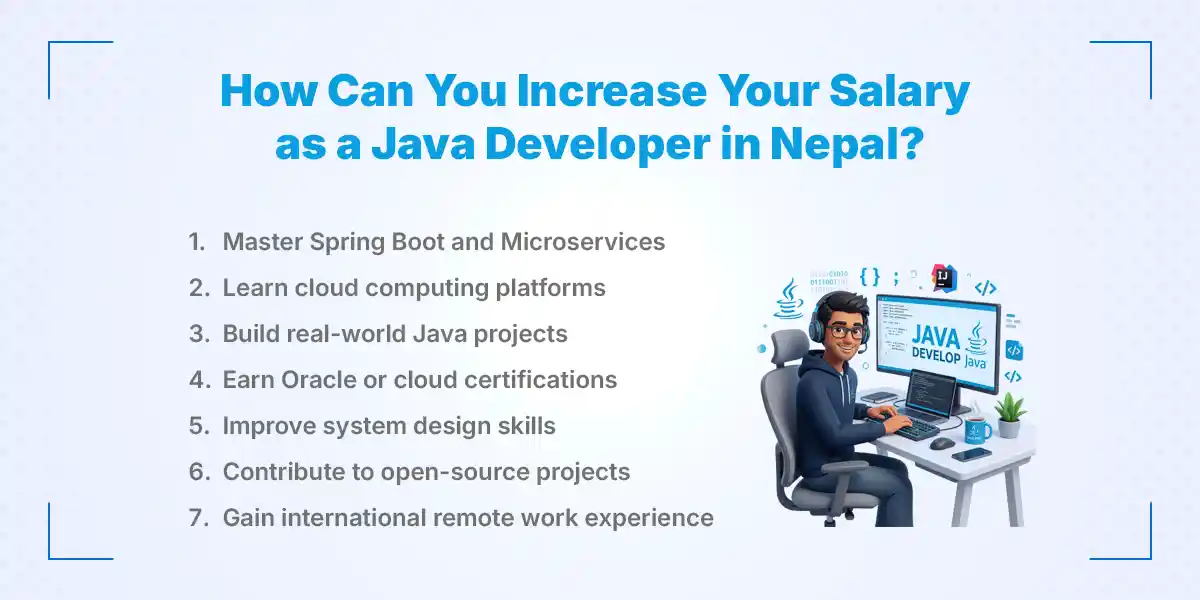
1. Master Spring Boot and Microservices
Spring Boot has become the default framework for building modern Java backends in Nepal's software and banking sectors. Employers consistently pay more for developers who can design RESTful APIs, manage dependency injection, and break monolithic applications into microservices. This skill set signals that a developer can build scalable, maintainable systems rather than just write working code. Developers who skip this update often get stuck maintaining older, monolithic codebases at lower pay.
2. Learn cloud computing platforms
Cloud experience, particularly with AWS or Azure, is one of the strongest salary multipliers available to Java developers in Nepal. Employers pay more for developers who can deploy, scale, and secure Java applications in the cloud rather than hand that work off to someone else. Practical experience with containers, load balancing, and CI/CD pipelines carries more weight in interviews than certification alone. Developers who add cloud skills to a strong Java foundation often qualify for senior pay ahead of schedule.
3. Build real-world Java projects
A portfolio of real, working Java projects gives employers concrete proof of skill that a resume alone cannot provide. Projects like a Spring Boot API with authentication, a small e-commerce backend, or a cloud-deployed microservice demonstrate practical ability far better than course completion certificates. Recruiters and technical interviewers at Nepali outsourcing firms routinely review GitHub activity before extending offers. A thin or outdated portfolio can undercut an otherwise strong application, especially for remote roles.
4. Earn Oracle or cloud certifications
Certifications like Oracle Certified Professional Java Programmer or AWS/Azure cloud credentials give hiring managers a fast way to verify baseline skill. They matter most for developers targeting outsourcing firms or international remote roles, where employers can't easily verify local reputation through word of mouth. A certification alone rarely justifies a raise on its own, but it opens interview doors that skill-only candidates don't get. Pairing a certification with a matching portfolio project makes the credential far more persuasive.
5. Improve system design skills
System design ability separates mid-level developers from senior and lead candidates more reliably than coding speed does. Understanding how to structure databases, design APIs for scale, and choose between monolithic and microservices architecture becomes essential once a developer starts leading features. Interviewers at banks and larger outsourcing firms test this directly, often through system design discussions. Developers who invest time here typically reach the senior salary band faster than peers who focus only on writing code.
6. Contribute to open-source projects
Contributing to established open-source Java projects gives developers visible, verifiable proof of code quality that employers can check independently. It also exposes developers to coding standards and collaboration practices used by larger, more disciplined engineering teams. Consistent, meaningful contributions stand out on a resume far more than a list of completed online courses. Developers targeting international remote roles benefit the most, since open-source activity is often the first thing foreign employers check.
7. Gain international remote work experience
International remote experience, even on a small freelance project, consistently pays more per hour than local full-time roles in Nepal. It also builds a track record of independent project ownership and client communication that local employers value highly during promotions. Developers who freelance part-time while employed can use that income and experience as direct leverage in salary negotiations. Over time, many developers convert freelance clients into stable, higher-paying long-term remote contracts.
Java Developer Career Growth in Nepal
A typical Java developer career path in Nepal follows a fairly predictable ladder, though the pace of progression depends heavily on the skills covered above:
- Junior Java Developer – Entry point, focused on bug fixes and supervised feature work.
- Mid-Level Java Developer – Independent ownership of backend features, APIs, and database work.
- Senior Java Developer – System design input, code review, and client-facing responsibility.
- Technical Lead – Manages a small team's technical direction and delivery quality.
- Solution Architect – Designs system-wide architecture across multiple projects.
- Engineering Manager – Shifts toward people management and delivery planning.
- Software Architect – Sets technical standards and technology strategy at the organization level.
- Chief Technology Officer (CTO) – Available to professionals who combine deep technical credibility with business and leadership experience.
Is Java Development a Good Career in Nepal?
Yes, Java development remains one of the more stable and well-paying IT careers in Nepal, largely because banks, fintech firms, and outsourcing companies depend on it for core systems. Current job demand stays strong across banking, insurance, healthcare technology, and outsourcing, with new listings added regularly on platforms like Kumari Job. Long-term career prospects also look solid, since Java's role in enterprise and financial systems tends to change slowly compared to newer frameworks.
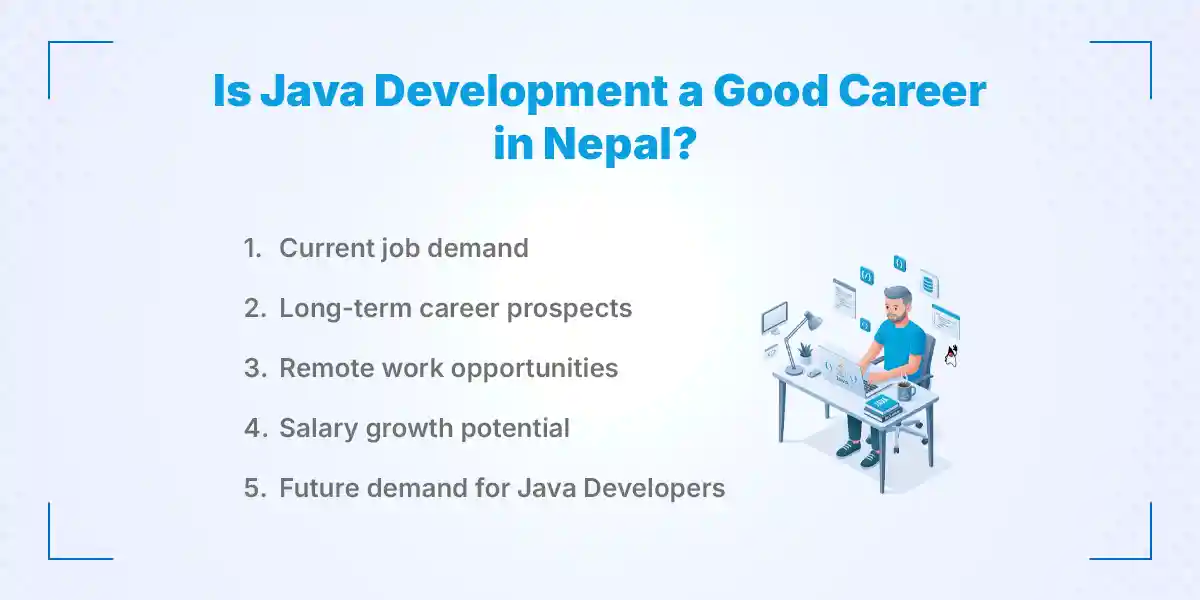
- Current job demand – Steady hiring from banks, fintech firms, and outsourcing companies across Kathmandu Valley.
- Long-term career prospects – Java's entrenched role in banking and enterprise systems supports long career stability.
- Remote work opportunities – Growing steadily as international companies hire more Nepali Java talent.
- Salary growth potential – Strong for developers who add cloud, microservices, and communication skills.
- Future demand – Expected to stay resilient as digitization expands across banking, insurance, and government sectors.
Where to Find Java Developer Jobs in Nepal?
The most reliable places to find Java developer jobs in Nepal are dedicated job portals, LinkedIn, and direct company career pages. Each channel tends to surface a different mix of local and remote opportunities, so most serious job seekers use more than one at a time. Recruitment agencies and freelance platforms fill in the gaps for roles that never get publicly posted.
- Kumari Job – Verified Java and IT job listings across Nepal, filterable by city and experience level.
- LinkedIn Jobs – Strong for both local openings and international remote roles.
- Company career pages – Useful for targeting specific banks, fintech firms, and outsourcing companies known for hiring Java talent.
- IT recruitment agencies – Often have access to unadvertised senior and lead roles at larger companies.
- Freelancing platforms – A practical entry point into international client work and higher effective hourly rates.
- Professional networking events – Local tech meetups and alumni networks frequently surface referral-based openings before they're posted publicly.
Conclusion
The single most useful takeaway from this data is that experience level alone does not determine a Java developer's salary in Nepal; industry and client geography matter just as much. A five-year developer stuck on small local projects can easily earn less than a two-year developer working for a bank, fintech firm, or international outsourcing client. The fastest path to meaningfully higher pay isn't waiting for more years on the job; it's deliberately targeting the industries and skills that this guide breaks down.
If you're actively job hunting or benchmarking your next offer, browse current Java developer openings on Kumari Job to see real, verified salary ranges and requirements from companies hiring in Nepal right now.
Frequently Asked Questions
Submit your comments

Get Our App On



How to Register a Personal PAN Card in Nepal: Online & Offline Methods
VIEW DETAILS
What Is the Average JavaScript Developer Salary in Nepal?
VIEW DETAILS
Salary Tax Slab 2083/84 in Nepal: Latest Tax Rates & Calculation
VIEW DETAILS
What Is the Average C# Developer Salary in Nepal?
VIEW DETAILS


Loading Comments...