


JavaScript Developers are among the most in-demand IT professionals in Nepal. Businesses, startups, software companies, fintech firms, e-commerce platforms, and international clients rely on JavaScript to build modern websites and web applications. As demand continues to grow, JavaScript Developer salaries in Nepal are becoming more competitive for both freshers and experienced professionals.
This guide explains the average JavaScript Developer salary in Nepal, salary by experience level, the highest-paying industries, key factors that affect earnings, employee benefits, and practical tips to increase your salary. Whether you are a beginner or an experienced developer, this guide will help you understand your earning potential and career opportunities in Nepal.
In this blog
What Is the Average JavaScript Developer Salary in Nepal?
The average JavaScript developer in Nepal earns roughly NPR 894,500 a year, or about NPR 74,500 a month, based on published salary data covering the full range of experience levels. Half of all JavaScript developers earn less than the median of NPR 858,100 a year, and half earn more, with the middle 50% falling between NPR 596,100 and NPR 1,065,800 annually. Freshers typically start much lower, around NPR 20,000 to NPR 40,000 a month, while senior and full-stack developers at established companies can clear NPR 120,000 to NPR 250,000 or more.
This spread exists because JavaScript spans such a wide range of roles, from junior developers doing simple frontend fixes to senior full-stack engineers building complete products for international clients. City, company type, and whether the work involves remote or freelance clients all pull the number in different directions just as much as raw years of experience do.
JavaScript Developer Salary in Nepal by Experience Level
JavaScript Developer salaries in Nepal vary based on experience, technical skills, and the type of company. Developers with expertise in modern JavaScript frameworks and real-world project experience generally earn higher salaries.
- Entry-Level JavaScript Developer (0–2 years): NPR 30,000–50,000 per month
- Mid-Level JavaScript Developer (2–5 years): NPR 50,000–90,000 per month
- Senior JavaScript Developer (5+ years): NPR 90,000–150,000 per month
- Lead JavaScript Developer / Technical Architect (8+ years): NPR 150,000–250,000+ per month
JavaScript Developer Salary by City in Nepal
Location has a significant effect on JavaScript developer pay in Nepal, largely because startups, SaaS companies, and outsourcing firms concentrate heavily around Kathmandu Valley.
| City | Entry-Level (NPR/month) | Experienced/Senior (NPR/month) |
|---|---|---|
| Kathmandu | 25,000 – 40,000 | 120,000 – 250,000 |
| Lalitpur | 25,000 – 40,000 | 110,000 – 220,000 |
| Bhaktapur | 22,000 – 38,000 | 90,000 – 180,000 |
| Pokhara | 20,000 – 35,000 | 70,000 – 140,000 |
| Biratnagar | 18,000 – 32,000 | 55,000 – 110,000 |
| Butwal | 18,000 – 32,000 | 55,000 – 110,000 |
| Chitwan | 18,000 – 32,000 | 55,000 – 110,000 |
Kathmandu leads by a clear margin because it hosts most of Nepal's startups, SaaS companies, digital agencies, and outsourcing firms in one metro area. Lalitpur trails closely behind, especially around Jawalakhel and Pulchowk, where several product-based companies and tech offices are based. Pokhara continues to grow as a secondary hub, though local pay still runs lower than the capital for equivalent experience. Smaller cities like Biratnagar, Butwal, and Chitwan have fewer direct employers, but developers there increasingly close the gap through remote and freelance work with clients based elsewhere.
JavaScript Developer Salary by Industry
JavaScript Developer salaries in Nepal differ across industries based on project complexity, company size, and demand for skilled developers. Companies working with international clients or advanced web technologies generally offer higher salaries.
- Software Development Companies: NPR 40,000–100,000 per month
- Fintech Companies: NPR 60,000–120,000 per month
- E-commerce Companies: NPR 40,000–90,000 per month
- IT Outsourcing Companies: NPR 50,000–120,000 per month
- Digital Agencies: NPR 30,000–70,000 per month
- SaaS Companies: NPR 70,000–150,000 per month
- International Remote Companies: NPR 120,000–350,000+ per month (depending on client and experience)
Factors That Affect JavaScript Developer Salary in Nepal
Several factors combine to determine where a JavaScript developer lands within Nepal's wide salary range:
- Experience level – The single biggest driver, with pay roughly doubling at each major career stage.
- Technical skills – React, Node.js, and TypeScript experience consistently command higher offers than basic JavaScript alone.
- Education and certifications – A relevant degree helps at the entry level, while framework or cloud certifications matter more for mid-career raises.
- Company size – Larger SaaS companies and outsourcing firms generally pay more than small local agencies.
- Industry – Fintech, SaaS, and international outsourcing consistently out-pay general web agency work.
- Location – Kathmandu Valley salaries run well above those in secondary cities for equivalent roles.
- English communication skills – Critical for client-facing roles and virtually mandatory for international remote work.
- Remote work opportunities – Developers serving international clients typically earn several times the local average.
How Can You Increase Your Salary as a JavaScript Developer in Nepal?
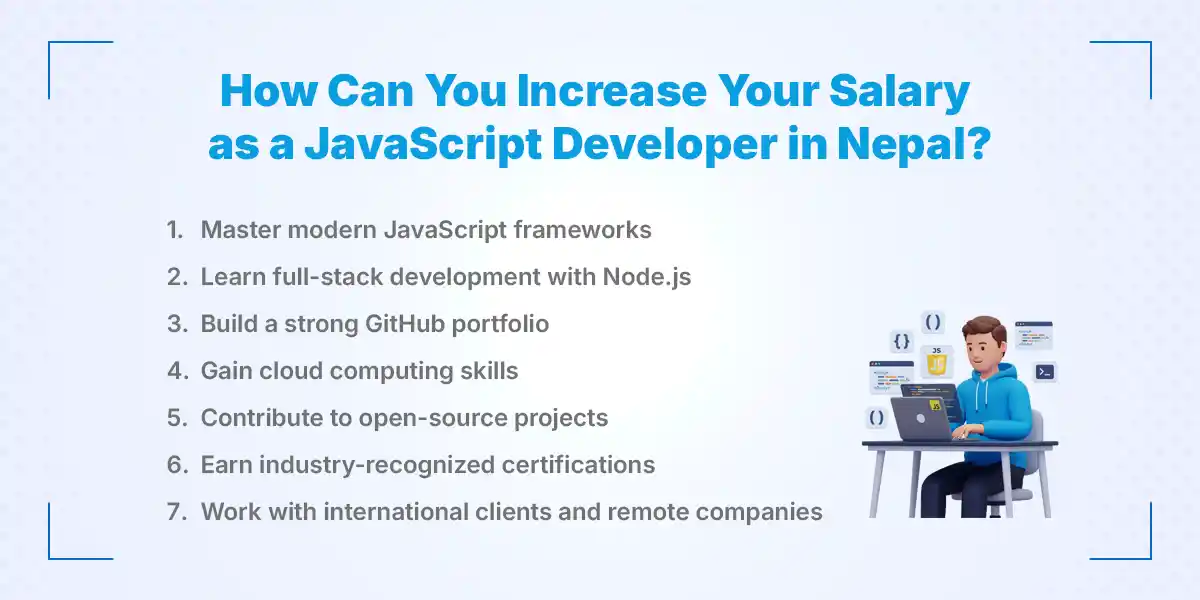
The fastest way to increase a JavaScript developer salary in Nepal is to move beyond frontend-only work and pair strong technical skills with exposure to international clients. Local pay ceilings are largely set by company size and industry, but full-stack ability and remote work routinely break through those limits. The seven areas below cover the highest-leverage moves available at any experience level.
1. Master modern JavaScript frameworks
Deep, practical knowledge of React, Vue, or Angular signals that a developer can build production-grade interfaces rather than just follow tutorials. Employers consistently pay more for developers who understand state management, component architecture, and performance optimization within these frameworks. This skill set separates candidates who can maintain large codebases from those who can only build small demos. Developers who skip this depth often get stuck on simple maintenance work at lower pay.
2. Learn full-stack development with Node.js
Node.js turns a frontend-only developer into a full-stack candidate who can own an entire feature from database to browser. Employers pay noticeably more for developers who can build and consume their own APIs rather than depend entirely on a separate backend team. This skill also opens up a wider pool of job listings, since many Nepali companies hire generalist full-stack developers over narrow specialists. Developers who add Node.js to a strong frontend foundation often qualify for mid-level pay well ahead of schedule.
3. Build a strong GitHub portfolio
A public GitHub profile with real, working projects gives employers concrete proof of skill that a resume alone cannot provide. Projects like a full-stack app with authentication, a small SaaS tool, or a polished component library demonstrate practical ability far better than course completion certificates. Recruiters and technical interviewers at Nepali startups and outsourcing firms routinely check GitHub activity before extending offers. A thin or inactive portfolio can undercut an otherwise strong application, especially for remote roles.
4. Gain cloud computing skills
Cloud experience, particularly with AWS or Azure, is one of the strongest salary multipliers available to JavaScript developers in Nepal. Employers pay more for developers who can deploy, scale, and monitor applications in the cloud rather than hand that work off to someone else. Practical experience with serverless functions, CI/CD pipelines, and basic DevOps practices carries more weight in interviews than certification alone. Developers who add cloud skills to full-stack JavaScript often qualify for senior pay ahead of schedule.
5. Contribute to open-source projects
Contributing to established open-source JavaScript projects gives developers visible, verifiable proof of code quality that employers can check independently. It also exposes developers to coding standards and collaboration practices used by larger, more disciplined engineering teams. Consistent, meaningful contributions stand out on a resume far more than a list of completed online courses. Developers targeting international remote roles benefit the most, since open-source activity is often the first thing foreign employers check.
6. Earn industry-recognized certifications
Certifications from platforms like Meta, AWS, or freeCodeCamp give hiring managers a fast way to verify baseline skill, especially for developers without a traditional computer science degree. They matter most for candidates targeting outsourcing firms or international remote roles, where employers can't easily verify local reputation. A certification alone rarely justifies a raise on its own, but it opens interview doors that skill-only candidates don't get. Pairing a certification with a matching portfolio project makes the credential far more persuasive.
7. Work with international clients and remote companies
International client experience, even on a small freelance project, consistently pays more per hour than local full-time roles in Nepal. It also builds a track record of independent project ownership and client communication that local employers value highly during promotions. Developers who freelance part-time while employed can use that income and experience as direct leverage in salary negotiations. Over time, many developers convert freelance clients into stable, higher-paying long-term remote contracts.
Highest-Paying Companies Hiring JavaScript Developers in Nepal
- Software development companies – Steady, broad hiring across frontend, backend, and full-stack JavaScript roles.
- Fintech companies – Strong pay for developers building secure, high-performance financial dashboards and tools.
- SaaS companies – Among the better local payers, since long-term product ownership commands stronger salaries.
- Product-based companies – Pay well for developers who can commit to a single codebase and product roadmap over time.
- IT consulting firms – Offer competitive pay tied to client billing rates, especially for senior full-stack talent.
- International outsourcing companies – Frequently match or beat local product-company salaries for client-facing developers.
- Remote global employers – The highest-paying category overall, particularly for developers with strong English and full-stack skills.
JavaScript Developer Career Growth in Nepal
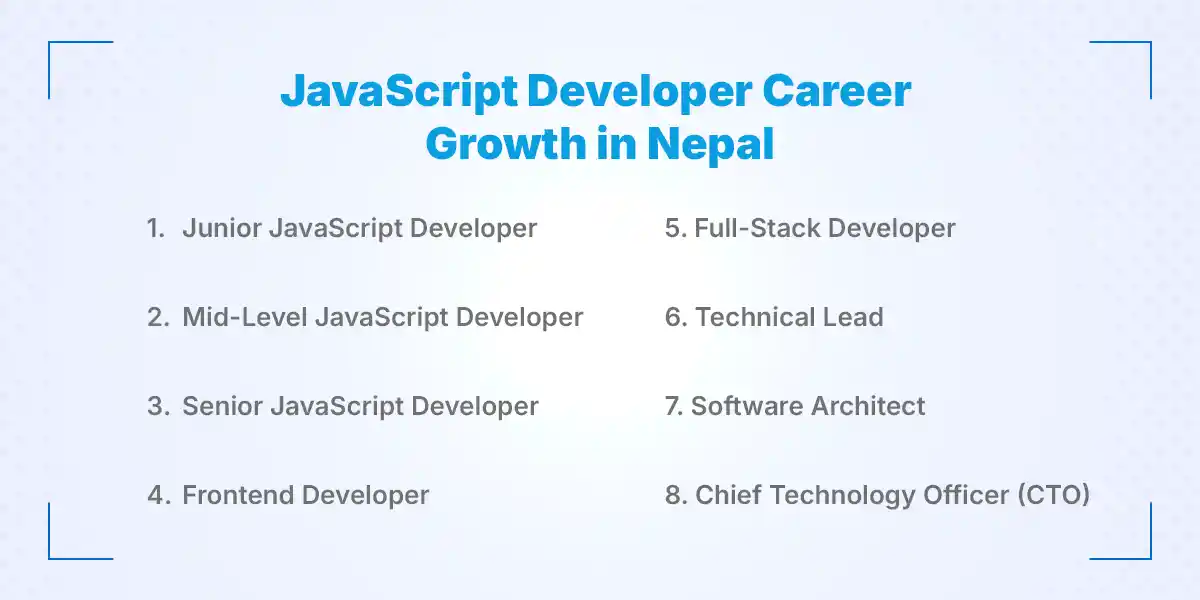
A typical JavaScript developer career path in Nepal follows a fairly predictable ladder, though the pace of progression depends heavily on the skills a developer picks up at each stage.
1. Junior JavaScript Developer
A Junior JavaScript Developer is the entry point into the career, usually held by developers with zero to two years of experience. Work at this stage centers on UI fixes, small component tasks, and supervised feature tickets under a senior developer's guidance. Most juniors earn between NPR 20,000 and NPR 40,000 a month while they build core JavaScript and framework fundamentals. Moving past this stage quickly usually depends on how fast a developer picks up a modern framework like React or Vue.
2. Mid-Level JavaScript Developer
A Mid-Level JavaScript Developer typically has two to five years of experience and works with far less day-to-day supervision. At this stage, developers independently own entire features and start contributing to technical decisions within their team. Pay usually ranges between NPR 50,000 and NPR 100,000 a month, with Node.js or backend exposure pushing offers toward the higher end. This is also the stage where many developers begin receiving remote or freelance offers for the first time.
3. Senior JavaScript Developer
A Senior JavaScript Developer generally has five or more years of experience and takes on architecture-level responsibility. Duties expand to include code review, performance optimization, and mentoring junior team members. Senior developers in Nepal typically earn NPR 120,000 to NPR 250,000 a month or more, especially at companies serving international clients. Strong communication skills at this stage often decide whether a developer moves into a specialized or leadership track next.
4. Frontend Developer
A Frontend Developer is a specialization path rather than a strict seniority level, focused deeply on UI architecture, design systems, and performance. Developers on this track build deep expertise in a specific framework ecosystem, component libraries, and browser performance tuning. This path suits developers who prefer depth in the user-facing layer over managing full application stacks. Frontend specialists with strong design sensibility often command pay similar to full-stack peers at product-focused companies.
5. Full-Stack Developer
A Full-Stack Developer owns both the frontend and backend layers of a product, typically using Node.js alongside a JavaScript framework. This path appeals to developers who want broader ownership over how a feature works end-to-end, from database to browser. Full-stack developers are in high demand among Nepali startups and SaaS companies that prefer generalists over narrow specialists. This versatility often makes full-stack developers among the highest earners at the mid-to-senior level.
6. Technical Lead
A Technical Lead manages the technical direction and delivery quality of a small development team. Responsibilities shift from writing all the code personally to reviewing architecture decisions, unblocking teammates, and setting coding standards. This role usually requires strong senior-level technical skill combined with the ability to communicate priorities clearly to both engineers and stakeholders. Technical Leads typically earn above standard senior pay, particularly when they also manage client relationships.
7. Software Architect
A Software Architect sets technical standards and technology strategy at the organization level, well beyond a single team or project. This role involves choosing the right technologies, defining system-wide architecture, and ensuring different teams build in a consistent, scalable way. Reaching this level usually requires a proven track record of scaling production systems across multiple projects. Software Architects rank among the highest-paid individual contributors in Nepal's JavaScript job market.
8. Chief Technology Officer (CTO)
A Chief Technology Officer sits at the top of the technical career ladder, responsible for a company's entire technology strategy and engineering organization. This role blends deep technical credibility with business judgment, budget ownership, and team leadership at scale.
Developers usually reach this position after years of combined technical and managerial experience, often after passing through architect or engineering manager roles. CTO positions are less common in Nepal's JavaScript job market but represent the clearest ceiling for long-term career growth in the field.
Is JavaScript Development a Good Career in Nepal?
Yes, JavaScript development remains one of the most accessible and in-demand IT careers in Nepal, largely because nearly every startup, agency, and product company needs frontend or full-stack talent. Current job demand stays strong across startups, SaaS companies, and outsourcing firms, with new listings added regularly on platforms like Kumari Job. Career growth opportunities are also broad, since JavaScript skills transfer easily between frontend, backend, and full-stack roles as a developer's interests evolve.
- Current job demand – Consistent hiring from startups, agencies, SaaS companies, and outsourcing firms across Kathmandu Valley.
- Career growth opportunities – Multiple paths available, from deep frontend specialization to full-stack and architecture roles.
- Remote work potential – Among the highest of any tech stack in Nepal, given global demand for JavaScript talent.
- Salary growth – Strong for developers who add Node.js, cloud, and communication skills.
- Future demand – Expected to stay strong as more businesses build web and SaaS products.
Where to Find JavaScript Developer Jobs in Nepal?
The most reliable places to find JavaScript developer jobs in Nepal are dedicated job portals, LinkedIn, and direct company career pages. Each channel tends to surface a different mix of local and remote opportunities, so most serious job seekers use more than one at a time. Recruitment agencies and freelance platforms fill in the gaps for roles that never get publicly posted.
- Kumari Job – Verified JavaScript and IT job listings across Nepal, filterable by city and experience level.
- LinkedIn Jobs – Strong for both local openings and international remote roles.
- Company career pages – Useful for targeting specific startups, SaaS companies, and outsourcing firms known for hiring JavaScript talent.
- IT recruitment agencies – Often have access to unadvertised senior and lead roles at larger companies.
- Freelancing platforms – A practical entry point into international client work and higher effective hourly rates.
- Professional networking events – Local tech meetups and alumni networks frequently surface referral-based openings before they're posted publicly.
Conclusion
The single most useful takeaway from this data is that experience level alone does not determine a JavaScript developer's salary in Nepal; the breadth of your stack and your client base matter just as much. A five-year frontend-only developer can easily earn less than a two-year developer who has picked up Node.js and started working with international clients. The fastest path to meaningfully higher pay isn't waiting for more years on the job; it's deliberately building full-stack range and the client exposure this guide breaks down.
If you're actively job hunting or benchmarking your next offer, browse current JavaScript developer openings on Kumari Job to see real, verified salary ranges and requirements from companies hiring in Nepal right now.
Frequently Asked Questions
Submit your comments

Get Our App On



How to Register a Personal PAN Card in Nepal: Online & Offline Methods
VIEW DETAILS
Salary Tax Slab 2083/84 in Nepal: Latest Tax Rates & Calculation
VIEW DETAILS
What Is the Average Java Developer Salary in Nepal?
VIEW DETAILS
What Is the Average C# Developer Salary in Nepal?
VIEW DETAILS


Loading Comments...