


Many businesses in Nepal struggle with cash flow problems, missed tax deadlines, and poor financial decisions because they do not maintain proper accounting records. Without accurate financial information, it becomes difficult to understand business performance, control expenses, or plan for future growth, which can eventually affect profitability and long-term success.
Proper accounting provides a clear picture of your business's financial health and helps you make informed decisions with confidence. This guide explains why every business in Nepal needs proper accounting, how it supports legal compliance and business growth, and the practical steps every entrepreneur should take to build a strong financial foundation.
In this blog
What Is Proper Accounting?
Proper accounting is the process of accurately recording, organizing, tracking, and reporting all financial transactions of a business. It helps business owners understand their income, expenses, profits, and overall financial position while supporting better decision-making and compliance with tax and legal requirements in Nepal.
Accounting is different from bookkeeping because bookkeeping focuses on recording daily financial transactions, while accounting analyzes and summarizes that information into useful financial reports. Maintaining accurate financial records reduces errors, improves cash flow management, simplifies tax filing and audits, and provides a clear picture of a business's financial health.
Why Every Business in Nepal Needs Proper Accounting
Every business in Nepal needs proper accounting to accurately track income and expenses, manage cash flow, comply with tax laws, and make informed financial decisions. It also improves financial transparency, reduces errors, supports business growth, and helps build trust with investors, lenders, and government authorities.
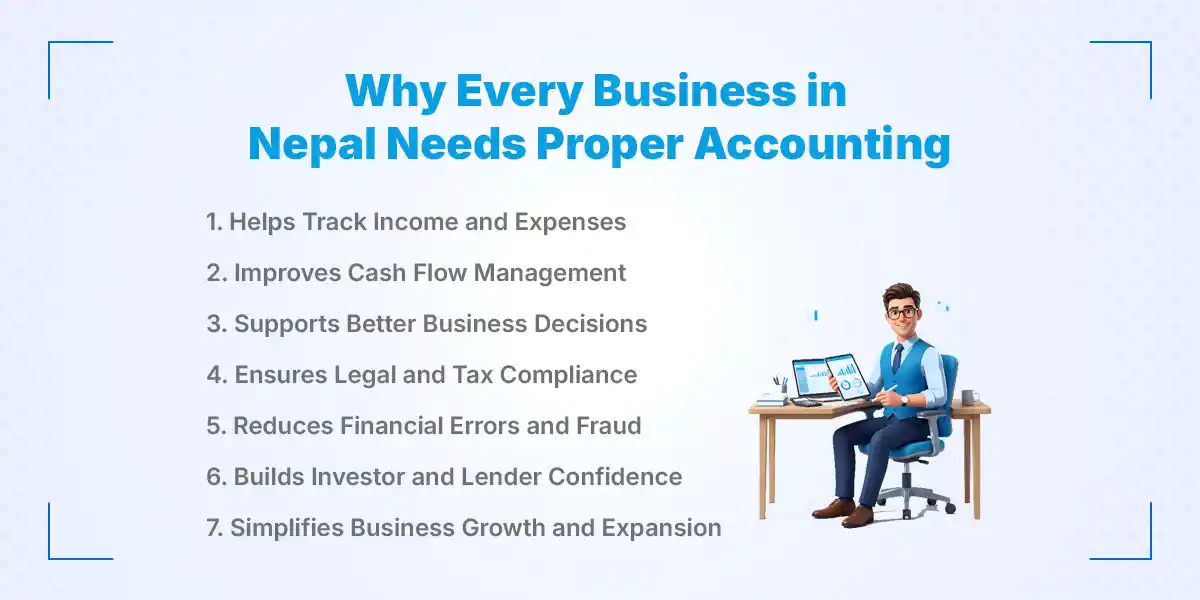
1. Helps Track Income and Expenses
Proper accounting records every business transaction accurately, making it easy to monitor income and expenses. This helps business owners control costs, prepare budgets, and understand their overall financial performance.
2. Improves Cash Flow Management
Accounting provides a clear view of the money coming into and going out of the business. Better cash flow management helps businesses pay suppliers, employees, and taxes on time while avoiding financial shortages.
3. Supports Better Business Decisions
Accurate financial records provide reliable information for making important business decisions. Business owners can use financial reports to plan investments, manage expenses, and identifygrowth opportunitiesh.
4. Ensures Legal and Tax Compliance
Proper accounting helps businesses maintain records required for income tax, VAT, and other regulatory obligations in Nepal. Keeping accurate records reduces errors and makes tax filing and financial reporting much easier.
5. Reduces Financial Errors and Fraud
A well-organized accounting system minimizes mistakes and makes it easier to detect unusual financial activities. Regular recordkeeping also strengthens internal controls and protects business assets.
6. Builds Investor and Lender Confidence
Investors and financial institutions prefer businesses with accurate and transparent financial records. Proper accounting demonstrates financial stability and increases the chances of securing loans or investments.
7. Simplifies Business Growth and Expansion
Accounting provides financial insights that help businesses plan expansion with confidence. Reliable financial data supports better budgeting, resource allocation, and long-term business growth.
Key Benefits of Accounting for Nepalese Businesses
Proper accounting helps Nepalese businesses improve financial management, make informed decisions, and maintain legal compliance. Some of the key benefits include:
- Better Budgeting and Financial Planning
- Accurate Profit and Loss Tracking
- Easier Audit Preparation
- Improved Operational Efficiency
- Better Business Valuation
- Stronger Financial Transparency
- Improved Cash Flow Management
- Simplified Tax Filing and Compliance
- Better Decision-Making
- Enhanced Investor and Lender Confidence
Where Can You Learn Practical Accounting Skills in Nepal?
You can learn practical accounting skills in Kumari Job Accounting Training is one of the best options in Nepal if you want to build a strong career in bookkeeping and accounting. Practical accounting skills can be learned through professional training institutes, colleges, universities, and industry-focused courses. Hands-on training helps learners understand real business accounting processes, accounting software, taxation, financial reporting, and bookkeeping practices.
When selecting an accounting course, consider the following factors:
- A curriculum that covers bookkeeping, accounting principles, taxation, VAT, payroll, and financial reporting.
- Practical training using popular accounting software.
- Experienced instructors with industry knowledge.
- Case studies and real-world accounting exercises.
- Internship or placement support where available.
- Certificates that strengthen your professional profile.
For students, job seekers, entrepreneurs, and finance professionals looking to build practical accounting skills, Kumari Job offers accounting training designed to bridge the gap between theoretical knowledge and workplace requirements. Learning from industry-oriented programs can improve employability and help professionals confidently manage business finances.
How Accounting Helps Businesses Stay Compliant in Nepal
Proper accounting helps businesses comply with Nepal's financial and tax regulations by maintaining complete and accurate financial records. It supports timely reporting, reduces compliance risks, and ensures businesses meet their legal obligations.
1. Income Tax Requirements
Businesses in Nepal are required to maintain financial records for accurate income tax calculation and filing. Proper accounting keeps track of taxable income, deductible expenses, and financial transactions throughout the year. Organized records make tax preparation faster and reduce the likelihood of reporting errors. Timely tax compliance helps businesses avoid penalties and maintain a good standing with tax authorities.
2. VAT Compliance
Businesses registered for Value Added Tax (VAT) must maintain detailed records of taxable sales and purchases. Proper accounting ensures VAT invoices, input tax credits, and output tax liabilities are accurately recorded. Consistent recordkeeping makes VAT return preparation much more efficient. Accurate VAT compliance reduces financial risks during government inspections or audits.
3. Financial Reporting Obligations
Businesses must prepare reliable financial statements to understand their financial performance and meet reporting requirements. Proper accounting ensures reports are accurate, consistent, and supported by complete financial records. Well-prepared financial statements improve transparency for owners, investors, and lenders. Reliable reporting also strengthens confidence in the overall financial management of the business.
4. Audit Requirements
Many businesses are required to undergo financial audits depending on their size and legal obligations. Proper accounting provides auditors with complete documentation, reducing delays during the audit process. Organized records help identify discrepancies before the audit begins and improve overall accuracy. Efficient audit preparation also minimizes business disruptions and strengthens financial credibility.
5. Government Regulations
Businesses must comply with various financial regulations established by government authorities in Nepal. Proper accounting helps maintain documentation that demonstrates compliance with applicable legal and regulatory requirements. Accurate financial records support transparency during inspections and official reviews. Following regulatory requirements protects businesses from unnecessary legal complications and financial penalties.
Essential Financial Reports Every Business Should Maintain
Every business should maintain accurate financial reports because they provide a complete picture of financial performance and support informed decision-making. These reports help business owners monitor profitability, manage cash flow, meet legal obligations, and plan for future growth.
- Income Statement (Profit & Loss): Summarizes revenue, expenses, and net profit over a specific period. It helps businesses evaluate operational performance and identify opportunities to improve profitability.
- Balance Sheet: Shows a company's assets, liabilities, and owner's equity at a specific point in time. It provides insight into the overall financial health and stability of the business.
- Cash Flow Statement: Tracks the movement of cash into and out of the business. It helps business owners ensure they have enough cash to meet daily operating expenses and future financial commitments.
- General Ledger: Acts as the central record of all financial transactions. It organizes accounting data and serves as the foundation for preparing financial statements.
- Trial Balance: Lists all account balances before preparing financial statements. It helps identify recording errors and ensures that total debits equal total credits.
- Accounts Receivable and Payable Reports: Monitor money owed by customers and payments due to suppliers. These reports help businesses maintain healthy cash flow and improve payment management.
How to Set Up an Effective Accounting System for Your Business
An effective accounting system creates a strong financial foundation by ensuring every transaction is recorded accurately and consistently. It improves financial control, simplifies reporting, and helps businesses make informed decisions as they grow.

1. Choose the Right Accounting Method
Selecting the appropriate accounting method is one of the first decisions every business should make. Small businesses often choose between cash accounting and accrual accounting based on their operational needs and legal requirements. The right method improves financial reporting accuracy and supports better business planning. Reviewing your accounting approach regularly ensures it continues to meet your business objectives.
2. Maintain Daily Financial Records
Recording financial transactions every day helps prevent missing or inaccurate information. Daily bookkeeping keeps income, expenses, receipts, and payments organized throughout the year. Consistent recordkeeping also makes month-end reporting and tax preparation much easier. Businesses that update their records regularly have greater confidence in their financial data.
3. Separate Business and Personal Finances
Keeping business and personal finances separate improves financial transparency and simplifies accounting. Separate bank accounts make it easier to track business income and operating expenses accurately. This practice also reduces confusion during audits and tax filing. Maintaining financial separation supports better budgeting and professional financial management.
4. Use Reliable Accounting Software
Modern accounting software automates many routine financial tasks and reduces manual errors. Features such as invoicing, expense tracking, payroll management, and financial reporting save valuable time for business owners. Cloud-based accounting solutions also improve data security and provide access from multiple locations. Choosing software that matches your business size and requirements increases long-term efficiency.
5. Review Financial Statements Regularly
Financial statements should be reviewed consistently to understand business performance and identify potential problems early. Monthly or quarterly reviews help business owners monitor profitability, cash flow, and overall financial health. Regular analysis also supports better budgeting and future business planning. Businesses that review financial reports frequently can make faster and more informed decisions.
Why Small Businesses and Startups in Nepal Should Prioritize Accounting
Small businesses and startups should prioritize accounting from the beginning because it builds financial discipline and supports sustainable growth. Establishing good accounting practices early reduces costly mistakes and prepares businesses for future expansion.
- Financial Discipline from the Beginning: Recording every transaction creates a habit of responsible financial management and improves business accountability.
- Easier Fundraising: Investors and banks are more likely to support businesses that maintain accurate financial statements and transparent accounting records.
- Better Business Planning: Reliable financial information helps entrepreneurs set realistic goals, forecast expenses, and allocate resources more effectively.
- Long-Term Profitability: Consistent accounting helps businesses monitor financial performance, identify opportunities for improvement, and make strategic decisions that support long-term success.
Conclusion
Proper accounting is not just a financial taskt is a critical business function that supports growth, compliance, profitability, and long-term stability. Businesses that maintain accurate financial records can make better decisions, manage risks more effectively, and build stronger relationships with investors, lenders, customers, and regulatory authorities.
The most successful businesses in Nepal treat accounting as a strategic asset rather than an administrative requirement. If you want to build practical accounting skills, improve your career opportunities, or strengthen your business finance knowledge, explore the accounting training programs offered by Kumari Job to gain industry-relevant expertise.
Frequently Asked Questions
Submit your comments

Get Our App On



What Does an Accounting Course Syllabus in Nepal Usually Cover?
VIEW DETAILS
Which Digital Marketing Classes Are Better in Kathmandu: Online or Offline?
VIEW DETAILS
How to Choose the Right Digital Marketing Course in Nepal?
VIEW DETAILS
What is the best digital marketing course with an internship in Nepal?
VIEW DETAILS


Loading Comments...