


Have you noticed how almost every business is hiring digital marketers today? The hunger of strong online presence for all business sizes has made digital marketing one of the most in-demand skills in Nepal. Naturally, training institutes are growing just as fast.
But with so many digital marketing courses, almost all claiming to be the best, how do you know which one is actually worth your time and money?
That's exactly what this guide will help you with.
We'll cover the key factors to compare, the red flags to avoid, and the questions you should ask before enrolling. By the end, you'll know how to choose a digital marketing course in Nepal that matches your goals and helps you build skills that employers truly value.
In this blog
Why Choosing the Right Digital Marketing Course Matters
Choosing the right course can shape your career. A good program helps you build practical skills, while the wrong one can waste both your time and money.
1. Learn Practical Skills, Not Just Theory
The best courses go beyond classroom lessons. They let you work on live projects, real campaigns, and practical assignments that prepare you for jobs, freelancing, or running your own business.
2. Save Time and Money
An outdated course often means learning the same skills again somewhere else. Choosing the right institute from the start helps you get better value for your investment.
3. Open More Career Opportunities
Quality training can lead to internships, better job opportunities, freelance work, or business growth. Many institutes also provide portfolio and placement support to help you get started.
What Should a Good Digital Marketing Course Include?
A good digital marketing course should cover skills like SEO, Google Ads, social media marketing, and content creation that employers and businesses actually need today. It should combine core marketing concepts with practical tools, real projects, and the latest AI-powered techniques. Here are the key topics every quality course should include.
| Topic | What You Should Learn |
|---|---|
| Search Engine Optimization (SEO) | Keyword research, on-page SEO, technical SEO, and ranking websites on Google. |
| Google Ads | Search campaigns, audience targeting, bidding, and conversion tracking. |
| Meta Ads (Facebook & Instagram) | Campaign setup, audience targeting, retargeting, and performance optimization. |
| Social Media Marketing | Content planning, audience engagement, and platform-specific strategies. |
| Content Marketing | Content planning, SEO writing, and creating content that drives results. |
| Email Marketing | Email campaigns, automation, audience segmentation, and lead nurturing. |
| Google Analytics | Website traffic, user behavior, and campaign performance using GA4. |
| AI Tools for Marketing | AI for content creation, research, productivity, and campaign planning. |
| Marketing Strategy | Customer journey, marketing funnels, budgeting, and ROI. |
| Live Projects & Case Studies | Real campaigns, practical assignments, and portfolio-building experience. |
10 Factors to Consider While Choosing a Digital Marketing Institute
Choosing the right digital marketing institute comes down to more than just fees or popularity. You should compare the curriculum, trainers, practical learning, career support, and the overall value you'll receive. The following factors will help you make a confident and informed decision:
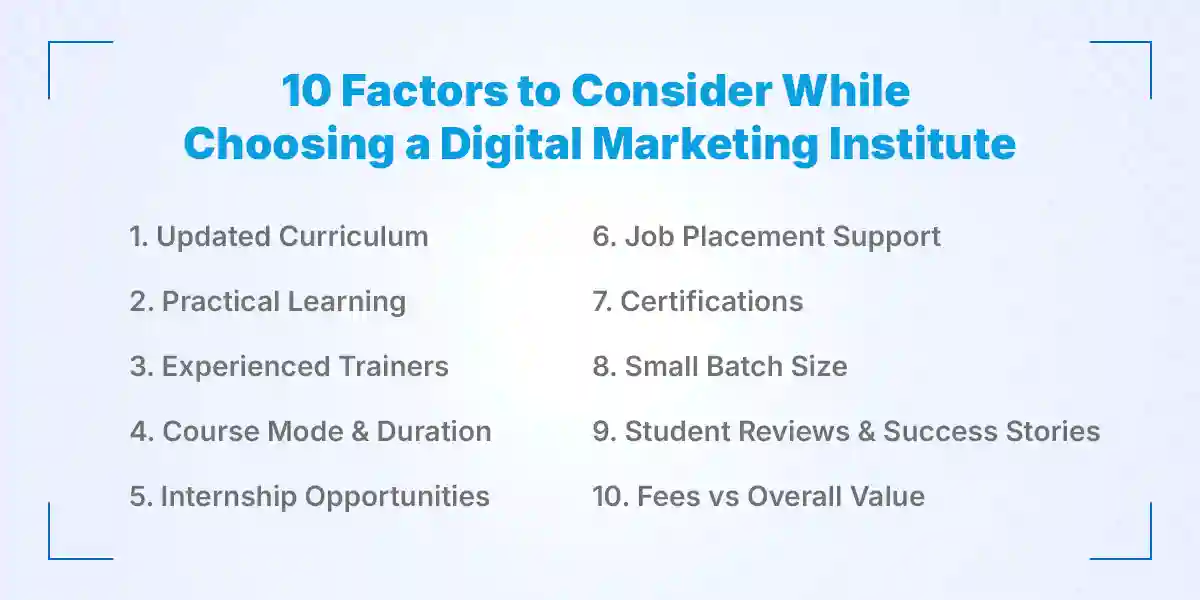
1. Updated Curriculum
Digital marketing changes quickly, so your course should keep up. Check whether it covers AI tools, GA4, SEO, Google Ads, Meta Ads, and current marketing trends. A good example is Kumari Job's updated curriculum, which combines core digital marketing with practical AI tools instead of treating them as separate topics.
Ask to see the latest syllabus before enrolling. If the curriculum hasn't been updated in years, it's best to look elsewhere.
2. Practical Learning
The best way to learn digital marketing is by doing it. Choose a course that includes live projects, campaign creation, website optimization, and practical assignments. At Kumari Job, students work on hands-on projects throughout the course. These activities help you apply what you learn. They also prepare you for real work after the course.
3. Experienced Trainers
A trainer should have real industry experience, not just teaching experience. They should be able to share practical examples, common mistakes, and proven strategies from actual campaigns. Don't hesitate to check their background. Learning from working professionals gives you better insights.
4. Course Mode & Duration
Pick a course that matches both your schedule and learning goals. Online classes offer flexibility, while physical classes provide more interaction. Also, look at the course duration carefully. A well-structured program should give enough time for both learning and practice.
5. Internship Opportunities
An internship helps you understand how digital marketing works in a real business. It also gives you valuable experience before applying for jobs. Ask whether the internship involves actual projects or only observation. Practical exposure makes a big difference.
With Kumari Job’s course, you get a benefit here. Their students find internship opportunities through its strong network of recruiters and top employers. Since Kumari Job connects a bridge between creating talents and connecting talents with employers, you reduce the job hunting friction with their system.
6. Job Placement Support
Some institutes continue supporting students even after training ends. They may help with CV writing, interview preparation, portfolio reviews, and job referrals. This support can make your job search much easier. Always ask what placement assistance is actually included. Kumari Job, for example, helps students prepare for jobs with CV support, interview guidance, and placement assistance as part of the course.
7. Certifications
A certificate adds value, but only when it's backed by real skills. The certificate you hold must be recognisable for your future employer, so it’s important to get one from a reputed training center. Look if they provide practical experience. If you're considering advanced digital marketing courses, look for training that covers AI, analytics, automation, and performance marketing to help you move beyond the basics.
8. Small Batch Size
Smaller classes usually mean better learning. Trainers can answer more questions, provide detailed feedback, and give personal attention during practical sessions. This creates a more interactive classroom. It also helps you learn with confidence.
9. Student Reviews and Success Stories
Reviews can tell you a lot about the quality of a course. Read detailed student feedback instead of looking only at ratings. Look for comments about practical learning, trainer support, and career outcomes. Genuine success stories are another positive sign.
10. Fees vs Overall Value
Don't choose a course just because it's the cheapest. Compare what you receive for the fee, including projects, tools, internship opportunities, mentorship, and placement support. A slightly higher fee may provide much greater value. Focus on your return on investment, not just the price.
Warning Signs of a Low-Quality Digital Marketing Institute
A good course tells you what you'll learn, while a poor one focuses only on making promises. Before you enroll, look beyond the advertisements and evaluate the quality of the training. These warning signs can help you avoid wasting your time and money.
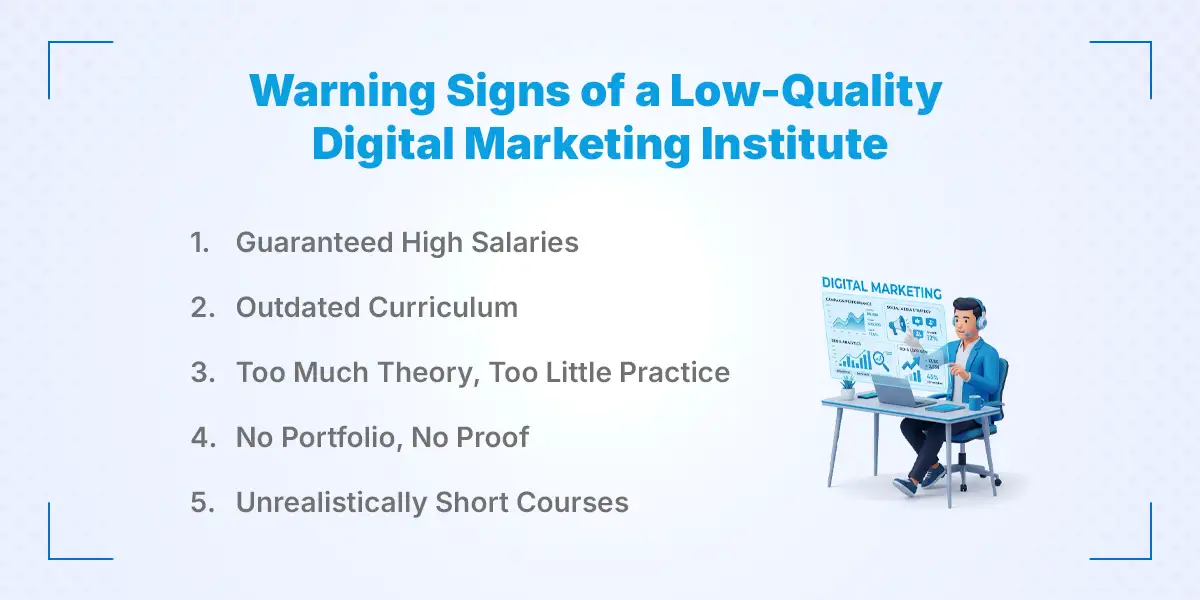
1. Guaranteed High Salaries
No institute can honestly promise a fixed salary after course completion. Your income depends on your skills, experience, portfolio, and the job market. Be cautious if marketing focuses more on salary claims than learning outcomes. A trustworthy institute sets realistic expectations.
2. Outdated Curriculum
Digital marketing changes every year, and your course should change with it. If the syllabus misses AI tools, GA4, or the latest Google and Meta Ads features, it's already behind. Always ask to see the current curriculum. Updated training keeps your skills relevant.
3. Too Much Theory, Too Little Practice
Watching slides and taking notes won't make you a digital marketer. A quality course should include live projects, campaign setup, practical assignments, and hands-on exercises. These experiences build real confidence. Practice is what prepares you for work.
4. No Portfolio, No Proof
By the end of the course, you should have work to showcase. This could include SEO audits, ad campaigns, content samples, or marketing strategies. A portfolio proves your skills to employers and clients. Without one, it becomes harder to stand out.
5. Unrealistically Short Courses
Digital marketing takes time to learn and practice. Be careful of courses that promise to teach everything in just a few days or a single weekend. Strong programs balance theory with hands-on learning. If it sounds too good to be true, it probably is.
Kumari Job vs Other Digital Marketing Courses in Nepal: A Quick Comparison
The biggest differences between Kumari Job and other digital marketing institutes in Nepal is that Kumari Job offers practical learning, updated course content, AI training, and career support. While many courses focus on completing the syllabus, Kumari Job focuses on helping students become job-ready through hands-on experience.
Here's a side-by-side comparison to help you choose the right course:
| Factor | Kumari Job Digital Marketing Course | Many Other Courses |
|---|---|---|
| Practical Projects | Live projects from day one | Limited practice |
| AI Training | Included throughout the course | Often not included |
| SEO | Practical, advanced training | Basic concepts only |
| Google Ads | Live campaign experience | Mostly theory |
| Meta Ads | Hands-on Facebook & Instagram Ads | Basic overview |
| Internship | Widely Available, given their recruitment network | Rarely available |
| Placement Support | Job and interview support | Limited support |
| Updated Curriculum | Regularly updated | May be outdated |
| Mentorship | Continues after the course | Usually ends with classes |
Conclusion
Choosing the best digital marketing course in Nepal comes down to one good thing: finding a course that helps you build real skills, not just earn a certificate. Focus on practical learning, an updated curriculum, experienced trainers, and career support before making your decision.
The right course can open the door to your first job, freelance projects, or business growth. If you're ready to learn through hands-on training, AI-powered tools, internship opportunities, and placement support. Explore Kumari Job's in-demand courses and take the first step toward your digital marketing career.
Frequently Asked Questions
Submit your comments

Get Our App On



What Does an Accounting Course Syllabus in Nepal Usually Cover?
VIEW DETAILS
Which Digital Marketing Classes Are Better in Kathmandu: Online or Offline?
VIEW DETAILS
Why Every Business in Nepal Needs Proper Accounting
VIEW DETAILS
What is the best digital marketing course with an internship in Nepal?
VIEW DETAILS


Loading Comments...