

Are you looking for a great accounting course in Nepal?
Many accounting courses in Nepal promise to teach everything you need for a successful career. But once you start comparing them, the differences quickly become clear. Some courses focus mostly on theory, while others actually include accounting software, VAT, payroll, and hands-on practice.
You see, choosing the right accounting training in Nepal isn't just about the institute or the course fee. It's about understanding what you'll actually learn and whether those skills match what employers expect.
A well-designed syllabus gives you a clear picture of the topics covered, the practical skills you'll develop, and the tools you'll learn to use. In this guide, we'll walk you through what an accounting course syllabus in Nepal usually covers and how to identify a program that supports your career goals.
In this blog
Why Does the Accounting Course Syllabus Matter?
An accounting course syllabus matters because it tells you exactly what skills you will learn, helps you compare schools, and saves you from wasting money. By checking this simple plan, you can avoid outdated classes that only teach old textbook theory. That is why we should look closely at how this document protects your time and money.
What Does Nepal’s Accounting Course Syllabus Usually Cover?
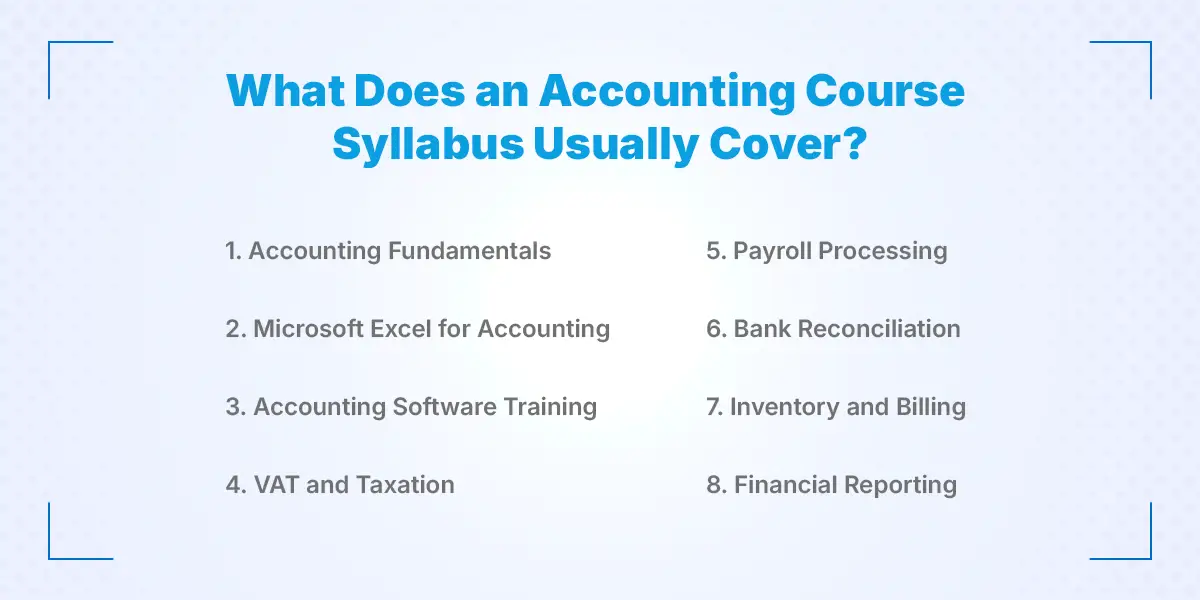
A good accounting syllabus in Nepal covers basic bookkeeping, Microsoft Excel, VAT taxes, monthly payroll, and software like Tally Prime. Learning these key topics helps you handle the daily work that local businesses do every day. Let us look at each of these important subjects in detail so you can see what you will learn.
1. Accounting Fundamentals
This section teaches you the basics of what is accounting to rules of double-entry bookkeeping. You will learn how to write journal entries, post to ledgers, and create a trial balance. It also covers preparing basic financial statements. These topics provide the foundation for everything students learn later.
2. Microsoft Excel for Accounting
Excel is a vital tool for every modern office. In this part of the course, you will practice data entry and use basic formulas. You will also learn to organize financial data and build simple reports. Excel remains one of the most commonly used tools in accounting offices.
3. Accounting Software Training
This topic teaches you how to use popular software like Tally Prime, Swastik, and Busy. You will practice recording daily transactions, managing customer records, and creating reports. Understanding these ERP basics prepares you for real daily accounting work in a local business.
4. VAT and Taxation
In Nepal, businesses must follow strict tax laws. This module covers basic tax rules and the VAT registration process. You will learn how to calculate VAT and file tax returns. It is all about keeping the business in compliance with government rules.
5. Payroll Processing
Every business needs to pay its staff accurately and on time. This section teaches you how to calculate salaries, overtime, leaves, and tax deductions. Learning payroll processing is useful because it is a task you will perform every single month.
6. Bank Reconciliation
This lesson teaches you how to compare the company books with bank statements. You will learn to match transaction records and find mistakes or missing payments. Doing this regularly is the only way to maintain accurate financial records for a business.
7. Inventory and Billing
Managing stock is crucial for businesses that sell physical goods. You will learn how to keep purchase and sales records. The course also shows you how to create professional invoices. This training helps you manage everyday business operations smoothly.
8. Financial Reporting
You will learn how to prepare final summaries like the Balance Sheet and Cash Flow statement. The syllabus also covers the Profit and Loss statement. These reports help businesses understand their financial performance and support better decision-making.
What Practical Skills Should an Accounting Course Include?
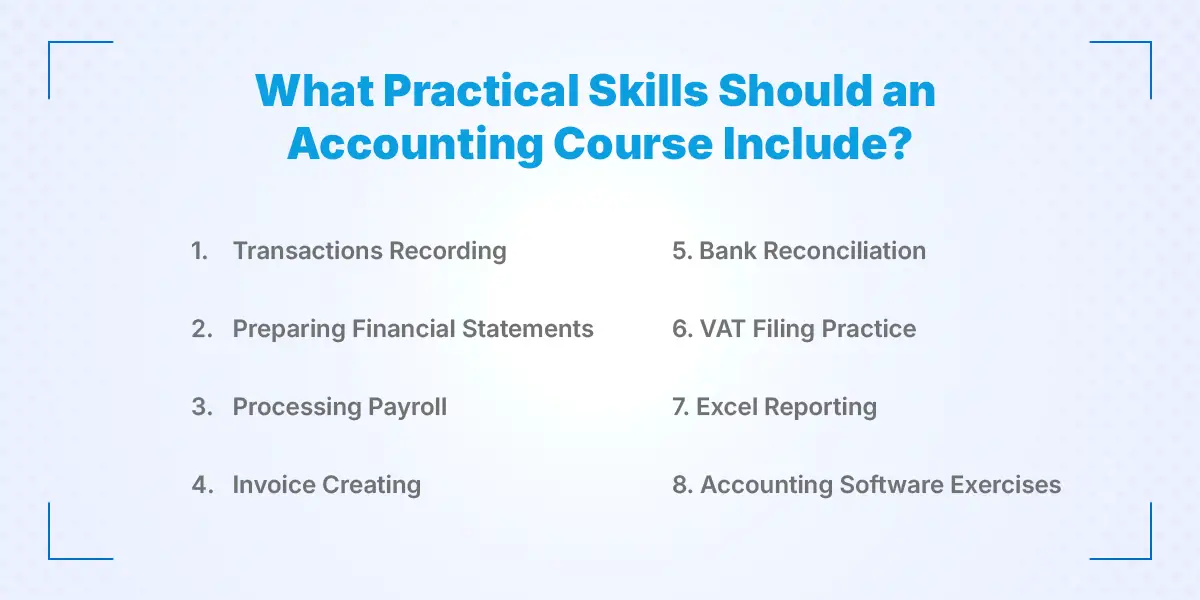
A quality course should give you hands-on practice for the real jobs you will do every day. Working on real tasks during your classes is the best way to build your skills before you start working. On that note, here is a list of the practical lessons and training you should receive from your school.
1. Recording Transactions
You should get physical ledger books to practice writing actual daily sales, purchases, and expenses. This hands-on work builds the real muscle memory you need for busy offices.
2. Preparing Vouchers
The program must teach you to create and organize physical debit, credit, and journal vouchers. This teaches you how actual businesses document every single transaction.
3. Bank Reconciliation
You should receive step-by-step practice matching real-world bank statements with company cash books. This helps you quickly spot math errors, missing deposits, and bank fees.
4. VAT Calculation
Your classes must include real-world exercises to calculate Nepalese VAT and fill out actual government tax folders. This is a highly demanded skill for local business jobs.
5. Payroll
The course should teach you how to build salary sheets, calculate overtime, and manage tax deductions. You should practice making these sheets both by hand and on computers.
6. Invoice Preparation
You should receive clear invoice templates to practice billing customers. Learning to create professional bills ensures you can handle daily sales operations without making costly mistakes.
7. Financial Reporting
The syllabus must show you how to read and explain key reports like Profit and Loss sheets. This skill helps you show managers how the business is doing.
8. Excel Practice
You should get lots of practical spreadsheet exercises to organize large amounts of corporate data. Mastering formulas and shortcuts will save you hours of work every week.
9. Accounting Software Practice
A training institute must provide plenty of lab hours to practice on tools like Tally Prime. Spending time on actual software makes you fast, accurate, and ready for work.
In conclusion, practicing these tasks prepares you for the actual work. This practical learning improves confidence and makes you ready to handle office duties without fear.
What Is the Difference Between a Job-Oriented and an Advanced Accounting Course?
A job-oriented accounting course helps beginners build the practical skills needed for entry-level accounting jobs, while an advanced accounting course is designed for learners who want to strengthen their existing knowledge and take on more complex accounting work. The right choice depends on your current skill level, experience, and career goals. At Kumari Job, both training programs are designed for different stages of an accountant's career journey.
| Job-Oriented Accounting Training | Advanced Accounting Training |
|---|---|
| Best for beginners and fresh graduates | Best for learners with accounting knowledge or experience |
| Focuses on practical accounting basics | Focuses on advanced accounting concepts and workflows |
| Covers everyday accounting tasks | Covers advanced reporting, taxation, and business accounting |
| Introduces accounting software and Excel | Builds advanced software and reporting skills |
| Prepares learners for entry-level accounting roles | Helps professionals upgrade their skills and grow their careers |
1. Job-Oriented Accounting Training
Kumari Job's Job-Oriented Accounting Training is designed for beginners, college students, and fresh graduates who want to build practical, workplace-ready skills. The course focuses on everyday accounting tasks, accounting software, Excel, VAT, payroll, and bookkeeping, helping learners prepare for entry-level accounting roles with confidence.
2. Advanced Accounting Training
Kumari Job's Advanced Accounting Training in Nepal is ideal for learners who already understand the fundamentals of accounting and want to take the next step in their careers. It covers advanced accounting software, financial reporting, taxation, and other practical skills that help professionals handle more complex responsibilities and advance in the workplace.
How Long Does an Accounting Course Usually Take?
A basic accounting course usually takes one to three months, while advanced training takes one to two months and degree programs last several years. The exact time you spend in class depends mostly on how many hours you practice on the computer. As a result, let us look at the typical schedules you can expect to find.
| Course Type | Typical Duration |
|---|---|
| Short workshops | Few days to 2 weeks |
| Job-oriented accounting training | 1 to 3 months |
| Advanced accounting training | 1 to 2 months |
| Degree programs | Several years |
As you can see, the overall duration depends heavily on the syllabus. For example, a course that only teaches theory might end quickly. On the other hand, courses with practical sessions often increase learning time. This is because you need extra hours to practice on computer software.
That is why shorter is not always better. A two-week course might sound fast and easy. However, it will not give you enough time to practice real-world tasks. It is always better to choose a program that gives you plenty of lab hours, even if it takes a bit longer.
How to Evaluate an Accounting Course Syllabus Before Enrolling?
You can check an accounting syllabus by looking for new tax rules, lots of computer practice hours, and real-world bookkeeping projects. Finding these key features before you pay ensures you get modern training that local businesses actually respect. Because of this, here is a simple checklist of the most important details to look for.
- Choose courses with real business tasks over textbooks.
- Ensure hands-on practice with Tally software and Excel.
- Confirm trainers are active, working accounting professionals.
- Ask about internship opportunities and job placement support.
Red Flags to Watch Out For
The worst warning signs in a course are too much textbook reading, no practice on Tally software, and outdated tax lessons. Signing up for an outdated class will leave you unprepared for the real work that modern offices expect. On that note, here are the major red flags you should watch out for.
- Avoid courses that only teach textbook theory without hands-on practice.
- Watch out for programs that completely skip Tally software training.
- Beware of classes that do not include Microsoft Excel lessons.
- Reject syllabuses that still teach outdated tax rules and laws.
- Skip institutes that do not provide real-world homework and assignments.
Which Accounting Course Should You Choose?
You should choose a job-oriented course if you are a beginner, or select an advanced course if you already have experience and want a promotion. Picking a program that matches your current skills helps you learn faster without feeling confused or bored. To help you decide, here is a simple guide to find the perfect fit for your goals.
| Your Current Situation | Your Career Goal | Best Course for You |
|---|---|---|
| I am a student or beginner with no accounting background. | I want to learn the basics and get my first job. | Job-Oriented Accounting Training |
| I understand basic accounting but need computer skills. | I want to work as a professional office clerk. | Job-Oriented Accounting Training |
| I already work as an accountant in a local company. | I want a promotion and a higher salary. | Advanced Accounting Training |
| I manage a business and want to understand deep tax laws. | I want to handle corporate audits and tax filings. | Advanced Accounting Training |
Beginners should build a strong practical foundation first. Learners who already understand accounting basics can focus on upgrading their technical and professional skills through advanced training.
Conclusion
Every accounting course is different, and you must not choose one blindly. A good syllabus balances classroom theory with real-world practice. This balance is the only way to ensure you can perform actual office tasks after graduation.
For example, your chosen course must cover accounting software, Excel, VAT, payroll, and financial reporting. It should also provide plenty of practical exercises. Working on these tasks helps you build confidence before you start your job search.
We encourage you to compare syllabuses from different institutes carefully. That is how you can find the right match. Always choose the training program that fits your current knowledge level and your long-term career goals.
Frequently Asked Questions
Submit your comments

Get Our App On



Which Digital Marketing Classes Are Better in Kathmandu: Online or Offline?
VIEW DETAILS
How to Choose the Right Digital Marketing Course in Nepal?
VIEW DETAILS
Why Every Business in Nepal Needs Proper Accounting
VIEW DETAILS
What is the best digital marketing course with an internship in Nepal?
VIEW DETAILS


Loading Comments...