




Most job seekers in Nepal accept the first salary offer they receive. Not because they are satisfied with it, but because they do not know how to negotiate, or they are afraid to try.
This is a costly mistake. A salary difference of even NPR 5,000 per month adds up to NPR 60,000 per year. Over five years, that gap becomes NPR 300,000 or more, without counting future increments calculated on a lower base.
Salary negotiation is not about being greedy or aggressive. It is a professional conversation backed by research, confidence, and preparation. Employers in Nepal, especially in the IT, NGO, and banking sectors, often set their initial offer below the actual budget specifically because they expect candidates to negotiate.
This guide explains exactly how to negotiate salary in Nepal, when to do it, what to say, common mistakes to avoid, and how to handle different workplace situations with confidence.
In this blog
What Is Salary Negotiation?
Salary negotiation is a professional discussion between a job candidate or employee and an employer to agree on fair compensation for work. It involves presenting your market value, skills, and experience to justify a higher pay than initially offered.
Negotiation can happen at three main stages. The first is the job offer stage, which takes place after receiving an offer letter but before signing. The second is the annual performance review, where employees request an increment based on their contributions over the year. The third is during a promotion or role change, when responsibilities increase and pay should reflect that growth. Many people confuse salary negotiation with demanding or complaining. It is neither. It is a structured, respectful conversation supported by facts and professional reasoning.
Why Salary Negotiation Matters in Nepal
Salary negotiation matters in Nepal because most employers set their initial offer below the actual budget; negotiating also signals confidence and professionalism; the gender pay gap remains a real issue in Nepalese workplaces; and your starting salary directly affects every future increment and opportunity throughout your career.
1. Initial Offers Are Rarely the Final Budget
Most HR managers in Nepal confirm that there is usually a salary range for each role. The first offer is typically at the lower end of that range. Negotiating allows you to move closer to what the company is actually willing to pay.
2. Long-Term Financial Impact Is Significant
A difference of NPR 8,000 per month in your starting salary affects every future increment, promotion, and job offer that references your current pay. Starting higher has a compounding effect on lifetime earnings.
3. Employers Respect Prepared Candidates
In both the private sector and NGO space in Nepal, candidates who negotiate professionally are often viewed as confident, self-aware, and serious about their career. It signals that you know your value.
4. The Gender Pay Gap Is Real
Research and field observations in Nepal's workplace consistently show that women are less likely to negotiate, which contributes to the gender pay gap. Negotiating is one practical step toward closing that gap at an individual level.
When Should You Negotiate Salary in Nepal?
You should negotiate salary when you receive a job offer before signing, during your annual performance review, after receiving a promotion, or when your responsibilities have grown significantly beyond your original role. These moments give you the most natural leverage because the employer is already evaluating your value and is more open to compensation discussions. Choosing the right moment makes your request easier to justify and significantly increases your chances of a positive outcome.

1. After Receiving a Job Offer
This is the most appropriate and effective time to negotiate. Once an employer has decided they want you, they have already invested time and effort in the hiring process. They are motivated to reach an agreement. Do not negotiate during the interview itself unless the employer asks for your salary expectations first.
2. During Annual Performance Reviews
If you have completed one year or more with a company and have measurable achievements, a performance review is a legitimate time to ask for an increment. Come prepared with specific examples of your contributions, not just a general request. This is your opportunity to show the direct value you have added to the organization over the past year.
3. After a Promotion
When your job title and responsibilities change, your salary should reflect that change. Many employees in Nepal accept promotions without salary discussions and regret it later. Always treat a promotion as a new negotiation opportunity because your role has fundamentally changed.
4. When Taking on Extra Responsibilities
If your role has expanded significantly without a formal promotion, that is also a valid reason to raise a salary conversation. Document the additional responsibilities clearly before the meeting. Having evidence of your expanded workload makes your request more credible and harder to dismiss.
How to Research Salary Before Negotiating
Research your salary before negotiating by checking job portals like Kumari Job for salary ranges listed in similar job postings, reviewing LinkedIn salary insights for your specific job title and industry, talking to peers and seniors in similar roles who can share realistic pay expectations, and studying industry-specific salary reports from sectors like IT, NGO, and banking. You should also factor in your years of experience, certifications, location, and the size of the company you are applying to, as these details directly influence where you fall within the market range.
1. Job Portals and Listings
Websites like Kumari Job regularly post job advertisements that include salary ranges. Reviewing these listings for similar roles in your industry gives you a realistic sense of what the market offers.
2. LinkedIn Salary Insights
LinkedIn provides salary data based on job titles, industries, and locations. While the data may not always be perfectly localized for Nepal, it gives useful benchmarks, especially for IT, marketing, and management roles.
3. Professional Communities and Peers
Talking to colleagues, seniors, or people in similar roles is one of the most accurate ways to understand salary norms. Many professionals in Nepal's IT and NGO sectors are open to sharing general pay ranges within trusted circles.
4. Industry-specific Reports
Some industries in Nepal publish salary surveys periodically. NGOs and INGOs often have more transparent pay scales. The IT Association of Nepal and banking sector reports occasionally contain compensation benchmarks.
5. How to Calculate Your Market Value
Once you have gathered salary data, calculate your personal market value by considering the following:
Your years of experience in the specific role
Certifications, specialized skills, or training
Your track record of measurable results
The size and type of the hiring company
Geographic location (Kathmandu roles typically pay more than outside the valley)
Use this research to establish a realistic average salary in Nepal for yourself, with a target number and a minimum acceptable figure.
How to Negotiate Salary in Nepal: Step by Step
Negotiate salary in Nepal by knowing your worth before the conversation, setting a target range instead of a fixed number, letting the employer give the first number, using confident and polite language, justifying your ask with data and achievements, negotiating the full package beyond just basic salary, and always getting the final offer in writing.
Step 1: Know Your Worth Before the Conversation
Before entering any negotiation, you must be clear on three numbers:
Your target salary, what you ideally want
Your acceptable salary, the minimum you would accept
Your walk-away point below which you would decline the offer
Without these three figures defined in advance, you will struggle to negotiate with confidence.
Step 2: Set a Target Range, Not a Fixed Number
Instead of saying "I want NPR 60,000," say "I am looking for something in the range of NPR 58,000 to NPR 65,000." A range gives you negotiating flexibility and signals that you are open to discussion. Set your target at the higher end of your range so there is room to move.
Step 3: Let the Employer Give the First Number
Whenever possible, avoid stating your salary expectations first. If the employer asks, you can respond with, "I would love to hear more about the full scope of the role first so I can give you a well-informed answer." This allows you to respond to their number rather than anchoring the conversation too low.
However, if pressed, state your researched range with confidence. Do not give a vague answer or say "whatever is standard."
Step 4: Use Confident and Polite Language
Nepal's workplace culture values respect and hierarchy. Your negotiation tone should be assertive but never aggressive or demanding. Phrases that work well include:
"Based on my research and experience, I was expecting something closer to..."
"I am very excited about this opportunity. Could we discuss the salary further?"
"I believe my background in [specific skill] adds strong value to this role. Would there be flexibility in the offer?"
Avoid ultimatums, emotional language, or comparisons to what colleagues earn.
Step 5: Justify With Data and Achievements
Generic requests rarely succeed. Specific justifications do. Support your ask with:
Market rate data from your research
Specific achievements from your previous role (percentage growth, projects delivered, teams managed)
Certifications or skills that directly apply to the role
Any specialized experience that makes you a stronger candidate than average
For example: "In my previous role, I led a team that increased client retention by 30 percent. Based on the responsibilities in this role and market benchmarks, I feel a salary of NPR 75,000 is appropriate."
Step 6: Negotiate the Full Package, Not Just Basic Salary
Salary is only one part of your total compensation. If the employer cannot move on basic pay, explore other elements:
Festival allowance and Dashain bonuses
Travel and fuel allowance
Health insurance coverage
Paid leave and flexible working hours
Remote work options
Training and professional development budget
Provident fund and gratuity terms
Sometimes a company cannot increase the base salary due to internal pay bands, but they can offer better allowances or benefits that increase your total package significantly.
Step 7: Get the Final Offer in Writing
Once you reach an agreement, always request a formal offer letter that includes the agreed salary, benefits, allowances, and starting date. Verbal agreements in Nepal's job market are not always honored. A written document protects both parties and avoids confusion later. This will help you get a good salary compared to other candidates starting in your career.
Salary Negotiation Scripts for Nepal
Having the right words ready before a salary negotiation can make the entire conversation feel less intimidating. The scripts below cover the most common negotiation situations you are likely to face in Nepal, from responding to a new job offer to requesting a raise from your current employer.
Script 1: Negotiating a New Job Offer
"Thank you so much for the offer. I am genuinely excited about joining the team. I was hoping we could discuss the compensation. Based on my experience and research into similar roles in the market, I was expecting something in the range of NPR [X] to NPR [Y]. Is there any flexibility there?"
Script 2: Asking for a Salary Raise
"I would like to discuss my compensation today. Over the past year, I have [specific achievement]. Based on my contributions and current market rates for this role, I would like to request a revision to NPR [target figure]. I believe this reflects the value I bring to the team."
Script 3: Counter-Offering After a Low Offer
"I really appreciate the offer, and I am very interested in this position. However, the offered salary is a bit lower than what I had anticipated based on my research. Would you be open to considering NPR [counter figure]? I am confident I will add strong value to the role from day one."
Salary Negotiation Tips for Freshers in Nepal
Fresh graduates in Nepal often underestimate their negotiating power simply because they are new to the workforce. While experience matters, it is not the only thing employers value. Skills, certifications, academic achievements, and internship results can all serve as legitimate leverage when entering your first salary negotiation.
What freshers can use as leverage:
Freshers can still negotiate effectively by using the following as leverage. Not having years of experience does not mean you have nothing to offer. The right combination of skills, achievements, and preparation can make your case just as strong as someone with more time in the field.
- Academic achievements or relevant coursework
- Internship experience and measurable results
- Certifications (Google, AWS, CFA, ACCA, etc.)
- Portfolio projects, freelance work, or volunteer contributions
- Language skills or technical skills relevant to the role
Freshers should negotiate politely but should still negotiate. Even a modest increase of NPR 3,000 to NPR 5,000 at the entry level sets a better base for future growth.
Common Salary Negotiation Mistakes to Avoid in Nepal
Common salary negotiation mistakes candidates make are accepting the first offer immediately, revealing their current salary too early, negotiating without proper market research, making the conversation personal instead of professional, giving up too quickly after the first refusal, and failing to get the final agreed offer in writing.
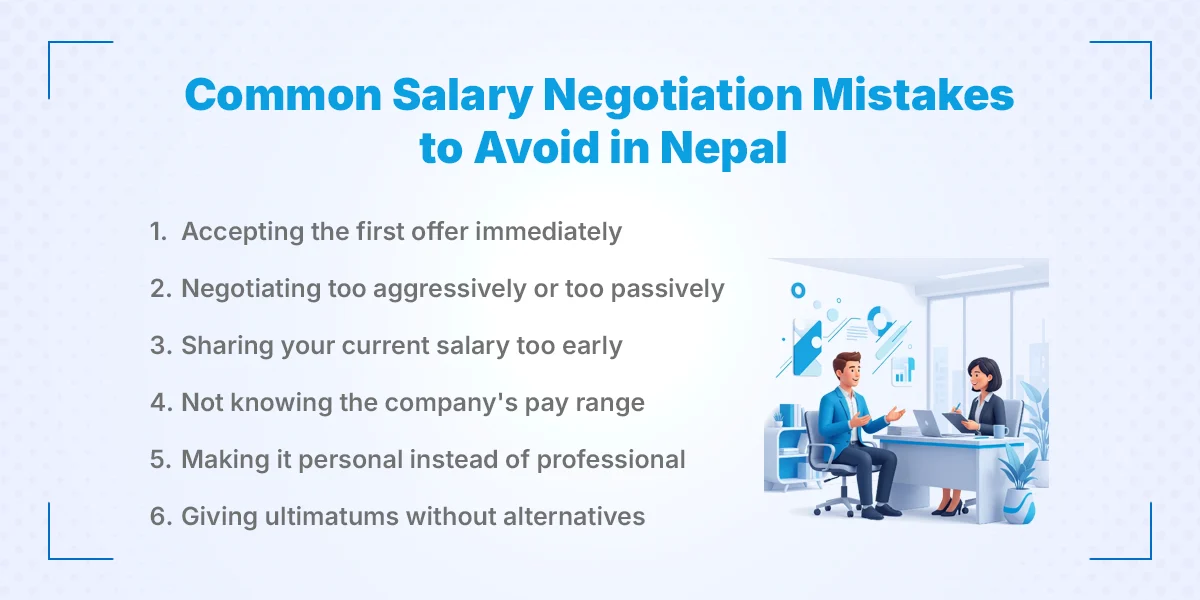
1. Accepting the First Offer Immediately
Many candidates in Nepal say yes before the HR manager finishes the sentence. Take time. It is professionally acceptable to say, "Thank you. Could I have a day to review the offer?" Rushing into an acceptance signals that you did not prepare and may cause you to regret the decision once you learn what others in similar roles are earning.
2. Revealing Your Current Salary Too Early
Your current salary should not define your market value. If asked, you can respond: "I would prefer to discuss what this role is worth rather than what I currently earn." Sharing your current salary too early gives the employer an anchor point that may limit how much they are willing to offer you.
3. Negotiating Without Research
Asking for a number you cannot justify weakens your position. Always back your request with market data and personal achievements. Walking in without research makes it easy for the employer to dismiss your request simply by saying the number does not align with industry standards.
4. Making It Personal
Avoid statements like "I need more money because of my rent" or "My friend earns more than this." Employers respond to professional value, not personal circumstances. Keeping the conversation focused on market data and your contributions keeps you in a stronger and more credible position.
5. Accepting "No" as a Final Answer Too Quickly
If the salary is firm, explore benefits, performance review timelines, or signing bonuses before fully accepting. A firm "no" on salary does not mean everything else is fixed. Many candidates in Nepal leave significant value on the table simply because they stop negotiating the moment basic pay is refused.
6. Not Following Up in Writing
After a verbal agreement, always send or request a written confirmation. Many candidates in Nepal have experienced changes between verbal offers and final letters. Having everything documented protects you and ensures both parties are aligned on what was agreed.
How to Negotiate Salary via Email in Nepal
Sometimes negotiations happen remotely, or a follow-up email is more appropriate than a phone call. Here is a professional sample for when you got the job but want to increase your salary from the initial offer.
[Date]
Subject: Regarding the Job Offer – [Your Name]
Dear [HR Manager's Name],
Thank you sincerely for extending the offer for the [Job Title] position at [Company Name]. I am very excited about the opportunity to contribute to your team.
After careful consideration, I would like to respectfully discuss the compensation. Based on my research into market rates for similar roles in Nepal and my [X years] of experience in [Relevant Field], I was expecting a salary closer to NPR [Target Figure].
I am confident that my background in [Specific Skill or Achievement] will bring strong value to the role. I hope we can find a mutually agreeable figure.
I remain very enthusiastic about joining [Company Name] and look forward to your response.
Warm regards,
[Your Full Name]
[Phone Number]
Keep the email brief, professional, and solution-focused. Avoid lengthy explanations or emotional justifications.
Salary Ranges by Industry in Nepal (2026)
Salary ranges in Nepal vary significantly depending on the industry, level of experience, and size of the company. The table below provides approximate monthly salary benchmarks across major sectors in Nepal for 2026, giving you a realistic starting point before entering any negotiation.
| Industry | Entry-Level (NPR) | Mid-Level (NPR) | Senior-Level (NPR) |
|---|---|---|---|
| IT / Software | 20,000 – 50,000 | 60,000 – 120,000 | 150,000+ |
| NGO / INGO | 25,000 – 45,000 | 55,000 – 100,000 | 120,000+ |
| Banking / Finance | 20,000 – 35,000 | 45,000 – 80,000 | 100,000+ |
| Marketing / Digital | 20,000 – 35,000 | 45,000 – 75,000 | 90,000+ |
| Hospitality | 18,000 – 30,000 | 35,000 – 60,000 | 70,000+ |
| Teaching / Education | 15,000 – 25,000 | 30,000 – 55,000 | 65,000+ |
Disclaimer: These figures are approximate industry estimates based on publicly available job listings and market observations. Actual salaries vary by company size, location, and individual qualifications.
Cultural Factors That Affect Salary Negotiation in Nepal
Nepal's workplace culture is shaped by hierarchy, respect for authority, and community values. These factors directly influence how salary negotiations are approached and received.
1. Hierarchy and Seniority
Many employees hesitate to negotiate because they feel it shows disrespect toward seniors or management. In reality, professional negotiation is not disrespectful. Framing it as a collaborative conversation rather than a demand helps maintain workplace harmony.
2. Fear of Losing the Offer
A common concern in Nepal's competitive job market is that negotiating will cause the employer to withdraw the offer. This rarely happens. Employers do not rescind offers because a candidate negotiated respectfully. If they do, that itself is a red flag about the company culture.
3. Government vs. Private Sector vs. NGO
Government jobs in Nepal have fixed pay scales and leave little room for negotiation. Private sector companies, especially in IT and retail, often have more flexibility. NGOs and INGOs generally follow published pay scales but may negotiate allowances and benefits.
4. Negotiation Comfort by Gender
Women in Nepal's workforce are statistically less likely to initiate salary negotiations. Building awareness around this issue and normalizing negotiation as a professional skill is important for workplace equity.
What to Do If Your Negotiation Fails
Not every salary negotiation will go the way you planned, and that is completely normal. What matters most is how you respond when the answer is not what you hoped for. Handling a failed negotiation professionally keeps the door open for future opportunities and ensures you leave the conversation with your reputation and relationship with the employer fully intact.
1. Ask for a Review Timeline
If the salary cannot be increased now, ask when the next performance review will happen and what it would take to earn an increment. Get this in writing if possible.
2. Negotiate Non-Monetary Benefits
If the base salary is fixed, explore extra leave days, flexible working hours, remote work options, training budgets, or transport allowances that add real value to your package.
3. Evaluate the Full Picture
Sometimes a lower salary at a company with strong growth potential, good culture, and skill development opportunities is worth accepting. Make the decision based on long-term career value, not just immediate pay.
4. Decline Professionally if Necessary
If the offer genuinely does not meet your minimum requirement and the company has no flexibility, it is acceptable to decline. Do so respectfully: "I truly appreciate the offer and the time you invested. After careful consideration, I am unable to accept at this stage, but I hope we can connect again in the future."
Conclusion
Salary negotiation in Nepal is not confrontation. It is a professional skill that every job seeker and working professional should develop. Whether you are a fresh graduate stepping into your first role or an experienced professional seeking a fair increment, the principles remain the same: research your market value, prepare your justification, choose the right moment, and communicate with confidence and respect.
Most employers in Nepal expect negotiation. The ones who do not are often the ones worth questioning. You have nothing to lose by asking professionally and everything to gain by starting your career or your next chapter on the right financial footing.
Start your research today. Know your worth. And negotiate for it. You can contact Kumari Job if you want to switch your career or get a new job.
Frequently Asked Questions
Submit your comments

Get Our App On



How to Become an Auditor in Nepal
VIEW DETAILS
What Is the Salary of a Spa Therapist in Nepal?
VIEW DETAILS
How to Start a Career as a Game Developer in Nepal
VIEW DETAILS
What Is the Salary of a Brand Manager in Nepal?
VIEW DETAILS


Loading Comments...