



Trying to find an AI job in Kathmandu or remotely is tough without knowing exactly what skills (like specific machine learning frameworks) companies want right now.
This guide breaks down the exact technical requirements and hiring platforms you need to secure a high-paying role. You will learn how to build a portfolio that stands out, where to find hidden opportunities, and what salary ranges to expect across different experience levels.
In this blog
What Are AI Jobs?
Artificial intelligence jobs are specialized technology careers focused on designing, training, and deploying algorithms that enable machines to process large datasets, automate complex tasks, and make independent decisions. These roles transition businesses from manual operations to predictive, data-driven ecosystems. Both local startups and global enterprises actively recruit professionals to build these technical pipelines.
The global shift toward automation directly fuels hiring growth within Nepal's tech hubs. Nepalese IT outsourcing agencies require machine learning talent to service international clients, creating a sustainable local job market. Demand spans across all experience levels, providing clear entry points for fresh graduates alongside lucrative leadership positions for senior developers.
For example, a Kathmandu-based fintech company hires data scientists to create fraud-detection algorithms that analyze daily mobile banking transactions. Fresh analysts enter the team to structure the raw financial datasets, while senior machine learning engineers architect and deploy the final predictive models.
Types of AI Jobs in Nepal
The tech ecosystem in Nepal offers diverse artificial intelligence career paths ranging from raw data processing to complex neural network architecture. For example, Kathmandu-based IT outsourcing agencies frequently hire these exact specialists to build end-to-end medical software for international healthcare providers.
1. AI Engineer
An AI Engineer builds, tests, and deploys comprehensive artificial intelligence algorithms that integrate directly into enterprise software systems to execute specific automated tasks without continuous human oversight. These professionals bridge the critical gap between initial software development and intelligent system architecture. You must learn API integration and containerization tools like Docker to package these models effectively for production environments. Companies rely on this role to maintain the daily infrastructure that keeps automated systems running smoothly.
2. Machine Learning Engineer
A Machine Learning Engineer programs computer algorithms that allow software systems to learn from historical data and improve their predictive accuracy over time without manual human intervention. This position focuses heavily on the mathematics and logic behind predictive modeling rather than general software development. You need to master cloud platforms like AWS or Google Cloud to scale the processing power required for extensive model training. Nepalese outsourcing companies actively hire these engineers to build and refine recommendation engines for international e-commerce clients.
3. Data Scientist
A Data Scientist analyzes complex, unstructured datasets using advanced statistical techniques to extract actionable business insights that guide high-level corporate strategy and product development decisions. They act as the primary interpreters translating raw numerical data into clear objectives for non-technical business stakeholders. You should build expertise in visualization tools like Tableau or PowerBI to present your findings clearly to management teams. Telecommunication companies in Kathmandu employ data scientists to predict customer churn rates using historical mobile billing information.
4. Data Analyst
A Data Analyst collects, cleans, and organizes numerical information into structured databases to help operational managers understand current market trends and evaluate past company performance. This role acts as the fundamental entry point into the broader artificial intelligence sector for many recent tech graduates. You must master SQL query writing and Excel spreadsheet manipulation to handle daily corporate reporting tasks. Local digital marketing agencies utilize data analysts to track ad campaign metrics across various social media platforms.
5. NLP Engineer
A Natural Language Processing Engineer develops specialized algorithms that enable computers to understand, interpret, and generate human language in both written text and spoken audio formats. These specialists focus on teaching machines the structural nuances of grammar, regional slang, and contextual meaning. You need to study linguistics alongside frameworks like Hugging Face and PyTorch to build functional conversational agents. Tech firms currently hire NLP talent to build customer service chatbots capable of understanding Romanized Nepali text inputs.
6. Computer Vision Engineer
A Computer Vision Engineer designs software systems that process digital images and videos to identify specific objects, track motion patterns, and automate visual inspection tasks. This career path translates raw pixel data into mathematical arrays that a machine can physically process and categorize. You must practice using OpenCV libraries and convolutional neural networks to build effective image recognition software. Drone companies in Nepal recruit these engineers to analyze crop health and land topography through aerial satellite imagery.
Skills Required for AI Jobs in Nepal
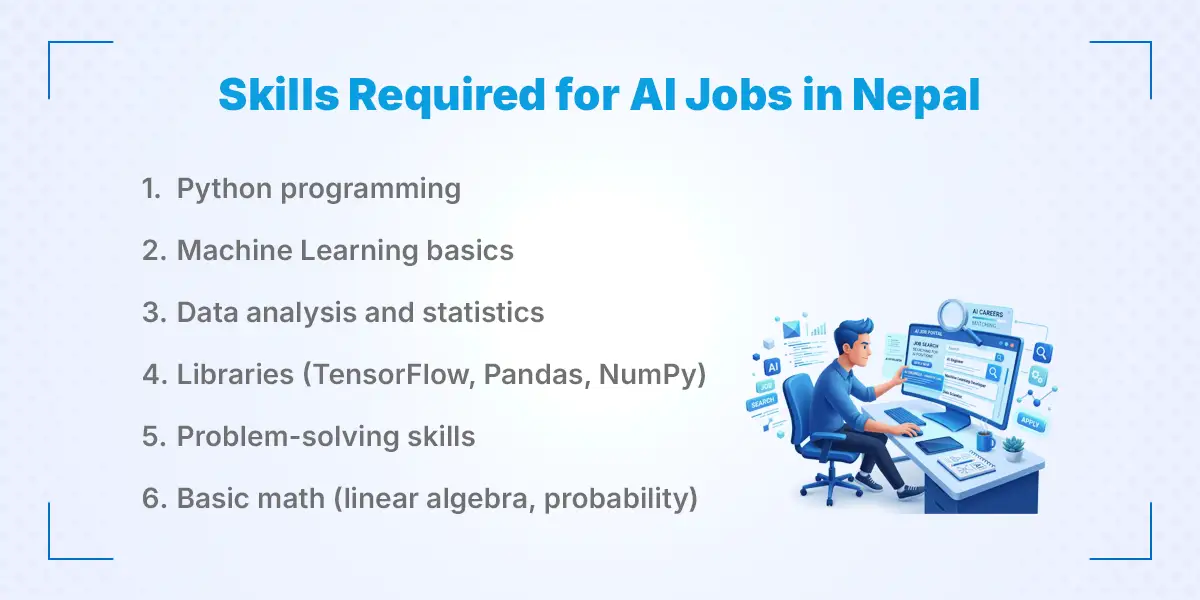
Securing an artificial intelligence role requires a specific blend of programming proficiency and mathematical logic to construct functional automation pipelines. For example, Kathmandu-based fintech startups expect junior developers to quickly write Python scripts that format raw daily transactions before building predictive models.
1. Python Programming
Python programming acts as the primary language for building AI pipelines due to its highly readable syntax and extensive data-focused libraries. Nepali tech agencies use Python to script automated web scrapers that gather local market pricing data. You must master writing clean, efficient code to handle these daily automation tasks.
2. Machine Learning Basics
Machine learning basics encompass core algorithms like linear regression and decision trees that enable software to identify patterns from historical data. Understanding these fundamentals allows you to select the correct mathematical approach for specific business problems. E-commerce platforms in Nepal rely on these foundational algorithms to match user browsing habits with targeted product recommendations.
3. Data Analysis and Statistics
Data analysis provides the necessary methods to clean messy datasets, identify trends, and validate the accuracy of your predictive models. You cannot train an effective algorithm if the underlying data contains formatting errors or unchecked biases. Local analysts apply statistical testing daily to ensure the raw information collected from mobile app users remains structurally sound for modeling.
4. Libraries (TensorFlow, Pandas, NumPy)
Specialized libraries like TensorFlow, Pandas, and NumPy are pre-written code packages that drastically accelerate complex mathematical computations. Mastering these tools enables you to manipulate massive datasets without writing basic algorithms from scratch. A local computer vision engineer utilizes TensorFlow to quickly assemble neural layers for analyzing agricultural drone footage.
5. Problem-Solving Skills
Problem-solving in this field means breaking down abstract business challenges into structured technical steps that an algorithm can successfully execute. Employers highly value engineers who can independently debug failing models and optimize code for limited hardware resources. When a language model misinterprets Romanized Nepali text, you must creatively adjust the tokenization logic to correct the error.
6. Basic Math (Linear Algebra, Probability)
Linear algebra and probability represent the mathematical logic determining how neural networks process information and make predictions under uncertainty. Understanding these concepts helps you manually adjust algorithm parameters when a model outputs inaccurate results. You apply probability theories daily to set the correct confidence threshold for automated fraud detection systems.
Top Platforms to Find AI Jobs in Nepal
The best platforms to find artificial intelligence jobs in Nepal combine global professional networks with localized job boards tailored to the Kathmandu tech scene. For example, a junior data analyst might secure their first role through a local portal like Kumari Job, while a senior machine learning engineer lands a remote international contract via LinkedIn.
1. LinkedIn Jobs
LinkedIn Jobs functions as the primary recruitment tool for top-tier tech companies and international outsourcing firms operating in Nepal. You need to optimize your profile with specific keywords like "TensorFlow" or "Data Scientist" to appear in direct recruiter searches. Hiring managers frequently reach out to candidates who regularly post updates about their personal coding projects or Kaggle competition results.
2. Job Portal (Kumari Job)
Local job portals like Kumari Job specifically aggregate open positions from domestic startups, established banks, and Kathmandu-based tech agencies. These platforms remain the most effective route for securing entry-level and mid-level roles that do not require international remote experience. You should set up daily email alerts on these sites to apply the moment a new data analyst position goes live.
3. Company Career Pages
Company career pages represent the direct hiring channels for major Nepalese IT firms, banks, and telecommunication providers. Many of these organizations avoid third-party job boards to reduce recruitment costs, meaning their best roles stay hidden from general searches. Bookmark the career pages of your target companies and check them weekly to bypass the massive applicant pools found on public portals.
4. Freelancing Platforms (Upwork, Fiverr)
Freelancing platforms like Upwork and Fiverr allow Nepali developers to bypass the local job market entirely and work directly with global clients. You start by bidding on specific, short-term contracts such as building a custom web scraper or deploying a basic customer service chatbot. Earning strong reviews on these initial small gigs quickly leads to long-term, high-paying retainers that often exceed local salary standards.
How to Apply for AI Jobs in Nepal in 2026 (Step-by-Step)
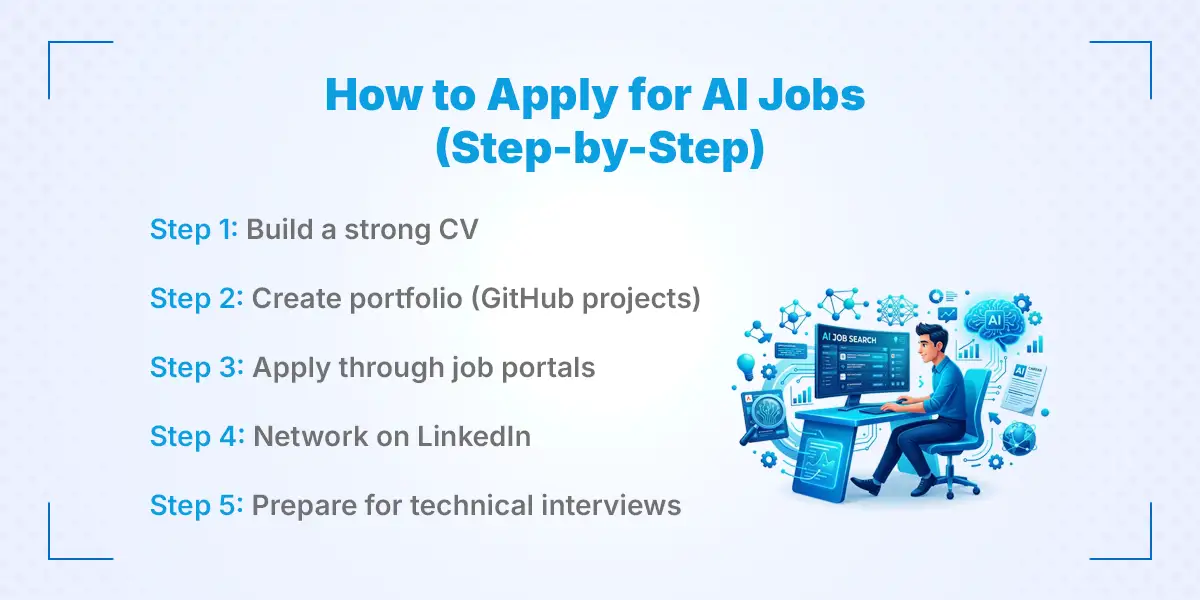
Applying for artificial intelligence jobs in Nepal requires a structured approach that moves beyond generic resumes by actively showcasing verifiable code and targeting local hiring managers. For example, a recent graduate successfully landed a data role at a Kathmandu fintech company by messaging the lead developer directly with a link to their relevant GitHub project rather than submitting a standard application.
1. Build a Strong CV
Building a strong CV means creating a one-page document that highlights your specific technical skills, programming languages, and measurable project outcomes rather than vague career objectives. Hiring managers at Nepali IT firms scan resumes in seconds, looking for exact keyword matches like "Python" or "SQL." You must quantify your achievements to prove real-world impact. For example, write "reduced data processing time by 20% using Pandas" instead of simply stating you understand data analysis.
2. Create a Portfolio (GitHub Projects)
Creating a portfolio involves hosting your original code on platforms like GitHub to provide employers with undeniable proof that you can actually build functioning artificial intelligence models. Tech recruiters in Kathmandu prioritize candidates who show their work over those who simply list course certificates. You should upload clean, well-documented projects that solve local problems, such as a predictive model for regional weather patterns or a Nepali text classifier. Ensure your code repositories include clear 'ReadMe' files explaining your logic and methodology.
3. Apply Through Job Portals
Applying through job portals requires setting up targeted alerts on sites like Kumari Job to submit your tailored application within the first 24 hours of a posting. Early applicants consistently secure more interview requests because local HR teams often close listings once they receive a sufficient number of qualified candidates. You should customize your cover letter for each specific role to highlight how your skills solve the exact problems mentioned in the job description. Track your submitted applications in a simple spreadsheet to manage your follow-up timeline.
4. Network on LinkedIn
Networking on LinkedIn means actively connecting with tech leads, data scientists, and technical recruiters working at your target companies in Nepal to uncover hidden job opportunities. Many lucrative machine learning roles are filled through internal referrals long before they ever reach public job boards. You must send personalized connection requests explaining your specific interest in their company's recent projects rather than asking for a job immediately. Engaging thoughtfully with their posts builds familiarity and trust before you submit a formal application.
5. Prepare for Technical Interviews
Preparing for technical interviews involves practicing live coding exercises, explaining your mathematical logic clearly, and defending the structural choices you made in your portfolio projects. Nepali tech agencies typically conduct multi-stage interviews that test your ability to write clean code under pressure and communicate complex ideas to non-technical stakeholders. You should practice verbalizing your thought process while solving algorithmic problems on a whiteboard or shared screen. Review core statistical concepts and prepare to discuss how you would handle messy, incomplete datasets in a production environment.
Salary of AI Jobs in Nepal
Artificial intelligence roles offer some of the highest compensation packages within the Nepalese tech industry due to a massive local shortage of specialized machine learning talent. Salaries scale rapidly based on your practical experience, mastery of specific coding frameworks, and your ability to independently handle complex data architectures.
1. Entry-Level
An entry-level artificial intelligence salary in Nepal typically ranges from NPR 30,000 to NPR 70,000 per month for recent graduates or junior analysts. During this initial phase, you focus heavily on data cleaning, basic algorithm testing, and shadowing senior developers rather than architecting full systems from scratch. Tech companies prioritize your willingness to learn the practical business applications of Python and SQL over immediate project leadership.
2. Mid-Level
Mid-level AI engineers in Nepal earn between NPR 60,000 and NPR 150,000 per month, directly reflecting their ability to manage complete project pipelines with minimal supervision. At this career stage, you take full ownership of deploying machine learning models into live production environments and optimizing existing company algorithms. Employers expect you to consistently translate vague business requirements into functioning code without relying on constant managerial direction.
3. Senior-Level
Senior-level AI developers and data architects command monthly salaries ranging from NPR 150,000 to over NPR 300,000, depending heavily on the employing company's size and international reach. These seasoned professionals lead entire engineering departments, design enterprise-wide automation strategies, and actively mentor junior staff members. Your compensation at this tier reflects your ability to drive significant financial value for the business through advanced predictive analytics and flawless system architecture.
4. Remote Jobs Can Pay Higher
Remote artificial intelligence jobs allow Nepalese developers to bypass the local economy and earn international salaries in US dollars, often ranging from $1,000 to $5,000+ (NPR 135,000 to NPR 675,000+) per month. Foreign tech startups hire local talent via platforms like LinkedIn or Upwork to access high-quality engineering at competitive global rates. Securing these highly lucrative contracts requires flawless English communication skills and a highly visible GitHub portfolio showcasing complex, production-ready machine learning models.
Challenges in AI Job Search in Nepal
Navigating the artificial intelligence job market in Nepal presents unique hurdles, primarily due to the early-stage nature of the local tech ecosystem. For instance, a recent graduate might struggle to find specialized machine learning roles in Kathmandu because most local agencies still prioritize general full-stack web development over advanced data architecture.
1. Limited Local Opportunities
Limited local opportunities refer to the restricted number of specialized artificial intelligence roles available within Nepal's domestic tech industry compared to broader software engineering positions. Many Kathmandu-based startups still lack the financial resources to fund dedicated data science teams, forcing candidates to look toward a few select enterprise companies. You must target international outsourcing firms operating locally or seek remote global contracts to bypass this domestic hiring bottleneck.
2. High Competition
High competition describes the intense rivalry among Nepali tech graduates fighting for a very small pool of entry-level data analyst and machine learning positions. Since local university IT programs produce thousands of graduates annually, hiring managers easily receive hundreds of applications for a single open AI engineering role. You have to build a highly specialized GitHub portfolio that proves you can write production-ready code to stand out from the generic applicant crowd.
3. Skill Gap
The skill gap is the severe disconnect between the theoretical knowledge taught in Nepali universities and the practical coding frameworks demanded by modern tech companies. While fresh graduates often understand basic mathematical concepts, they frequently lack hands-on experience deploying actual models using industry-standard tools like Docker or AWS. Bridging this gap requires you to independently study cloud computing and advanced Python libraries completely outside of your standard academic curriculum.
4. Need for Practical Experience
The need for practical experience highlights employers' strict requirement that candidates must demonstrate proven, real-world execution of machine learning projects before securing a full-time contract. Local tech companies cannot afford to spend months training junior developers on how to clean messy data or debug failing algorithms in a live business environment. You should actively participate in Kaggle competitions and take on small freelance projects to build undeniable proof of your technical execution capabilities.
Conclusion
Securing a lucrative artificial intelligence role in Nepal depends entirely on your ability to prove your technical execution rather than just listing academic credentials. Focus your immediate energy on deploying one functional machine learning model to a public GitHub repository to instantly separate yourself from generic applicants.
If you are ready to apply these skills and find your next role, start browsing the latest AI and tech openings on Kumari Job today.
Frequently Asked Questions
Submit your comments

Get Our App On



SEO Training for Freshers in Nepal: Skills, Career & Job Opportunities
VIEW DETAILS
SEO Training vs. Self-Learning: Which Is Right for You?
VIEW DETAILS
How to Choose Between Two Job Offers
VIEW DETAILS
Digital Marketing Training Interview Questions and Answers for Freshers
VIEW DETAILS


Loading Comments...