



Low productivity, missed deadlines, repeated mistakes, and poor communication can slow down a company's growth, even when it has talented employees. Without the right skills, guidance, and learning opportunities, employees may struggle to complete tasks efficiently and meet workplace expectations.
Corporate training helps businesses address these challenges by improving employee skills, confidence, teamwork, and efficiency. Understanding how corporate training improves employee productivity can help organizations in Nepal build stronger teams, improve workplace performance, and achieve business goals.
In this blog
What Is the Role of Corporate Training in Employee Productivity?
Corporate training improves employee productivity by equipping employees with the skills, knowledge, and practical abilities they need to perform their responsibilities efficiently. It helps employees understand workplace expectations, reduce mistakes, manage tasks effectively, and contribute more confidently to organizational goals. Training also supports continuous learning and professional development.
Employee productivity refers to how effectively employees use their time, skills, and resources to complete work and achieve expected results. Corporate training connects employee learning with workplace performance by helping employees develop the competencies required for their roles.
When organizations provide relevant training, employees can:
- Understand their responsibilities more clearly.
- Perform tasks with greater accuracy.
- Improve their professional skills.
- Communicate more effectively with colleagues.
- Adapt to new technologies and workplace processes.
- Handle challenges with greater confidence.
For employers, training is an investment in workforce development that can improve operational efficiency, employee satisfaction, and organizational performance over time.
How Does Corporate Training Improve Employee Productivity?
Corporate training improves employee productivity by developing practical skills, reducing workplace errors, strengthening communication, and helping employees manage their responsibilities more effectively. It also builds confidence, encourages teamwork, improves problem-solving, and supports employee engagement, helping organizations create a more capable and efficient workforce.
1. Improves Job-Specific Skills
Job-specific training helps employees develop the technical and professional abilities required to perform their daily responsibilities. Employees who understand the tools, processes, and standards related to their roles can complete tasks more accurately and efficiently. For example, HR employees can improve recruitment skills, while accounting professionals can develop their knowledge of financial systems. Relevant training helps employees perform their jobs with fewer skill-related difficulties.
2. Reduces Workplace Errors
Corporate training helps employees understand workplace procedures, responsibilities, and quality standards. Employees who receive proper instruction are less likely to make mistakes caused by confusion, incomplete knowledge, or incorrect processes. Training can also help employees identify problems before they affect business operations. Fewer errors can reduce rework, wasted resources, and unnecessary delays.
3. Enhances Time Management
Time management training helps employees prioritize tasks, organize schedules, and meet deadlines more consistently. Employees can learn practical methods for managing workloads, avoiding unnecessary distractions, and handling multiple responsibilities. These skills help individuals complete important tasks without spending excessive time on less urgent activities. Better time management can improve daily workflow and overall productivity.
4. Strengthens Workplace Communication
Communication training helps employees share information clearly, listen actively, and understand instructions more effectively. It can improve communication between employees, managers, departments, and clients. Employees who communicate well can reduce misunderstandings, resolve issues faster, and coordinate their work more efficiently. Strong workplace communication supports better collaboration and smoother business operations.
5. Builds Employee Confidence
Corporate training gives employees opportunities to develop their abilities and understand how to handle workplace responsibilities. When employees gain relevant knowledge and practical experience, they may feel more confident making decisions and completing tasks. Confidence can encourage employees to take responsibility, participate in discussions, and approach challenges more positively. This can improve individual performance and workplace engagement.
6. Encourages Problem-Solving
Problem solving training helps employees identify workplace challenges, evaluate possible solutions, and make informed decisions. It encourages critical thinking instead of relying entirely on supervisors for every issue. Employees can learn to assess situations, recognize causes, and respond to problems more effectively. This ability helps teams maintain productivity when unexpected challenges arise.
7. Improves Teamwork
Teamwork training helps employees understand shared responsibilities, collaboration, communication, and conflict management. Employees learn how their individual contributions support team objectives and organizational success. Training activities can also help build trust and improve cooperation between colleagues. Better teamwork reduces unnecessary coordination problems and supports more efficient project completion.
8. Supports Employee Engagement
Learning opportunities can make employees feel that organizations value their professional development. Training encourages employees to improve their skills, explore new responsibilities, and participate more actively in workplace activities. Employees who receive development opportunities may feel more motivated and connected to their work. Greater engagement can support productivity, retention, and a healthier workplace environment.
What Types of Corporate Training Help Improve Employee Productivity?
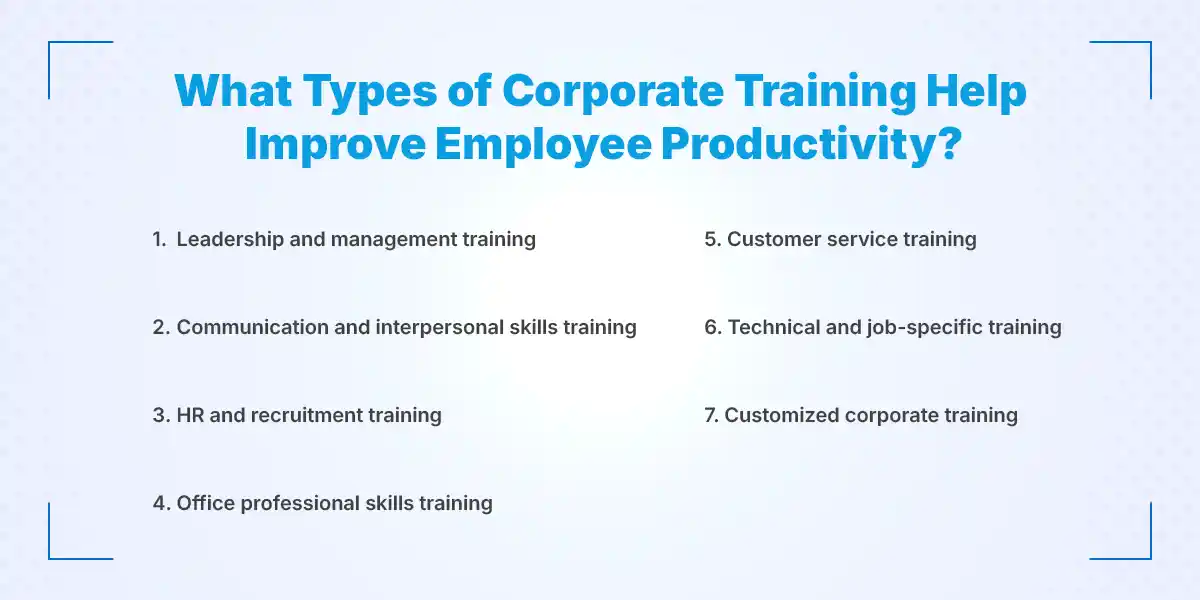
Different types of corporate training help employees develop the professional, technical, communication, and leadership skills needed to perform their work effectively. Organizations can choose training programs based on employee responsibilities, performance gaps, industry requirements, and business objectives. The most effective training focuses on skills employees can apply directly to their daily work.
1. Leadership and Management Training
Leadership and management training develops the abilities managers need to guide teams, delegate responsibilities, make decisions, and manage workplace challenges. It helps supervisors communicate expectations, motivate employees, and handle conflicts more effectively. Managers can also learn how to evaluate employee performance and provide constructive feedback. Strong leadership skills help teams work toward shared goals with greater clarity and coordination.
2. Communication and Interpersonal Skills Training
Communication and interpersonal skills training helps employees improve verbal communication, listening, professional behaviour, and relationship-building skills. Employees can learn how to communicate with colleagues, clients, managers, and other stakeholders more effectively. This training may also cover conflict resolution, presentation skills, negotiation, and workplace etiquette. Better communication helps reduce misunderstandings and supports stronger professional relationships.
3. HR and Recruitment Training
HR and recruitment training helps human resource professionals improve their knowledge of recruitment, employee management, interviewing, and workplace practices. Employees in HR roles can learn how to screen candidates, conduct interviews, manage employee records, and support organizational policies. Training can also introduce modern HR tools, recruitment techniques, and employee engagement practices. Improved HR capabilities help organizations manage workforce responsibilities more efficiently.
4. Office Professional Skills Training
Office professional skills training develops the practical abilities employees need to work effectively in professional environments. It can cover workplace etiquette, email communication, document management, teamwork, time management, and professional behaviour. Employees can learn how to organize tasks, communicate with colleagues, and manage office responsibilities more effectively. These skills help improve daily workplace coordination and operational efficiency.
5. Customer Service Training
Customer service training helps employees develop the skills needed to communicate with customers, understand their needs, and resolve complaints. Employees can learn active listening, customer handling, professional communication, and service recovery techniques. Training can also help employees respond to challenging situations while maintaining a positive customer experience. Better customer service skills can improve customer satisfaction and support business growth.
6. Technical and Job-Specific Training
Technical and job-specific training helps employees develop the knowledge required to use workplace tools, software, equipment, and industry-specific processes. It may include training in digital systems, financial software, technical operations, sales tools, or specialized workplace technologies. Employees can learn through demonstrations, hands-on activities, practical exercises, and guided instruction. This training helps employees complete their responsibilities more accurately and adapt to changing work requirements.
7. Customized Corporate Training
Customized corporate training focuses on the specific skills, challenges, and objectives of an organization. Businesses can design programs around employee skill gaps, industry requirements, team responsibilities, and organizational priorities. Customized learning can combine communication, leadership, technical skills, HR practices, and other relevant subjects. This approach helps organizations provide training that directly supports workplace performance.
How Can Companies Use Corporate Training to Increase Employee Productivity?
Companies can increase employee productivity through corporate training by identifying skill gaps, setting clear learning objectives, choosing relevant programs, and providing practical learning experiences. They should encourage employees to apply new skills at work and regularly evaluate training outcomes. A structured approach ensures that training supports both employee development and business performance.
1. Identify Employee Skill Gaps
Begin by assessing employees' current abilities, responsibilities, and performance challenges. Managers can use performance reviews, employee feedback, workplace observations, and task evaluations to identify areas that need improvement. Compare existing skills with the competencies employees need to perform their jobs effectively. This assessment helps organizations select training programs that address real workplace needs.
2. Set Clear Training Objectives
Define what employees should learn and achieve after completing a training program. Objectives should focus on practical improvements such as better communication, faster task completion, improved accuracy, or stronger leadership abilities. Clear objectives also help trainers develop relevant sessions and activities. They provide a measurable foundation for evaluating training effectiveness.
3. Choose Relevant Training Programs
Select training programs that match employee responsibilities, identified skill gaps, and organizational goals. Avoid providing general training that does not address the challenges employees face in their daily work. Consider the employees' experience levels, learning requirements, department needs, and available resources. Relevant training increases the likelihood that employees will use their newly acquired skills.
4. Provide Practical Learning Opportunities
Use workplace examples, demonstrations, role-playing, group discussions, case studies, and practical exercises to make training more useful. Employees should have opportunities to practice the skills they are learning instead of relying only on theoretical explanations. Practical activities help employees understand how to apply knowledge in real situations. This approach can improve learning retention and workplace readiness.
5. Encourage Employee Participation
Create a learning environment where employees feel comfortable asking questions, sharing experiences, and participating in training activities. Encourage employees to discuss challenges they face in their roles and explore possible solutions with trainers. Managers should communicate the value of training and support employee participation. Active involvement makes training more meaningful and engaging.
6. Apply Training in the Workplace
Encourage employees to use newly learned skills in their daily responsibilities after completing training. Managers can assign practical tasks, provide coaching, and offer feedback to support skill application. Employees should receive opportunities to practice new techniques and improve through experience. Applying training at work helps connect learning with actual performance improvements.
7. Evaluate Training Outcomes
Review employee performance before and after training to determine whether the program achieved its objectives. Measure relevant indicators such as task completion time, work quality, communication, error rates, and employee feedback. Discuss improvements with managers and employees to identify remaining challenges. Use these findings to improve future training programs.
What Are the Common Challenges That Prevent Corporate Training from Improving Productivity?
Corporate training may fail to improve productivity when organizations do not connect learning with actual workplace needs or provide sufficient support after training. Some common challenges include:
- Irrelevant training content: Training does not address the skills employees need for their daily responsibilities.
- Lack of practical learning: Employees receive theoretical information without opportunities to practice.
- Poor knowledge application: Employees struggle to apply training lessons to real workplace situations.
- Limited managerial support: Managers do not encourage employees to use their newly developed skills.
- Unplanned training schedules: Training sessions interrupt regular work or fail to accommodate employee availability.
- Lack of performance measurement: Organizations do not evaluate whether training improves employee performance.
- Insufficient follow-up: Employees do not receive coaching, feedback, or refresher sessions after training.
- Low employee participation: Employees do not engage actively in learning activities or recognize the value of training.
How Can Businesses Measure the Impact of Corporate Training on Employee Productivity?
Businesses can measure the impact of corporate training by checking employee performance, work quality, task completion, teamwork, and productivity before and after training. They can use the following metrics:
- Task Completion Time: Check how quickly employees complete their tasks.
- Work Quality: Track mistakes, accuracy, and work quality.
- Employee Performance: Compare employee performance before and after training.
- Team Collaboration: Check how well employees communicate and work together.
- Employee Engagement: Measure employee motivation, participation, and satisfaction.
- Training ROI: Compare training costs with the improvements in employee productivity and business results.
What Are the Best Practices for Making Corporate Training Effective?
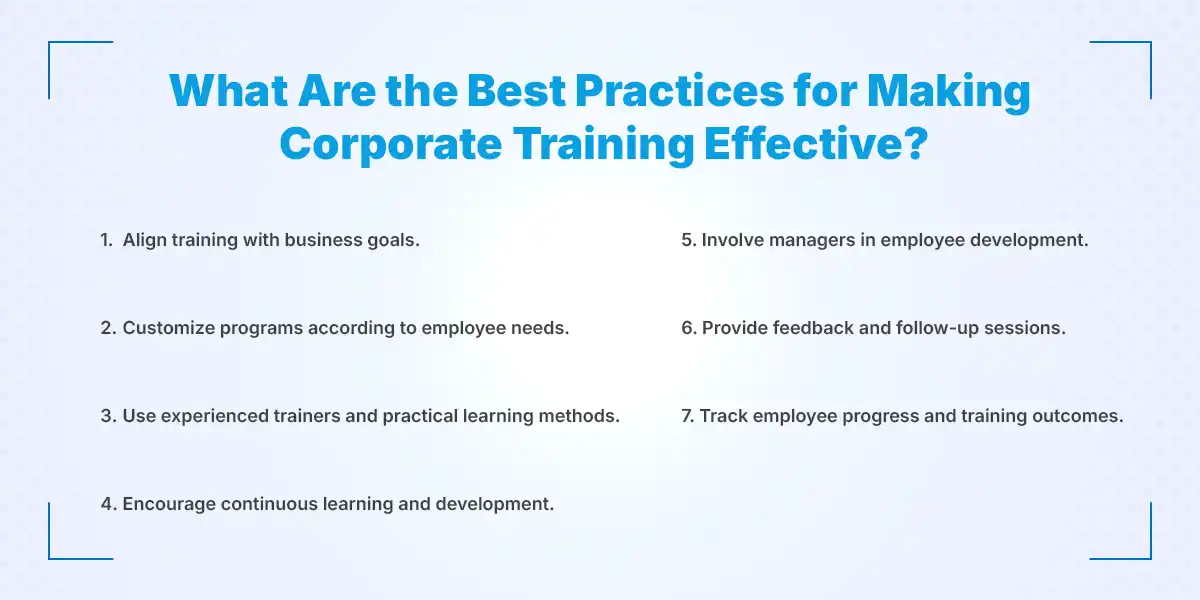
Businesses can make corporate training effective by choosing relevant programs that match employee skills, job roles, and company goals. Practical learning methods and experienced trainers also help employees gain useful knowledge.
Regular feedback, follow-up sessions, and continuous learning opportunities help employees apply their new skills at work. These practices improve employee performance, workplace efficiency, and overall productivity.
1. Align Training Programs with Business Goals
Organizations should choose training programs that support their business objectives and help employees perform their responsibilities more effectively.
2. Customize Training According to Employee Needs
Businesses should design training programs based on employees' job roles, current skills, and areas that need improvement to make learning more relevant.
3. Choose Experienced Trainers and Practical Learning Methods
Organizations should work with experienced trainers who use real workplace examples, practical exercises, and interactive activities to improve employee learning.
4. Encourage Continuous Learning and Development
Companies should provide regular learning opportunities, workshops, and skill development sessions to help employees improve their knowledge and adapt to workplace changes.
5. Involve Managers in Employee Development
Managers should guide employees, encourage them to apply new skills, and provide support to improve their performance after completing training.
6. Provide Regular Feedback and Follow-Up Sessions
Organizations should provide constructive feedback and follow-up training sessions to help employees understand their progress and improve their workplace skills.
7. Track Employee Progress and Training Results
Businesses should regularly measure employee performance, work quality, and productivity to understand whether training programs are achieving their expected goals.
How Does KumariJob Corporate Training Help Businesses Improve Employee Productivity?
Corporate Training helps businesses in Nepal develop employees' professional skills through customized workplace learning programs designed around organizational needs. Its training offerings support HR professionals, managers, teams, and employees through practical learning, experienced facilitators, and relevant skill-development programs.
Businesses can explore training programs that focus on:
- HR and Recruitment Training: Develop recruitment, interviewing, candidate evaluation, and human resource management skills.
- Leadership and People Management: Improve leadership abilities, team management, delegation, decision-making, and employee development.
- Office Professional Skills: Strengthen workplace communication, professionalism, teamwork, time management, and office-related competencies.
- Customized Workplace Training: Develop learning programs based on organizational goals, employee skill gaps, industry requirements, and team needs.
KumariJob's corporate training programs can be tailored to company objectives, team size, employee responsibilities, and learning requirements. Organizations can also explore workplace delivery options and industry-led learning to develop skills that employees can apply in their daily responsibilities.
Businesses looking to improve workforce performance and strengthen employee capabilities can explore KumariJob's Corporate Training Services to find suitable training programs for their teams.
Conclusion
Employee productivity depends on more than individual effort; it also requires the right skills, supportive management, clear communication, and opportunities for professional development. Organizations that create a workplace learning culture can help employees handle responsibilities more effectively, adapt to changing demands, and contribute to better business performance.
Rather than treating training as an occasional activity, businesses should make employee development an ongoing priority that supports measurable improvements in workplace performance. Businesses in Nepal can explore KumariJob's Corporate Training Services to develop their workforce through relevant and customized training programs.
Frequently Asked Questions
Submit your comments

Get Our App On



How to Screen Job Applications Efficiently: A Guide for Employers in Nepal
VIEW DETAILS
What Are the Best Corporate Training Programs for Employees in Nepal?
VIEW DETAILS
Common Payroll Mistakes in Nepal and How Businesses Can Avoid Them
VIEW DETAILS
10 Benefits of Corporate Training for Employees and Organizations
VIEW DETAILS


Loading Comments...