



You have two offer letters in front of you, and both look good enough to accept. One pays more, the other feels like a better place to grow, and the employers want an answer within days. Many job seekers in Nepal pick the bigger number on the spot and feel stuck six months later, because salary was the only thing they compared.
A better approach is to compare both offers on the same set of factors: total pay, responsibilities, career growth, culture, benefits, location, and job stability. This guide gives you a step-by-step framework, a simple scorecard, and the exact questions to ask before you sign. By the end, you can choose the offer that fits your next three years, not just your next paycheck.
In this blog
What Should You Consider When Choosing Between Two Job Offers?
Compare total pay, daily responsibilities, career growth, company stability, culture, benefits, and work-life balance before deciding. Salary matters, but it covers only one part of the offer. A job that pays less today can still earn you more over five years.
1. Salary and Total Compensation
Total compensation is everything you receive in a year, not only the monthly figure on the offer letter. Bonuses, allowances, and retirement contributions can change the real value of an offer by a wide margin. Add every component into one yearly number for each offer. Then compare the two totals side by side.
2. Responsibilities and Skill Development
Your daily tasks decide what you can put on your CV in two years. Compare how much of each role involves real ownership and how much is routine support work. Ask what you will learn in the first six months. Pick the role where learning continues after the first month.
3. Career Growth and Promotion Opportunities
A job is a step, so check where it leads. Look for a defined promotion path, regular reviews, and examples of people who moved up. Ask how long promotions usually take. Avoid roles where the next step is unclear or depends on one person's goodwill.
4. Company Reputation, Stability, and Job Security
A respected employer adds weight to your CV for years. Check whether the company pays salaries on time, keeps its clients, and retains its staff. Confirm whether the position is permanent or contract-based. Job security matters more when you support a family or repay a loan.
5. Culture, Manager, and Team
Your manager shapes your daily experience more than the company logo does. A supportive manager teaches faster and protects your time. Meet that person before you accept. Walk away from any offer where your future boss avoids simple questions.
6. Work-Life Balance, Location, and Flexibility
Hours, commute, and remote options decide how much energy you have left after work. Compare the official hours with the hours people actually work. Count commute time as part of your workday. Hybrid or remote options add real value when travel is long.
7. Employee Benefits
Benefits can turn an average salary into a strong package. Compare health insurance, paid leave, retirement contributions, and training budgets. Ask for every benefit in writing. Convert each one into rupees so both offers use the same unit.
How to Compare Two Job Offers Step by Step
Compare two job offers by listing pay, duties, growth, culture, hours, location, and stability for each, then scoring both against your goals. A numbered process keeps emotion out of the decision. Follow the ten steps below in order.
1. Read Both Job Offers Carefully
Start with the full text, not the summary the recruiter gave you. Check the job title, contract type, probation period, notice period, and any bonus conditions. Highlight every item that is vague or missing. Send those questions to the employer before you compare anything else.
2. Write Down the Salary and Benefits
Create one sheet with a column for each offer. List basic salary, allowances, bonuses, insurance, and retirement contributions in rupees per year. Mark which items are guaranteed and which depend on performance. Count guaranteed money in full and conditional money at a discount.
3. Compare the Actual Job Responsibilities
A job title tells you little about daily work. Ask for a typical week and the top three outcomes expected in the first six months. Check whether the tasks match the skills you want to build. Prefer the role where at least half your time goes to work you would proudly list on your CV.
4. Check Career Growth Opportunities
Growth shows up in promotion history, not promises. Ask how many people moved up in the last two years and how long it took. Look at the career paths of former employees on LinkedIn. A clear path with dates is worth more than a verbal promise.
5. Evaluate Company Culture
Culture is the set of unwritten rules about how people work, speak, and treat each other. Ask to meet your future manager or a teammate before accepting. Notice how they talk about mistakes, deadlines, and feedback. If possible, ask a current or former employee for an honest view.
6. Compare Working Hours and Flexibility
Hours affect your health and your time for learning. Confirm the official hours, overtime rules, and how common weekend work is. Ask about remote or hybrid options in writing. A flexible schedule can be worth more than a small raise.
7. Consider Location and Commuting Costs
A long commute is a hidden pay cut, paid in both time and money. In Nepal's major cities, heavy traffic can add two hours or more to a daily trip. Estimate the monthly travel cost and weekly travel hours for each office. Subtract that cost from the salary before you compare.
8. Research Each Company's Stability and Reputation
Stable employers pay on time, keep their staff, and keep growing. Search for news, employee reviews, and the company's client history. Ask how long the average employee stays. High turnover usually signals a problem that the offer letter will not mention.
9. Think About Your Long-Term Career Goals
Pick the job that moves you closer to where you want to be in three years. Write that goal in one sentence before you look at any scores. Then check which offer builds the skills, network, and title that goal needs. An offer that fits your goal beats one that only pays more.
10. Give Each Offer an Overall Score
Score each factor from 1 to 5 and multiply it by a weight that reflects how much it matters to you. Add the results for each offer. A clear gap points to your answer, and a close result means you should revisit your priorities. Treat the score as a guide, not an order.
Should You Choose the Higher Salary or Better Career Opportunity?
The highest salary is not automatically the best choice, especially for freshers. Choose higher pay when you carry financial pressure and growth is similar. Choose the stronger opportunity when the pay gap is small, and the role builds skills, mentorship, and a better brand name.
1. When the Higher Salary Makes Sense
A higher salary is the right choice when you must cover rent, loans, or family expenses. It also makes sense when both roles offer similar learning and growth. Compare the monthly gap with your real monthly gap in expenses. If the extra money removes a serious financial risk, take it.
2. When a Lower Salary Builds More Value
A lower salary can pay off when the job gives you rare skills, a respected employer on your CV, or a clear promotion path. These assets raise your market value for years. Estimate how much more you could earn at your next job because of them. If the long-term gain beats the short-term gap, the lower offer wins.
3. How to Weigh Future Earning Potential
Future earning potential depends on the skills you gain and the people you meet. Ask what a person two levels above you earns and how they got there. Project your salary for three years in each role, using realistic raises. Choose the path where the three-year total is higher, not the one with the bigger first month.
How Important Is Career Growth When Comparing Two Jobs?
Career growth is often the most important factor once your basic living costs are covered. It decides how fast your skills, title, and salary improve. A role with strong growth can repay a lower starting salary within two to three years.
Check each offer for these growth signals:
- A written promotion path with clear criteria
- Training budgets, workshops, or paid certifications
- A named mentor or regular one-to-one meetings
- New responsibilities added within the first year
- Chances to move into other teams or departments
- Evidence that past employees reached senior roles
- Salary reviews tied to performance, not favoritism
How to Compare Salary and Benefits Between Two Job Offers
Convert every pay component into a yearly figure and compare the two totals. Monthly salary hides bonuses, retirement contributions, and allowances. In Nepal, two offers with the same monthly salary can lead to very different take-home pay.
Include these items in your comparison:
- Basic salary and total monthly gross
- Performance bonuses and incentives
- Dashain and other festival bonuses
- Health and life insurance
- Provident fund or Social Security Fund contributions
- Paid leave and public holidays
- Transportation and communication allowances
- Overtime pay rules
Take-home value differs because employers split pay in different ways. Retirement contributions and some bonuses are usually calculated on basic salary, so a lower basic with high allowances changes both your savings and your deductions. Tax is calculated on taxable income, so confirm how each employer treats allowances. The example below uses illustrative numbers to show how equal monthly pay can hide a gap.
Confirm current contribution rates and tax rules with each employer, because these can change.
How Can Company Culture and Work Environment Affect Your Decision?
Culture decides how your workday feels, how fast you learn, and how long you stay. A poor fit with your manager or team can cancel the benefit of a higher salary. You cannot see culture in an offer letter, so you need to test it.
Look for these signs before you decide:
- Management style: does the manager guide or only control?
- Team collaboration: do people share work and credit?
- Communication: are questions welcomed or ignored?
- Employee treatment: how does the company handle mistakes and leave requests?
- Working hours: does overtime happen occasionally or every week?
- Turnover: how many people left in the last year?
- Professional development: does the company pay for learning?
What Questions Should You Ask Before Accepting a Job Offer?
Before accepting a job offer, ask about your responsibilities, working hours, probation period, salary and benefits, job security, performance expectations, and career growth. Asking the right questions can help you understand the job clearly and make a confident decision.
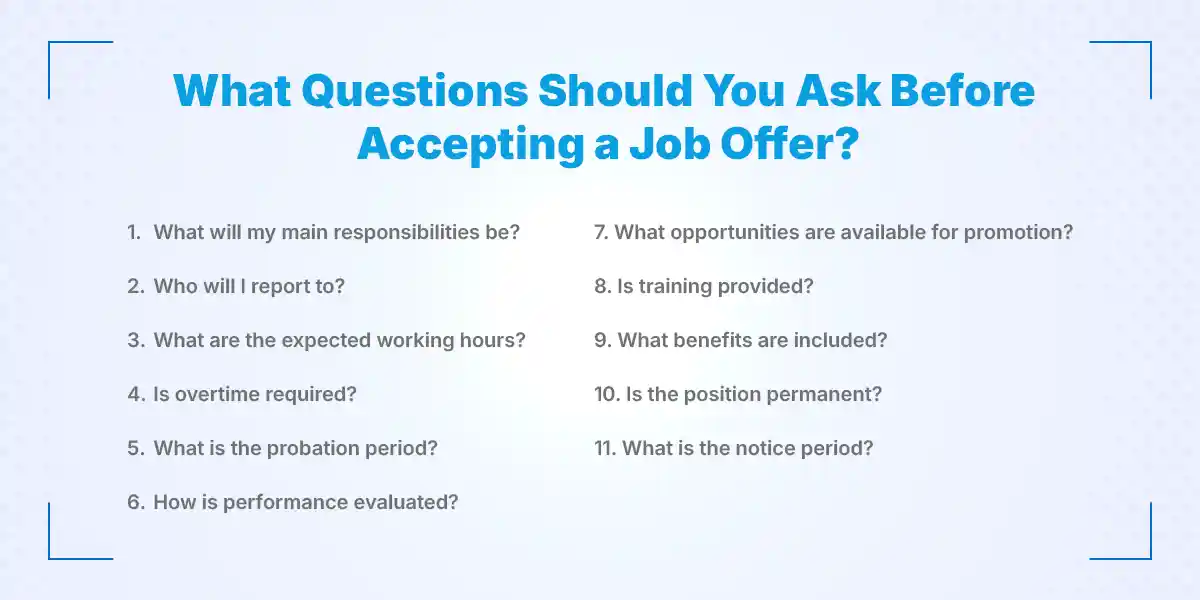
1. What Will My Main Responsibilities Be?
Ask about your daily tasks and key responsibilities so you know exactly what the job requires.
2. Who Will I Report To?
Find out who your direct manager or supervisor will be and how your team is structured.
3. What Are the Expected Working Hours?
Confirm your regular working hours, workdays, and whether flexible or remote work options are available.
4. Is Overtime Required?
Ask whether overtime is expected and whether you will receive additional pay or other benefits for extra hours.
5. What Is the Probation Period?
Understand how long the probation period lasts and what is expected from you before becoming a permanent employee.
6. How Is Performance Evaluated?
Ask how your performance will be measured and how often performance reviews are conducted.
7. What Opportunities Are Available for Promotion?
Find out whether the company provides clear career growth and promotion opportunities.
8. Is Training Provided?
Ask whether the company provides training, onboarding, or skill development opportunities for new employees.
9. What Benefits Are Included?
Confirm the benefits included in the job offer, such as paid leave, bonuses, insurance, allowances, or other employee benefits.
10. Is the Position Permanent?
Ask whether the position is permanent, temporary, contractual, or project-based.
11. What Is the Notice Period?
Confirm the required notice period if you decide to leave the company in the future.
How to Choose Between Two Job Offers as a Fresher
Freshers should choose the offer with stronger learning, mentorship, and skill-building, as long as the salary covers basic living costs. Your first job shapes your market value for years. A small salary gap matters less than a strong first two years.
1. Prioritize Learning and Mentorship
Early in your career, the people around you teach more than any course. Ask who will train you and how often you will get feedback. A manager who explains the reasons behind decisions speeds up your growth. Choose the offer with the stronger teacher.
2. Compare Responsibilities and Training
Look at what you will do in the first ninety days. Check for structured onboarding, training sessions, and real tasks instead of only observing. Roles that give you ownership early build confidence and a stronger CV. Avoid jobs that keep new hires on repetitive work for a year.
3. Choose Transferable Skills and Stability
Skills like communication, analysis, project handling, and software tools move with you to any employer. Stable companies give you time to learn without the fear of sudden layoffs. Check how long the company has operated and whether it pays on time. Balance a modest starting salary against these long-term gains.
When Should You Choose the Job With the Lower Salary?
Choose the lower salary when the role offers clearly better growth, mentorship, skills, stability, or balance, and the pay still covers your needs. The gap should be small enough to recover through future raises. Write down the specific gain you expect before you accept.
A lower-paying role can be the better choice when it offers:
- Faster career growth and a clear promotion path
- Stronger mentorship from experienced seniors
- Better exposure to new tools and skills
- A more respected company name
- Better work-life balance
- A shorter commute that saves time and money
- Better benefits, such as insurance or paid training
- Greater job stability
- A closer match with your long-term goals
Conclusion
The one big takeaway is that the best offer is the one that matches where you want to be in three years, not the one with the larger number. Salary pays your bills this year, but skills, mentors, and a respected employer set your earning power for the next ten. Write down your priorities, score both offers on paper, and let the scorecard challenge your first instinct.
Do not rush the answer, and do not be afraid to negotiate. Employers expect questions from serious candidates, and a clear reply gives you a stronger start in the role you choose. Explore relevant job opportunities on KumariJob and make informed career decisions.
Frequently Asked Questions
Submit your comments

Get Our App On



Digital Marketing Training Interview Questions and Answers for Freshers
VIEW DETAILS
Why Am I Not Getting Shortlisted for Jobs?
VIEW DETAILS
Why Job Vacancies Disappear Without Hiring Anyone
VIEW DETAILS
Why Are Companies Not Hiring Freshers?
VIEW DETAILS


Loading Comments...