


You send your CV to twenty vacancies, check your email every morning, and hear nothing back. After a few weeks, the silence starts to feel personal, and you begin to wonder whether something is wrong with you.
Most of the time, the problem is not your ability. It is a gap between what the employer asked for and what your application showed. This article explains the nine most common reasons recruiters in Nepal skip a candidate, and it gives you clear steps to fix each one so your next application earns a call.
In this blog
What Does It Mean When You Are Not Shortlisted for a Job?
Not being shortlisted for a job means your application was not selected for the interview or next stage of hiring. After receiving applications, employers screen candidates based on skills, qualifications, experience, and job requirements. A candidate can be qualified but still not shortlisted because of strong competition, limited vacancies, or other applicants being a closer match.
Why Am I Not Getting Shortlisted for Jobs?
Most candidates miss the shortlist because their CV or profile is not optimized, their skills do not match the role, or they apply for unsuitable jobs. High competition, weak keyword matching, and unexplained employment gaps add to the problem. Fixing these areas one by one raises your chances quickly.
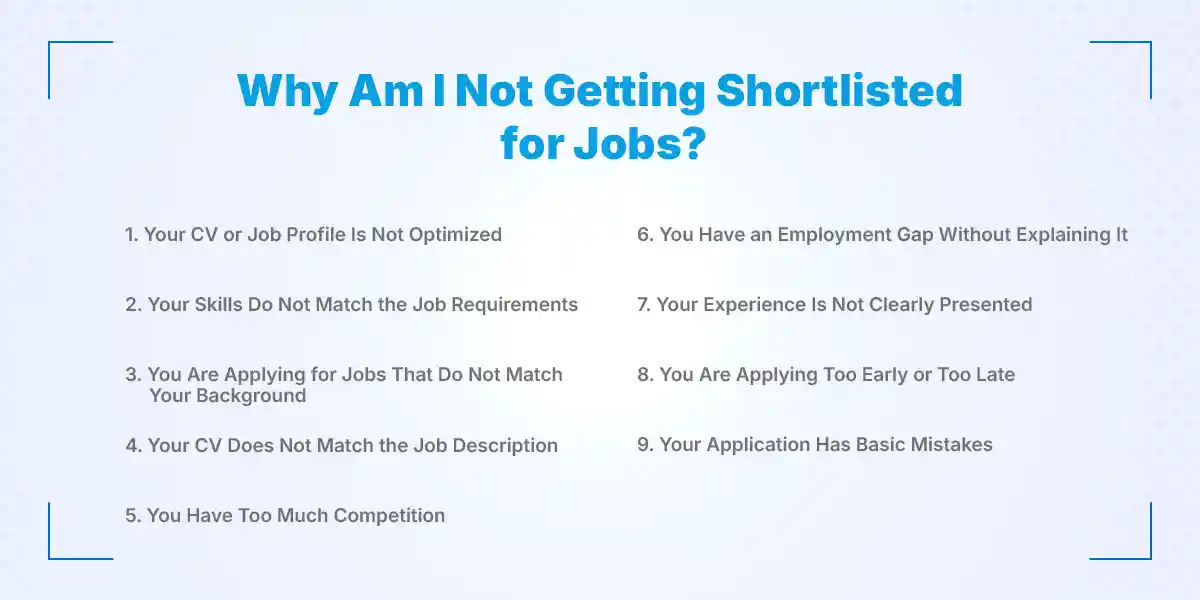
1. Your CV or Job Profile Is Not Optimized
An outdated or generic CV tells the recruiter you did not prepare for this specific job. Weak summaries, missing skills, vague duties, and no measurable results make you look like every other applicant. Rewrite your summary in three lines, list your strongest skills near the top, and add numbers such as "handled 40 customer calls a day. Make sure your job portal profile matches your CV, because recruiters notice when the two disagree.
2. Your Skills Do Not Match the Job Requirements
Employers shortlist people whose skills match the listed requirements, and both technical and soft skills count. If the vacancy asks for Excel, English communication, or accounting software and your CV shows none of them, the recruiter moves on. Read the job description line by line, and mark which skills you already have and which you lack. Close the gaps with a short course or certification, and add it to your CV as soon as you finish.
3. You Are Applying for Jobs That Do Not Match Your Background
Random applications waste your time because recruiters check education and experience first. A commerce graduate with no design work rarely gets a call for a graphic designer post, and a fresher seldom wins a senior manager role. Before you apply, compare the education level, years of experience, and job title with your own record. Save your energy for roles where you meet most of the requirements.
4. Your CV Does Not Match the Job Description
Recruiters and job portal filters look for the same words that appear in the vacancy. When you send one generic CV everywhere, you miss those words and hide your most relevant experience. Copy the exact skill and tool names from the job post into your CV, but only where they honestly describe your work. Place the closest-fitting experience at the top so the recruiter sees it first.
5. You Have Too Much Competition
Popular entry-level posts in Nepal, such as banking trainee, sales, and office assistant roles, attract a very large number of applicants. Many freshers hold similar degrees, so a plain CV disappears in the crowd. A qualified candidate can still lose out because another CV showed clearer proof of skill. Add projects, internships, or small achievements that make your application more relevant than the rest.
6. You Have an Employment Gap Without Explaining It
An unexplained gap makes recruiters guess, and their guesses rarely help you. A gap is not a problem by itself, especially when you spent the time on study, training, freelancing, volunteering, or family care. Add one honest line to your CV or cover note, such as "Completed a digital marketing course and freelanced for two local clients." Keep the explanation short, truthful, and focused on what you learned.
7. Your Experience Is Not Clearly Presented
A job title alone tells the recruiter very little about what you actually did. Employers want to see your responsibilities, your results, and the tools you used. Write two to four bullet points under each role, start each with an action word, and add numbers where you can. List the experience that fits the vacancy most closely at the top of each section.
8. You Are Applying Too Early or Too Late
Timing affects your chances more than most people expect. Applying before you meet the minimum requirements often ends in a quick rejection, and applying near the closing date can put your CV behind many others. Some employers also stop reviewing once they collect enough strong candidates. Apply once you meet the requirements, and send your application within the first few days of the posting.
9. Your Application Has Basic Mistakes
Small errors signal carelessness, and recruiters have plenty of other candidates to choose from. Spelling mistakes, wrong phone numbers, inconsistent dates, missing documents, or the wrong CV file can end your application in seconds. Read your CV out loud, check every date, and confirm your phone number and email address. Open the uploaded file to make sure it is the correct version and that the application form is complete.
How Can I Improve My Chances of Getting Shortlisted?
You improve your chances by matching your CV to each vacancy, applying only to suitable roles, and proving your skills with clear results. These habits take little time once they become part of your routine. Follow the ten steps below before every application.
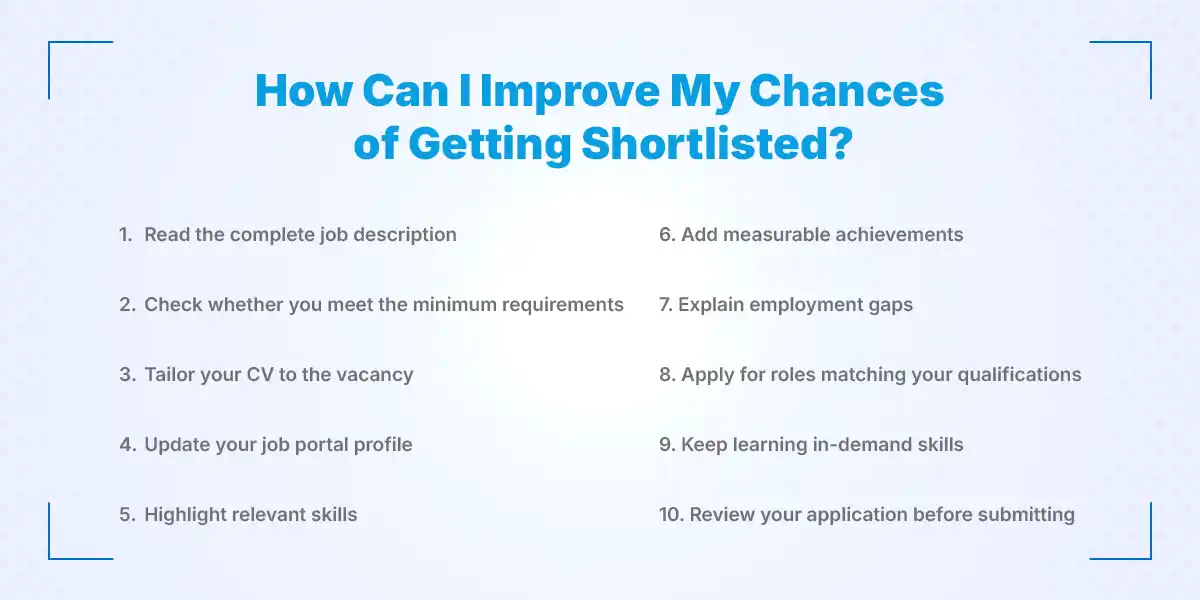
- Read the complete job description.
- Check that you meet the minimum requirements.
- Tailor your CV to the vacancy.
- Update your job portal profile.
- Highlight the skills the employer asks for.
- Add measurable achievements.
- Explain any employment gap in one honest line.
- Apply for roles that match your qualifications.
- Keep learning in-demand skills.
- Review everything before you submit.
What Should I Check Before Applying for a Job?
Check that you meet the education, experience, skill, location, and document requirements before you click apply. A two-minute check saves you from applications that never had a chance. Use this checklist for every vacancy.
- Education requirement: Confirm your degree level and subject fit the post.
- Experience requirement: Compare the type and years of experience asked for with your own.
- Technical skills: List the tools and software named in the vacancy.
- Soft skills: Note any communication, teamwork, or leadership needs.
- Location: Confirm you can work at the stated place or remotely.
- Salary expectations: Check the offered range, or prepare your expected figure if the form asks.
- Required documents: Gather your CV, certificates, and any other files the employer lists.
- Application deadline: Note the closing date and plan to apply early.
- Job responsibilities: Make sure you can handle the daily tasks.
- Industry or company relevance: Check that the sector fits your background and goals.
Are You Applying for the Right Jobs?
Yes, relevance matters more than volume, because ten well-matched applications usually beat a hundred random ones. Recruiters look for fit first and effort second. A focused search shows them that you know your direction.
- Quality over quantity: Spend your time improving fewer applications instead of sending many weak ones.
- Match your education: Choose roles that fit your degree or training.
- Match your experience: Apply where your years and type of work meet the stated level.
- Use transferable skills: A shop assistant's customer handling, for example, supports a move into sales or customer service.
- Avoid unrelated posts: Skip vacancies where you meet almost none of the requirements.
- Build a focused strategy: Pick two or three target job titles, and keep one CV version for each.
How Can Freshers Get Shortlisted Without Experience?
Freshers get shortlisted by showing proof of skill through internships, projects, training, and practical results instead of job titles. Employers hiring at entry level expect limited experience, so they look for effort and readiness. Your job is to make that readiness easy to see.
1. Turn Internships, Projects, and Freelance Work Into Experience
Recruiters treat real work as experience, even when nobody paid you a full salary. An internship, a college project, a freelance task, or a volunteer role all show that you can finish something useful. Describe each one with what you did, which tools you used, and what result you achieved. Put this section right below your education so the recruiter finds it quickly.
2. Use Training, Certifications, and Coursework
Relevant courses tell an employer that you already started learning the job. Choose training linked to the roles you want, such as accounting software, digital marketing, or basic programming. List certificates with the institute name and the year you completed them. Mention coursework only when it matches the vacancy, and skip subjects that add no value.
3. Show Practical and Soft Skills
Employers hiring freshers often care as much about attitude as about knowledge. Communication, teamwork, time management, and willingness to learn all help, but claims alone carry no weight. Back each skill with a short example, such as leading a class project or organizing a campus event. Keep your list honest, because interviewers test what you write.
4. Build a Clean Fresher CV and Target Entry-Level Roles
A strong fresher CV stays short, usually one page, and puts skills and projects ahead of space. Apply to posts marked entry-level, trainee, or junior, since these roles expect new graduates. Adjust your summary for each application so it names the role and one or two matching strengths. Send fewer, better applications, and you will see more responses.
What Can I Do If I Keep Applying but Never Get Shortlisted?
Stop, review your past applications, and look for patterns before you send another one. Repeating the same approach usually brings the same silence. A short diagnosis often shows the exact problem.
- Stop sending the same CV everywhere. Create a tailored version for each type of role.
- Review your last 10 to 20 applications. List the job title, employer, and result for each.
- Identify repeated job types. Note which kinds of roles you apply for most often.
- Compare requirements with your skills. Mark every requirement you did not clearly meet.
- Improve your weakest skill first. Pick one gap and start a course or practice plan.
- Update your CV and profile. Apply what you learned to both.
- Ask for feedback when possible. A teacher, mentor, or recruiter can spot problems you miss.
- Track applications in a spreadsheet. Use columns for job title, company, date, CV version, and outcome.
- Adjust your strategy based on patterns. Change the roles, the CV, or the skills that keep showing up as the weak point.
How Can I Make My Job Profile More Attractive to Employers?
Make your profile attractive by keeping your education, experience, skills, certifications, achievements, and contact details complete, accurate, relevant, and updated. Recruiters read profiles quickly, so clear and current information wins attention. Review your profile at least once a month, and after every new skill or job.
- Professional headline: State your role and main skill in one line, such as "Junior Accountant | Tally and Excel.
- Summary: Write three or four lines about who you are, what you do well, and what role you want.
- Skills: List the skills employers in your field ask for most often.
- Education: Add your degrees, institutions, and completion years.
- Experience: Describe duties and results for each role, using numbers where possible.
- Certifications: Include recent, relevant courses with dates.
- Projects: Show one to three pieces of work that prove your skills.
- Languages: Add Nepali, English, and any other language you use at work.
- Updated contact details: Check your phone number and email every time you apply.
- Professional profile photo: Use a clear, simple photo with a plain background if the portal supports one.
Conclusion
Getting shortlisted is a matching problem, not a talent problem. Employers choose the candidates whose CVs clearly show the skills and experience in the vacancy, so a better-matched application beats a bigger stack of applications every time. Change one thing before you apply again: stop sending your CV to every post, and start sending a tailored one to the posts that fit.
Treat every silent application as data. Compare it with the job requirements, find the gap, and fix that gap in your next attempt. Explore the latest vacancies on KumariJob, pick three roles that match your background, and tailor your CV to each one today.
Frequently Asked Questions
Submit your comments

Get Our App On



Why Job Vacancies Disappear Without Hiring Anyone
VIEW DETAILS
Why Are Companies Not Hiring Freshers?
VIEW DETAILS
How to Use AI Tools at Work Without Losing Your Job
VIEW DETAILS
Should I Accept a Job With Low Salary for Experience?
VIEW DETAILS


Loading Comments...