


Walking into a digital marketing interview as a fresher often feels like being asked to speak a new language on day one. The interviewer says SEO, CTR, and funnel in one breath, and the mind goes blank even when the candidate studied the terms the night before. Many freshers also assume the panel expects campaign results they never had a chance to produce.
Interviewers for training programs and entry-level roles usually test basics, clear speech, and curiosity, not years of experience. This guide covers the most common digital marketing training interview questions and answers across SEO, social media, content, Google Ads, email, and analytics. It also shows how to structure each answer and how to prepare in the days before the interview.
In this blog
What Is Digital Marketing?
Digital marketing is the process of promoting products, services, or brands through online channels such as search engines, websites, social media, email, and online advertising. It helps businesses connect with their target audience, increase brand awareness, generate leads, and promote their products or services online.
Unlike traditional marketing methods such as newspapers, television, and billboards, digital marketing allows businesses to reach specific audiences and measure results such as clicks, views, engagement, leads, and conversions. Digital marketing channels such as SEO, social media, content marketing, email marketing, and paid advertising are commonly used as part of an effective online marketing strategy.
Why Do Companies Ask Digital Marketing Questions in Interviews?
Companies ask these questions to confirm that a candidate understands the basics well enough to learn on the job. Freshers rarely have campaign results to show, so the answers act as proof of effort and clear thinking. Each question tests a slightly different skill.
- Basic knowledge: Interviewers check whether the candidate can define core terms without reading from notes.
- Communication and analytical thinking: They listen for a logical, clear explanation, not a perfect textbook line.
- Channel awareness: They test whether the candidate knows what SEO, ads, email, and social media each do.
- Willingness to learn: They watch how the candidate reacts to an unfamiliar question.
- Industry terminology: They confirm the candidate recognizes words such as CTR, CPC, and conversion.
What Are the Most Common Digital Marketing Interview Questions for Freshers?
The most common questions fall into eight groups: basics, SEO, social media, content, Google Ads, email, analytics, and practical scenarios. Most interviews pull four or five questions from these groups, starting with the easiest. Preparing one clean answer per group covers most of what a fresher will face.
- Basics: definitions, channels, funnel, and conversion
- SEO: keywords, on-page, off-page, and technical SEO
- Social media: platforms, engagement, and content calendars
- Content marketing: strategy, blogs, and keyword optimization
- Google Ads and PPC: CPC, CTR, and Quality Score
- Email marketing: lists, segmentation, and open rate
- Analytics: Google Analytics, bounce rate, and conversion rate
- Practical and situational: short planning tasks and problem-solving
What Are the Basic Digital Marketing Questions Freshers Should Prepare For?
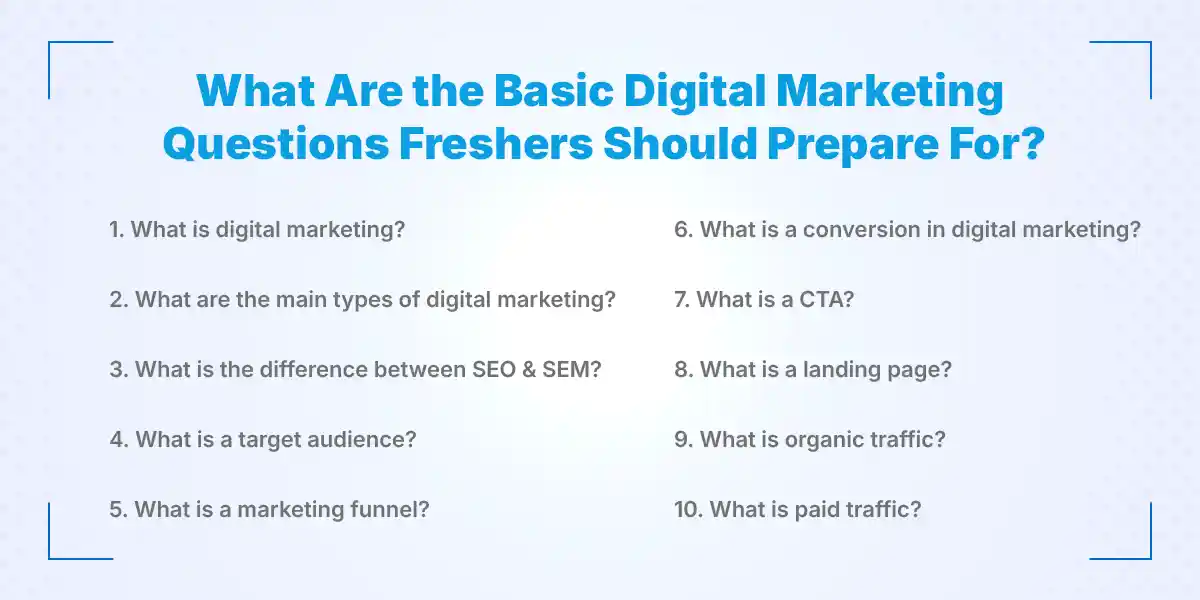
Freshers should prepare for ten basic questions: what digital marketing is, its main types, SEO versus SEM, target audience, marketing funnel, conversion, CTA, landing page, organic traffic, and paid traffic. Interviewers use these to warm up, so short and accurate answers score best. The goal is a two-sentence definition plus one example for each.
1. What Is Digital Marketing, and What Are Its Types?
Digital marketing promotes a business online, and its main types are SEO, paid search, social media, content, email, and affiliate marketing. Start with this simple definition and add one sentence about why it matters. Then name the types in a natural order, moving from free (organic) methods to paid ones. This answer sets up the follow-up questions, so keep it calm and short.
2. What Is the Difference Between SEO and SEM?
SEO improves a website so it ranks higher in unpaid search results, while SEM usually means buying search ads. Some definitions treat SEM as the umbrella term that includes SEO, so the answer should state which meaning applies. A safe summary says SEO earns traffic over time and search ads buy traffic immediately. A bakery, for example, can rank for "cake shop near me" slowly through SEO or appear at the top at once through an ad.
3. Target Audience, Marketing Funnel, and Conversion
A target audience is the specific group of people most likely to buy, defined by traits such as age, location, interests, and needs. A marketing funnel maps the path from awareness to interest, decision, and action. A conversion is any goal a visitor completes, such as a purchase, a form submission, or a course enrollment. Tie the three together in the answer, because the funnel moves the audience toward a conversion.
4. CTA, Landing Page, and Traffic Types
A CTA, or call to action, is a button or phrase that tells people the next step, such as Register Now." A landing page is a focused page built for one goal, with no menu distractions. Organic traffic arrives through unpaid sources like search rankings, while paid traffic arrives through ads. Mention that a landing page and a CTA work as a pair, because the page builds trust and the CTA asks for the action.
What Social Media Marketing Questions Can Freshers Expect?
Freshers can expect questions on platforms, engagement, organic versus paid posts, content calendars, and performance measurement. Interviewers often ask for a plan, such as how to grow a page, so thinking beyond definitions helps. Real examples from a personal or class project make answers stand out.
1. Platforms, Organic, and Paid Social Media
Social media marketing means promoting a business on platforms such as Facebook, Instagram, LinkedIn, TikTok, and YouTube. Organic marketing uses free posts, while paid marketing uses boosted posts and ads to reach more people. Platform choice depends on the audience, because LinkedIn suits professionals and employers while Instagram suits visual products. State one reason for each platform named, since that shows real thinking.
2. Engagement, Reach, and Impressions
Engagement counts the actions people take on a post, such as likes, comments, shares, and saves. Reach is the number of unique people who saw the post, while impressions count every view, including repeat views by the same person. A post shown to 1,000 people twice has a reach of 1,000 and 2,000 impressions. This small example proves the difference faster than any definition.
3. Content Calendar, Hashtags, and Performance
A content calendar is a schedule that lists what to post, where, and when, so posting stays steady. Hashtags group posts by topic and help new viewers find them, but three to five relevant tags work better than a long list. To measure performance, track reach, engagement rate, follower growth, link clicks, and conversions against the original goal. To raise engagement on a post, a strong answer suggests asking a question, using a clear image, and posting when the audience is online.
What Content Marketing Questions Are Asked in Digital Marketing Interviews?
Interviewers ask about content strategy, SEO-friendly writing, keywords, blogs, evergreen content, and duplicate content. These questions test whether a fresher can connect writing to search behavior and audience needs. A short, repeatable topic-selection process is often enough to impress.
1. Content Marketing, Strategy, and Blogs
Content marketing creates useful material, such as blogs, videos, and guides, to attract and keep a defined audience. A content strategy is the plan that decides what to create, for whom, on which channel, and with what goal. A blog is one common format, and it works best when each post answers one specific question. Mention that content should help the reader first and sell second, since that idea drives the whole strategy.
2. SEO-Friendly Content, Keywords, and Duplicate Content
SEO-friendly content answers the search intent clearly, uses the main keyword naturally, and follows a clean heading structure. Keyword optimization means placing the target keyword and related terms in the title, headings, first paragraph, and image alt text without forcing repetition. A quick way to choose a blog topic is to search the keyword, read the top results, and find what they missed. Duplicate content, meaning the same text on more than one page, can confuse search engines, so every page needs its own unique value.
3. Evergreen Content and Audience Fit
Evergreen content stays useful for months or years, such as "how to write a CV," unlike news posts that expire quickly. It keeps bringing search traffic with only small updates. To write for a specific audience, define who they are, list their top three questions, and match the tone and detail to their level. A guide for school leavers, for example, needs plain words and short steps, while a guide for managers needs data and speed.
What Google Ads and PPC Questions Should Freshers Know?
Freshers should know the basic terms of Google Ads, including PPC, CPC, CTR, impressions, conversions, keywords, and Quality Score. Interviewers rarely expect campaign-management experience from a beginner. They want to hear that the candidate understands how the pieces connect.
1. Google Ads, PPC, and CPC
Google Ads is Google's advertising platform that shows ads on search results, partner websites, and YouTube. PPC, or pay-per-click, is a model where the advertiser pays only when someone clicks the ad. CPC, or cost per click, is the amount paid for each click, and it changes with competition for the keyword. Businesses use paid ads because they deliver visitors the same day, while SEO needs weeks or months.
2. Impressions, CTR, and Conversions
An impression happens each time an ad appears on a screen, whether or not anyone clicks. CTR, or click-through rate, equals clicks divided by impressions, so 50 clicks from 1,000 impressions gives a CTR of 5 percent. A conversion is the valuable action after the click, such as a sign-up or a phone call. Low CTR points to a weak ad, while many clicks and few conversions point to a weak landing page.
3. Keywords, Quality Score, and SEO vs PPC
A keyword in Google Ads is the word or phrase that can trigger an ad when someone searches for it. Quality Score is Google's 1-to-10 rating of ad quality, based on expected CTR, ad relevance, and landing page experience. A higher score usually lowers costs and improves ad position. SEO earns unpaid rankings slowly, while PPC pays for visibility fast, and many businesses run both.
What Email Marketing Questions Can Be Asked to Freshers?
Freshers can be asked to define email marketing, email lists, campaigns, segmentation, open rate, click-through rate, and CTAs. These questions are short, so a clear definition and one example are enough. Email also shows whether the candidate understands permission and trust.
1. Email Marketing, Lists, Campaigns, and Segmentation
Email marketing sends targeted messages to people who agreed to receive them, in order to inform, nurture, or sell. An email list is the collection of those subscribers, and it should grow through permission, never through purchase. An email campaign is a planned set of messages with one goal, such as promoting a new training batch. Segmentation splits the list into groups, such as new subscribers and past buyers, so each group gets a relevant message.
2. Email Metrics and Effective Emails
Open rate is the percentage of recipients who open the email, while click-through rate is the percentage who click a link inside it. Open rates have become less reliable since Apple Mail Privacy Protection began pre-loading emails in 2021, so clicks give a truer signal. An effective email has a clear subject line, one main message, short text, and a single CTA button. Testing one change at a time, such as the subject line, shows what actually improves results.
What Digital Marketing Analytics Questions Should Freshers Prepare?
Digital marketing analytics is the process of collecting and reading data about website traffic, user behavior, campaign performance, and conversions, using tools such as Google Analytics and Google Search Console, so marketers can see what works and improve their next decision. Interviewers use this topic to see whether a fresher respects data over guesswork. Beginners need to know what each metric means, not how to build advanced reports.
1. Google Analytics and Google Search Console
Google Analytics, now GA4, tracks what visitors do on a website, such as pages viewed, time spent, and goals completed. Google Search Console shows how a site appears in Google Search, including queries, clicks, impressions, and indexing problems. A simple way to separate them is that Search Console covers what happens before the click, and Analytics covers what happens after. Name both tools together, since interviewers often ask for the difference.
2. Traffic, Bounce Rate, and Conversion Rate
Website traffic is the number of visits a site receives, and it can be split into organic, paid, social, email, and direct sources. Bounce rate is the share of visits where the user left without meaningful action, and GA4 also reports engagement rate, the opposite measure. Conversion rate equals conversions divided by visitors, so 20 sign-ups from 1,000 visitors gives 2 percent. A high bounce rate is not always bad, since a visitor who finds a phone number and leaves has still succeeded.
3. User Engagement and Why Data Matters
User engagement measures how actively visitors interact, using signals such as engaged sessions, scroll depth, and clicks. Data matters because it replaces opinions with evidence and shows where to spend the next part of the budget. A practical answer gives one example, such as a blog post with high traffic but no sign-ups, which signals that the CTA needs a fix. Close the answer by saying every campaign should start with a goal, so the numbers have something to be measured against.
How Should Freshers Answer Digital Marketing Interview Questions?
Freshers should answer digital marketing interview questions by giving a simple definition first, explaining the idea in their own words, adding a short practical example, and linking the answer to a business goal, while staying honest about anything they do not know. The method works for any question, even one the candidate has never seen. Practicing it aloud turns it into a habit within a week.
1. Understand the Question and Start Simple
Listen to the full question and pause for two seconds before answering. Ask for a repeat if a term sounds unfamiliar, because a short clarification shows care, not weakness. Begin with a one-sentence definition in plain words. A simple opening buys time to organize the rest of the answer.
2. Use Your Own Words and Add an Example
Restate the idea in personal words, since memorized lines sound flat and invite harder follow-up questions. Add one small example from a class project, a personal blog, or a local business. A short example proves understanding better than extra definitions. Keep the whole answer under about 45 seconds.
3. Connect the Answer to a Business Goal
Every marketing activity serves a goal such as leads, sales, or awareness. Finish the answer by naming that goal, for example, "SEO helps the institute get more inquiries without paying for each click." This habit separates a thoughtful candidate from one who only recites terms. It also gives the interviewer an easy next question to ask.
4. Handle Gaps with Honesty
Say plainly when an answer is unknown, then explain how the topic would be researched. A candidate can say the topic is new, then describe reading the Google Ads help pages and testing with a small budget. Avoid guessing with confident wrong facts, because interviewers notice and trust drops. Finish with a willingness to learn, since training programs value that more than perfection.
How Can Freshers Prepare for a Digital Marketing Training Interview?
Freshers can prepare by revising core concepts, practicing answers aloud, and researching the organization several days before the interview. A short daily routine beats one long cram session. The checklist below turns that routine into ten clear tasks.
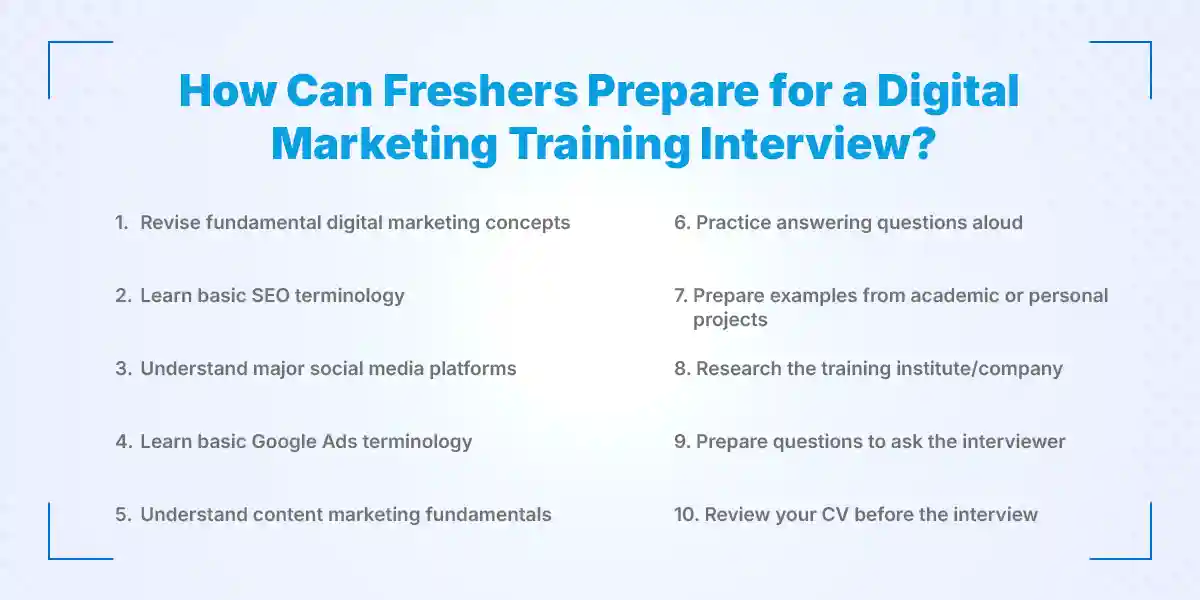
- Revise fundamental concepts: channels, funnel, conversion, and traffic types.
- Learn basic SEO terms: keywords, on-page, off-page, and technical SEO.
- Understand major social media platforms and who uses each one.
- Learn basic Google Ads terms: CPC, CTR, impressions, and Quality Score.
- Understand content marketing fundamentals such as search intent and structure.
- Practice answers aloud with a friend or a phone recorder.
- Prepare examples from academic or personal projects, such as a sample blog or practice social page.
- Research the training institute or company, including its courses, tone, and recent posts.
- Prepare two or three questions to ask the interviewer.
- Review your CV and be ready to explain every line.
Digital Marketing Interview Preparation Checklist for Freshers
| Area | What to Prepare |
|---|---|
| Digital Marketing | Basic concepts, channels, and funnel stages |
| SEO | Keywords, on-page, off-page, and technical SEO |
| Social Media | Platforms, content types, and engagement metrics |
| Content | Content strategy, search intent, and optimization |
| PPC | Google Ads basics, CPC, CTR, and Quality Score |
| Analytics | GA4, traffic sources, and conversions |
| Practical Skills | Basic campaign and content ideas for a sample business |
| Communication | Clear, calm, and confident answers with examples |
Conclusion
The one idea worth carrying into the interview is that a simple explanation with a small example beats a perfect textbook definition. Freshers do not need to know everything on day one, and interviewers know it. They remember the candidate who stayed calm, explained the idea in plain words, and showed how it connects to a business goal.
Tonight, pick five terms from this guide, explain each aloud in two sentences, and add one example per term. Skills grow fastest when practice meets guided training, and candidates who want that structure can explore digital marketing training opportunities through KumariJob.
Frequently Asked Questions
Submit your comments

Get Our App On


Why Am I Not Getting Shortlisted for Jobs?
VIEW DETAILS
Why Job Vacancies Disappear Without Hiring Anyone
VIEW DETAILS
Why Are Companies Not Hiring Freshers?
VIEW DETAILS
How to Use AI Tools at Work Without Losing Your Job
VIEW DETAILS


Loading Comments...