


SEO interview questions help employers assess your understanding of search engine optimization (SEO), problem-solving ability, and knowledge of digital marketing. Whether you are applying for an SEO internship, SEO executive role, or digital marketing job, preparing for common SEO interview questions can improve your confidence and increase your chances of getting hired. This guide covers the most important SEO interview questions every beginner should practice in Nepal.
If you are a student, recent graduate, job seeker, freelancer, or someone starting a career in digital marketing, this guide is for you. It includes beginner-friendly SEO interview questions, practical tips, and essential SEO concepts that employers commonly ask during interviews. By practicing these questions, you can build a strong foundation and prepare for SEO job opportunities in Nepal.
In this blog
What Are SEO Interview Questions?
SEO interview questions are questions employers ask to evaluate your knowledge of search engine optimization (SEO) and digital marketing. These questions cover topics such as keyword research, on-page SEO, technical SEO, link building, SEO tools, Google Search Console, Google Analytics 4 (GA4), and content optimization. They help employers determine whether you understand the basic concepts and can apply SEO techniques in real-world situations.
Employers ask SEO interview questions to assess your technical knowledge, problem-solving ability, analytical thinking, and communication skills. Recruiters also evaluate how well you understand search engine ranking factors, website optimization, and SEO best practices. Strong answers demonstrate that you have the practical knowledge and confidence needed to succeed in an SEO or digital marketing role.
Why Should Beginners Prepare for SEO Interviews?
Preparing for SEO interviews helps beginners understand the skills and knowledge employers expect from SEO professionals. As more businesses in Nepal invest in digital marketing, the demand for skilled SEO professionals continues to grow. Learning common SEO interview questions helps you understand important topics such as keyword research, on-page SEO, technical SEO, and SEO tools, making you better prepared for job opportunities.
Good interview preparation also improves your confidence and increases your chances of getting hired. By practicing your answers and understanding real-world SEO concepts, you can explain your knowledge clearly during interviews. This not only helps you perform better but also shows employers that you are ready to learn, solve problems, and contribute to their digital marketing team.
Practical SEO Interview Questions
Practical SEO interview questions test your ability to apply SEO knowledge to real-world situations. These questions focus on problem-solving, website optimization, keyword research, SEO tools, and improving search engine rankings. Employers ask these questions to evaluate your practical skills and determine how you would handle everyday SEO tasks.
1. What Is SEO?
SEO (Search Engine Optimization) is the process of improving a website so it ranks higher on search engines like Google. It helps increase organic traffic, visibility, and website visitors without paid advertising.
2. Why Is SEO Important?
SEO helps websites appear in search results, attract targeted visitors, build credibility, and generate more leads or sales. It is one of the most effective long-term digital marketing strategies.
3. What Are the Different Types of SEO?
The main types of SEO are:
- On-Page SEO
- Off-Page SEO
- Technical SEO
- Local SEO
- E-commerce SEO
4. What Is On-Page SEO?
On-page SEO is the process of optimizing individual web pages using keywords, title tags, meta descriptions, headings, images, internal links, and high-quality content to improve search rankings.
5. What Is Off-Page SEO?
Off-page SEO refers to activities performed outside your website, such as building backlinks, guest posting, social media promotion, and brand mentions to improve website authority.
6. What Is Technical SEO?
Technical SEO focuses on improving a website's technical performance, including site speed, mobile-friendliness, crawlability, indexing, XML sitemaps, HTTPS, and structured data.
7. What Is Keyword Research?
Keyword research is the process of finding the words and phrases people search for on Google. It helps create content that matches user search intent.
8. What Are Short-Tail and Long-Tail Keywords?
Short-tail keywords are broad search terms with high search volume, while long-tail keywords are longer, more specific phrases with lower competition and higher conversion potential.
9. What Is Search Intent?
Search intent is the reason behind a user's search query. The four main types are informational, navigational, commercial, and transactional intent.
10. What Is SERP?
SERP stands for Search Engine Results Page. It is the page displayed by Google or other search engines after a user enters a search query.
11. What Is Meta Title?
A meta title is the clickable title displayed in search engine results. It tells users and search engines what a webpage is about.
12. What Is a Meta Description?
A meta description is a short summary of a webpage shown below the title in search results. It encourages users to click on the page.
13. What Are Heading Tags (H1–H6)?
Heading tags (H1 to H6) organize webpage content into sections. They improve readability, user experience, and help search engines understand page structure.
14. What Is Internal Linking?
Internal linking is the practice of linking one page of a website to another page on the same website. It improves navigation, SEO, and page authority.
15. What Is External Linking?
External linking means linking from your website to another trusted website. It helps provide additional information and improves content credibility.
16. What Is a Backlink?
A backlink is a link from another website pointing to your website. High-quality backlinks improve domain authority and search engine rankings.
17. What Makes a High-Quality Backlink?
A high-quality backlink comes from a relevant, trustworthy, and authoritative website. It should be natural, contextually relevant, and placed within valuable content.
18. What Is Domain Authority (DA)?
Domain Authority (DA) is a metric developed by Moz that predicts how likely a website is to rank in search engines. It is measured on a scale from 1 to 100.
19. What Is Page Authority (PA)?
Page Authority (PA) is a Moz metric that estimates the ranking potential of an individual webpage based on its link profile and other SEO factors.
20. What Is Anchor Text?
Anchor text is the clickable text used in a hyperlink. Descriptive anchor text helps users and search engines understand the linked page.
21. What Is a Canonical Tag?
A canonical tag tells search engines which version of a webpage is the preferred version when duplicate or similar content exists.
22. What Is an XML Sitemap?
An XML sitemap is a file that lists the important pages of a website. It helps search engines discover and index webpages more efficiently.
23. What Is robots.txt?
robots.txt is a file that tells search engine crawlers which pages or sections of a website they can or cannot access.
24. What Is Google Search Console?
Google Search Console is a free Google tool that helps website owners monitor search performance, fix indexing issues, submit sitemaps, and improve SEO.
25. What Is Google Analytics 4 (GA4)?
Google Analytics 4 (GA4) is Google's web analytics platform that tracks website and app traffic, user behavior, conversions, and marketing performance to help improve business decisions
Practical SEO Interview Questions
Practical SEO interview questions assess your ability to apply SEO knowledge in real-world situations. Employers ask these questions to evaluate your problem-solving skills, experience with SEO tools, and understanding of website optimization, helping them determine whether you are ready for an SEO role.
1. How Do You Perform Keyword Research?
I use keyword research tools like Google Keyword Planner, Google Trends, Ahrefs, or SEMrush to find relevant keywords with good search volume and manageable competition. I also consider user search intent before selecting keywords.
2. How Would You Improve a Website's Ranking?
I would improve content quality, optimize on-page SEO, fix technical SEO issues, improve page speed, build quality backlinks, and regularly update the website with useful content.
3. How Do You Conduct an SEO Audit?
I check website performance, indexing issues, page speed, mobile-friendliness, broken links, technical SEO, on-page optimization, and backlinks using SEO tools.
4. How Do You Optimize a Blog Post for SEO?
I optimize the title, meta description, headings, target keywords, images, internal links, URL, and content while ensuring it matches user search intent and provides valuable information.
5. Which SEO Tools Have You Used?
I have used tools such as Google Search Console, Google Analytics 4 (GA4), Google Keyword Planner, Google Trends, Ahrefs, SEMrush, Screaming Frog, and PageSpeed Insights.
6. How Do You Measure SEO Success?
I measure SEO success by tracking organic traffic, keyword rankings, click-through rate (CTR), conversions, impressions, bounce rate, and website performance using Google Analytics 4 and Google Search Console.
7. What Would You Do If Website Traffic Suddenly Dropped?
I would check Google Search Console for errors, review Google algorithm updates, analyze website traffic in GA4, identify technical issues, and evaluate recent website changes to find and fix the problem.
8. How Do You Stay Updated with Google's Algorithm Changes?
I follow Google's official Search Central Blog, read trusted SEO websites, watch industry webinars, and regularly practice SEO to stay updated with the latest trends and algorithm changes.
Common SEO Tools Beginners Should Know
Learning the right SEO tools is essential for beginners because they help with keyword research, website analysis, technical SEO, and performance tracking. Most employers expect SEO professionals to have basic knowledge of these tools.
- Google Search Console: Monitors website performance, indexing, search traffic, and technical SEO issues.
- Google Analytics 4 (GA4): Tracks website visitors, user behavior, traffic sources, and conversions.
- Google Keyword Planner: Helps find relevant keywords, search volume, and keyword ideas for SEO and Google Ads.
- Google Trends: Shows keyword popularity and search trends over time.
- Ahrefs: Used for keyword research, backlink analysis, competitor research, and website audits.
- SEMrush: An all-in-one SEO tool for keyword research, competitor analysis, site audits, and rank tracking.
- Screaming Frog: Crawls websites to identify broken links, duplicate content, missing tags, and technical SEO issues.
- Google PageSpeed Insights: Analyzes website speed and provides recommendations to improve performance and Core Web Vitals.
How to Prepare for an SEO Interview in Nepal?
Preparing for an SEO interview requires both theoretical knowledge and practical experience. Employers in Nepal look for candidates who understand SEO basics, can use popular SEO tools, and can explain how they solve real-world SEO problems. Following these steps can help you perform confidently in your interview.
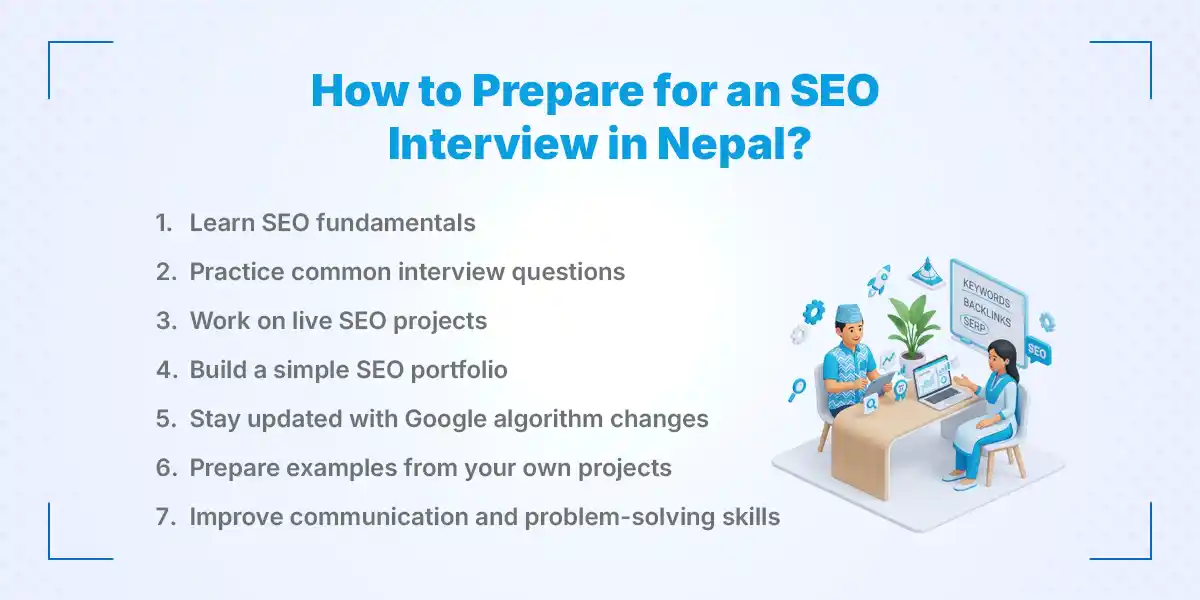
- Learn SEO Fundamentals: Understand the basics of on-page SEO, off-page SEO, technical SEO, keyword research, and search intent.
- Practice Common Interview Questions: Prepare answers to frequently asked SEO interview questions and practice explaining concepts clearly.
- Work on Live SEO Projects: Gain hands-on experience by optimizing your own website, blog, or a practice project.
- Build a Simple SEO Portfolio: Showcase your SEO work, keyword research, content optimization, and website improvements to demonstrate your skills.
- Stay Updated with Google Algorithm Changes: Follow Google's latest SEO updates and industry trends to keep your knowledge current.
- Prepare Examples from Your Own Projects: Be ready to explain the SEO strategies you used, the challenges you faced, and the results you achieved.
- Improve Communication and Problem-Solving Skills: Answer questions confidently, think logically, and explain your SEO approach in a simple and professional way.
SEO Skills Employers Look for in Beginners
Employers look for beginners who have a strong understanding of SEO fundamentals, practical skills, and the ability to learn and solve problems. Developing these skills can improve your chances of getting an SEO job.
- Keyword Research: Ability to find relevant keywords based on search intent and search volume.
- On-Page SEO: Knowledge of optimizing titles, meta descriptions, headings, URLs, images, and content.
- Technical SEO Basics: Understanding of website speed, mobile-friendliness, indexing, XML sitemaps, and robots.txt.
- Content Optimization: Ability to create and optimize SEO-friendly content that provides value to users.
- Basic Link Building Knowledge: Understanding how backlinks improve website authority and search rankings.
- Analytical Thinking: Ability to analyze SEO data and identify opportunities to improve website performance.
- Communication Skills: Ability to explain SEO concepts clearly and work effectively with team members or clients.
- Familiarity with SEO Tools: Basic knowledge of tools like Google Search Console, Google Analytics 4 (GA4), Google Keyword Planner, Ahrefs, and SEMrush.
Career Opportunities After Learning SEO
Learning SEO can open the door to many career opportunities in Nepal and around the world. As businesses continue to invest in digital marketing, the demand for skilled SEO professionals is growing across industries.
- SEO Executive: Optimize websites, conduct keyword research, and improve search engine rankings.
- SEO Analyst: Analyze website performance, track SEO metrics, and develop strategies to increase organic traffic.
- Content SEO Specialist: Create and optimize SEO-friendly content that ranks well on search engines.
- Technical SEO Executive: Improve website speed, indexing, crawlability, and overall technical performance.
- Local SEO Specialist: Optimize Google Business Profiles and local search visibility for businesses targeting specific locations.
- Freelance SEO Consultant: Provide SEO services to multiple clients, helping them increase website traffic and online visibility.
Why Learn SEO at Kumarijob Training?
Kumarijob Training is a great choice for anyone who wants to build practical SEO skills and prepare for a successful career in digital marketing. The course is designed for students, job seekers, freelancers, and professionals who want hands-on experience and industry-relevant knowledge.
- Industry-Focused Curriculum: Learn the latest SEO techniques and best practices used by businesses.
- Hands-On Practical Training: Gain real experience by working on SEO tasks and website optimization.
- Live Projects: Apply your knowledge to real-world SEO projects and build a strong portfolio.
- Expert Mentorship: Learn from experienced SEO professionals who provide guidance and feedback.
- SEO Tools Training: Get practical experience with Google Search Console, Google Analytics 4 (GA4), Google Keyword Planner, Ahrefs, SEMrush, Screaming Frog, and other essential SEO tools.
- Certificate of Completion: Receive a certificate after successfully completing the training to strengthen your resume.
- Career Guidance and Placement Support: Get resume-building support, interview preparation, career counseling, and placement assistance to help you start your SEO career.
Conclusion
Preparing for SEO interview questions is one of the best ways to start a successful career in digital marketing. By understanding SEO fundamentals, practicing common interview questions, learning SEO tools, and gaining hands-on experience, you can confidently answer interview questions and improve your chances of getting hired.
If you want to build job-ready SEO skills, joining a practical SEO training program can make a big difference. Kumarijob Training provides industry-focused learning, live projects, expert mentorship, SEO tools training, and career support to help beginners prepare for SEO interviews and succeed in the digital marketing industry.
Frequently Asked Questions
Submit your comments

Get Our App On



What Is the Taxpayer Incentive Gift Program in Nepal?
VIEW DETAILS
What Is the Difference Between Free and Paid Digital Marketing Courses in 2026?
VIEW DETAILS
How Do Facebook Ads Work in 2026?
VIEW DETAILS
How to Create Your First Google Ads Campaign (Beginner's Step-by-Step Guide)
VIEW DETAILS


Loading Comments...