


The public is interested in how much Nepalese lawmakers are paid because they want to know how their tax money is being used. While their basic salary is public, various allowances and meeting fees often make the total amount confusing for the average person.
This guide gives you a clear breakdown of the 2026 salary and benefits for Federal Parliament members. You will see exactly what an MP earns, the specific perks they get, and what it takes to become one.
In this blog
Who are Members of Parliament (MPs) in Nepal?
Members of Parliament (MPs) are the elected or nominated individuals who serve in the Federal Parliament of Nepal. They hold the supreme legislative authority to draft national laws and oversee the government's executive actions.
1. Types of MPs in Nepal
Nepal's bicameral parliament consists of members from two distinct houses with different selection methods.
House of Representatives (Pratinidhi Sabha): 275 members representing the lower house.
National Assembly (Rastriya Sabha): 59 members representing the upper house and provincial interests.
Directly Elected MPs: 165 individuals chosen through the First-Past-The-Post (FPTP) system.
Proportional Representation (PR) MPs: 110 individuals selected based on the total votes received by their political party.
2. Role and Responsibilities of MPs
The primary duty of an MP is to bridge the gap between the needs of the citizens and the official policy of the state.
Legislative Action: Drafting, debating, and voting on new laws or amendments.
Public Representation: Advocating for the specific needs and development of their home constituencies.
Executive Oversight: Monitoring government spending and holding ministers accountable during parliamentary discussions.
Policy Formation: Contributing to national development strategies and foreign policy debates.
Salary of MPs in Nepal
The remuneration of Nepalese lawmakers consists of a fixed baseline salary heavily subsidized by specific performance and housing allowances. The Federal Parliament scales this pay based on the executive responsibility held by the official.
1. Basic Salary of Nepalese MPs
A standard Member of Parliament in Nepal receives a monthly basic salary of NPR 66,070, which serves as their primary taxable income. The Ministry of Finance occasionally revises this figure during the annual national budget announcement to account for inflation and economic shifts. While the basic salary remains a fixed guarantee, allowances act as separate, variable payments meant strictly to cover official logistical expenses.
2. Position-wise Salary in Parliament
Leadership roles carry higher base pay to reflect their heavy constitutional burdens. The Speaker of the House and the National Assembly Chairperson receive a basic monthly salary of NPR 67,320, alongside dedicated government housing and state vehicles. Deputy Speakers and Committee Coordinators earn slightly less base pay but still benefit from substantial perks, including state-funded fuel quarters and private secretariat arrangements that standard MPs do not receive.
Allowances and Facilities Received by MPs
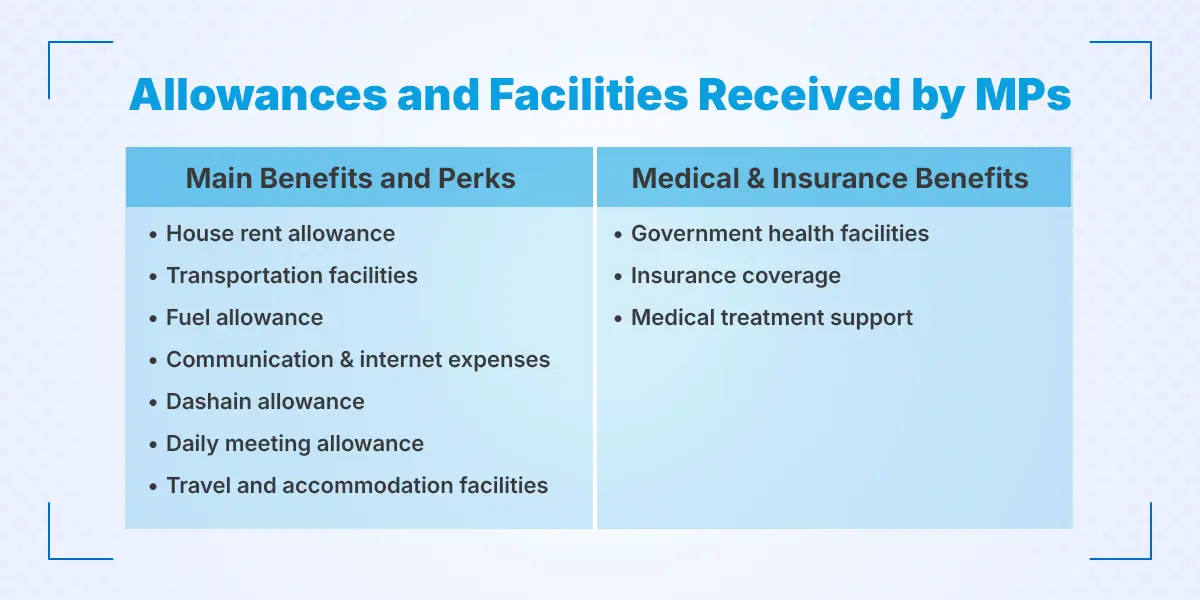
Lawmakers receive extra funds beyond their basic pay to help them perform their duties effectively in the capital. The Parliament Secretariat manages these allowances to cover living costs, travel, and health needs.
1. Main Benefits and Housing Perks
Housing and communication perks are monthly funds given to lawmakers to ensure they have a secure place to live and can stay connected with their voters. An MP without a house in the Kathmandu Valley receives NPR 18,000 monthly for rent. Homeowners in the capital receive NPR 9,000 instead for basic maintenance.
Representatives also get NPR 3,000 for mobile and internet bills, plus NPR 2,000 for water and electricity. During the major Dashain festival, the state gives them an extra month's basic salary as a festive bonus.
For example, a newly elected MP moving from a rural district will use the housing allowance and a one-time NPR 15,000 furniture grant to quickly set up a functional apartment in Kathmandu.
2. Daily Meeting and Travel Allowances
Travel and meeting allowances are daily financial payments given to representatives strictly to cover their transport and effort when they actively participate in parliamentary sessions. Lawmakers earn NPR 1,000 for attending a meeting and another NPR 1,000 to cover local vehicle fares for that specific day.
When traveling from their home district to Kathmandu, the state reimburses their flight or bus tickets. The Secretariat also provides up to NPR 2,500 per day for food and snacks during this transit.
Regular MPs do not receive an unlimited monthly fuel allowance. The government actually cut fuel limits in April 2026 to control public expenditure, which strictly reduced the fuel quotas for high-ranking officials and committee chairs who use state vehicles.
3. Medical and Insurance Benefits
Medical coverage for lawmakers involves state-funded health insurance and direct hospital support designed to keep public officials healthy and capable of serving their full legislative term. The government generally covers major medical treatments at designated public facilities like the VIP wing of Bir Hospital.
Nepal's national health insurance system faced severe funding shortages in early 2026, causing many public hospitals to temporarily suspend regular insurance-based services.
Despite these wider national insurance problems, MPs still secure their medical care through direct state funding. They submit their private or public hospital bills directly to the Parliament Secretariat to get their expensive treatment costs refunded.
How Much Do MPs Earn Monthly in Nepal?
The total monthly income of a regular Member of Parliament in Nepal typically ranges between NPR 89,000 and NPR 119,000, depending on their housing status and how many parliamentary sessions they attend that month.
This total is calculated by combining their fixed basic salary with standard monthly allowances (for housing, communication, and utilities) and variable daily allowances (meeting and transport fees). It is also important to note that most political parties deduct a mandatory monthly "levy" directly from the MP's paycheck before it reaches their bank account.
Here is a clear breakdown of all potential monthly earnings:
| Earnings Category | Amount (NPR) | Description |
|---|---|---|
| Basic Salary | 66,070 | Fixed monthly base pay, subject to income tax. |
| Housing Allowance | 18,000 or 9,000 | 18,000 for non-homeowners; 9,000 maintenance for homeowners. |
| Communication | 3,000 | Fixed monthly allowance for mobile and internet bills. |
| Utilities | 2,000 | Fixed monthly allowance for water and electricity. |
| Daily Meeting Fee | 1,000 per day | Paid only for days a parliamentary session is held. |
| Daily Transport Fee | 1,000 per day | Paid only for days a parliamentary session is held. |
Salary of MPs Compared to Other Government Officials
The financial compensation of an MP sits squarely in the middle tier of Nepal's government pay scale. Their earnings reflect their legislative role rather than the heavy administrative duties held by executive or judicial leaders.
MP Salary vs Minister Salary
A regular MP earns a basic monthly salary of NPR 66,070, while a Cabinet Minister earns approximately NPR 79,230. Ministers receive significantly higher pay and superior benefits, such as dedicated government housing, personal security details, and state-funded vehicles, to support their executive duties in running entire government departments.
MP Salary vs Chief Justice Salary
The Chief Justice of Nepal earns a fixed monthly base salary of NPR 102,293, making it substantially higher than an MP's salary. This higher pay tier is designed to ensure absolute financial security and judicial independence, accompanied by a state-maintained Baluwatar residence and a lifetime pension, which regular MPs do not receive.
MP Salary vs Civil Service Officers
An MP's basic salary of NPR 66,070 is comparable to the pay of a high-ranking Civil Service Secretary, whose base pay starts around NPR 68,460. However, mid-level civil servants like Section Officers earn much less, around NPR 47,000, though civil servants benefit from long-term job security, yearly grade increments, and standard government pensions that elected lawmakers lack.
How are MPs Paid in Nepal?
Lawmakers receive their monthly salaries and reimbursements directly from the Federal Parliament Secretariat. These funds are sourced entirely from the annual national budget through taxpayer money.
Source of MP Salary
The Ministry of Finance allocates a specific budget to the legislative branch during the annual fiscal planning. The Parliament Secretariat then manages this taxpayer-funded budget, depositing the fixed basic salaries and calculated allowances directly into the MPs' bank accounts each month, after deducting applicable income taxes and mandatory political party levies.
Qualifications Required to Become an MP in Nepal
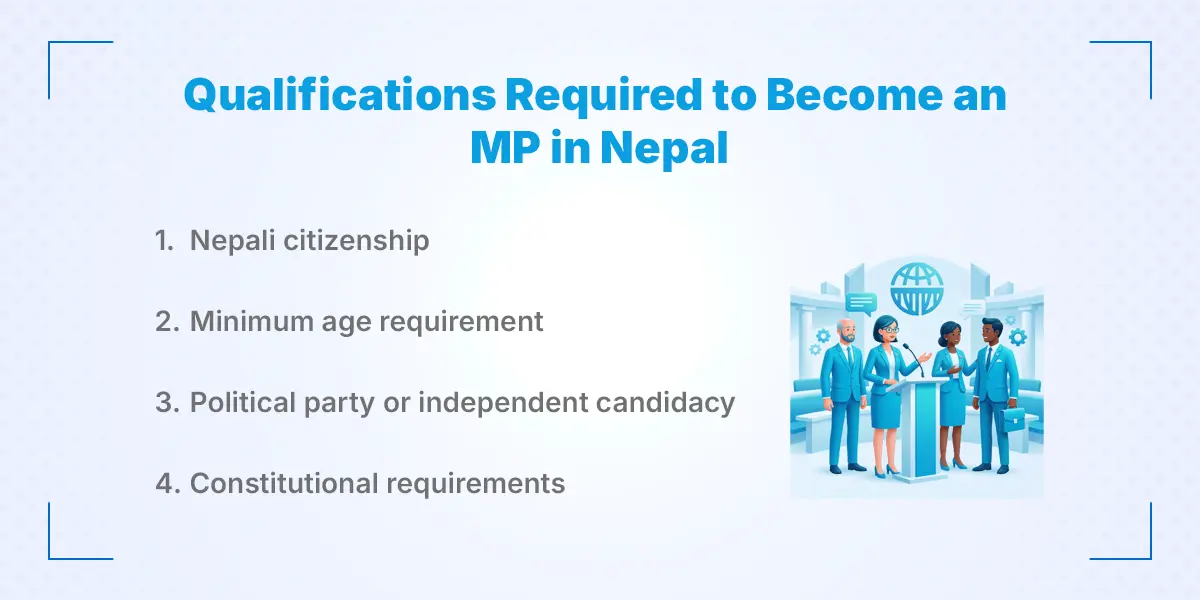
To become a Member of Parliament in Nepal, candidates must meet strict eligibility criteria set by Article 87 of the Constitution. These rules ensure that only legally qualified and morally responsible citizens can hold supreme legislative power.
1. Nepali Citizenship and Basic Eligibility
The most fundamental requirement to stand for parliamentary elections is holding official Nepali citizenship. A candidate cannot simply be a resident; they must possess a valid citizenship certificate issued by the state. This rule prevents foreign influence in national policy-making and ensures complete allegiance to the country. Candidates must present this documentation to the Election Commission during the formal nomination process. If a person acquires foreign citizenship or permanent residency abroad, they immediately lose their eligibility to serve in the Federal Parliament.
2. Minimum Age Requirements for Both Houses
The Constitution sets different age thresholds depending on which parliamentary house a candidate wishes to enter. To run for a seat in the House of Representatives, a person must have completed 25 years of age. However, to serve in the National Assembly, the age requirement is significantly higher at 35 years. This difference exists because the upper house is designed to be a mature, permanent oversight body, requiring more life and professional experience. Young politicians often focus on the lower house first before attempting to secure a nomination for the National Assembly later in their careers.
3. Political Party or Independent Candidacy Rules
Citizens can choose to run for office under the banner of a registered political party or as independent candidates. Party-affiliated candidates must secure a formal nomination ticket from their party's central committee. Independent candidates bypass this party machinery but must gather a specific number of verified signatures from registered voters within their chosen constituency. Both types of candidates must pay a required deposit fee to the Election Commission, which is forfeited if they fail to secure a minimum percentage of the valid votes. This system allows for diverse political representation while filtering out non-serious contenders.
4. Constitutional and Moral Turpitude Requirements
The state strictly prohibits individuals with serious criminal backgrounds from entering the Federal Parliament. A candidate must not have been convicted of any criminal offense involving moral turpitude, such as corruption, rape, human trafficking, or money laundering. Additionally, they must not hold any "office of profit" under the government, meaning they cannot receive a state salary for another job while serving as an MP. The Election Commission actively screens nominations and will immediately disqualify anyone who violates these constitutional boundaries. For example, a former civil servant must officially resign from their government post before filing their candidacy papers.
How are MPs Elected in Nepal?
Nepal uses a mixed electoral system to choose representatives for the Federal Parliament. Voters participate in two separate processes to select local candidates directly and national political parties proportionally.
1. The Mixed Electoral System (FPTP and PR)
The mixed system combines First-Past-The-Post (FPTP) for individual candidates with Proportional Representation (PR) for political parties to ensure a diverse legislative body. Out of the 275 lower house seats, 165 members are elected directly from specific geographic constituencies. The remaining 110 seats are distributed based on the total nationwide votes each party receives, ensuring minority and gender representation quotas are met.
2. Candidate Nomination and Campaigns
Political party nomination involves the selection of official candidates by party committees to represent their platform during the national election cycle. Independent candidates can also bypass this process by securing verified voter signatures. Once nominated, politicians engage in a brief, highly regulated campaign period to present their manifestos to the public before a mandatory "silence period" begins just before election day.
3. Voting and Final Result Declaration
Final result declaration occurs after the Election Commission counts all valid ballots and assigns seats based on both direct wins and the proportional vote share. The results for the 165 direct FPTP seats are typically announced within days of the election. The proportional seats take longer, as the Commission uses specialized software and mathematical formulas to fairly distribute the 110 remaining seats among parties that cross the 3% vote threshold.
Facilities After Retirement for MPs
Unlike career civil servants, Nepalese lawmakers do not receive a traditional lifetime pension or extensive state support once their five-year term ends. Recent government austerity measures in 2026 have actively reduced the post-service perks that former officials previously enjoyed.
1. Pension-Related Discussions
The Federal Parliament does not provide a regular monthly pension to former regular Members of Parliament. Politicians only receive a lump-sum return of the money they contributed to the Provident Fund during their active tenure, along with accumulated interest. While recent drafts of civil service bills sparked debates about granting lifelong financial benefits to former high-ranking state officials, intense public backlash and economic constraints have prevented standard MPs from receiving lifetime state salaries.
2. Government Facilities After Tenure
Once an MP leaves office, the state immediately cuts off access to government housing, fuel quotas, and communication allowances. Furthermore, an April 2026 Supreme Court ruling officially abolished the controversial provision that allowed the government to fund expensive overseas medical treatments for former dignitaries and MPs. Former lawmakers must now rely on their personal savings or standard national health insurance for medical care.
3. Security and Protocol Services
Former MPs do not automatically receive state-funded personal security officers (PSOs) or government vehicles upon retirement. Security details are strictly reserved for former Prime Ministers, Presidents, or individuals with a proven, documented threat assessment. In early 2026, the Ministry of Finance directed the Home Ministry to recall unauthorized security entourages from former officials to stop the exploitation of police personnel and state resources.
Conclusion
Transparency in public spending ensures that every citizen can hold their elected representatives accountable for their legislative performance. By looking past the official figures, voters gain a clearer understanding of how national resources support the work of the Federal Parliament.
If you are ready to take the next step in your own professional journey within the public or private sector, start your search with the right career platform. Explore the Latest Job Vacancies in Nepal on Kumari Job.
Submit your comments

Get Our App On



SEO Training for Freshers in Nepal: Skills, Career & Job Opportunities
VIEW DETAILS
SEO Training vs. Self-Learning: Which Is Right for You?
VIEW DETAILS
How to Choose Between Two Job Offers
VIEW DETAILS
Digital Marketing Training Interview Questions and Answers for Freshers
VIEW DETAILS


Loading Comments...