


Finding reliable information about the Chief Justice of Nepal's salary and perks often leads to confusing government documents and outdated reports. Whether you are studying for civil service exams or just curious about high-level government pay, you likely want clear figures without the legal jargon.
This guide breaks down the monthly salary, special allowances, and the full list of facilities provided to the Pradhan Nyayadhish. You will walk away with a complete understanding of the financial package, the appointment process, and the retirement benefits that come with Nepal's highest judicial office.
In this blog
Who is the Present Pradhan Nyayadhish of Nepal?
When the top judge leaves, the court still needs a strong leader to handle daily legal issues. For example, when Chief Justice Prakash Man Singh Raut retired in April 2026 due to the age limit, the Supreme Court could not pause its work. The senior-most judge immediately stepped up as the acting leader to keep the justice system running smoothly and prevent case delays.
1. Name of the Current Chief Justice
As of May 2026, the present Pradhan Nyayadhish of Nepal is Sapana Pradhan Malla, who serves as the Acting Chief Justice. She took over the role after the former Chief Justice reached his legal age limit. Recently, on May 7, 2026, the Constitutional Council recommended Justice Dr. Manoj Kumar Sharma to be the next official Chief Justice. This choice skipped over older judges and caused a major debate in the legal community. Until parliament officially approves the new choice, Justice Malla will continue to direct the Supreme Court.
2. Appointment Date
Sapana Pradhan Malla officially started her role as Acting Chief Justice on April 1, 2026. She took this position the exact day the previous leader retired. She has served as a Supreme Court Justice since August 1, 2016. If parliament approves Dr. Manoj Kumar Sharma, the President will give him a new official appointment date very soon. Fast changes in leadership help the courts avoid long delays in hearing important cases.
3. Educational and Professional Background
Sapana Pradhan Malla holds a Bachelor of Law from Tribhuvan University, a Master in Comparative Law from Delhi University, and a Master in Public Administration from Harvard University. Before becoming a judge, she worked as a top lawyer fighting for women's rights and legal equality in Nepal. She also helped write laws as a member of Nepal's first Constituent Assembly from 2008 to 2012. Her strong education helps her understand both making laws and defending them in court. This deep background makes her highly qualified to judge difficult national issues.
4. Major Responsibilities in Office
The Chief Justice holds the primary responsibility of leading Nepal’s judiciary, running the Supreme Court, and protecting the constitutional rights of all citizens. This leader actively decides which judges will hear specific cases every single day. The Chief Justice also manages all the lower courts across the country to make sure they deliver justice fairly. They sit on a special council that helps pick leaders for other important groups. By doing all these tasks, the Chief Justice keeps the rule of law strong and active in Nepal.
What Does a Chief Justice (Pradhan Nyayadhish) Do?
The Chief Justice of Nepal acts as the highest judicial officer who leads the entire court system, manages the Supreme Court's daily operations, and protects citizen rights by interpreting the national constitution.
This leader actively decides which cases require immediate legal attention and assigns specific judges to handle them. They also chair critical committees, including the Judicial Council, which guide nationwide legal policies. Their daily work guarantees that no government action oversteps legal boundaries.
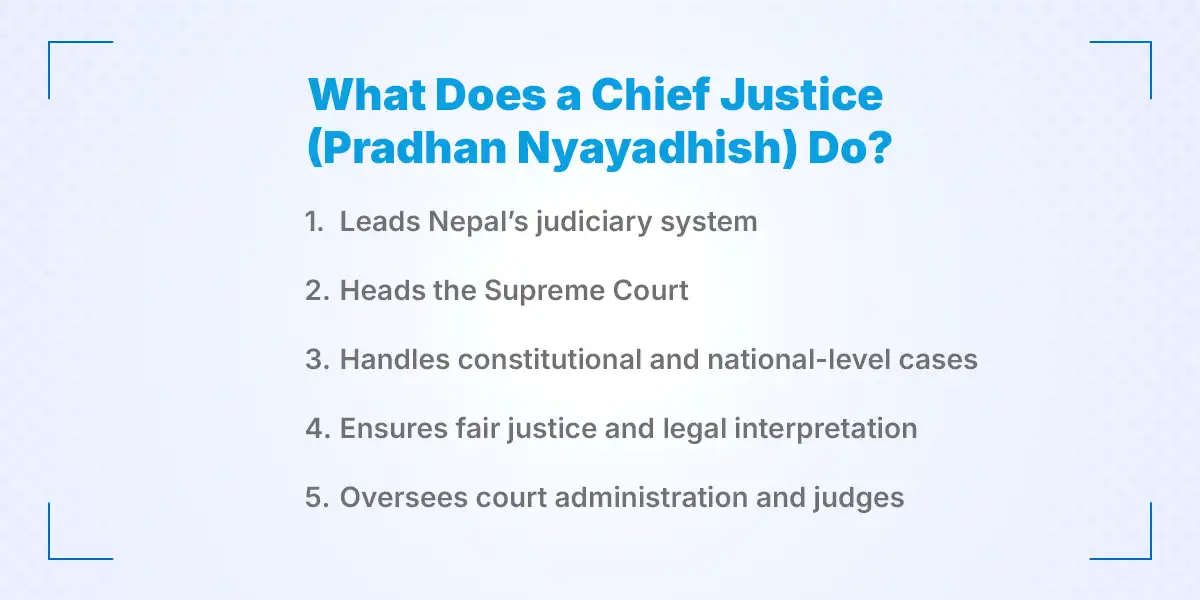
As the ultimate authority in the legal system, the Pradhan Nyayadhish performs several core duties:
Leads Nepal’s Judiciary System: The Chief Justice holds the ultimate responsibility for delivering effective justice across all subordinate courts, specialized tribunals, and local judicial bodies.
Heads the Supreme Court: As the chief judge, they manage the daily case schedules, direct the administrative staff, and control the internal working procedures of the top court.
Handles Constitutional and National-Level Cases: They personally lead the five-member Constitutional Bench to resolve major political conflicts, such as disputes between the federal government and provincial authorities.
Ensures Fair Justice and Legal Interpretation: They actively protect citizens by issuing extraordinary writs, such as habeas corpus, to correct illegal government actions and clarify exactly what complex laws mean.
Oversees Court Administration and Judges: Through their role on the Judicial Council, the Chief Justice controls the hiring, transfer, promotion, and disciplinary actions for judges in all lower courts.
To understand this power in action, look at their constitutional oversight. For example, if a new federal policy illegally restricts public freedom, the Chief Justice can use extraordinary writ jurisdiction to freeze the policy immediately until a full court review determines its legality.
Chief Justice (Pradhan Nyayadhish) Salary in Nepal
The Chief Justice of Nepal earns a fixed monthly base salary of NPR 102,293, supplemented by state-funded allowances, a fully maintained government residence, and lifetime pension benefits. The government structured this specific compensation package to guarantee total financial independence for the head of the judiciary. For example, when the government last enacted a sweeping 15 percent pay hike for civil servants, the Chief Justice's base pay increased directly from NPR 88,950 to the current NPR 102,293 to match the national cost of living.
1. Monthly Salary Details
The monthly salary of Nepal's Chief Justice currently stands at a fixed base of NPR 102,293. The Ministry of Finance deposits this exact amount directly into the official's bank account at the end of every Nepali calendar month. This specific base figure serves as the mathematical foundation for calculating all future pension payouts and festival bonuses. The state established this high salary tier to ensure the top judge remains financially secure and resistant to outside influence. The pay structure reflects the massive constitutional responsibility placed entirely on one individual.
2. Government Allowances and Benefits
The state provides a comprehensive package of non-taxable financial allowances to support the Chief Justice's daily operational and professional needs. The official receives a specific communication allowance to cover mobile and internet expenses required for reviewing urgent legal documents at home. The government also supplies a dedicated hospitality allowance used to host foreign dignitaries or visiting judicial scholars. A separate fuel allowance covers all official travel costs across the country. These combined financial allowances significantly increase the actual monthly take-home value far beyond the base salary number.
3. Dashain Allowance and Yearly Increments
The Dashain allowance is a legally mandated, once-a-year bonus equivalent to exactly one full month's basic salary, which currently equals NPR 102,293. The government issues this payment a few weeks before the Dashain festival to help the official cover traditional holiday expenses. Beyond this specific festival bonus, the Chief Justice benefits from a standard system of yearly grade increments. Each full year of completed service adds a fixed grade amount to the base pay. This dual system ensures the total compensation package grows steadily to combat national inflation.
4. Official Facilities and Perks
The Chief Justice receives exclusive access to a fully furnished, state-maintained official residence located in a highly secure zone in Kathmandu. The government assigns a dedicated luxury vehicle, complete with a professional driver, for all official and personal transportation needs. To ensure absolute safety, the state provides a permanent security detail composed of armed police personnel who guard the official constantly. The office also includes a team of personal administrative staff, including private secretaries and domestic helpers. Following retirement, the state continues to provide a lifelong monthly pension and subsidized medical care.
5. Salary Comparison with Other High-Ranking Officials
The Chief Justice's base salary ranks among the absolute highest in the Nepalese civil and political structure. To understand this scale, the Prime Minister earns a lower base salary of roughly NPR 77,280, though executive allowances push the final total higher. Supreme Court Justices earn NPR 85,043 per month, sitting firmly below their leader. Cabinet Ministers receive around NPR 72,730, while Members of Parliament earn approximately NPR 66,240. This specific pay hierarchy demonstrates that the national government places immense financial value on the independence of the judicial branch.
Benefits and Facilities of Nepal’s Chief Justice
The Nepalese government provides a complete lifestyle and security package to the Chief Justice to ensure total judicial independence. For example, when former Chief Justices face high-profile threats after ruling on major political cases, the state's dedicated security and housing facilities protect them from external pressure. These benefits extend far beyond a monthly salary, covering everything from daily transport to lifetime medical care.
1. Government Residence
The Chief Justice of Nepal receives a state-owned, fully furnished official residence located in the highly secure Baluwatar area of Kathmandu, with all maintenance and utility costs covered by the government. This specific location keeps the judiciary's head close to other top government leaders while maintaining strict privacy.
The government's dedicated maintenance department handles all housing repairs, landscaping, and daily upkeep immediately. This setup ensures the official does not waste time managing personal housing issues during their term. By living in this secure zone, the Chief Justice can review sensitive court documents at home without fearing espionage or public harassment.
2. Official Vehicle and Security
The state provides the Chief Justice with a high-end luxury vehicle, a professional government driver, and a dedicated 24-hour security detail composed of armed Nepal Police personnel. The government pays for all fuel, regular maintenance, and insurance costs for this official car.
A pilot vehicle with armed guards clears the traffic ahead during daily commutes to the Supreme Court. The security team also guards the official residence and accompanies the leader during all domestic travel. This strict protection protocol actively shields the judge from any physical threats related to controversial court decisions.
3. Medical and Insurance Benefits
The Nepalese government pays the complete medical expenses for the Chief Justice and their immediate family members, including costs for specialized emergency treatments required at recognized foreign hospitals. The Finance Ministry maintains a specific emergency medical fund strictly for top-level constitutional officials.
If the leader requires complex surgery unavailable in Kathmandu, the state will fly them to advanced medical centers abroad. This health insurance package remains active throughout their entire working tenure at the Supreme Court. Providing free, high-quality healthcare prevents financial stress from affecting major legal judgments.
4. Pension and Retirement Facilities
Upon completing their service, the retired Chief Justice receives a lifelong monthly pension equal to a high percentage of their final active salary, along with continued state security services. The government also provides a dedicated vehicle and a personal driver for their remaining years.
These specific retirement benefits recognize the individual's lifetime commitment to the nation's legal system. The state guarantees this ongoing financial support so former leaders never have to seek private employment after stepping down. This policy completely removes the temptation for a sitting judge to make corrupt deals for future financial gain.
5. Administrative and Support Staff
The Chief Justice directs a private secretariat funded entirely by the Supreme Court budget, which includes a personal secretary, legal assistants, and domestic helpers for the official residence. This team actively filters daily communications, manages a highly complex scheduling calendar, and prepares legal briefs.
The legal assistants do deep research on past case laws to save the head judge valuable time. The domestic staff handles cooking and cleaning at the Baluwatar house. Giving the leader a large support team allows them to focus purely on delivering justice rather than handling basic office tasks.
How is the Chief Justice Appointed in Nepal?
The appointment of the Chief Justice of Nepal is a multi-step constitutional process involving the Constitutional Council’s recommendation, a parliamentary hearing, and a final official appointment by the President of Nepal. This rigorous system ensures that the head of the judiciary is chosen through a balance of power between the executive, legislative, and judicial branches. For example, the recent recommendation of Dr. Manoj Kumar Sharma on May 7, 2026, demonstrates how the Constitutional Council initiates the process by selecting a candidate from the pool of eligible Supreme Court judges before the name moves to the parliament for public vetting.
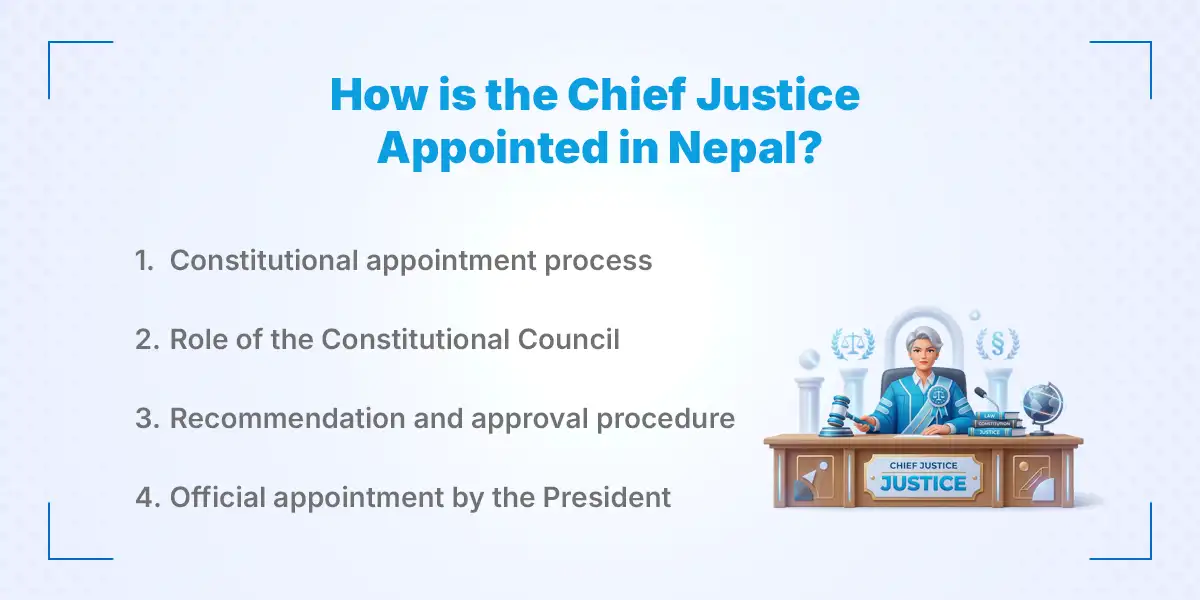
1. Constitutional Appointment Process
The Constitution of Nepal (Part 11, Article 129) establishes the formal legal framework for selecting the Chief Justice to ensure the judiciary remains independent from political interference. This process begins officially when the position is set to become vacant due to the mandatory retirement age or a resignation. The law mandates that the candidate must have served as a judge of the Supreme Court for at least three years to be eligible for the promotion. This legal structure prevents inexperienced individuals from leading the nation's highest court. By following these specific constitutional steps, the state maintains a predictable and stable transition of judicial leadership. The process protects the court's integrity by requiring multiple levels of institutional agreement.
2. Role of the Constitutional Council
The Constitutional Council is a powerful six-member body led by the Prime Minister that recommends a qualified individual for the position of Chief Justice. This council also includes the Speaker of the House of Representatives, the Chairperson of the National Assembly, the Chief Justice (unless the position is being filled), and the Leader of the Opposition. Their primary job is to review the professional records, judicial history, and moral character of the eligible senior judges. They must meet formally to debate the merits of each candidate before making a final choice. The council acts as the first major gatekeeper to ensure that only highly qualified people reach the final stages of the appointment. This group's diverse membership prevents any single political party from controlling the judicial selection.
3. Recommendation and Approval Procedure
Once the Constitutional Council selects a candidate, the Parliamentary Hearing Committee must investigate and approve the recommendation through a transparent public testimony process. The council sends the nominee's name to this fifteen-member committee, which represents all major political parties in the parliament. This committee invites the public to submit any complaints or evidence of misconduct against the nominee within a set timeframe. During the actual hearing, the candidate must answer direct questions about their judicial philosophy and past rulings. If the committee does not reject the candidate by a two-thirds majority, the nomination is considered officially approved. This step allows the citizens, through their representatives, to verify the fitness of the future head of the judiciary.
4. Official Appointment by the President
The President of Nepal officially appoints the Chief Justice and administers the oath of office once the Parliamentary Hearing Committee provides its final confirmation. This final ceremonial act takes place at the presidential palace, Shital Niwas, in the presence of the Prime Minister and other top dignitaries. The President signs the formal appointment letter, which officially grants the judge the powers of the Pradhan Nyayadhish. During the ceremony, the new Chief Justice swears to protect the Constitution and deliver justice without fear or favor. This official signature marks the precise moment the new leader gains full legal authority over the entire judicial system. The President's role serves as a final check to ensure the appointment followed every legal and protocol requirement.
Qualifications Required to Become Chief Justice in Nepal
The Constitution of Nepal clearly defines the stringent educational and professional standards required to lead the nation's highest court and protect the rule of law. For example, when Dr. Manoj Kumar Sharma was recommended for the position in May 2026, his legal eligibility rested solely on his fulfillment of the specific constitutional mandate of three years of service at the Supreme Court level, despite skipping over senior colleagues. This action proved the system strictly follows constitutional experience requirements over simple seniority alone.
1. Educational Qualifications
To qualify for the role of Chief Justice, an individual must hold a minimum of a recognized Bachelor’s Degree in Law from an accredited university. This foundational academic requirement ensures the judicial leader fully comprehends the complex mechanics of drafting, analyzing, and applying statutory frameworks.
The theory behind this requirement dictates that formal legal education provides the necessary intellectual tools to handle complex constitutional interpretations. In practice, future candidates complete their undergraduate law studies before pursuing advanced degrees like a Master in Comparative Law to deepen their analytical skills.
The Judicial Council strictly enforces this academic standard during the very first hiring phase for section officers. Without this formal degree, no citizen can enter the judicial service or begin the long climb to the Supreme Court.
2. Legal and Judicial Experience
A candidate must possess an extensive and unbroken history of professional legal practice or judicial service before they can even enter the Supreme Court pool. To reach the top court initially, a judge usually needs at least five years of experience as a High Court judge or fifteen years practicing law constantly as a senior advocate.
This long professional journey guarantees the individual has successfully navigated thousands of real-world legal disputes before handling national crises. A lawyer builds this experience by actively litigating complex cases in lower courts and earning the respect of the Nepal Bar Association.
The system actively screens out inexperienced individuals at multiple levels of promotion. This rigorous vetting ensures only battle-tested legal minds reach the final selection phase for the highest office.
3. Constitutional Eligibility Criteria
The Constitution of Nepal strictly mandates that a candidate must maintain a high moral character, be a citizen of Nepal, and face no legal disqualifications to lead the judiciary. The state requires absolute ethical purity because the Chief Justice serves as the ultimate guardian of fundamental citizen rights.
If an individual has a past conviction for a criminal offense involving moral turpitude, the law automatically and permanently bars them from holding this high office. Candidates prove their moral standing by maintaining a clean professional record free from corruption charges throughout their entire career.
The Parliamentary Hearing Committee actively investigates the candidate's background to ensure they meet these ethical standards. This strict constitutional gatekeeping protects the Supreme Court from internal corruption and maintains public trust in the justice system.
4. Experience as a Supreme Court Judge
Article 129 of the Constitution explicitly states that an individual must serve actively as a Supreme Court judge for at least three full years to qualify for the Chief Justice position. This specific rule acts as the final and most critical filter, proving the candidate can handle the intense pressure of the nation's highest judicial bench.
The theory asserts that leading the Supreme Court requires direct, hands-on knowledge of its unique internal procedures, administrative challenges, and case management systems. Judges actively fulfill this requirement by presiding over major national cases, writing complex legal opinions, and serving on constitutional benches during their initial tenure.
The Constitutional Council cannot legally recommend any judge who has served for only two years, regardless of their past brilliance. This mandatory waiting period prevents political leaders from placing outside allies directly into control of the entire judicial branch.
Powers and Responsibilities of the Chief Justice
The Chief Justice of Nepal exercises supreme judicial authority by leading the Supreme Court, forming constitutional benches to resolve national disputes, and supervising all lower-level courts to ensure the fair application of law.
This leader serves as the final arbiter of legal truth, ensuring that no branch of government oversteps its constitutional boundaries. A clear example of this power occurred during the historic House of Representatives dissolution cases, where the Chief Justice led the bench to determine whether the Prime Minister's actions aligned with the national charter. By exercising these powers, the official maintains the delicate balance between the state and its citizens.
1. Judicial Leadership
The Chief Justice serves as the ultimate spokesperson and moral leader of the national legal community to protect the independence of the court from external political pressure. This leader sets the ethical standards that all other judges and lawyers must follow during their professional duties. They represent the judiciary in high-level meetings with the President and Prime Minister to discuss the state of the law. By maintaining a strong public image, the Chief Justice ensures that citizens trust the court's ability to provide fair trials. This leadership is critical for keeping the three branches of government balanced and functional.
2. Formation of Constitutional Benches
The Chief Justice holds the exclusive authority to select specific judges to sit on the Constitutional Bench, which handles cases involving the most critical legal disputes in Nepal. This power allows the leader to decide who will hear arguments about federalism, election disputes, or the removal of top officials. According to the Constitution, this bench must include the Chief Justice and four other judges chosen from the Supreme Court. By picking these individuals, the leader directly influences how the nation’s most important laws are interpreted and applied. This strategic role prevents any single person from deciding the fate of the nation alone while ensuring the best legal minds are involved.
3. Interpretation of the Constitution
The Chief Justice acts as the final gatekeeper of legal meaning by clarifying ambiguous laws and ensuring that every government action aligns with the written Constitution of Nepal. When the executive or legislative branches pass a law that seems unfair, this official has the power to declare it void through a formal judicial review. This process involves examining the deep legal intent behind the words of the Constitution to protect the fundamental rights of the public. The leader’s interpretation becomes a binding precedent that every lower court in the country must follow in future cases. This responsibility guarantees that the law remains consistent and predictable for all citizens across Nepal.
4. Managing the Judiciary System
The Chief Justice manages the vast administrative machinery of the entire court system, including overseeing budgets, physical buildings, and the specialized staff required to run the Supreme Court. This role requires the leader to work closely with the Registrar to ensure that case files are organized and the courtrooms function efficiently. They must plan for the long-term needs of the judiciary, such as upgrading computer systems or building new court facilities in remote provinces. By controlling these resources, the leader ensures that the wheels of justice turn without being slowed down by poor management or lack of funding. Effective administration is the foundation that allows judges to focus entirely on hearing cases and making decisions.
5. Supervising Lower Courts
The Chief Justice exercises total supervisory control over the High Courts and District Courts to ensure that justice is delivered uniformly and without corruption across all levels of government. This official can issue specific directives to lower-level judges to improve their speed in handling cases and reducing legal backlogs. They often visit different regions to inspect court facilities and meet with local judicial officers to discuss the challenges they face. If a lower court is failing to follow the law correctly, the Chief Justice can initiate administrative reviews to fix the problem immediately. This oversight keeps every judge in the country accountable and ensures that a citizen in a small village gets the same quality of justice as someone in the capital.
Term Duration and Retirement Age of Chief Justice
The Chief Justice of Nepal serves a maximum tenure of six years or until they reach the mandatory retirement age of 65, whichever comes first. This dual-limit system ensures the judiciary maintains a consistent rotation of leadership and prevents any single person from holding power indefinitely. For instance, if a judge is appointed at age 62, they will retire at 65 after serving only three years, rather than completing the full six-year term.
1. Official Tenure System
The Chief Justice of Nepal serves a maximum fixed term of six years to ensure leadership turnover and prevent the concentration of judicial power. This legal limit requires the official to vacate their post as soon as the six-year mark is reached, regardless of their performance. The Judicial Council tracks these dates carefully to prepare the next senior judge for a smooth transition. Most leaders in this position never reach the full six years because they hit the age limit first. This specific timeframe allows for enough time to implement reforms without creating a permanent judicial regime.
2. Retirement Age in Nepal
The mandatory retirement age for the Chief Justice is 65 years as strictly defined by Article 131 of the Constitution of Nepal. The Supreme Court administration maintains verified birth records to trigger the retirement process exactly on the official's birthday. This age limit serves to keep the highest court staffed with judges who possess the energy and modern legal perspectives required for the job. Once this age milestone is reached, the judge must step down immediately to allow for a new appointment. For example, the retirement of Prakash Man Singh Raut in early 2026 followed this exact constitutional age mandate.
3. Conditions for Resignation or Removal
A Chief Justice can leave their position early by submitting a hand-written resignation to the President or by being removed through a formal parliamentary impeachment. Impeachment only happens if the leader is found guilty of a serious constitutional violation, corruption, or physical/mental inability to work. A motion to remove them requires the signatures of at least one-fourth of the House of Representatives members to begin. To finalize the removal, two-thirds of the total parliament must vote in favor of the impeachment. This high bar protects the judge from political bullying while ensuring they remain accountable to the law.
Difference Between Chief Justice and Other Judges
The Chief Justice holds supreme administrative authority over the entire judicial branch, while other judges focus primarily on hearing and deciding individual legal cases. While their votes on a bench carry equal weight, the Chief Justice receives higher pay, specialized security, and the exclusive power to manage the court's daily schedule.
| Feature | Chief Justice (Pradhan Nyayadhish) | Other Supreme Court Judges |
|---|---|---|
| Monthly Base Salary | NPR 102,293 | NPR 85,043 |
| Case Assignment | Decides the daily cause list and bench members. | Presides only over cases assigned to them. |
| Constitutional Council | Acts as a core member to pick state leaders. | No involvement in the council. |
| Security Detail | 24-hour armed escort and pilot vehicle. | Standard police security without a pilot car. |
| Official Residence | Dedicated state mansion in Baluwatar. | Government-provided housing in various zones. |
| Judicial Council | Chairs the council that manages all judges. | No administrative control over other judges. |
History of Chief Justices in Nepal
The history of Nepal’s Chief Justices reflects the nation’s transition from a royal monarchy to a democratic republic, highlighting the continuous struggle to establish a fully independent judiciary. For example, during the 1950s, the first leaders had to build the Supreme Court from scratch under royal authority, whereas today's leaders navigate complex federalism disputes under a modern constitution.
1. First Chief Justice of Nepal
Hari Prasad Pradhan served as the first Chief Justice of Nepal when the Supreme Court officially formed in 1951. He holds a unique place in history because King Tribhuvan appointed him directly to establish the foundational rules for the modern legal system. He remains the only jurist to serve two separate terms, completing his second run under King Mahendra in the early 1960s. During his time in office, he made the historic decision to allow women lawyers to practice law in the country. His early work set the basic legal precedents that later judges used to build the modern court system.
2. Evolution of Nepal’s Judiciary
The Supreme Court evolved from a royal advisory council into a powerful, independent branch of the federal republic. In the early decades, the King held the ultimate power to appoint and dismiss the head judge at will. After the democratic movement of 1990, the new constitution granted the judiciary much stronger independence to check the power of the Prime Minister. The 2015 Constitution further cemented this by giving the Chief Justice explicit powers to manage federal disputes. Today, the appointment process requires parliamentary approval, proving the court now answers to the people rather than a monarch.
3. Important Former Chief Justices
Several past leaders made historic impacts that permanently changed how justice works in Nepal. Bishwonath Upadhyaya led the court during the 1990s and became famous for his fierce defense of judicial independence against political pressure. Sushila Karki made history in 2016 when she became the first female Chief Justice of Nepal. She built a strong reputation for fighting corruption and reforming the court's administrative delays. These leaders faced intense political backlash, including impeachment attempts, but their strong rulings shaped the modern legal landscape.
4. Major Judicial Reforms
Over the past two decades, the Supreme Court implemented massive reforms to modernize how courts handle daily cases. The leadership introduced digital case tracking systems to prevent case files from going missing. They also created strict schedules for hearing old cases to reduce the massive backlog that keeps citizens waiting years for justice. The Judicial Council created new ethical guidelines to hold lower-court judges accountable for accepting bribes. These structural changes aimed to make the court faster, cleaner, and more accessible to normal citizens.
Challenges Faced by the Chief Justice in Nepal
The Chief Justice in Nepal currently battles intense political interference, massive case backlogs, and public pressure to maintain transparency in court operations. A major example occurred in May 2026, when the Constitutional Council bypassed the senior-most judge, Sapana Pradhan Malla, and recommended the fourth-ranking judge, Dr. Manoj Kumar Sharma. This move immediately sparked lawsuits and public protests regarding political manipulation of the judiciary.
1. Political Influence and Pressure
The Chief Justice faces constant pressure from top political leaders who try to influence rulings on major constitutional cases. Because the Constitutional Council includes active politicians, the selection process itself often becomes a political negotiation rather than a strict legal review. Once in power, the leader must frequently rule on cases directly involving the very politicians who approved their appointment. Politicians sometimes threaten impeachment motions to scare the judge into making favorable decisions. The leader must constantly fight this pressure to protect the strict rule of law.
2. Judicial Transparency
Maintaining transparency in case assignments remains one of the hardest administrative challenges for the head of the court. Historically, the public and lawyers heavily criticized the traditional method where the Chief Justice manually selected judges for specific cases, suspecting favoritism. To fix this, the court recently introduced an automated lottery system to assign daily cases randomly. However, managing this system and ensuring no one tampers with the software requires constant vigilance. The leader must continuously prove to the public that court decisions are based on law, not hidden deals.
3. Delayed Case Management
The Supreme Court currently suffers from a massive backlog of unresolved legal cases that slows down the entire justice system. The Chief Justice must find ways to force judges to work faster without sacrificing the quality of their legal research. Thousands of citizens wait for years just to get a final hearing on simple property or business disputes. The leader frequently issues new directives to speed up the process, but a lack of modern court infrastructure often blocks real progress. Fixing this delay is the single most common complaint the leader hears from the Nepal Bar Association.
4. Maintaining Public Trust
The public often views the justice system with suspicion due to past scandals, forcing the Chief Justice to work actively to rebuild community trust. When the media reports on corrupt judges in lower courts, the entire judiciary suffers a massive blow to its reputation. The leader must act quickly to investigate and punish bad judges to prove the system works fairly. They also need to ensure court services remain affordable and accessible for poor citizens living outside the Kathmandu valley. If the public loses faith in the court, the entire democratic system becomes unstable.
Why the Chief Justice Position is Important in Nepal
The Chief Justice serves as the ultimate protector of the national constitution, ensuring that neither the parliament nor the Prime Minister violates the basic rights of Nepalese citizens. When the federal government and a provincial government disagree over who controls local taxes, the Chief Justice leads the Constitutional Bench to solve the crisis peacefully.
1. Protects Constitutional Rights
The Chief Justice guarantees that every citizen receives the specific freedoms promised by the Constitution of Nepal. If the police arrest someone illegally or the government seizes private land without payment, this leader can order immediate corrective action. They hold the power to review any new law passed by parliament and cancel it completely if it harms public rights. This power gives ordinary people a legal weapon to fight back against government abuse. Without this protection, citizens would have no safe way to defend themselves from state power.
2. Ensures Rule of Law
By leading the judicial branch, the official ensures that every person, regardless of their wealth or political power, must obey the exact same laws. The Chief Justice creates a strict legal environment where even a sitting Prime Minister can face legal consequences for breaking the rules. They monitor the lower courts to guarantee that local judges apply the law fairly and without bias. This consistency creates a stable environment for businesses to operate and for citizens to plan their lives. True justice relies entirely on this predictable application of legal rules.
3. Maintains Judicial Independence
The head of the court acts as a physical shield protecting lower-level judges from political bullying and external threats. By controlling the Judicial Council, the Chief Justice prevents politicians from firing judges who make unpopular but legally correct decisions. They fight constantly for better funding and security so judges never have to rely on outside favors to survive. This independence guarantees that court rulings are based entirely on evidence and the written law. A strong democracy cannot survive if its judges are afraid to rule against the government.
4. Strengthens Democracy
The Chief Justice actively keeps the three main branches of government balanced, which stops any single political group from taking total control of the country. When elections face legal challenges or voting fraud occurs, the Supreme Court provides the final, trusted answer to settle the dispute. This peaceful resolution of major political fights prevents public violence and military interference. By holding leaders accountable to the constitution, the head judge forces the government to respect the democratic process. This legal stability allows the nation to grow and develop peacefully over time.
Conclusion
The Chief Justice of Nepal holds the ultimate responsibility for protecting the constitution, managing the national court system, and ensuring fair legal treatment for all citizens. To secure the judiciary's total independence, the state provides this specific official with a substantial NPR 102,293 monthly salary, high-level security, and comprehensive lifelong benefits. To navigate the complex Nepalese legal system effectively, always verify the latest Supreme Court rulings d
Frequently Asked Questions
Submit your comments

Get Our App On



SEO Training for Freshers in Nepal: Skills, Career & Job Opportunities
VIEW DETAILS
SEO Training vs. Self-Learning: Which Is Right for You?
VIEW DETAILS
How to Choose Between Two Job Offers
VIEW DETAILS
Digital Marketing Training Interview Questions and Answers for Freshers
VIEW DETAILS


Loading Comments...