



Many students and science enthusiasts in Nepal dream of exploring space and studying life beyond Earth, but one big question often stops them: how much can I really earn as an astrobiologist? The uncertainty about salary and career opportunities makes it hard to plan for the future.
In this guide, we will clearly break down astrobiologists' salaries in Nepal, showing what beginners, mid-level researchers, and senior professionals can expect. You will also learn what factors affect earnings, which skills increase your pay, and the career paths that lead to success. By the end, you’ll have a clear picture of whether astrobiology is a rewarding and realistic career choice in Nepal.
In this blog
Who is an Astrobiologist?
An astrobiologist is a scientist who studies life in the universe. They try to answer big questions like how life started on Earth and if there are living things on other planets like Mars. They do not just look through telescopes. They study tiny bacteria, old rocks, and even the chemistry of faraway stars to find clues about life.
To do this work, they combine different types of science. An astrobiologist might be an expert in one of these areas:
- Biology: Studying how living things survive in harsh places.
- Geology: Looking at rocks and fossils to see how planets change.
- Astronomy: Searching for planets that have water or air like Earth.
- Chemistry: Checking if the right ingredients for life exist in space.
In short, they are space detectives. They use science to find out if we are alone in the universe or if there are neighbors waiting to be found.
What is the Average Astrobiologist Salary in Nepal?
The average salary for an astrobiologist in Nepal usually starts around NPR 20,000 and can go above NPR 1,00,000 per month. How much you earn depends mostly on your years of experience and your level of education. While the field is small in Nepal, those with strong research skills can find steady pay in academic and scientific roles.
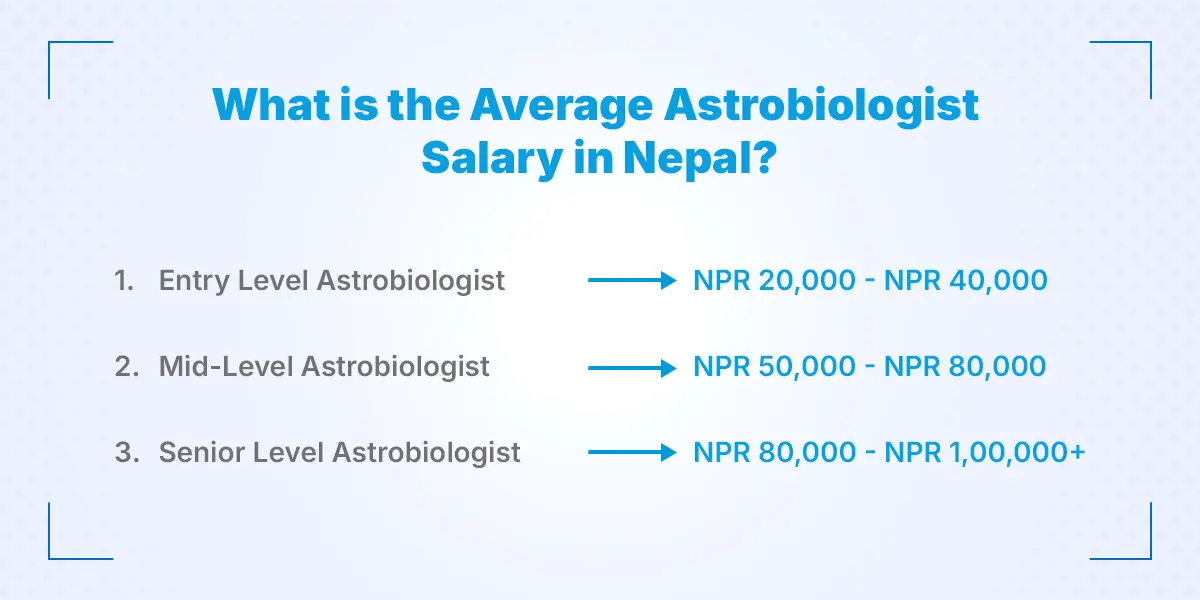
1. Entry Level Astrobiologist
When you first start your career after college, you will likely earn between NPR 20,000 and NPR 40,000. At this stage, your main job is to help senior scientists with their experiments and lab work. You will spend most of your time learning how to use complex tools and collecting data. Since you are still a beginner, the focus is more on gaining experience than on high pay. Many people in this role work in university labs or as science assistants. It is a very important time to build your skills for the future.
2. Mid-Level Astrobiologist
Once you have worked for a few years, your salary can increase to between NPR 50,000 and NPR 80,000. By now, you have enough knowledge to lead small research projects on your own. You might also start writing scientific articles or teaching college students about space science. Your pay goes up because you can solve problems without needing help all the time. Many mid-level scientists also start working with international researchers during this phase. This is where your career starts to become more stable and respected.
3. Senior Level Astrobiologist
Expert astrobiologists with many years of experience can earn NPR 80,000 to over NPR 1,00,000 every month. These are the leaders who manage entire research departments and guide big projects. They are responsible for finding the money and grants needed to keep scientific studies going. At this level, you might travel to other countries to share your findings at big meetings. You are seen as a master of your field and a teacher to younger scientists. In some cases, working on global projects can lead to even higher earnings.
How to Become an Astrobiologist in Nepal?
To become an astrobiologist in Nepal, you should start with a strong science degree in Physics, Biology, or Chemistry, and then specialize through research and higher studies. Since there is no specific degree named Astrobiology in Nepal, you must build your foundation in a core science subject first. By following the right educational steps and joining scientific communities, you can turn your passion for space into a professional career.
1. Choose the Right Science Stream in High School
The first step starts in Grades 11 and 12 by choosing the Science stream. You should focus on subjects like Physics, Chemistry, and Biology to understand how life and the universe work. Having a strong background in Mathematics is also very helpful for future research. During these years, try to stay curious and read books about space and stars. This early foundation is necessary for getting into a good university later. Most science careers in Nepal require a solid start in these core subjects.
2. Pursue a Bachelor’s Degree in a Core Science
In Nepal, you can study for a B.Sc. in subjects like Physics, Microbiology, or Biotechnology at universities like Tribhuvan University (TU) or Kathmandu University (KU). Since there is no direct Astrobiology degree, choosing a major in one of these fields is the best path. For example, Physics will help you understand stars, while Microbiology will teach you about tiny living things. You should aim for a high score to keep your options open for future studies. Many students also start learning basic computer programming during this time. This degree is your entry ticket into the world of professional science.
3. Join Research Groups and Organizations
While studying, you should join local groups like the Nepal Astronomical Society (NASO). These organizations offer workshops, asteroid search campaigns, and competitions like the Astronomy Olympiad. Being part of such groups helps you meet other people who share your interests. You can learn about real space projects and gain hands-on experience that you cannot get from textbooks alone. It is also a great way to find mentors who can guide your career. Networking with local scientists is a big step toward finding job opportunities later.
4. Learn Technical and Data Skills
Astrobiology is not just about theories; it involves a lot of data and laboratory work. You should learn how to use scientific software and basic coding languages like Python. These skills are very important for analyzing information from space missions or lab experiments. You can find many free online courses to learn these technical skills at your own pace. Knowing how to handle data makes you a much more valuable candidate for research jobs. Many modern scientists spend a lot of time working on computers to solve space mysteries.
5. Apply for International Internships and Programs
Because the field is still small in Nepal, looking for global opportunities is a smart move. Agencies like NASA and other international space groups often have summer programs or online internships for students. You can apply for these to see how world-class research is actually done. Even participating in international science webinars can give you a better understanding of the global market. These experiences look great on your CV and show that you are serious about your career. They also help you build a network of scientists from different countries.
6. Plan for a Master’s or PhD Abroad
To become a fully qualified astrobiologist, you will eventually need to pursue a Master’s or PhD. While you can start your Master’s in Physics or Biology in Nepal, moving abroad for a PhD allows you to specialize in Astrobiology specifically. Many Nepali students receive scholarships to study in countries like the USA, Europe, or India, where space research is very advanced. During your PhD, you will focus on a very specific topic, such as "Can life survive on Mars?" This high level of education is what leads to senior positions and higher salaries. Constant learning is the only way to stay ahead in this exciting field.
Factors That Affect an Astrobiologist's Salary in Nepal
Getting a high salary as an astrobiologist in Nepal depends on several things. It is not just about the job title, but also about what you bring to the table. Your pay can grow quickly if you focus on the right areas. Here are the main factors that will decide how much you earn.

1. Education Level
Having a higher degree, like a Master’s or a PhD, will significantly increase your pay. Most high-paying research jobs in Nepal require at least a Master’s degree in a science subject. People with a PhD are often hired for senior roles or as university professors, which come with better salaries. Basically, the more you study, the more valuable you become to employers.
2. Work Experience and Research Contributions
The number of years you have spent working in science helps you earn more money. If you have published your own research papers in famous journals, companies will see you as an expert. Experience shows that you can handle difficult lab equipment and solve complex problems on your own. Senior scientists with a long history of successful projects always get the highest paychecks.
3. Employer Type
Who you work for makes a big difference in your monthly income. Private research centers or international NGOs often pay more than small local colleges. Government jobs provide good stability and extra benefits, even if the starting salary is fixed. If you work for a project funded by a foreign space agency, your earnings can be much higher than average.
4. Location and International Exposure
Working in big cities like Kathmandu usually offers better pay because that is where the main research hubs are. If you have studied or worked in another country, you can ask for a higher salary in Nepal. International exposure shows that you know global standards and can work with scientists from around the world. Being connected to the global science community opens doors to better-paying roles in the world.
5. Skills in Demand
Special IT skills like computer programming, data analysis, and using advanced lab tools are very important. If you know how to use software like Python to study space data, you will be in high demand. Employers are willing to pay extra for scientists who have technical skills that others do not have. Keeping your skills updated with new technology is a great way to boost your income.
Top Organizations Hiring Astrobiologists in Nepal
Finding a job as an astrobiologist in Nepal can be a bit different than other careers because it is a very specialized field. Most jobs are found in research groups, universities, and non-profit organizations that love space science. While you won't find these listings on every job site, these specific groups are the best places to start your career. Working with them helps you get the experience you need for even bigger global roles.
1. Nepal Astronomical Society (NASO)
NASO is the most famous group for space lovers in Nepal. They do a lot of work to bring space science to students and researchers through workshops and competitions. If you want to meet other scientists and work on projects like searching for asteroids, this is the place to be. They often partner with international groups, which gives you a chance to see how world-class research is done. It is a great starting point for anyone serious about astrobiology.
2. Nepal Academy of Science and Technology (NAST)
If you want to work at the forefront of science in Nepal, you should consider NAST, the main government body overseeing science and technology. With specialized departments in space research and biology, NAST is an ideal place for anyone interested in astrobiology. Working here gives you the chance to contribute to important national research projects while enjoying a stable and prestigious work environment. Being part of NAST not only advances your career but also strengthens your resume. If this sounds like the right fit, you can explore and apply for jobs in NAST to join their team of top scientists.
3. SEDS-Nepal
This is a great organization for students who want to explore space development. They focus on giving young people hands-on training and internships through special programs. SEDS-Nepal often teams up with groups like SpaceoNova to teach students about life in space. It is a very active community where you can learn by doing rather than just reading books. Joining them is a smart way to get your first real experience in the field.
4. Antarikchya Pratisthan Nepal
This organization is well-known for hosting events like SpaceCon, where people share their research. They are very interested in how humans can live in space habitats, which is a big part of astrobiology. By participating in their events, you can present your own papers and get feedback from experts. They encourage creative thinking and help bridge the gap between imagination and real science. It is a wonderful platform to show off your research skills to the public.
5. The Small Earth Nepal (SEN)
While this group focuses a lot on the environment and climate change, they do important work in microbiology. Since astrobiologists study how life survives in tough conditions, the field research done here is very relevant. You might find yourself studying tiny living things in water or soil to understand how life works. This kind of experience is very useful if you want to understand how life might exist on other planets. They offer a more hands-on, nature-based approach to science.
6. Academic Institutions (Tribhuvan University)
Tribhuvan University (TU) is the biggest place for scientific research and learning in Nepal. Many professors at TU lead labs where they study bacteria, physics, and chemistry. Even if they don't have a department named "Astrobiology," their labs provide the tools you need for space-related studies. You can work as a research assistant or a teaching assistant while finishing your studies. It is the best place to build a deep academic foundation in the core sciences.
Skills Required to Increase an Astrobiologist's Salary
To earn a higher salary as an astrobiologist in Nepal or abroad, you need to be more than just a dreamer. You must develop specific technical and professional skills that make you valuable to research teams and space agencies. By focusing on these five areas, you can move from a basic role to a high-paying expert position.
1. Advanced Computer and Data Science Skills
Modern space science uses a lot of data from telescopes and satellites. To get paid more, you should learn how to write code using languages like Python or C++. Many high-paying jobs now look for people who understand Artificial Intelligence (AI) to help sort through massive amounts of space information. If you can build computer models to simulate life on other planets, you will be in high demand. These technical skills are often what separate a junior researcher from a well-paid specialist.
2. Specialized Technical Expertise
Focusing on a specific niche is a great way to boost your income. For example, you could learn how to build and fix scientific sensors used on space probes. Another high-value area is studying "extremophiles," which are tiny living things that survive in very hot or cold places. Understanding the geology and rocks of other planets also makes you an expert whom international missions want to hire. Having "hands-on" skills with lab hardware usually leads to better job offers.
3. Grant Writing and Project Management
In the world of science, a lot of your salary comes from research "grants" or funding. If you know how to write a strong proposal to get money from international groups, your value to any organization goes up. You also need to be good at managing a team, keeping track of deadlines, and handling budgets. Being a good manager shows that you can lead a whole department, not just work in a lab. Scientists who can bring in their own funding are often the highest earners.
4. Technical Communication and Outreach
A good astrobiologist must be able to explain complex ideas in a way that everyone understands. You need to be skilled at writing scientific papers that get published in famous global journals. It is also important to be a good public speaker so you can present your findings to government officials or donors. When you can convince people that your research is important, it becomes easier to secure high-paying roles. Good communication helps you build a strong professional reputation worldwide.
5. Multidisciplinary Specialization
Since astrobiology covers many topics, being an expert in more than one science can help you "wiggle into" unique jobs. For example, if you understand both genetics and the chemistry of rocks, you can apply for roles that a normal biologist cannot. Combining different fields like physics and microbiology makes you a rare and valuable employee. Most high-paying positions in space agencies require this kind of broad, "all-in-one" scientific knowledge. This flexibility allows you to work on many different types of space missions.
Is Astrobiology a Good Career in Nepal?
Yes, astrobiology is a good career in Nepal. Choosing a career in astrobiology in Nepal is a bold and exciting move. While it is a very new field in our country, it offers a chance to be a pioneer in space science. It is a perfect path for those who are not afraid of challenges and want to do something different from traditional jobs. However, like any unique career, it has its own set of ups and downs.
Pros vs Cons
One of the biggest pros is the prestige and the chance to work on global projects. You get to solve the biggest mysteries of the universe and often travel for international research. On the other hand, the cons include limited job openings within Nepal and a lack of high-tech labs. You may also find that most of your work depends on getting research grants, which can be competitive.
Who Should Choose This Career?
- Space Lovers: If you have always been fascinated by stars, planets, and the idea of alien life.
- Curious Minds: If you enjoy asking "why" and love solving complex science puzzles.
- Patient Researchers: Since space missions take years, you need to be someone who can stay focused on long-term goals.
- Strong Science Students: This path is best for those who excel in Physics, Biology, or Chemistry.
Long-Term Earning Potential
In the long run, an astrobiologist has a very high earning potential, especially if they look beyond local borders. While you might start with a modest salary in Nepal, your income grows as you gain international experience and a PhD.
- Global Opportunities: Many Nepali scientists move to work with agencies like NASA or ESA, where salaries are much higher than in the local market.
- Consultancy and Teaching: Senior experts can earn well by advising space startups or becoming high-level professors.
- Research Grants: Successful scientists can win large amounts of money to fund their own labs and projects.
- Industry Roles: Private space companies are growing fast, and they pay very well for people who understand planetary science.
If you are willing to study hard and connect with the global scientific community, this career can be both financially rewarding and mentally satisfying.
Conclusion
The earning potential for those in this field grows steadily as you gain experience. When you first start, the pay is basic because you are still learning how to work in labs. As you move into higher roles, your income increases a lot. To reach the best pay levels, you should get advanced degrees, learn computer skills, and work on international research projects.
While this path takes time and hard work, the financial rewards are real. You might not become rich quickly, but your passion for space can become a secure and high-paying job. An astrobiologist's salary in Nepal becomes very competitive for those who connect with the global science community. Choosing this unique career offers a stable future if you are willing to keep learning.
Looking for more job opportunities like this? Visit Kumari Job and start your journey toward a successful science career today!
Frequently Asked Questions
Submit your comments

Get Our App On



SEO Training for Freshers in Nepal: Skills, Career & Job Opportunities
VIEW DETAILS
SEO Training vs. Self-Learning: Which Is Right for You?
VIEW DETAILS
How to Choose Between Two Job Offers
VIEW DETAILS
Digital Marketing Training Interview Questions and Answers for Freshers
VIEW DETAILS


Loading Comments...