



Starting SEO can feel confusing on Day 1 because there are hundreds of YouTube videos, blogs, courses, tools, and opinions telling you what to learn first. You may wonder whether you should pay for SEO training, learn everything yourself for free, or do both, especially if your goal is to become job-ready in Nepal.
The right choice depends on your goals, budget, available time, learning style, and need for practical guidance. This guide compares SEO training with self-learning, explains the strengths and limitations of each approach, and shows how beginners can build useful SEO skills through structured learning, independent practice, and real projects.
In this blog
What Is SEO Training?
SEO training is a structured learning program that teaches search engine optimization through organized lessons, practical exercises, tools, projects, and guidance from trainers. A good program takes learners from basic concepts such as keywords and on-page optimization to technical SEO, off-page SEO, analytics, and practical website work. The main advantage is that learners follow a planned path instead of trying to decide what to study next.
SEO training commonly covers:
- Search engine fundamentals
- Keyword research and search intent
- Keyword mapping and topic clustering
- On-page SEO
- Technical SEO
- Off-page SEO and link building
- Local SEO
- Content optimization
- Internal linking
- Schema markup and structured data
- Google Search Console
- Google Analytics 4
- SEO auditing
- SEO reporting
- SEO tools and workflows
For beginners, instructor guidance can make difficult concepts easier to understand. Practical assignments also provide an opportunity to apply concepts instead of only reading or watching lessons.
A structured program may also provide:
- Feedback on SEO work
- Practical projects
- Industry examples
- Peer interaction
- Career guidance
- Portfolio development
- Certification
- Internship or placement support, depending on the provider
The quality of the training matters more than the certificate itself. Google also emphasizes that SEO is about helping search engines understand content while making it useful and accessible for people, so a useful training program should teach both search fundamentals and user-focused optimization.
What Is Self-Learning SEO?
Self-learning SEO means developing SEO knowledge independently through resources such as search documentation, blogs, videos, online courses, communities, SEO tools, and hands-on website practice. It gives learners control over what they study, when they study, and how deeply they explore each subject. The challenge is that learners must create their own roadmap and evaluate whether the information they find is accurate and current.
Common self-learning resources include:
- Google Search Central documentation
- SEO blogs
- YouTube tutorials
- Online courses
- SEO communities
- Industry newsletters
- SEO case studies
- Search results and competitor analysis
- Personal websites and blogs
- Free and paid SEO tools
Google provides its own SEO documentation and Search Console resources for website owners and SEO professionals, making official documentation an important source for independent learners.
Self-learning becomes much more valuable when you apply each concept to a real website. Reading about canonical tags, for example, is useful, but identifying duplicate URL problems and checking how canonical signals are implemented teaches a much deeper lesson.
SEO Training vs. Self-Learning: What Is the Difference?
SEO training and self-learning can both develop useful skills, but they differ mainly in structure, guidance, cost, accountability, and practical support.
| Factor | SEO Training | Self-Learning |
|---|---|---|
| Learning Structure | Structured roadmap | Learner creates the roadmap |
| Instructor Support | Usually available | Usually unavailable |
| Cost | Usually paid | Free to low-cost options available |
| Learning Speed | Guided | Self-paced |
| Practical Projects | Often included | Depends on the learner |
| Feedback | Trainer can provide feedback | Learner evaluates their own work |
| Accountability | Higher | Depends on personal discipline |
| Certification | May be included | Usually not necessary |
| Networking | Possible | Depends on communities |
| Career Support | May be available | Usually self-managed |
| Flexibility | Depends on schedule | Very flexible |
Neither option automatically produces better SEO professionals. The quality of practice, ability to solve real problems, understanding of search intent, and willingness to keep learning have a major influence on the outcome.
SEO Training vs. Self-Learning: Which Is Better for Beginners?
For beginners, SEO training is often easier when they need a structured roadmap and direct guidance, while self-learning works well for people who are disciplined and comfortable researching problems independently. A beginner should choose based on learning style, budget, available time, career goals, and access to practical projects. The strongest approach for many learners is to combine structured education with independent practice.
Consider SEO training if you:
- Have never studied SEO before
- Feel confused by the number of SEO topics
- Want someone to explain difficult concepts
- Prefer a fixed learning roadmap
- Want practical assignments
- Need feedback on your work
- Want to prepare for an SEO career
- Prefer learning with other students
Self-learning may suit you if you:
- Have a limited learning budget
- Can create and follow your own study plan
- Enjoy researching independently
- Already understand basic SEO
- Prefer flexible learning hours
- Want to focus on a specific SEO specialization
- Have access to a website for practice
For a student or fresher, the important question is not simply, "Which one is cheaper?" A better question is, "Which approach will help me understand SEO and prove that I can actually do SEO work?"
What Are the Advantages of SEO Training?
SEO training provides structure, guidance, and opportunities for practical learning that can reduce the confusion beginners often experience when starting SEO. A strong training program can connect individual topics such as keyword research, content, technical SEO, analytics, and reporting into one complete workflow. It can also provide an environment where learners can ask questions and receive feedback instead of repeatedly trying to solve every problem alone.
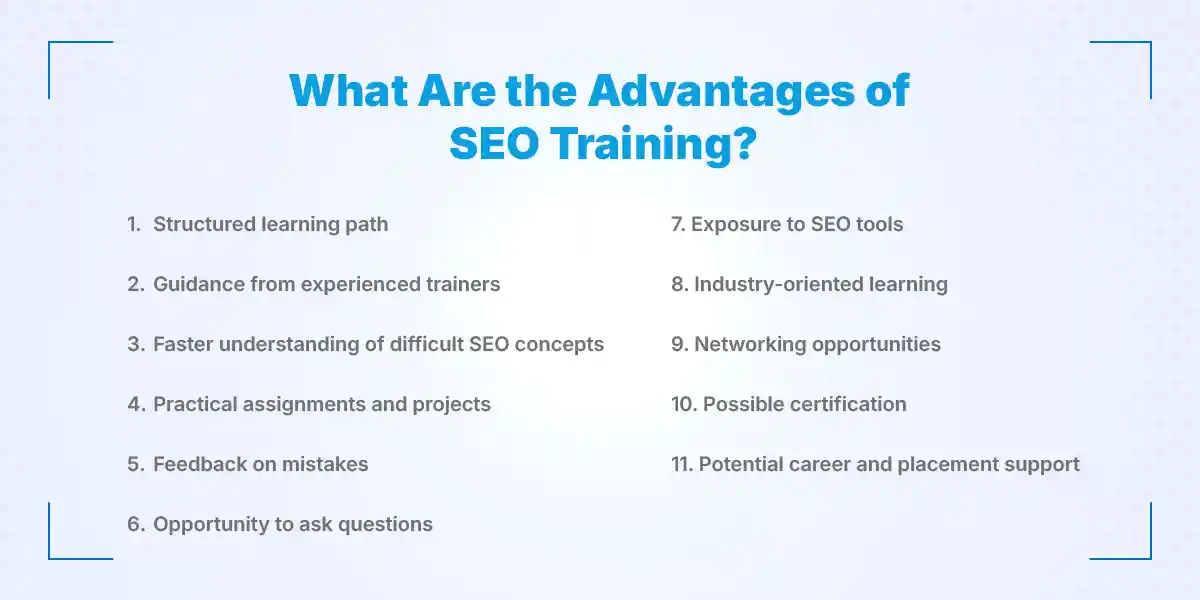
Major advantages include:
- Structured learning: You follow a planned sequence rather than random tutorials.
- Expert guidance: A trainer can explain difficult concepts and correct misunderstandings.
- Practical assignments: You can apply SEO concepts to websites instead of only studying theory.
- Feedback: Someone can review your keyword research, content optimization, audits, or reports.
- Tool exposure: Training can introduce tools used for keyword research, technical audits, analytics, and reporting.
- Accountability: A schedule and assignments can make it easier to maintain consistency.
- Career preparation: Job-oriented programs may include portfolio, interview, internship, or placement support.
- Networking: Learning alongside other students can create opportunities to exchange ideas and experiences.
- Faster troubleshooting: Questions can be answered before a small misunderstanding becomes a larger learning gap.
KumariJob's current SEO training structure, for example, includes SEO foundations, on-page SEO, technical SEO, off-page SEO, local SEO, analytics, AI-related SEO topics, live projects, internship tasks, and portfolio development.
However, training should not replace independent learning. Search behavior, websites, tools, and SEO practices change, so professionals need to continue researching and testing after completing any course
What Are the Advantages of Learning SEO by Yourself?
Self-learning gives you maximum flexibility and allows you to study SEO according to your own interests, schedule, and career goals. It can also develop independent research and problem-solving skills because you must find reliable information and determine how to apply it. For learners with strong discipline, self-learning can become a long-term habit rather than a short course.
Key benefits include:
- Low cost: Many reliable SEO resources are available for free.
- Flexible schedule: You can learn before work, after college, or during weekends.
- Self-paced learning: You can repeat difficult lessons without worrying about a class schedule.
- Topic freedom: You can move quickly into areas such as technical SEO, local SEO, or content SEO.
- Independent research: You learn how to investigate SEO questions yourself.
- Real-world experimentation: You can test ideas on your own website.
- Continuous learning: You can follow industry updates after completing a course.
- Personal specialization: You can focus on the SEO skills required for your preferred career path.
The biggest advantage of self-learning is not simply saving money. It is learning how to solve problems independently, which becomes increasingly important when working on websites where the answer is not available in a textbook.
How to Choose Between SEO Training and Self-Learning?
Choose SEO training when you need structure, mentorship, practical guidance, or career-focused support, and choose self-learning when you have strong discipline, flexibility, and the ability to create your own learning path. The decision should come from your current skill level rather than the assumption that one method works for everyone. You can also combine both methods instead of treating them as completely separate choices.
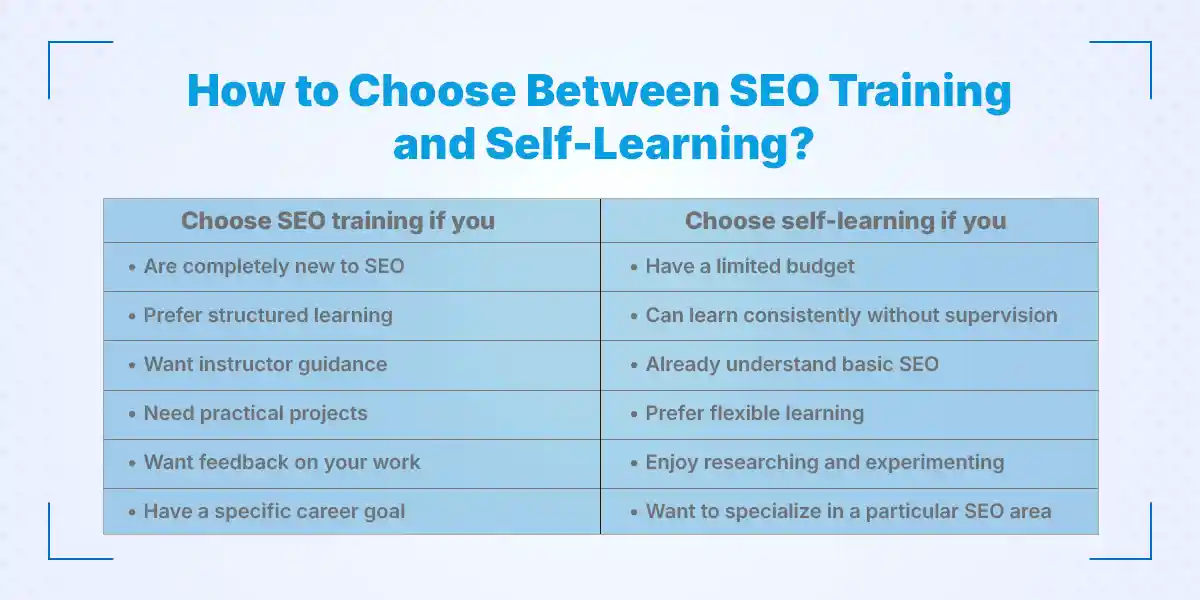
Choose SEO training if you:
- Are completely new to SEO
- Prefer structured lessons
- Want trainer guidance
- Need feedback
- Want practical assignments
- Have a clear career goal
- Learn better through scheduled sessions
Choose self-learning if you:
- Have a limited budget
- Already know basic SEO
- Enjoy independent research
- Need flexible learning hours
- Can maintain a consistent study routine
- Want to specialize in a particular SEO area
Choose a combination if you:
- Want structured fundamentals
- Want to practice independently
- Need guidance for difficult concepts
- Want to build a portfolio
- Want to stay updated after training
This hybrid model can be particularly useful because training provides direction while self-learning builds independence.
Can You Learn SEO Without Taking a Course?
Yes, you can learn SEO without taking a course by studying reliable resources, practicing on real websites, using SEO tools, and consistently analyzing the results of your work. You do not need a formal classroom to understand SEO, but you do need a clear roadmap, regular practice, reliable information, and a way to identify and correct your mistakes.
A practical self-learning path can include:
- Learn how search engines crawl, index, and understand websites.
- Study keyword research and search intent.
- Practice title, meta description, heading, URL, and content optimization.
- Learn internal linking and content structure.
- Understand technical SEO basics.
- Study off-page and local SEO.
- Learn Google Search Console and analytics.
- Perform basic SEO audits.
- Practice on a real website.
- Track changes and analyze results.
- Build case studies from your projects.
- Follow reliable SEO documentation and industry updates.
Google's SEO Starter Guide recommends focusing on helping search engines understand content and helping users find useful information, rather than looking for secret tactics that guarantee first position.
One practical rule is simple: every topic you learn should lead to an action. If you study internal linking, actually improve internal links on a website; if you study technical SEO, run an audit and identify real issues.
Which Option Is Better for an SEO Career in Nepal?
For an SEO career in Nepal, neither training nor self-learning is enough by itself unless you can demonstrate practical skills through projects, portfolios, internships, or measurable work. Employers can benefit more from seeing what you can actually do than from seeing a certificate without evidence of practical ability. SEO career opportunities in Nepal include roles such as SEO Executive, SEO Specialist, SEO Analyst, Technical SEO Specialist, Content SEO Specialist, and SEO Manager.
For an aspiring SEO professional, focus on:
- Keyword research
- Search intent analysis
- On-page SEO
- Technical SEO basics
- Content optimization
- Internal linking
- Off-page SEO
- Local SEO
- Google Search Console
- GA4
- SEO auditing
- Reporting
- Competitor analysis
- Communication
- Problem-solving
Build a portfolio that demonstrates your work. A portfolio could include a keyword research project, an on-page audit, a technical SEO audit, a content optimization example, a local SEO project, or a before-and-after performance analysis.
Internships can also bridge the gap between learning and employment because they expose beginners to real workflows, deadlines, websites, clients, and team processes. KumariJob's SEO training currently emphasizes practical projects, internship tasks, portfolio development, and career preparation alongside technical SEO topics.
Can You Combine SEO Training With Self-Learning?
Yes, combining SEO training with self-learning creates a balanced approach in which structured education provides direction while independent practice develops problem-solving skills. This approach allows learners to understand fundamentals systematically and then explore topics beyond the classroom. It is particularly useful because SEO requires continuous learning rather than one-time education.
A practical hybrid approach looks like this:
- Learn the fundamentals through structured lessons.
- Revisit each topic independently after class.
- Apply the concept to a real website.
- Record the problem, action, and result.
- Ask for guidance when you cannot identify the cause.
- Research alternative solutions independently.
- Build case studies from your practical work.
- Continue learning after completing training.
For example, a trainer may explain canonical tags, but independent practice can involve finding duplicate URLs, checking canonical implementation, understanding indexing behavior, and documenting the fix. That combination turns a definition into a usable professional skill.
Best Way to Learn SEO for Long-Term Success
The best way to learn SEO long term is to combine foundational knowledge, structured practice, real website experience, performance measurement, and continuous independent learning. SEO should be treated as a practical skill rather than a subject that you finish after completing a course. The goal is to become capable of investigating a problem, selecting an appropriate solution, implementing it, and measuring the outcome.
1.Learn SEO Fundamentals
Start with how search engines discover, crawl, index, and understand pages. Then learn the basic relationship between technical SEO, content, links, search intent, and user experience.
2. Understand Search Intent and Keywords
Learn how to identify what users actually want when they search for a keyword. Practice grouping keywords according to informational, commercial, navigational, and transactional intent.
3. Learn On-Page SEO
Practice optimizing titles, headings, URLs, content, images, internal links, and metadata. Focus on making each page useful rather than simply inserting keywords repeatedly.
4. Learn Technical SEO Basics
Study crawling, indexing, canonicalization, robots.txt, XML sitemaps, redirects, mobile usability, page performance, structured data, and common technical errors. You do not need to become a developer, but you should understand how technical issues can affect search visibility.
5. Learn Off-Page and Local SEO
Understand backlinks, digital authority, brand mentions, local citations, Google Business Profile, reviews, and local search intent. Focus on quality and relevance instead of trying to build as many links as possible.
6.Practice With Real Websites
Create a personal website, optimize a small business website, work on a training project, or contribute to a real SEO campaign. Real websites expose problems that tutorials often cannot fully reproduce.
7. Use Google Search Console and Analytics
Learn how to inspect search queries, pages, clicks, impressions, indexing information, and performance trends. Use data to determine whether your optimization work actually changed website performance.
8. Analyze Competitors and SERPs
Search your target keywords and study the pages already ranking. Look at content depth, search intent, page structure, internal links, topical coverage, unique information, and user experience rather than simply copying competitors.
9.Build an SEO Portfolio
Document your projects with the problem, research, changes, reasoning, and measurable outcomes. Even small projects can demonstrate that you understand how to approach SEO systematically.
10. Keep Learning and Testing
Follow reliable search documentation, monitor algorithm changes, study new search features, and test your assumptions. SEO professionals improve by learning from both successful experiments and failed ones.
The most useful mindset is to stop asking, "What SEO trick will rank this page?" and start asking, "What does the searcher need, what prevents this page from satisfying that need, and what evidence can I use to improve it?
Conclusion
The biggest decision is not whether SEO training or self-learning is universally better; it is whether your learning method gives you enough structure, practice, feedback, and real-world problem-solving experience to become useful in an actual SEO role. If you need direction, mentorship, and practical guidance, structured training can shorten the learning curve, while self-learning remains essential for developing independence and keeping your knowledge current.
If your goal is to build practical, job-ready SEO skills through structured lessons, real projects, industry tools, and career-focused support, explore KumariJob's SEO Training in Nepal and choose a learning path that matches your career goals.
Frequently Asked Questions
Submit your comments

Get Our App On



SEO Training for Freshers in Nepal: Skills, Career & Job Opportunities
VIEW DETAILS
How to Choose Between Two Job Offers
VIEW DETAILS
Digital Marketing Training Interview Questions and Answers for Freshers
VIEW DETAILS
Why Am I Not Getting Shortlisted for Jobs?
VIEW DETAILS


Loading Comments...