



You finished your degree, you keep hearing that companies want SEO skills, and you open Google to learn them. Within minutes you face dozens of tools, conflicting advice, and no clear first step, so many freshers stall before they begin.
SEO training gives you a structured path from zero knowledge to job-ready skills, and you do not need a coding background to start. This guide explains what SEO training covers, which skills and tools employers expect, how to build a portfolio, which jobs and career paths open up, and how to choose the right course. You can also explore related jobs and learning options on KumariJob as you go.
In this blog
What Is SEO Training for Freshers?
SEO training for freshers is a beginner course that teaches how to help websites rank higher on search engines like Google. It covers search engine optimization basics such as keywords, content, technical health, and links through lessons and hands-on tasks. The goal is to move you from understanding SEO fundamentals to doing real optimization work.
- What beginners learn: how search engines find and rank pages, how to research keywords, and how to improve pages and track results.
- Theoretical learning: explains concepts through lectures and slides.
- Practical learning: has you edit real pages, run audits, and read live data.
- Core concepts to know: crawling, indexing, rankings, search intent, and the difference between on-page, off-page, and technical SEO.
Freshers benefit most from a beginner SEO course that mixes both styles but leans toward practice.
Why Should Freshers Learn SEO in Nepal?
Freshers should learn SEO in Nepal because more businesses depend on online visibility, and few beginners can provide it. SEO applies to almost every industry, from education and travel to retail and finance. It also offers a low-cost entry into digital marketing without a technical degree.
- Business demand: companies compete for attention on Google and need people who can grow organic traffic.
- Entry points: internships and entry-level roles accept beginners who show practical ability.
- Client range: you can work with local brands first and international clients later.
- Skill overlap: SEO strengthens marketing, content, and business skills.
- Progression: you can grow from SEO Executive to SEO Specialist as results build.
1. Is SEO a Good Career for Freshers in Nepal?
Yes, SEO is a good career for freshers in Nepal who will practice consistently and keep learning. Demand for digital marketing skills is growing, and entry-level roles exist in agencies, in-house teams, and freelance work. The field rewards measurable results, so that a strong portfolio can matter as much as a degree. Success still depends on steady practice, because search rankings change and skills must stay current.
What Do Freshers Learn in SEO Training?
Freshers learn how to find keywords, optimize pages, fix technical issues, build links, and measure results in SEO training. A good course teaches these topics in a logical order, starting with simple concepts. Each topic should include a task so you can practice what you learn.
- Research: keyword research, search intent, competitor analysis
- Optimization: on-page SEO, content optimization
- Technical and authority: technical SEO basics, off-page SEO, link building, local SEO
- Analysis: SEO audits, Google Search Console, Google Analytics, SEO reporting
- Modern skills: basic AI-assisted SEO
Practical SEO Skills Freshers Should Develop
- Find relevant keywords and study competitors, because this shows what searchers want and what already ranks.
- Optimize title tags, meta descriptions, and headings, because clear pages match search intent and earn more clicks.
- Improve internal linking and spot technical problems like broken links and slow pages, because these fixes help search engines understand your site.
- Build simple reports that measure organic traffic and rankings, because clients and managers want proof that your work moved numbers
How Can Freshers Start Learning SEO in Nepal?
Freshers can start learning SEO by studying the basics, practicing on a real or sample website, and building a portfolio before applying for jobs. The process runs through ten steps, grouped into five stages below. Each stage builds on the one before it.
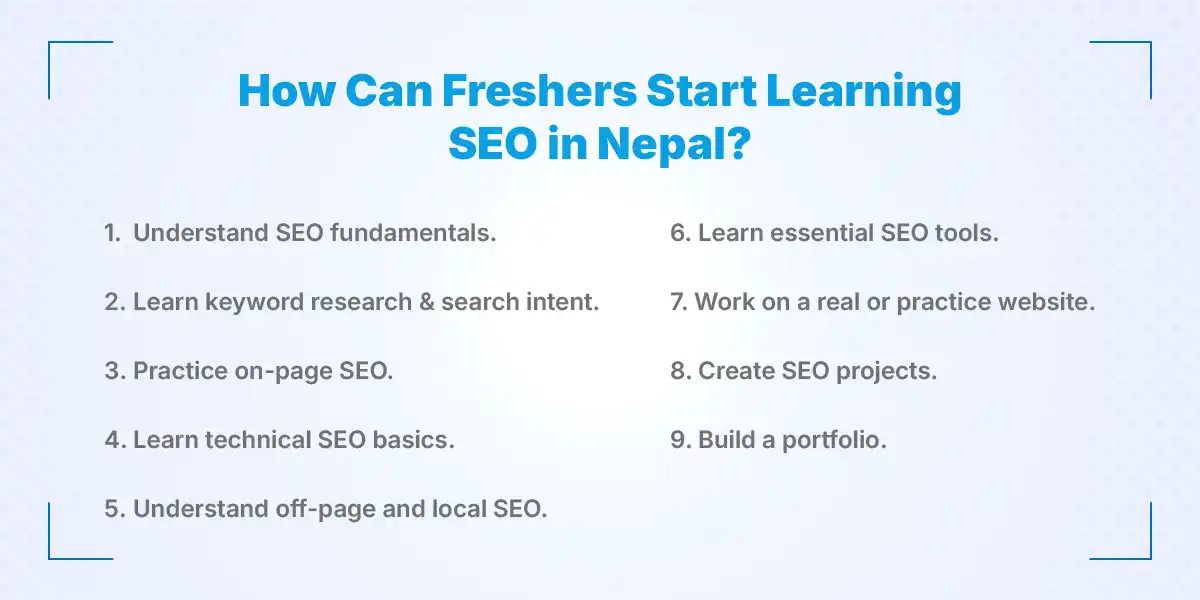
1. Understand SEO Fundamentals
Start by learning the basics of SEO, including how search engines work, crawling, indexing, ranking, and search results.
2. Learn Keyword Research and Search Intent
Learn how to find relevant keywords and understand what users want when they search for a topic.
3. Practice On-Page SEO
Learn how to optimize titles, meta descriptions, headings, URLs, content, images, and internal links for search engines and users.
4. Learn Technical SEO Basics
Understand basic technical SEO, including website speed, mobile-friendliness, crawlability, indexing, XML sitemaps, robots.txt, and canonical tags.
5. Learn Off-Page and Local SEO
Learn how backlinks, online mentions, business listings, Google Business Profile, and local citations can improve a website’s visibility.
6. Learn Essential SEO Tools
Practice using tools such as Google Search Console, Google Analytics, Google Keyword Planner, Google Trends, and SEO analysis tools.
7. Work on a Real or Practice Website
Apply what you learn by optimizing your own website, blog, or a practice website and tracking its SEO performance.
8. Create SEO Projects
Work on practical projects such as keyword research, content optimization, technical SEO audits, backlink building, and local SEO.
9. Build an SEO Portfolio
Create a simple portfolio that shows your SEO projects, the work you completed, and the improvements or results you achieved.
10. Apply for SEO Internships and Entry-Level Jobs
Once you have basic knowledge and practical experience, apply for SEO internships, SEO trainee positions, and entry-level SEO jobs to build your professional career.
Should Freshers Take SEO Training or Learn SEO by Themselves?
Freshers should choose SEO training if they need structure and feedback, and self-learning if they have discipline and a limited budget. Neither option is better for everyone. The right choice depends on your learning style, time, and money.
| Factor | SEO Training | Self-Learning |
|---|---|---|
| Structure | Structured learning | Flexible learning |
| Guidance | Mentor guidance | Independent research |
| Practice | Practical assignments | Self-created projects |
| Feedback | Faster feedback | Requires self-evaluation |
| Cost | Course fee | Usually low-cost or free |
- Choose training if you are a beginner who needs direction, deadlines, and expert review.
- Choose self-learning if you are disciplined, comfortable researching alone, and able to judge your own work honestly.
- Combine both if you want structure first and then self-made projects for extra practice.
What SEO Skills Do Employers Look for in Freshers?
Employers look for freshers who can research keywords, optimize pages, read basic data, and explain results clearly. They care more about what you can do than what you studied. A simple working sample often answers their questions faster than a resume line.
- SEO skills: keyword research, on-page optimization, content optimization, basic technical SEO, link-building knowledge
- Tools: Google Search Console, Google Analytics, and common SEO tools
- Analysis: reporting and data interpretation
- Soft skills: communication, content writing, and problem-solving
1. Why Practical Ability Beats a Certificate
A certificate shows that you attended a course, but it does not show that you can improve a page. Hiring managers prefer candidates who can walk them through an audit or a ranking improvement. A short project with clear before-and-after results proves skill faster than any credential. Treat your certificate as support for your portfolio, not a replacement for it.
Which SEO Tools Should Freshers Learn?
Freshers should learn a small set of SEO tools grouped by purpose, starting with the free Google tools. Each tool answers a different question, from what people search for to why a page loads slowly. You do not need to master all of them at once.
| Tool | Main Purpose |
|---|---|
| Google Search Console | Search performance and indexing |
| Google Analytics | Website traffic and user behavior |
| Google Keyword Planner | Keyword research |
| Google Trends | Search trends |
| Google Search | SERP research |
| Screaming Frog | Technical SEO auditing |
| Ahrefs / Semrush | Keyword and competitor research |
| PageSpeed Insights | Performance analysis |
Start with Search Console, Analytics, and PageSpeed Insights. Add auditing and research tools such as Screaming Frog, Ahrefs, or Semrush as your projects grow.
How Can Freshers Build an SEO Portfolio Without Experience?
Freshers can build an SEO portfolio without experience by completing practice projects on their own or a sample website and documenting every result. Employers want proof of your process, so show what you changed and why. Even small projects count when you explain them clearly.
- Create a sample keyword research report.
- Optimize a small website.
- Perform an SEO audit.
- Write and optimize a blog article.
- Create an internal-linking plan.
- Conduct competitor research.
- Prepare a sample monthly SEO report.
- Document before-and-after improvements.
What Jobs Can Freshers Get After SEO Training?
Freshers can get entry-level roles such as SEO Intern, SEO Executive, and Digital Marketing Executive after SEO training. These roles focus on keyword research, content updates, and reporting. Titles vary by company, so read each job description closely.
- SEO Intern: assists with keyword lists, page checks, and reports while learning.
- SEO Executive: makes on-page updates, tracks rankings, and traffic reports.
- Junior SEO Specialist: handles audits, content briefs, and basic technical fixes.
- Digital Marketing Executive: supports SEO alongside social media, email, and ads.
- Content & SEO Executive: plans and optimizes articles for search.
- SEO Content Writer: writes search-focused content based on keyword research.
- Local SEO Executive: manages business listings, reviews, and local rankings.
- Digital Marketing Intern: supports campaigns across several channels.
What Is the SEO Career Path for Freshers in Nepal?
The SEO career path usually moves from SEO Intern to SEO Executive, SEO Specialist, Senior SEO Specialist, and SEO Manager. Each step adds more ownership of strategy, data, and people. Promotion speed depends on results and skills more than years alone.
Alternative paths:
- Technical SEO
- Local SEO
- Content SEO
- SEO Analytics
- Digital Marketing
- Performance Marketing
- SEO Consulting
1. How to Build a Career in SEO in Nepal
To build a career in SEO in Nepal, learn the fundamentals, finish practical projects, and apply for internships or entry-level roles. Pick a focus area after your first year, such as technical, content, or local SEO, so you can develop greater skills. Track your results, because measurable wins support promotions and better offers. Keep learning, since search engines and AI search features keep changing.
How Much Can an SEO Fresher Earn in Nepal?
SEO fresher pay in Nepal varies, so no single figure fits every role. Companies set pay based on skills, role type, and business needs. Check current job listings for realistic ranges instead of relying on one number.
- Experience level
- Company size and type
- Location
- SEO skills and technical knowledge
- Agency or in-house role
- Client or project experience
How to Choose the Right SEO Training in Nepal?
Choose SEO training that teaches practical skills through real projects, not only lectures. Compare the curriculum, instructors, and outcomes before you pay. A good course leaves you with work you can show employers.
- Beginner-friendly curriculum
- Practical assignments and live projects
- Experienced instructors
- Technical, on-page, and off-page SEO coverage
- Local SEO exposure
- Hands-on training with SEO tools
- Google Search Console and Google Analytics lessons
- Portfolio development
- Internship or placement support
- Reasonable course duration and fee
- Reviews and credibility
KumariJob offers SEO training built around these points, and you can use this checklist to compare it with any other option. Because KumariJob also lists SEO and digital marketing jobs, you can move from learning to applying in one place.
Best Practices for Freshers Starting an SEO Career
- Practice consistently, even for 30 minutes a day.
- Follow Google Search updates.
- Build small SEO projects.
- Track measurable results.
- Learn from ranking changes.
- Develop analytical skills.
- Improve your writing and communication.
- Keep your portfolio current.
- Apply for internships early.
- Continue learning after your training ends.
Conclusion
The biggest difference between freshers who get hired and those who keep waiting is visible proof of work. A certificate says you studied SEO, but a documented project says you can do it. Pick one small website, improve it, record the results, and repeat the process until you have a portfolio that speaks for you.
Start building that proof with guided practice. Explore SEO training and current SEO job openings on KumariJob to turn your first project into your first role.
Frequently Asked Questions
Submit your comments

Get Our App On



SEO Training vs. Self-Learning: Which Is Right for You?
VIEW DETAILS
How to Choose Between Two Job Offers
VIEW DETAILS
Digital Marketing Training Interview Questions and Answers for Freshers
VIEW DETAILS
Why Am I Not Getting Shortlisted for Jobs?
VIEW DETAILS


Loading Comments...