


Actuary salary in Nepal is gaining attention as the insurance and financial sectors continue to grow rapidly. Many students and finance professionals are now exploring actuarial science because it offers strong career stability, high earning potential, and international job opportunities. Due to the limited number of qualified actuaries in Nepal, companies are willing to offer competitive salaries to skilled professionals with strong analytical and mathematical abilities.
Actuaries mainly work in insurance companies, banks, investment firms, and risk management organizations. They help businesses analyze financial risks, predict future losses, and make data-driven decisions. As the demand for risk assessment and financial planning increases, actuarial jobs in Nepal are becoming one of the highest-paying career options in the finance industry.
In this blog
What Does an Actuary Do?
An actuary is a financial and risk management professional who uses mathematics, statistics, and data analysis to predict future risks and help organizations make informed financial decisions. Actuaries mainly work in insurance, banking, investment, and consulting sectors where risk calculation and financial forecasting are important for business growth and stability.
1. Core Responsibilities of an Actuary
The core responsibility of an actuary is to analyze financial risks and develop strategies that help companies reduce losses and improve long-term profitability. Actuaries calculate insurance premiums, evaluate investment risks, prepare financial reports, and use statistical models to predict future events such as accidents, natural disasters, or market changes.
2. Industries Where Actuaries Work
Actuaries work in industries that depend heavily on financial forecasting, risk assessment, and data-driven planning. In Nepal, most actuaries are employed in life insurance companies, non-life insurance firms, banks, investment companies, pension funds, healthcare organizations, and risk management consulting firms.
3. Difference Between an Actuary and a Data Analyst
The main difference between an actuary and a data analyst is that actuaries specialize in financial risk prediction while data analysts focus on interpreting data for business insights and performance improvement. Actuaries use advanced probability models and actuarial science principles, whereas data analysts mainly work with business data, reporting tools, and trend analysis.
Average Actuary Salary in Nepal
The average actuary salary in Nepal depends on experience, professional certifications, technical skills, and the type of company hiring the candidate. Since actuarial science is still a specialized profession in Nepal, qualified actuaries often receive higher salaries than many other finance and analytics professionals.
Most entry-level actuaries in Nepal earn between NPR 30,000 and NPR 45,000 per month, while experienced professionals can earn more than NPR 180,000 per month. Senior actuaries working in insurance companies, consulting firms, or management positions may receive even higher compensation, along with bonuses and additional benefits.
On an annual basis, actuarial professionals in Nepal can earn approximately NPR 360,000 to NPR 3.2 million or more, depending on their expertise and certifications. Candidates who pass international actuarial exams and gain practical industry experience usually achieve faster salary growth and better career opportunities.
The salary range of actuaries also varies based on educational qualifications, analytical skills, and industry demand. Professionals with strong knowledge of risk management, financial modeling, statistics, and insurance regulations are more likely to secure higher-paying jobs in Nepal.
There is a significant difference between entry-level and senior-level actuarial salaries in Nepal. Fresh graduates typically begin with junior analyst, internships, or trainee roles, while senior actuaries and chief actuaries handle major financial decisions, risk forecasting, and company-level strategic planning, which leads to substantially higher salaries.
Actuary Salary in Nepal Based on Experience
An actuary's salary in Nepal increases significantly with experience, technical expertise, and professional certifications. Professionals who gain strong analytical skills and pass international actuarial exams usually achieve faster career growth and higher salaries in the insurance and finance industries.
1. Fresher Actuary Salary in Nepal
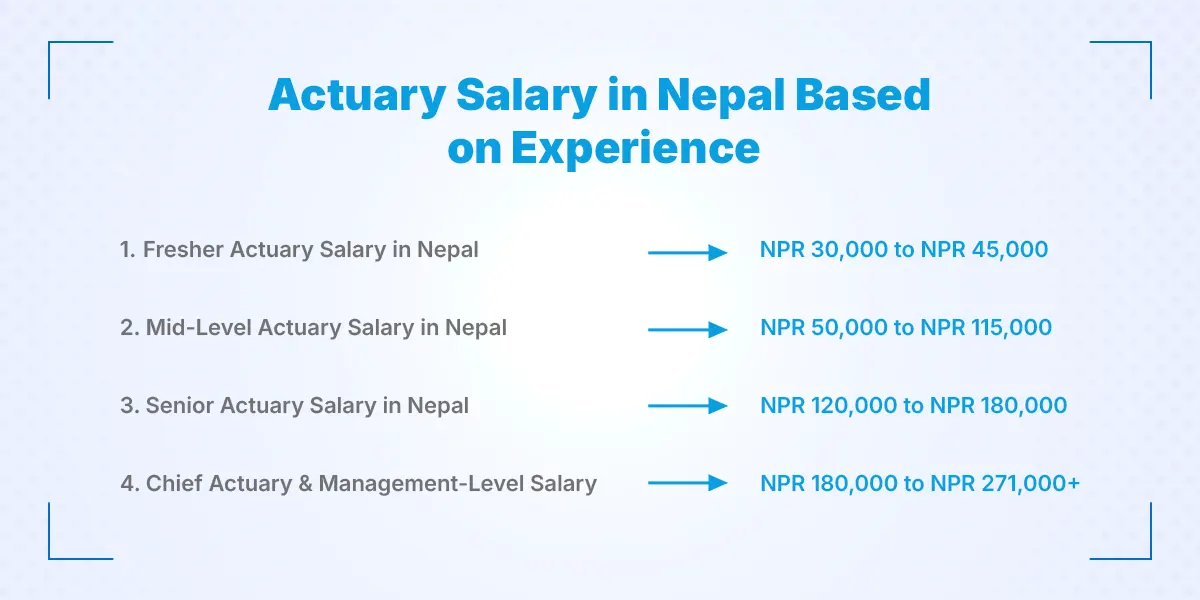
Fresher actuaries in Nepal usually earn between NPR 30,000 and NPR 45,000 per month, depending on their qualifications, internship experience, and technical skills. Most beginners start their careers as actuarial trainees or junior analysts in insurance companies where they assist with data analysis, financial calculations, and risk assessment tasks.
Fresh graduates with knowledge of statistics, Excel, financial modeling, and actuarial software often receive better salary packages than candidates with only theoretical knowledge. Companies also prefer candidates who have already passed a few international actuarial exams because it shows strong technical capability and long-term career commitment.
2. Mid-Level Actuary Salary
Mid-level actuaries in Nepal generally earn between NPR 50,000 and NPR 115,000 per month after gaining several years of professional experience. At this stage, actuaries handle more complex responsibilities such as insurance pricing, forecasting financial risks, preparing actuarial reports, and supporting strategic business decisions.
Professionals with strong problem-solving skills and international actuarial certifications often receive faster promotions and better compensation. Many mid-level actuaries also move into managerial or specialized risk management roles, which further increases their earning potential.
3. Senior Actuary Salary in Nepal
Senior actuaries in Nepal can earn between NPR 120,000 and NPR 180,000 per month based on their expertise, leadership responsibilities, and industry reputation. These professionals usually lead actuarial teams, supervise financial risk analysis, and help organizations make major investment and insurance-related decisions.
Senior actuaries are highly valued because they combine technical actuarial knowledge with business strategy and regulatory understanding. Their ability to reduce financial risks and improve company profitability makes them one of the highest-paid professionals in Nepal’s insurance and finance sectors.
4. Chief Actuary and Management-Level Salary
Chief actuaries and management-level professionals in Nepal typically earn between NPR 180,000 and NPR 271,000 or more per month. These senior executives oversee company-wide risk management strategies, regulatory compliance, product pricing, and long-term financial planning.
Management-level actuaries often work closely with top executives and contribute directly to major business decisions. Their salaries are higher because they carry significant responsibility for maintaining financial stability, managing risk exposure, and supporting overall organizational growth.
Salary of an Actuary in Nepal by Industry
Actuary salary in Nepal varies across industries based on the level of financial risk, technical responsibilities, and demand for actuarial expertise. Professionals working in insurance, banking, consulting, and risk management sectors often receive different salary packages depending on their experience and specialized skills.
1. Insurance Companies
Insurance companies are the largest employers of actuaries in Nepal because they rely heavily on risk assessment, premium calculation, and financial forecasting. Actuaries working in general insurance companies usually receive competitive salaries along with bonuses, career growth opportunities, and long-term job stability.
2. Life Insurance Sector
The life insurance sector offers some of the highest-paying actuarial jobs in Nepal due to the complexity of long-term financial planning and policy management. Life insurance actuaries analyze mortality rates, policy risks, investment returns, and future claim costs to help companies maintain financial stability and profitability.
3. Non-Life Insurance Companies
Non-life insurance companies also hire actuaries to manage risks related to health insurance, vehicle insurance, property insurance, and business coverage. Salaries in this sector depend on the company size, technical workload, and the actuary’s ability to predict and minimize financial losses accurately.
4. Banks and Financial Institutions
Banks and financial institutions increasingly hire actuaries for risk management, investment analysis, and financial forecasting roles. Actuaries in banking sectors often work on credit risk analysis, loan risk assessment, pension planning, and long-term financial strategy development.
5. Consulting and Risk Management Firms
Consulting and risk management firms offer strong career opportunities for actuaries with advanced analytical and communication skills. These professionals advise multiple clients on financial risks, insurance planning, regulatory compliance, and investment strategies, which often leads to higher salary potential and international exposure.
Skills Required to Become a High-Paid Actuary in Nepal
Highly paid actuaries in Nepal need strong technical, analytical, and communication skills to succeed in the insurance and finance industries. Employers prefer professionals who can analyze financial risks accurately, interpret complex data, and support strategic business decisions.
1. Statistical Analysis Skills
Statistical analysis skills help actuaries examine large amounts of financial and insurance data to identify trends, risks, and future outcomes. Strong statistical knowledge improves decision-making and allows companies to manage financial uncertainty more effectively.
2. Risk Assessment and Forecasting
Risk assessment and forecasting skills help actuaries predict future financial losses, insurance claims, and market risks. Companies rely on accurate forecasting models to reduce uncertainty and improve long-term financial planning.
3. Mathematics and Probability Expertise
Mathematics and probability expertise form the core foundation of actuarial science and risk analysis. Actuaries use mathematical formulas and probability theories to calculate premiums, estimate financial risks, and analyze investment performance.
4. Financial Modeling
Financial modeling skills help actuaries create financial projections and evaluate different business scenarios. Strong financial models support pricing strategies, investment decisions, and long-term business growth.
5. Data Analytics and Excel Skills
Data analytics and Excel skills are essential for handling complex financial data and preparing actuarial reports. Many employers in Nepal prefer candidates who can use Excel, SQL, Python, Power BI, and actuarial software efficiently.
6. Communication and Reporting Abilities
Communication and reporting abilities help actuaries explain technical financial information clearly to managers, clients, and stakeholders. Strong communication skills improve teamwork and help organizations make informed business decisions.
7. Knowledge of Insurance Regulations
Knowledge of insurance regulations helps actuaries ensure that companies follow industry rules and financial compliance standards properly. Professionals with strong regulatory knowledge are highly valued in the insurance and risk management sectors.
Educational Qualifications Needed for an Actuary in Nepal
Educational qualification plays a major role in building a successful actuarial career in Nepal. Students with strong mathematical, statistical, and analytical knowledge usually perform better in actuarial studies and professional certification exams.
1. Best Academic Background for Actuarial Science
The best academic background for actuarial science includes subjects related to mathematics, statistics, economics, finance, and business studies. Students who complete higher education in mathematics, actuarial science, commerce, data science, or finance often develop the analytical foundation needed for actuarial careers.
Strong performance in mathematics and probability is especially important because actuarial work involves financial forecasting, risk analysis, and statistical modeling. Many aspiring actuaries in Nepal begin preparing for actuarial exams during their bachelor’s degree to improve their career opportunities.
2. Actuarial Courses and Certifications
Actuarial courses and certifications help students gain professional knowledge and improve their employability in the insurance and finance sectors. These courses focus on statistics, risk management, financial mathematics, insurance principles, and actuarial modeling techniques.
Many employers in Nepal prefer candidates who have completed actuarial training programs or passed a few professional actuarial papers. Professional certifications also increase salary potential because they demonstrate technical expertise and commitment to the actuarial profession.
3. International Actuarial Exams and Their Importance
International actuarial exams are important because they provide globally recognized qualifications and improve career opportunities both in Nepal and abroad. Many Nepali actuaries prepare for exams conducted by international actuarial organizations to gain advanced technical knowledge and professional recognition.
Passing international actuarial exams increases credibility, salary potential, and opportunities to work in multinational insurance companies or global consulting firms. These exams are challenging, but they help professionals build strong expertise in financial risk management and actuarial science.
Why Is Actuarial Science a High-Paying Career in Nepal?
Actuarial science is a high-paying career in Nepal because there are very few qualified actuaries compared to the growing demand in insurance, banking, and financial sectors. Companies are willing to offer competitive salaries to professionals who can manage financial risks, analyze complex data, and support long-term business planning.
1. Limited Number of Qualified Actuaries
The limited number of qualified actuaries in Nepal is one of the main reasons actuarial professionals receive high salaries. Since actuarial exams are difficult and require strong mathematical and analytical skills, only a small number of candidates become fully qualified each year.
2. Increasing Growth of the Insurance Industry
The rapid growth of Nepal’s insurance industry has increased the demand for actuarial professionals in both life and non-life insurance companies. As insurance businesses expand, companies need skilled actuaries to calculate risks, set premiums, and maintain financial stability.
3. High Demand for Risk Management Professionals
The demand for risk management professionals is increasing because businesses now depend more on data-driven financial planning and risk analysis. Actuaries help organizations reduce financial uncertainty, improve investment strategies, and comply with insurance regulations.
4. International Career Opportunities
International career opportunities also make actuarial science a high-paying profession for Nepali professionals. Actuaries with international certifications and strong technical expertise can work in global insurance companies, consulting firms, and financial institutions with significantly higher salary packages.
Career Scope and Job Opportunities for Actuaries in Nepal
The career scope for actuaries in Nepal is growing steadily as insurance companies, banks, and financial institutions increasingly rely on risk analysis and financial forecasting. Actuarial professionals now have opportunities in both local and international markets due to the rising demand for skilled risk management experts.
1. Future Demand for Actuaries
The future demand for actuaries in Nepal is expected to increase as the insurance and finance industries continue to expand. Companies need qualified professionals who can analyze risks, manage financial uncertainty, and support long-term business planning through data-driven strategies.
2. Top Hiring Sectors in Nepal
Insurance companies are currently the top hiring sector for actuaries in Nepal because they require continuous risk assessment and financial analysis. In addition to insurance, banks, investment firms, pension funds, healthcare organizations, and consulting companies also hire actuarial professionals for specialized financial and analytical roles.
3. Opportunities Abroad After Actuarial Certification
Actuarial certification creates strong international career opportunities for Nepali professionals in countries with advanced insurance and financial markets. Candidates who pass internationally recognized actuarial exams can apply for jobs in multinational insurance companies, consulting firms, and global financial institutions.
4. Freelancing and Consulting Opportunities
Freelancing and consulting opportunities are also increasing for experienced actuaries with strong technical and analytical expertise. Many companies seek independent consultants for financial forecasting, insurance planning, risk management, and regulatory compliance projects, creating additional income opportunities for actuarial professionals.
Challenges of Becoming an Actuary in Nepal
Becoming an actuary in Nepal is challenging because the profession requires advanced mathematical skills, strong analytical thinking, and years of professional exam preparation. Although actuarial science offers high salaries and excellent career opportunities, students must invest significant time and effort to become fully qualified professionals.

1. Difficulty Level of Actuarial Exams
Actuarial exams are considered some of the most difficult professional exams because they test advanced concepts in mathematics, statistics, probability, finance, and risk management. Many students require several years of preparation to pass multiple actuarial papers successfully.
The exams demand strong problem-solving abilities, discipline, and consistent study habits. Candidates who lack a strong mathematical foundation often find the actuarial exam process challenging and time-consuming.
2. Time Required to Become a Certified Actuary
Becoming a certified actuary usually takes several years because candidates must pass multiple professional exams and gain practical work experience. The duration depends on the student’s learning speed, exam performance, and level of dedication.
Many actuarial students study while working full-time in insurance or financial companies, which makes the process more demanding. However, completing actuarial certification significantly improves long-term salary potential and career growth opportunities.
3. Competition and Skill Requirements
Competition in the actuarial field is increasing as more students become interested in high-paying finance and risk management careers. Employers prefer candidates who have strong technical skills, professional certifications, and practical experience in financial analysis.
Actuaries also need expertise in statistics, Excel, financial modeling, communication, and insurance regulations to succeed in the industry. Candidates who continuously improve their analytical and technical abilities usually achieve better career advancement and higher salaries in Nepal.
Future of Actuarial Science in Nepal
The future of actuarial science in Nepal looks highly promising as insurance companies and financial institutions increasingly depend on technology, data analysis, and risk forecasting. The growing focus on financial security, digital services, and advanced analytics is creating strong demand for skilled actuarial professionals across multiple industries.
1. Digital Transformation in Insurance
Digital transformation is changing how insurance companies operate in Nepal by improving customer services, claim processing, and financial management systems. Actuaries now work with advanced digital tools and software to analyze risks more accurately and support faster business decisions.
Insurance companies are also using digital platforms to manage policies, customer data, and financial forecasting more efficiently. This shift is increasing the importance of actuarial professionals with strong technical and analytical skills.
2. AI and Data-Driven Risk Analysis
Artificial intelligence and data-driven risk analysis are becoming important parts of modern actuarial science and financial planning. Companies use AI technologies to process large amounts of financial data, predict future risks, and improve decision-making accuracy.
Actuaries who understand data analytics, machine learning, and predictive modeling will have better career opportunities in the future. These technologies are helping organizations reduce financial uncertainty and improve long-term risk management strategies.
3. Rising Demand for Actuarial Professionals
The demand for actuarial professionals in Nepal is increasing because insurance companies, banks, and investment firms need experts in financial risk management. As businesses become more data-driven, companies require professionals who can analyze market trends and support strategic planning.
The limited number of qualified actuaries in Nepal also contributes to higher demand and better salary opportunities. Skilled professionals with actuarial certifications and technical expertise are likely to remain highly valuable in the coming years.
4. Long-Term Career Growth Opportunities
Actuarial science offers strong long-term career growth opportunities due to its specialized nature and global demand. Experienced actuaries can progress into consulting, investment analysis, and executive-level risk management, and other senior roles.
Professionals with international actuarial qualifications may also find opportunities in multinational companies and overseas financial markets. Continuous learning and technical skill development will remain important for long-term success in the actuarial profession.
Conclusion
Actuary salary in Nepal continues to grow as the demand for financial risk management and insurance professionals increases across the country. From entry-level positions to senior management roles, actuarial science offers strong earning potential, long-term job stability, and opportunities for international career growth.
Professionals with strong mathematical skills, analytical thinking, and internationally recognized actuarial certifications are more likely to achieve higher salaries and faster career advancement. As Nepal’s insurance and financial sectors continue to expand, actuarial science is expected to remain one of the most rewarding and high-paying careers in the finance industry.
Looking for more finance and accounting opportunities? Explore the latest openings and kickstart your career by checking out active listings on Kumari Job.
Frequently Asked Questions
Submit your comments

Get Our App On



How to Make a Police Report (Police Clearance Certificate) in Nepal?
VIEW DETAILS
Types of SEO and How They Work: Complete Beginner's Guide
VIEW DETAILS
Government Restricts New Lok Sewa Vacancy Requests 2083/84 — Or Not?
VIEW DETAILS
How to Apply for Tattoo Artist Jobs in Nepal?
VIEW DETAILS


Loading Comments...