

If you have ever searched for a job in the development sector in Nepal, you have probably come across both NGO and INGO vacancies, oftentimes on the same page.
And if you have ever paused and thought, wait, what is actually the difference?, you are definitely not alone.
A lot of job seekers in Nepal pick one over the other without really knowing what they are signing up for. That gap in clarity can cost you a better salary, a stronger career path, or simply the right fit.
So, this guide breaks it all down for you. We’ll cover what NGOs and INGOs actually are, how their jobs differ, what salaries look like, and most importantly the difference between NGO vs INGO jobs in Nepal and which one makes sense for where you are in your career right now.
In this blog
What is an NGO?
An NGO, or Non-Governmental Organization, is an organization that works independently from the government to serve people and communities. It is not profit-driven, meaning the goal is social impact, not earnings. NGOs are usually registered locally and run by people who are deeply rooted in the community they serve.
In Nepal, NGOs are everywhere. You will find them working in areas like girls' education in Karnali, sanitation projects in rural Terai, or mental health awareness in peri-urban communities. They are on the ground, close to the people, and often the first to respond when a community needs support.
Because they operate locally, NGOs are often smaller in scale. That also means they tend to work with tighter budgets and depend heavily on project-based funding from donors or government grants. Despite this, they are a critical part of Nepal's development landscape.
What is an INGO?
An INGO, or International Non-Governmental Organization, is essentially an NGO that operates across borders. It is headquartered in one country, often a developed nation, but runs programs in multiple countries, including Nepal. INGOs bring in large international funding and work on much bigger, often multi-year projects.
Think of organizations like Save the Children, World Vision, or Oxfam. These are INGOs that operate in Nepal and run programs across health, disaster relief, child protection, and livelihood support at a national or even regional scale. Their reach goes far beyond a single community.
Because INGOs are internationally funded and structured, they usually follow strict global standards in hiring, reporting, project management, and pay. That also means working at an INGO often feels more corporate and structured than a typical local NGO setup.
What is the Difference Between NGO and INGO?: Quick Comparison
The biggest difference between an NGO and an INGO is simple: NGOs operate locally with limited funding, while INGOs work internationally with significantly larger budgets and broader impact. This also directly affects salaries, hiring standards, and career growth opportunities. Here is a side-by-side look at how they compare across the key factors that matter most to job seekers.
NGO vs INGO Jobs in Nepal: Key Differences Explained
NGO and INGO jobs in Nepal differ across work scope, salary, environment, and how easy it is to get hired in the first place. Each of those differences matters depending on your background and goals. While NGOs offer accessible entry points with hands-on field experience, INGOs reward specialized skills with better pay and a more structured career track. Let us look at each of these differences up close.
1. Work Scope and Impact
NGO jobs in Nepal are mostly community-focused. You could be coordinating a nutrition program in a village in Sindhupalchok or running a women's empowerment workshop in Dang. The work is local, personal, and deeply connected to the people you serve. The impact is visible, but it is also limited to a specific geography or community.
INGO jobs, on the other hand, operate at a much larger scale. A program officer at an INGO in Kathmandu might be overseeing flood relief efforts across three provinces, coordinating with district offices, government bodies, and international partners all at once. The scope is broader, and so is the complexity of the work.
This difference in scale also shapes your day-to-day experience. In an NGO, you often wear many hats. You might be both the field coordinator and the report writer. In an INGO, roles are more defined and specialized, which helps you build deeper expertise in your specific area over time.
2. Salary Structure
NGO salaries in Nepal are modest, especially at the entry level role, but they are a solid starting point. The pay is tied closely to project funding, which means salaries can vary depending on the donor and the size of the project. Still, a stable NGO role gives you real experience that builds your career over time.
INGO salaries are noticeably higher, and they also come with added benefits like health insurance, provident fund contributions, travel allowances, and sometimes even performance bonuses. These packages make INGO jobs especially attractive for mid-to-senior professionals who have built their expertise and are ready to negotiate for better compensation.
3. Work Environment
NGO workplaces in Nepal tend to be more flexible and informal. Dress codes are relaxed, hierarchies are flatter, and decisions can sometimes be made quickly. However, the trade-off is that resources are limited, you may not always have the tools, systems, or budget you need to do your best work.
INGO offices, by contrast, follow international standards. Processes are documented, roles are clearly defined, and systems are in place. This makes the work environment more predictable and professional. For someone who thrives in a structured setting and wants global-standard work experience, INGOs offer exactly that.
4. Hiring Requirements
NGOs in Nepal are generally more accessible for freshers and early-career professionals. Many NGO roles only ask for a bachelor's degree, some volunteer experience, or basic computer skills. This makes them a great first step into the development sector, especially if you are still building your profile.
INGOs set a higher bar. Most positions require relevant work experience, often two to five years minimum, along with specialized skills, strong English proficiency, and sometimes specific certifications. Senior roles may even require postgraduate qualifications.
Competition is intense, and applications are reviewed against global standards. So if you are just starting out, gaining experience through NGOs first is actually one of the smartest paths into an INGO career later.
What is the Salary of NGO and INGO Jobs in Nepal: Comparative View
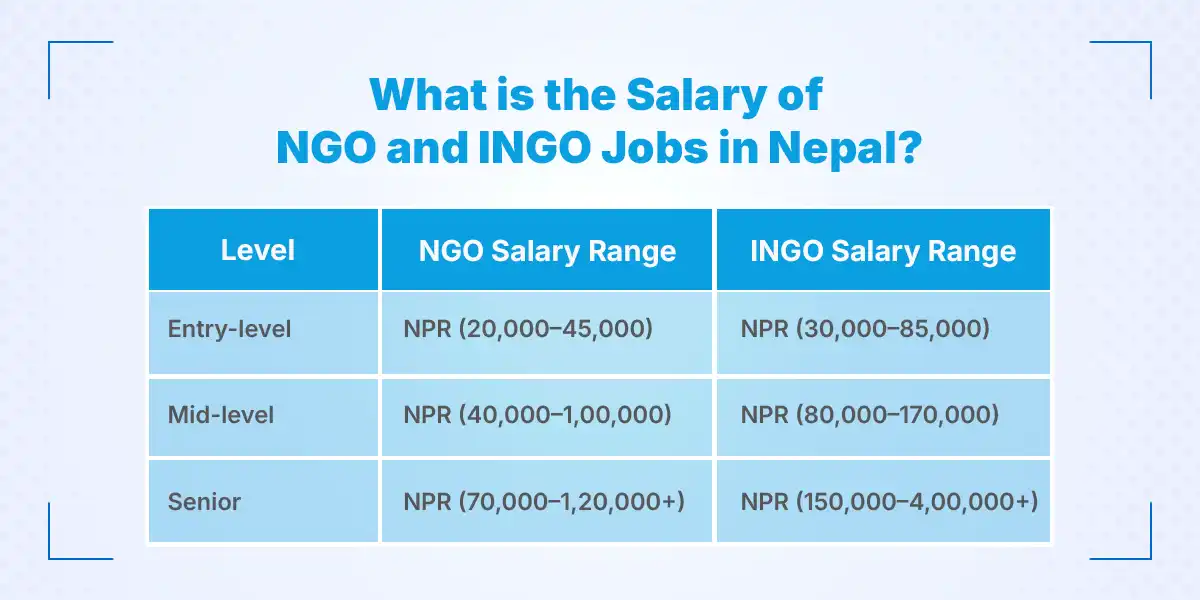
NGO salaries in Nepal typically range from NPR 20,000 to NPR 1,20,000+ depending on experience, while INGO salaries can go from NPR 30,000 at entry level all the way up to NPR 4,00,000+ at senior positions. The gap is real, and it reflects the difference in funding, accountability, and skill demands between the two. Here is a comparative look at what the numbers actually look like at each level.
1. Salary Range of NGO in Nepal
The salaries of NGOs in Nepal depend on experience and project funding. The lowest-level jobs such as field assistants or community mobilizers are usually paid between NPR 20,000 and 45,000 as they have low-paying jobs, but have good field experience. Mid level jobs like project coordinators or program officers are typically between NPR 40,000-1,00,000 based on the size of the project and the donor funding.
Top positions such as program managers or heads of finance may attract NPR 70,000-1,20,000 or more, and better remuneration is associated with experience, performance, and strength of the organization in regard to funding.
2. INGO Salary in Nepal
INGOs tend to provide better and better-organized salaries than NGOs. Program associates or other administration positions will be available at entry level with salaries of NPR 30,000-85,000 and may have standardized international pay scales. Mid-level employees like the finance officers or the HR managers are normally paid NPR 80,000-170,000, normally accompanied by other benefits like insurance and allowances. Top positions, such as country director, technical advisor, etc., may be paid NPR 1,50,000-4,00,000+ due to the high level of responsibility and scope of their activities.
3. Factors Affecting Salary in NGO and INGO Jobs
Your salary in Nepal's development sector is shaped mainly by your experience, education, the organization's funding, and where the job is located. These four factors together can push your pay significantly higher or keep it at the base level, so understanding them helps you negotiate smarter.
3.1. Experience
The more appropriate field or sector experience that you possess, the better your salary bargaining ground. Two to three years of practical experience on working with projects can also make a significant change, especially when applying to INGOs.
3.2. Education
Masters degree - in development studies, public health, social work or related areas is a gateway to NGO/INGO jobs with better pay brackets. In a few cases, senior INGO positions have postgraduate qualification as a minimum.
3.3. Project Financing
INGO and NGO salaries are directly linked to the activities that they operate. The better remuneration package will be a fully-funded USAID or DFID project compared to a smaller, locally funded program even within the same organization.
3.4. Location
Kathmandu jobs tend to be higher paid than field work in remote areas, in part because of cost of living adjustments. Nevertheless, certain INGOs provide hardship allowances on remote assignments, which in fact, can turn field jobs into rather competitive in terms of finances.
Benefits of Working in NGO vs INGO in Nepal
Both NGOs and INGOs offer real benefits, just different kinds. NGOs give you ground-level experience and community connection, while INGOs offer financial stability and professional growth on an international scale. Here is a quick breakdown of what each brings to the table.
1. Benefits of Working in NGO
Working at an NGO gives you something that money cannot always buy early in your career. It’s direct, grassroots impact and a fast track to diverse field experience. These roles expose you to real communities, real problems, and real solutions in a way that builds both empathy and practical skills. And if you are just starting out, NGOs are one of the easiest doors to open in the development sector.
- Hands-on grassroots experience
- Strong community connection and local networks
- Easier entry point for beginners and fresh graduates
- Flexible work culture with room to take initiative
- Builds a strong field profile for future INGO applications
2. INGO Benefits in Nepal
INGO jobs come with a package that is hard to match. Higher salaries, structured growth, and the kind of international exposure that can genuinely open global doors for your career. Beyond the pay, working at an INGO means operating within global standards, which sharpens your professional skills considerably. These are roles that look impressive on a CV anywhere in the world.
- Higher salary with full benefits (health, PF, insurance)
- International exposure and global network access
- Clear career advancement pathways
- Professional, structured work environment
- Opportunities to travel, train, and grow regionally or globally
Challenges of NGO and INGO Jobs in Nepal: What Differs?
Both sectors come with real challenges. NGO roles are often limited by funding and job security, while INGO roles demand high performance under intense competition. Knowing these challenges ahead of time helps you go in with realistic expectations rather than surprises. Here is what to watch out for on both sides.
1. Challenges in NGO Jobs
- Limited and unpredictable funding cycles
- Lower job security, especially on project-based contracts
- Slower salary growth and fewer formal promotion structures
- Resource constraints that can affect your ability to do quality work
- Burnout risk due to high workload with limited staff
2. Challenges of working in INGOs
- Highly competitive hiring process since quality applicants are plenty
- Most roles are contract-based and linked to project timelines
- High performance pressure with regular reporting and accountability
- Work-life balance can suffer in high-pressure projects
- Frequent staff turnover due to short project cycles
Which One Should You Choose: NGO or INGO?
If you are a fresher or early in your career, start with an NGO. It is the smarter, more realistic entry point. If you have a few years of experience and are ready for better pay and a more competitive environment, INGOs are worth going after.
The choice really comes down to where you are right now, what you need financially, and whether you are driven more by passion for ground-level work or ambition for international career growth.
- If you are a fresher: Start with NGOs. They are accessible, they teach you the development sector from the ground up, and they build the field profile that INGOs will eventually want to see.
- If salary is a priority: INGOs clearly win. The difference in compensation, especially at mid and senior levels, is significant and comes with added benefits that NGOs rarely match.
- If impact is what drives you: Both sectors serve communities, but NGOs put you closest to the people. If that direct, visible impact is what keeps you going, an NGO career can be deeply fulfilling, even if the pay is less.
- If you want to grow internationally: INGOs are the better choice. They connect you to global networks, offer cross-country experience, and position you for roles beyond Nepal if that is the direction you want to grow in.
The smartest move for most Nepali development sector job seekers is to start in NGOs, build two to three years of strong field experience, and then use that profile to move into an INGO role at a level that reflects your actual skills.
How to Get NGO and INGO Jobs in Nepal?
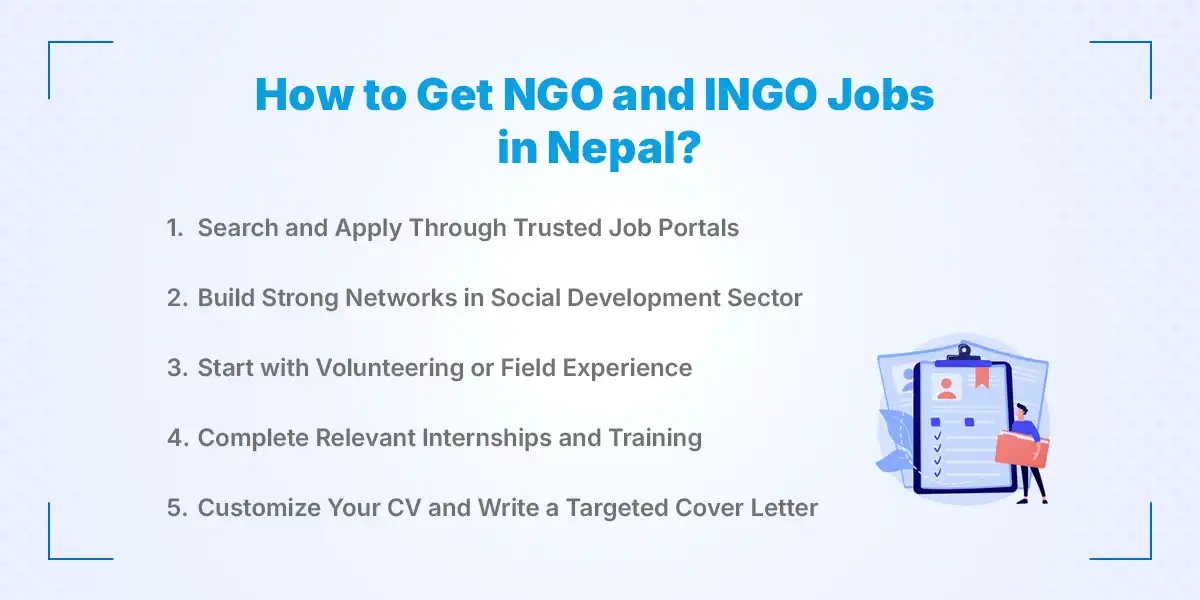
Getting hired in the development sector in Nepal starts with applying through the right platforms, building genuine connections, and making your CV work hard for you. Beyond that, field experience, whether through volunteering, internships, or short-term assignments is often the deciding factor between two otherwise similar candidates. Here are the most effective steps to actually land the job.
1. Search and Apply Through Trusted Job Portals
The most reliable places to find NGO and INGO vacancies in Nepal are dedicated job portals like Kumari Job, LinkedIn, and NGO-specific platforms for international roles. Set up job alerts so you never miss an opening in your target area. Many INGOs also post directly on their own websites, so it is worth bookmarking the career pages of organizations you want to work for and checking them regularly.
2. Build Strong Networks in the Social Development Sector
In Nepal's development sector, who you know genuinely matters. Attend sector events, workshops, and public seminars organized by INGOs and development organizations in Kathmandu and your district. Connect with professionals on LinkedIn and join relevant Facebook groups where sector jobs are frequently shared. Many roles, especially at NGOs, are filled before they are even advertised publicly, so staying networked keeps you in the loop.
3. Start with Volunteering or Field Experience
If you do not have formal work experience yet, volunteering is your fastest way in. Many NGOs in Nepal welcome volunteers for community programs, field surveys, and awareness campaigns. Even a few months of documented volunteer work shows hiring managers that you are serious, that you understand field realities, and that you are not waiting for the perfect opportunity to start. It also gives you stories to tell in interviews.
4. Complete Relevant Internships and Training
NGOs and INGOs internships are among the top secrets in career opportunities in the development sector in Nepal. A variety of organizations, large INGOs and many other, have their own structured internship programs which result in entry-level employment. In conjunction with internships, full short course opportunities in such fields as project management, monitoring and evaluation, gender mainstreaming, or public health. Such certifications bring out your CV in a competitive pool.
5. Customize Your CV and Write a Targeted Cover Letter
A generic CV will almost never get you past the first round, especially at INGOs. Tailor your resume to highlight experience and skills that are directly relevant to the job description. Use their language, mirror their priorities, and show that you understand what they do. Your cover letter should not repeat your CV. Instead, use it to explain why this specific organization and this specific role matters to you, and how your background makes you the right fit. One well-written CV will always beat ten generic ones.
Conclusion
NGOs provide easier points of entry, grassroots experience, and community access, and INGOs offer greater salaries and professional organization and international career development. They both fit in the development field of Nepal and the right option is all about your level of career, finances and your future aspirations.
Do not wait to get the perfect INGO job, especially when you are new and you can work in any place, gain some actual experience and climb the ladder. The development sector compensates individuals who attend to appear, remain consistent, and have the desire to make a difference. Starting in a small local NGO in your district or landing an entry-level position in INGO, the thing is to get moving.
Ready to move on? Browse the recent jobs of NGOs and INGOs in Nepal, create your job profile, and apply with a purpose.
Frequently Asked Questions
Submit your comments

Get Our App On



How to Make a Police Report (Police Clearance Certificate) in Nepal?
VIEW DETAILS
Types of SEO and How They Work: Complete Beginner's Guide
VIEW DETAILS
Government Restricts New Lok Sewa Vacancy Requests 2083/84 — Or Not?
VIEW DETAILS
How to Apply for Tattoo Artist Jobs in Nepal?
VIEW DETAILS


Loading Comments...