




Let's be honest. Choosing a career after your +2 or bachelor's degree feels overwhelming. Everyone around you seems to have it figured out, but you're still searching for a path that actually makes sense.
And somewhere between "just get any job" and "follow your passion," there's a smarter question to ask: which field will actually grow? It is wise and very important to choose a career with high and stable scope.
That's where financial management comes in. In Nepal's growing economy, companies, banks, NGOs, and startups all need people who understand money. This has also caused a notable rise in accounting and finance jobs in Nepal.
This guide breaks down the full scope of financial management, covering what it is, where it can take you, and how to get started the right way.
In this blog
What Is Financial Management?
Financial management, simply put, is the process of planning, organizing, and controlling money in a business or organization. Alongside bookkeeping or adding up numbers, it's about making smart decisions with money so that a business can grow, stay stable, and reach its goals. Think of it as the backbone behind every business move.
Every business, whether it's a small startup in Thamel, a bank in Kathmandu, or a big corporate house, needs someone who knows how money flows in and out. A financial manager helps decide where to invest, how to raise funds, and how to make the most of what the company already has. Without this, even a profitable business can run into serious trouble.
So at its core, financial management is about three things: making money work harder, reducing financial risk, and keeping the business healthy in the long run. Now let's understand its actual scope and why it matters for your career.
Why Financial Management Is Becoming a Top Career Choice Today
Financial management is one of the fields that keeps growing no matter what happens in the economy. It is a promising sector, not just now, but even five or ten years from now. Businesses need finance professionals in good times to grow, and in tough times to survive.
In Nepal, the demand for skilled finance professionals is rising fast. Banks, microfinance companies, NGOs, fintech startups, and corporate houses are all hiring. Globally, finance is one of the most stable and well-paying sectors, and Nepal is slowly catching up with that trend.
The reason it keeps growing is simple: every single business decision, from hiring to expansion to daily operations, involves money. Someone has to manage that money smartly. Here's why this field stands out:
- Consistent demand across all industries
- Competitive salaries even at entry level
- Career growth is fast with the right skills
- Versatility. finance skills work in any sector
- Respected profession in Nepal's job market
- Opportunities abroad for those who want to go global
Scope of Financial Management in 2026 and Beyond
The scope of financial management in Nepal and globally covers a wide range, from investment decisions and financing strategies to dividend management, working capital control, and financial forecasting. These aren't just theoretical concepts; they are real functions that businesses carry out every single day. Let's break each one down so you can see exactly where your skills could fit in.
1. Investment Decisions
Investment decisions involve calculating the places where a business ought to invest its money so as to reap the most. This might include investing in new machinery, moving to a new facility, stock purchases, or investing in a new project. Your task, as a professional in finance, is to carefully consider these choices, since all investments involve a degree of risk.
The most important idea here is risk vs. return. An option that has more potential gain will have greater risk and a less risky option will have less gain. It requires you to process data, compare alternatives and advise what is the most reasonable to the business at that moment. This skill is becoming highly important in the expanding market in Nepal.
2. Financing Decisions
The second question after deciding on what to invest in is: how do we finance it? That is what the financing decisions are. You consider such alternatives as borrowing a bank loan, attracting investors, issuing shares, or using the company saved money itself, and then weigh the mix of them that best applies.
The cost and consequence of each financing option are different. Loans are associated with interest, equity equates to the idea of sharing ownership, and internal funds can slow down other processes. An excellent finance practitioner balances these trade-offs and assists the business to develop without putting it into a precarious financial situation. To Nepalese businesses, particularly SMEs and startups, such type of smart financing advice can literally mean the difference between growing up and going out of business.
3. Dividend Decisions
Once a company has a profit, the other question arises should we give shareholders the profit, or should we plow the profit back to the business? This is what it is all about dividend decisions and it has a direct impact on how investors and stakeholders perceive the company.
Dividend distributions will ensure shareholders are satisfied and they will develop trust. However, profits retained and reinvested can enable the company to grow at a faster rate. This balance is determined by the stage of the business, future, and in the market. The finance professionals that comprehend the dividend policy can assist in creating the image of the company and long term value which is an even greater task than it may appear on the surface.
4. Working Capital Management
Working capital management is concerned with the on-day operations of a business, i.e., how to manage the cash-flow, to monitor the expenditure, to maintain the inventory, to ensure that the business is able to settle its short-term liabilities as they fall due. It is not glamorous like investment planning, but is extremely essential.
A business may be a profitable entity on paper and a business that may be in deep trouble when it lacks cash to meet its daily operations. This is why working capital management is one of the most practical and valuable spheres of financial management. Most of the businesses and particularly retail, manufacturing and services are not doing well in Nepal and this has made trained professionals in this field very valuable and demanded.
5. Financial Planning & Forecasting
Financial planning is forward looking, it involves making budgets, projections and plans into how the business will go in terms of finances. Forecasting assists the business to get ready to face the challenges of the future as they are yet to be a problem.
In the absence of financial planning, the businesses are left with reactive decisions rather than proactive decisions. An effective financial plan assists the management to spend resources in a wise manner, to set achievable goals and to be able to make progress even when circumstances are not going in the right direction. This skill has become one of the most demanded in the corporate and non-profit worlds as the business environment in Nepal is rapidly changing, and the situation on the market can alter anytime.
What are the Popular Job Roles in Financial Management in Nepal?
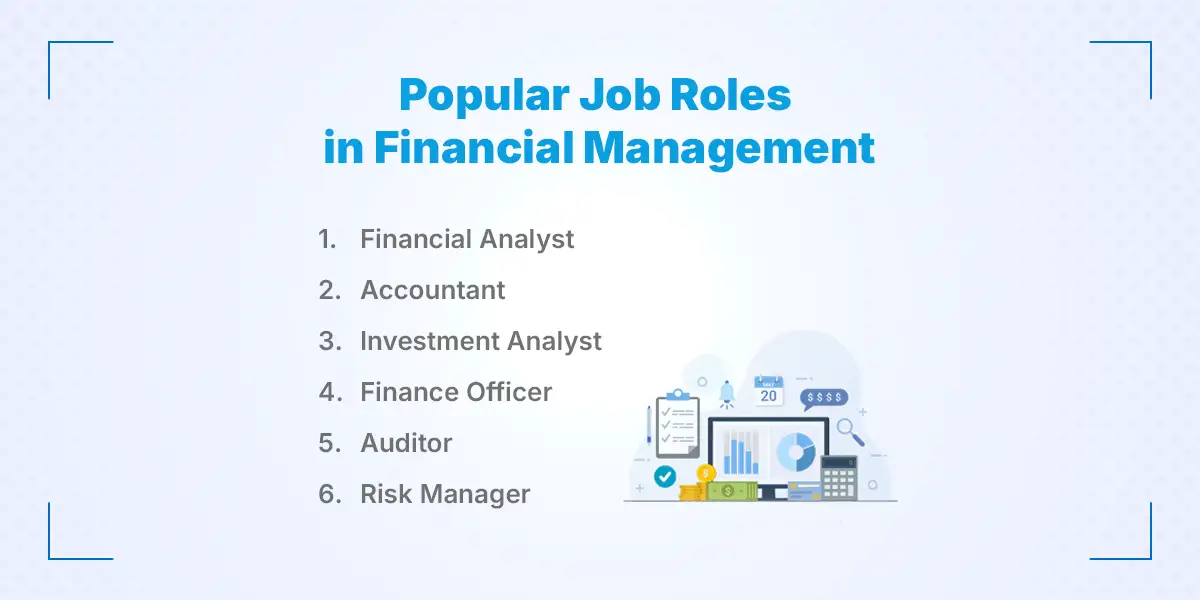
Some of the most in-demand roles in financial management in Nepal right now include financial analyst, accountant, finance officer, auditor, investment analyst, and risk manager. These roles exist across banks, corporate houses, NGOs, INGOs, and fast-growing fintech startups. Here's a closer look at what each role actually involves.
1. Financial Analyst
A financial analyst studies a company's financial data and turns it into insights that help business leaders make better decisions. You'll be looking at trends, building reports, and evaluating whether investments or strategies are working. It's a role that demands both technical skills and sharp business thinking.
In Nepal, financial analysts are increasingly in demand in banking, investment firms, and development organizations. Entry-level analysts can move up quickly if they combine strong Excel and data skills with an understanding of the local market. It's one of the best starting points for anyone who wants a finance career with clear growth potential.
2. Accountant
An accountant manages a company's financial records tracking income, expenses, payroll, taxes, and more. It might sound straightforward, but accurate accounting is what keeps a business legally compliant and financially healthy. Without a good accountant, companies face penalties, audits, and a whole lot of financial chaos.
In Nepal, accountants are needed in virtually every type of organization, from small businesses to government offices to international NGOs. If you have a solid foundation in accounting basics and tools like Tally or Excel, you can get into this role soon after graduation. It's a stable, respected career with growing demand across the country.
3. Investment Analyst
An investment analyst researches financial markets, companies, and economic trends to help organizations or individuals decide where to put their money. You'll be preparing detailed reports, analyzing risk, and recommending investment strategies, all backed by data. It's a high-responsibility role that requires strong analytical thinking.
In Nepal, the investment landscape is growing, from the stock market (NEPSE) to real estate and private equity. Investment analysts who understand the Nepali market context are especially valuable. If you enjoy research, numbers, and thinking strategically about money, this is a career path worth exploring seriously.
4. Finance Officer
A finance officer handles the overall financial operations of an organization, from budgeting and reporting to compliance and fund management. In Nepal, these roles in NGOs and INGOs are extremely common and well-compensated. You're essentially the go-to person for everything money-related within the organization.
What makes this role attractive is its versatility. Finance officers work across sectors and can move between corporate, nonprofit, and government environments. Strong reporting skills, attention to detail, and familiarity with donor reporting formats (for NGOs) can set you apart quickly in this career path.
5. Auditor
An auditor's job is to independently review a company's financial records and verify that everything is accurate, legal, and following the right standards. It's a role built on trust. Businesses, regulators, and investors rely on auditors to give an honest picture of the financial situation. Both internal and external auditing opportunities exist in Nepal.
In Nepal, auditing is a growing field, especially with increasing regulatory requirements for businesses and nonprofits. Many auditors also go on to start their own CA firms or consultancy practices. If you enjoy detail-oriented work and want a role where your findings actually matter at a high level, auditing is a strong career option.
6. Risk Manager
A risk manager identifies potential financial threats to an organization and creates strategies to reduce or manage those risks. This could involve market risks, credit risks, operational risks, or regulatory compliance issues. It's a proactive role where you're trying to prevent problems before they happen.
In Nepal's banking and insurance sectors, risk management is becoming increasingly important. As financial institutions grow and regulations tighten, they need professionals who can systematically assess and address risk. It's a specialized role that pays well and offers excellent long-term career stability for those willing to develop expertise in this area.
Essential Skills Required for a Career in Financial Management
The most important skills for a career in and financial management include analytical thinking, financial reporting basics, Excel proficiency, strong communication, and a solid problem-solving mindset. Having these skills is what separates candidates who get hired from those who get overlooked. Here's what each finance and accounting skill actually looks like in practice.
1. Analytical Thinking
Analytical thinking is the ability to interpret data, identify patterns, and make logical decisions. Finance roles require working with large datasets quickly and accurately. You can build this skill by analyzing reports, balance sheets, or even personal budgets. With consistent practice, your ability to think critically improves significantly.
2. Basic Financial Reporting and Accounting
Understanding financial statements like income statements, balance sheets, and cash flow reports is essential. These documents reflect a company’s financial health and guide decision-making. Even non-accountants need strong basics to succeed in finance roles. Practical exposure through case studies or real data helps build this skill faster than theory alone.
3. Excel & Financial Tools
Excel is a core requirement for most finance jobs, used for analysis, reporting, and modeling. Strong Excel skills help you stand out in a competitive job market. Tools like Tally and Power BI are also valuable but can be learned gradually. Start with basics like VLOOKUP, pivot tables, and simple formulas.
4. Communication and Decision-Making
Finance professionals must clearly explain complex data to non-finance stakeholders. Strong communication helps you present insights, justify decisions, and influence outcomes. Decision-making is equally important, especially when working with limited information. Structured thinking builds confidence and trust in professional settings.
5. Problem-Solving Mindset
Finance roles involve handling challenges like budget issues, cost increases, or financial risks. Employers value professionals who stay calm and think critically under pressure. This mindset develops through real-world exposure such as internships and case studies. Over time, you learn to approach problems as opportunities for solutions.
Educational Pathways to Build a Career in Financial Management
The main pathways into financial management in Nepal include undergraduate degrees like BBS, BBA, and BBM, followed by postgraduate options like MBS and MBA with finance specializations, along with optional but valuable certifications like ACCA and CFA. Your educational path matters because it shapes both your knowledge base and how employers see you. Here's what each pathway looks like.
1. BBS, BBA, BBM (Bachelor's Degrees)
BBS (Bachelor of Business Studies), BBA (Bachelor of Business Administration), and BBM (Bachelor of Business Management) are the most common entry points into finance in Nepal. All three cover core financial concepts: accounting, economics, business law, and financial management, giving you a solid theoretical foundation.
The BBS program under Tribhuvan University is the most widely pursued, while BBA programs at private colleges often offer more industry exposure. Regardless of which you choose, what matters most is how you supplement your degree, through internships, real projects, and additional skill-building. A degree opens the door; your practical skills determine how far you go.
2. MBS, MBA with Finance Specialization
If you want to move into senior roles faster, a postgraduate degree makes a significant difference. MBS (Master of Business Studies) or an MBA with a finance specialization deepens your understanding of financial strategy, investment, corporate finance, and economic policy. These are the things that matter at the leadership level.
In Nepal, MBA graduates with finance specializations often move into roles at commercial banks, investment firms, and multinational organizations. If you're serious about building a long-term career in finance, a postgraduate degree is a worthwhile investment in yourself.
3. ACCA, CFA (Certifications)
Certifications like ACCA (Association of Chartered Certified Accountants) and CFA (Chartered Financial Analyst) are optional, but they are genuinely powerful career boosters. ACCA is widely recognized in Nepal's banking and audit sectors, while CFA is globally regarded as the gold standard for investment and financial analysis professionals.
These certifications show employers that you've gone beyond classroom learning and tested yourself against global standards. Jobs in CA, ACCA, and CFA also tend to lead to higher salaries and faster promotions. They're not easy and require serious commitment. But for those who complete them, the career advantage is real and lasting.
4. Advanced Accounting Training
Advanced accounting training focuses on practical, job-ready skills that most colleges don’t teach. It typically covers tools like Tally, Excel for accounting, VAT, taxation, payroll, and real financial reporting. You learn by working on real scenarios, not just theory. This makes you immediately more employable and confident in interviews.
However, here's something most educational paths don't tell you: qualifications alone don't guarantee a job. There's a skill gap that many finance graduates in Nepal face when they step into the real world.
Challenges Students Face While Entering the Finance Field
The most common challenges finance students face in Nepal include a lack of practical exposure, limited industry-ready skills, confusion about career direction, and fierce competition in the job market. These challenges are real, but they're also very solvable. Here's a closer look at each one.
1. Lack of Real-World Experience
Most finance courses in Nepal focus heavily on theory, with little exposure to real business situations. This gap becomes obvious when students start applying for jobs. To fix this, get hands-on experience through internships, volunteering, or small freelance work. Consider job-oriented accounting courses over the theory-heavy ones. Even managing your own budget or analyzing companies can help build practical thinking.
2. Limited Industry-Ready Skills
Knowing concepts isn’t enough if you can’t apply them in real work. Many graduates struggle with tools like Excel or explaining financial data clearly. Employers notice this gap quickly. Focus on practical skills like financial modeling, Excel, or tools like Tally, and practice with real data.
3. Lack of Career Direction
Finance offers many paths, but most students aren’t sure which one to choose. This leads to random job applications without clear focus. The best way to gain clarity is through exposure. Talk to professionals, try internships, and explore different roles. Direction becomes clearer once you experience the field.
4. High Competition in the Job Market
Finance is a popular field, so entry-level roles are highly competitive. A degree alone won’t help you stand out. You need skills, experience, and proof of your work. Build a strong profile with projects, internships, and networking to improve your chances.
How to Build a Strong Career in Financial Management in 2026?
Building a strong career in financial management starts with getting your fundamentals right, developing real practical skills, gaining experience through internships, and staying consistently updated on financial trends. These steps aren't glamorous, but they work, and the students who follow them consistently end up miles ahead of those who don't. Here's how to approach each step:
1. Build Strong Fundamentals
Before anything else, make sure you actually understand the core concepts. This includes financial statements, budgeting basics, time value of money, financial ratios, bookkeeping, and how markets work. These fundamentals come up in every finance role, at every level. If your foundation is shaky, everything built on top of it becomes fragile.
Go back to basics if needed. Re-read your core finance textbooks, watch free lectures online, or join study groups. The goal isn't to memorize everything, it's to understand the logic behind financial decisions so you can think through new problems confidently. Strong fundamentals are what help you grow fast once you're actually working.
2. Gain Practical Skills (Tools, Real Cases)
Once your fundamentals are solid, shift focus to the tools and skills employers actually use. Master Excel formulae, pivot tables, financial modeling basics. Learn how to read and analyze real company financial reports. If possible, practice with accounting software like Tally or exposure to ERP systems used by Nepali businesses.
Work through real case studies. Many are freely available online. Try analyzing the financials of a well-known Nepali company or a business in the news. The more you practice with real data, the more your brain learns to think like a finance professional rather than just a student.
3. Do Internships
Internships are, without question, one of the fastest ways to build your career in Nepal's finance sector. They give you real exposure, professional references, and practical experience that no classroom can replicate. Many students who intern at banks or corporate houses end up getting hired through those same connections after graduation.
Don't wait until your final year. Start looking for internships as early as your second year of college. Even unpaid or short-term positions at small organizations count. They teach you how professional finance environments work and what employers expect. Every internship is a story you can tell in your next job interview.
4. Stay Updated with Financial Trends
Finance is not a static field. Regulations change, markets shift, and new tools emerge constantly. Professionals who keep up with these changes are far more valuable than those who rely only on what they learned in college. Make it a habit to follow financial news, read reports, and pay attention to what's happening in Nepal's economy.
Follow NRB (Nepal Rastra Bank) updates, SEBON vacancy guidelines, and financial news from reliable sources. Understanding what's actually happening in the market around you is what eventually separates a good finance professional from a great one, and it costs nothing but your attention.
5. Use Job Portals & Networking
Finding the right job is partly about where you look. Job portals that list verified finance roles in Nepal, like Kumari Job, make it easier to find opportunities that actually match your profile. Beyond portals, build your professional network actively: connect with seniors, attend industry events, and engage with finance communities online.
Networking doesn't mean being pushy, it means being present and genuine. Reach out to professionals, prepare for interviews, join finance-related groups, and stay visible in the right spaces. In Nepal's relatively small professional market, who you know often opens doors just as much as what you know.
Conclusion
Financial management is not only a good career option but also one of the most stable, expanding and influential career options that you can choose now in Nepal. The financial management skills will go a long way whether you are looking to work in a bank, take a startup to a new level, assist an NGO in its activities, or pursue a corporate career.
The finance field and the future of accounting is rewarding to those who integrate good knowledge with practical skills and a keen interest in how money influences decisions.
With services such as Kumari Job, you can more easily browse to find verified, relevant jobs in the Nepal finance sector. Other than job hunting, career preparation via specialised training programs provides you with a competitive advantage in the job market.
Frequently Asked Questions
Submit your comments

Get Our App On



What Is the Salary of a Travel Consultant in Nepal?
VIEW DETAILS
How to Become an Auditor in Nepal
VIEW DETAILS
What Is the Salary of a Spa Therapist in Nepal?
VIEW DETAILS
How to Start a Career as a Game Developer in Nepal
VIEW DETAILS


Loading Comments...