

Every year, hundreds of thousands of young Nepalis sit down dreaming of a government job, a stable salary, and a future their family can be proud of. And for most of them, that dream starts with three words: Lok Sewa Aayog.
The exam is hard, the competition is fierce, and most candidates struggle not because they aren't smart, but because they don't know how to prepare. They study hard without a plan, skip the right resources, and walk in underprepared.
This guide is here to fix that. Whether you're just starting out or already knee-deep in Lok Sewa Exam preparation, you'll find everything you need here, from understanding the exam structure to learning how to pass Lok Sewa exam in Nepal, and building a strategy that actually works. Let's get into it.
In this blog
Overview of Public Service Commission Nepal
The Public Service Commission, known as Lok Sewa Aayog, has been Nepal's official body for recruiting government employees since 15 June 1951. Its job is simple in theory: find the best people for civil service through fair, competitive exams. In practice, it's one of the most trusted institutions in the country, partly because the Constitution of Nepal (2063 BS) designates it as an independent constitutional body, free from political interference.
Today, Lok Sewa recruits across federal, provincial, and local government levels. Whether you want to be a Section Officer, Kharidar, Health Officer, or Army personnel, the path almost always runs through Lok Sewa first. It is, simply put, the front door to Nepal's civil service.
Who Should Prepare for Lok Sewa?
Lok Sewa preparation is for anyone who wants a stable, respected government career in Nepal. More specifically, it's for:
- Fresh graduates coming out of +2 or bachelor's programs
- Private sector professionals ready to make the switch
- Anyone targeting posts like Kharidar, Nayab Subba, Section Officer, or health and engineering roles
- People who value security, a pension, and long-term stability over fast income growth
- Candidates willing to commit 6–12 months of real, consistent preparation
If you've decided this path is for you, great!. Now let's understand exactly what you're walking into.
Understanding Lok Sewa Exam Structure
The Lok Sewa exam is a multi-stage selection process designed to test your knowledge, reasoning, and overall suitability for government service. The exam follows the Integrated and Unified Examination System.
As of 2082, the PSC increased the Stage 1 passing score to 45 marks out of 100 (previously 40). You must score 45+ in the preliminary paper to qualify for Stage 2. This change applies across Kharidar, Nayab Subba, and Section Officer exams.
The specific structure varies slightly by service group and position level, but the core format remains consistent. Technical service exams include subject-specific papers, while non-technical service exams focus heavily on general knowledge, language, and administrative understanding.
Before you start preparing, knowing which type of exam you're targeting makes a massive difference in how you plan your study.
1. Types of Lok Sewa Exams in Nepal
Lok Sewa Aayog conducts exams across three major categories: Administrative Services, Technical Services, and Non-Technical Services, each designed for different educational backgrounds and career paths. The syllabus, question format, and difficulty level vary significantly between these categories. Understanding which category your target post falls under is the very first step in building an effective preparation plan.
1.1. Administrative Services
This covers high-competition posts like Section Officer, Under Secretary, and roles under the Nepal Administrative Service, Foreign Affairs, Audit, and Parliamentary Service. You need a Bachelor's degree, and the exam tests governance, law, public policy, and formal written Nepali. It demands both depth of knowledge and strong written expression.
1.2. Technical Services
Engineers, doctors, agriculture officers, forestry officers. These are all technical service roles. The syllabus is heavily subject-specific, so your core field knowledge matters far more than GK here. Officer-level engineering posts require a B.E. degree; assistant roles accept a diploma. Specialized preparation is non-negotiable for this category.
1.3. Non-Technical Services
Kharidar and Nayab Subba fall here, the most applied-for entry-level posts in Nepal. The minimum qualification is SLC/SEE for Kharidar and 10+2 for NASU. The exam covers GK, Nepali language, math/IQ, and basic administrative understanding. Lower entry barrier means higher competition, so don't take this category lightly.
2. What are the Stages of Lok Sewa Exam?
The Lok Sewa exam runs through two to three key stages: a written preliminary exam, a main written exam, and a final interview (plus a practical test for certain posts). Each stage is eliminatory, meaning only candidates who clear one stage move to the next. Here's a closer look at what each stage actually involves:
2.1. Written Exam
Split into two parts: the preliminary (pre-qualifying) exam and the main written exam. The preliminary is MCQ-based, including GK, reasoning, and language. Now, you need 45+ to pass (raised in 2082). The main exam is descriptive and analytical, specific to your service group. Your final rank is mostly determined here, so this is where preparation depth pays off most.
2.2. Interview
The PSC interview panel assesses your communication, confidence, general awareness, and fit for the role. Many candidates who score well in the written stage lose marks here simply because they didn't prepare for it. Practice speaking about Nepal's governance, your target post's responsibilities, and your background.
2.3. Practical (If Applicable)
Certain posts include a skill test or group discussion before the interview. Section Officer candidates face a skill test and group test. Computer operators post test typing and software use. If your post has a practical component, treat it as seriously as the written paper, ignoring it is one of the most avoidable mistakes out there.
3. Importance of Lok Sewa Exams in Nepal
Lok Sewa exams in Nepal are important because they are the official, merit-based and constitutionally recognized gateway to entering the civil service, ensuring fair selection into stable government positions. Passing this exam not only leads to a secure career with pension and structured promotions, but also places individuals in roles that directly contribute to public service and national development. Here are the key reasons why Lok Sewa exams are highly valued:
The only transparent and merit-based entry system for government jobs
Lifelong job security after successful selection
Guaranteed pension and retirement benefits
High social respect in Nepali society
Fixed salary structure with regular grade increments
Opportunity to directly serve the public and nation
Additional benefits like housing, medical, and travel allowances
Clear and structured promotion system within civil service
Long-term platform for contributing to national development
Eligibility Criteria for Lok Sewa Nepal (2083 Overview)
To apply for Lok Sewa, you must meet three core criteria: the right educational qualification for the post, an age within the prescribed limit, and a valid set of required documents. The specific requirements vary by post and service group, so always read the official Loksewa vacancy notice before applying. Here's a breakdown of the key eligibility conditions:
1. Academic Qualifications
The minimum education varies by post. You’ll need SLC/SEE for Kharidar, 10+2 for Nayab Subba, and a Bachelor's degree for Section Officer. Specialized services like accounts or engineering require a relevant degree.
Lok Sewa doesn't care about your grades. A minimum GPA of 2.0 (50%) at SEE level is enough to qualify. After that, only your exam score matters. Don't let average marks hold you back from applying.
2. Age Limit
The standard range is 18 to 35 years for open competition. Women and persons with disabilities get an extended limit of up to 40 years. Health service posts may go up to 45 years. Existing permanent government employees are generally exempt from the upper cap. Always check the exact cutoff date in the vacancy notice, it changes with each advertisement.
3. Required Documents for Loksewa Exam
These are all the documents you’ll need while filling the Loksewa exam form:
Wrong file formats and mismatched details are among the most common reasons applications get rejected, so double-check everything before you hit submit
Lok Sewa Exam Syllabus Breakdown
Every Lok Sewa preliminary exam, regardless of post or service group, tests four common subjects through MCQ questions. These subjects form the foundation of your preparation, and strong scores here are what move you to the next stage. Here's what each one actually covers:
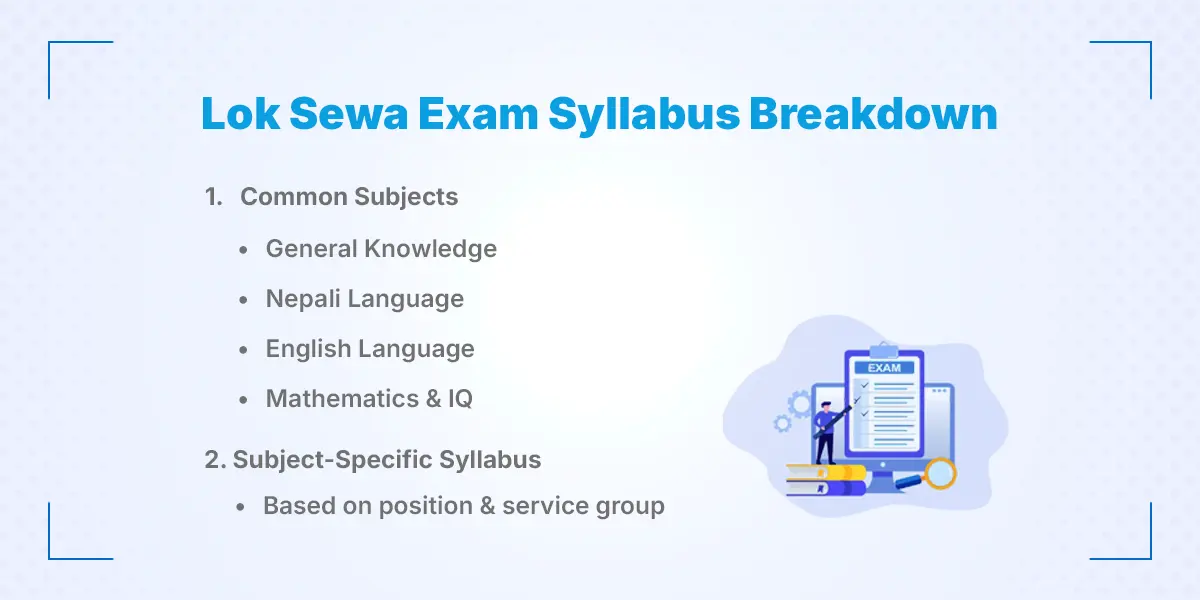
1. General Knowledge (GK)
GK is the broadest and most heavily weighted subject in the preliminary exam. It covers Nepal's history, geography, political system, constitution, current affairs, economics, international relations, notable national and global personalities, science, environment, and social topics.
The key to doing well here is consistency. Read Gorkhapatra, Nepal Samacharpatra, or any national daily for at least 20–30 minutes every day. Current affairs questions from the past 6–12 months show up in almost every exam, and no amount of last-minute cramming replaces months of regular reading.
2. Nepali Language
This section tests grammar, vocabulary, reading comprehension, and formal writing in Nepali. In the preliminary, it's mostly objective. But in the main written exam, you'll be required to write essays and official letters in proper, structured Nepali. That means strong language skills aren't optional for any post. Practice writing regularly, not just reading. Even writing a short paragraph daily, summarizing a news article or drafting a formal letter builds the fluency that shows up when it matters.
3. English Language
English is tested at a functional level. Basic grammar, comprehension, and vocabulary. Officer-level exams typically require a higher standard than assistant-level ones, so the depth of preparation needed does depend on the post you're targeting. The best way to improve here is through regular reading of English-language news and practice with grammar MCQs from past papers.
4. Mathematics & IQ
The math and reasoning section covers basic arithmetic, percentages, ratios, number series, logical reasoning, and verbal/non-verbal aptitude. These are standard competitive exam questions. Nothing wildly advanced but speed and accuracy both matter. Daily practice with past MCQs is the most effective way to improve here. The candidates who struggle in this section are almost always the ones who left it too late and tried to rush through it in the final weeks.
5. Subject-Specific Syllabus
In addition to the four common subjects, the main written exam includes papers specific to your chosen service group and position. These go deep into the knowledge and skills required for that particular role. Here's a quick overview by group:
Administration Group – Public administration, governance, laws, acts, office management
Accounts Group – Financial management, auditing, accounting standards, budget processes
Engineering – Core engineering subjects relevant to the field (civil, mechanical, electrical, etc.)
Health Services – Clinical knowledge, public health, epidemiology, or specialized medical subjects
Agriculture/Forestry – Technical subjects aligned with the specific service group
Always download and study the official syllabus for your specific post from the PSC website before you build your study plan. It's your single most important document — no book or app replaces it.
What is the Best Strategy to Pass Lok Sewa Exam in Nepal?
The best strategy to pass the Lok Sewa exam in Nepal is to follow a structured study plan, understand the exam pattern deeply, and focus on concept-based learning rather than rote memorization. A disciplined approach that combines consistent preparation, past paper analysis, and strong conceptual clarity significantly improves accuracy and performance in both objective and descriptive papers.
Now, let’s break down each of these strategies in detail to understand how to apply them effectively.
1. Create a Smart Study Plan
Start by setting clear, time-bound goals. Make note of what topics you'll cover daily, what you'll review weekly, and how many full revisions you'll complete before exam day. 3–4 hours of focused study per day for 6–12 months is typical for serious candidates, though this depends on your starting knowledge level and the post you're targeting.
Break your preparation into three phases:
In the first two months, cover the entire syllabus at least once. Don't go deep yet, just build familiarity.
In months three and four, revisit each topic with more depth and focus on weak areas.
From month five onward, shift to revision, past papers, and mock tests.
This structure keeps you progressing steadily rather than burning out early or cramming at the last minute.
Use focused 45-minute blocks with short breaks rather than sitting for hours without a break. Prioritize high-weightage topics in your daily slots, and always end each session with a quick revision of what you just studied. This dramatically improves long-term retention.
2. Understand the Exam Pattern
Analyzing the exam pattern saves you from preparing topics that rarely appear and missing the ones that show up almost every year. The best way to do this is by solving previous year papers, not just for practice, but to identify patterns in what the PSC consistently focuses on.
Look for repeated topics across 5 to 10 years of past papers. In GK, for example, you'll notice questions about Nepal's constitution, government structure, geography, and national events come up repeatedly. In math, basic percentage and ratio questions are almost always present. Once you identify these high-frequency topics, give them more time and depth in your preparation.
Pay attention to the question format too. MCQ papers reward speed and accuracy, while descriptive papers reward depth and structure.
3. Concept-Based Learning
One of the biggest mistakes Lok Sewa candidates make is rote memorization, trying to remember facts without understanding them. This approach may get you through the preliminary stage, but it will fail you in the main written exam, where questions are applied and analytical.
Focus on building conceptual clarity in every subject. For Nepal's constitution and governance, understand the structure of the federal system. For public administration, understand how government offices work and interact. For math and IQ, understand the logic behind each formula rather than just applying it blindly.
Concept-based learning helps you tackle new or unfamiliar questions without panicking, and that's exactly what separates top scorers from the rest.
Top Study Materials for Lok Sewa Preparation
The best study materials for Lok Sewa preparation include trusted books from Goodwill Publication and Pairavi Prakashan, GK resources by Bal Krishna Pokhrel or Dipak Upadhyaya, government publications, and online platforms like Loksewa Tayari App and Public Service Commission Nepal.
These materials are reliable, syllabus-aligned, and widely used by toppers, combining updated current affairs, structured notes, and real exam practice.
Now, let’s break down each category to understand how you can use them effectively in your preparation.
1. Recommended Books
Here are the most trusted and widely used resources among Lok Sewa aspirants in Nepal:
Position-specific prep books from Goodwill Publication or Pairavi Prakashan — get the edition for your exact post
GK books by Bal Krishna Pokhrel or Dipak Upadhyaya — standard across most preparation circles
Gorkhapatra and Samacharpatra weekly tayari supplements — free, updated, and directly aligned with the exam
2. Government Publications
The PSC's own official publications are among the most valuable yet most underused study resources. The officially published syllabus document is a must-have. Lok Sewa reading materials from the year 2082 BS are printed in publications like Gorkhapatra, Nepal Samacharpatra, and Rajdhani Daily and are available in weekly tayari supplements. These are directly aligned with the current exam pattern and are worth collecting and studying systematically.
3. Online Resources
Digital platforms have made Lok Sewa preparation significantly more accessible. Some of the most useful ones include:
Loksewa Tayari App – One of Nepal's most trusted Lok Sewa preparation apps, offering mock tests, daily MCQ practice, syllabus guides, and current affairs in one place
Bidhya Mandir (bidhyamandir.com) – Provides free PDF notes for GK, current affairs, and subject-specific topics for all major posts
Loksewa Sathi (loksewasathi.com) – Offers free study materials, PDF notes, past question solutions, and online practice exams
PSC Official Website (psc.gov.np) – Always your first stop for official syllabi, vacancy notices, and exam schedules
Common Mistakes to Avoid in Lok Sewa Exam
Most candidates who fail Lok Sewa don't fail because they didn't study, they fail because of small, repeated habits that quietly work against them. These mistakes are easy to make and hard to notice until it's too late. Here's what to watch out for:
1. Lack of Consistency
This is the most common one. Studying hard for a week, dropping off for two, then trying to make up for it never works. Lok Sewa prep is a long game, and the candidates who clear it are almost always the ones who showed up every single day, not the ones who studied the hardest in one stretch. Two focused hours daily is more valuable than a ten-hour Sunday session. Build the habit first. Everything else follows from that.
2. Ignoring the Syllabus
A surprising number of candidates spend months studying without ever properly reading the official PSC syllabus for their post. The syllabus is your exam blueprint. Every topic on it is fair game, and nothing outside it will appear. Study broadly without it, and you'll waste time on things that don't matter while leaving actual exam topics half-covered. Download it, print it if you have to, and use it to guide every week of your preparation.
3. Poor Revision Strategy
Studying new topics and moving forward without ever going back is how candidates forget everything they covered in month one by exam day. It's not about how much you study, it's about how much you retain. Set aside time every week specifically for revision. Not as an optional extra, but as a fixed part of your weekly schedule. What you revise consistently is what you'll actually remember when it matters.
4. Skipping Current Affairs
Most candidates plan to catch up on current affairs closer to the exam. Most never do. GK from recent national and international events comes up heavily in every preliminary paper, and it can't be crammed. You need ongoing exposure over months. Thirty minutes of daily newspaper reading sounds small, but maintained over six months, it's one of the highest-return habits in your entire preparation.
5. Underestimating the Interview
The written exam takes up most of the attention, but the interview has quietly ended many strong candidacies. Candidates who score well in the written stage still fail at the interview because they walked in underprepared. Practice speaking out loud, not just thinking through answers in your head. Know your target post. Know Nepal's governance structure. Know your own background well enough to talk about it clearly and confidently. The interview is where prepared candidates become selected candidates.
6. Not Starting Mock Tests Early Enough
Starting mock tests a week before the exam is too late to fix anything. Mock tests don't just show where you are, they train stamina, time management, and the composure needed for the real thing. None of that develops in a week. Start at least two months out, take one full timed test every week, and use the results to find weak areas while you still have time to work on them.
Common Mistakes to Avoid in Lok Sewa Exam
Most candidates who fail Lok Sewa don't fail because they didn't study, they fail because of small, repeated habits that quietly work against them. These mistakes are easy to make and hard to notice until it's too late. Here's what to watch out for:
1. Lack of Consistency
This is the most common one. Studying hard for a week, dropping off for two, then trying to make up for it never works. Lok Sewa prep is a long game, and the candidates who clear it are almost always the ones who showed up every single day, not the ones who studied the hardest in one stretch. Two focused hours daily is more valuable than a ten-hour Sunday session. Build the habit first. Everything else follows from that.
2. Ignoring the Syllabus
A surprising number of candidates spend months studying without ever properly reading the official PSC syllabus for their post. The syllabus is your exam blueprint. Every topic on it is fair game, and nothing outside it will appear. Study broadly without it, and you'll waste time on things that don't matter while leaving actual exam topics half-covered. Download it, print it if you have to, and use it to guide every week of your preparation.
3. Poor Revision Strategy
Studying new topics and moving forward without ever going back is how candidates forget everything they covered in month one by exam day. It's not about how much you study, it's about how much you retain. Set aside time every week specifically for revision. Not as an optional extra, but as a fixed part of your weekly schedule. What you revise consistently is what you'll actually remember when it matters.
4. Skipping Current Affairs
Most candidates plan to catch up on current affairs closer to the exam. Most never do. GK from recent national and international events comes up heavily in every preliminary paper, and it can't be crammed. You need ongoing exposure over months. Thirty minutes of daily newspaper reading sounds small, but maintained over six months, it's one of the highest-return habits in your entire preparation.
5. Underestimating the Interview
The written exam takes up most of the attention, but the interview has quietly ended many strong candidacies. Candidates who score well in the written stage still fail at the interview because they walked in underprepared. Practice speaking out loud, not just thinking through answers in your head. Know your target post. Know Nepal's governance structure. Know your own background well enough to talk about it clearly and confidently. The interview is where prepared candidates become selected candidates.
6. Not Starting Mock Tests Early Enough
Starting mock tests a week before the exam is too late to fix anything. Mock tests don't just show where you are, they train stamina, time management, and the composure needed for the real thing. None of that develops in a week. Start at least two months out, take one full timed test every week, and use the results to find weak areas while you still have time to work on them.
Conclusion
Passing the Lok Sewa exam is one of the most rewarding and most challenging things a young Nepali can accomplish. It demands real commitment, smart preparation, and the kind of discipline that most people talk about but few actually practice.
At its core, the path is simple: understand the structure, know your syllabus, build a consistent study habit, practice relentlessly, and walk in prepared.
For thousands of people who’ve succeeded in Loksewa, for them, their mantra was consistency. It was showing up on days when motivation was low. It was solving one more past paper even when they were tired.
If you treat your Lok Sewa preparation as a long-term project and not a sprint, you will get there. Nepal's civil service needs good, hardworking people. That could be you.
Frequently Asked Questions
Submit your comments

Get Our App On


How to Make a Police Report (Police Clearance Certificate) in Nepal?
VIEW DETAILS
Types of SEO and How They Work: Complete Beginner's Guide
VIEW DETAILS
Government Restricts New Lok Sewa Vacancy Requests 2083/84 — Or Not?
VIEW DETAILS
How to Apply for Tattoo Artist Jobs in Nepal?
VIEW DETAILS


Loading Comments...