

Every year, thousands of young Nepalese face the same big question: government or private job? It's a debate that happens at dinner tables, during tea breaks, and in every WhatsApp group of friends who just passed their SLC or finished their bachelor's.
The pull of a government job in Nepal is real. The stability, the pension, the social respect.
But so is the appeal of the private sector! The salary growth, the fast-paced work, the skill-building.
So, which one actually makes more sense for you? Which is better for you, government vs private jobs in Nepal? This guide breaks down both paths, clearly and practically. Stick till the end and make a smarter, more informed choice for your future.
In this blog
Overview of Government Jobs in Nepal
Government jobs in Nepal are roles offered by the federal, provincial, or local government. This includes positions under ministries, public institutions, Nepal Army, Nepal Police, Nepal Rastra Bank, and other state-owned organizations. The most common path to securing these jobs is through the Lok Sewa Aayog (Public Service Commission), which conducts highly competitive exams every year.
The structure in government jobs is fixed and hierarchical. Each role comes with a defined rank, a set of responsibilities, and a pay scale that is standardized across the board. In a government job, you know exactly where you stand, and you know what comes next, which is both a comfort and a limitation.
One thing every aspiring government employee should know upfront is that the recruitment process is long. Written exams, practical tests, and interviews can take months, sometimes over a year. Competition is intense, with thousands of candidates applying for a handful of seats. But for those who make it through, the rewards are stable and long-lasting.
What Are the Government Roles in Nepal?
Government roles in Nepal span a wide range of fields, from Nayab Subba (NASU), Section Officer, and Kharidar to engineers, doctors, teachers, police officers, and army personnel, among many others. These positions cover almost every sector of public service, making the government one of the largest employers in the country. Here's a look at the major types of government job roles in Nepal:
- Civil Service Roles: Kharidar, Nayab Subba (NASU), Section Officer, Under Secretary, Joint Secretary, Secretary
- Nepal Army & Police: Soldiers, Officers, Armed Police Force personnel
- Health Services: Government doctors, nurses, health assistants
- Education Sector: Community school teachers, university lecturers under government pay
- Engineering & Technical Roles: Engineers and surveyors under government departments
- Judicial & Legal Services: Court officials, government advocates
Banking & Financial Institutions: Roles under Nepal Rastra Bank, Rastriya Banijya Bank, Agriculture Development Bank
Overview of Private Jobs in Nepal
Private sector jobs are those offered by privately owned companies, from large corporates and commercial banks to startups, multinational companies, INGOs, and tech firms. Unlike the government, private employers set their own hiring rules, pay structures, and work cultures. This makes the sector more flexible, but also more unpredictable.
The hiring process in private companies is generally much faster than government recruitment. Most companies hire through applications, interviews, and sometimes a short assessment. Such a process can wrap up in a few weeks. For someone eager to start earning quickly, this is a big advantage.
What makes the private sector particularly attractive today is how skill-driven it has become. Employers look for people who can actually do things, whether that's writing code, managing accounts, running digital campaigns, or leading a team. The more you grow your skills, the more you can earn and advance.
What Are the Major Types of Private Jobs in Nepal?
Private jobs in Nepal cover a broad range of sectors, from banking, IT, and finance to NGOs, hospitality, and media. The variety is wide, and so are the salary ranges across these fields. Here are the major categories you'll find:
- Banking & Financial Services: Commercial banks, development banks, finance companies, insurance firms
- IT & Software: Software developers, system administrators, cybersecurity analysts, data analysts
- Multinational & INGO Roles: Project officers, program coordinators, M&E officers
- Business & Corporate Jobs: Marketing, HR, operations, supply chain, management roles
- Hospitality & Tourism: Hotel management, travel agencies, airline services
- Media & Communication: Journalism, digital marketing, content creation, PR
- Healthcare (Private Sector): Doctors, nurses, pharmacists in private hospitals and clinics
- Education (Private Schools & Colleges): Teachers and lecturers in private institutions
- Startups & Entrepreneurship-Adjacent Roles: Product managers, growth roles, customer success
Salary Structure Comparison: Government vs Private Jobs in Nepal
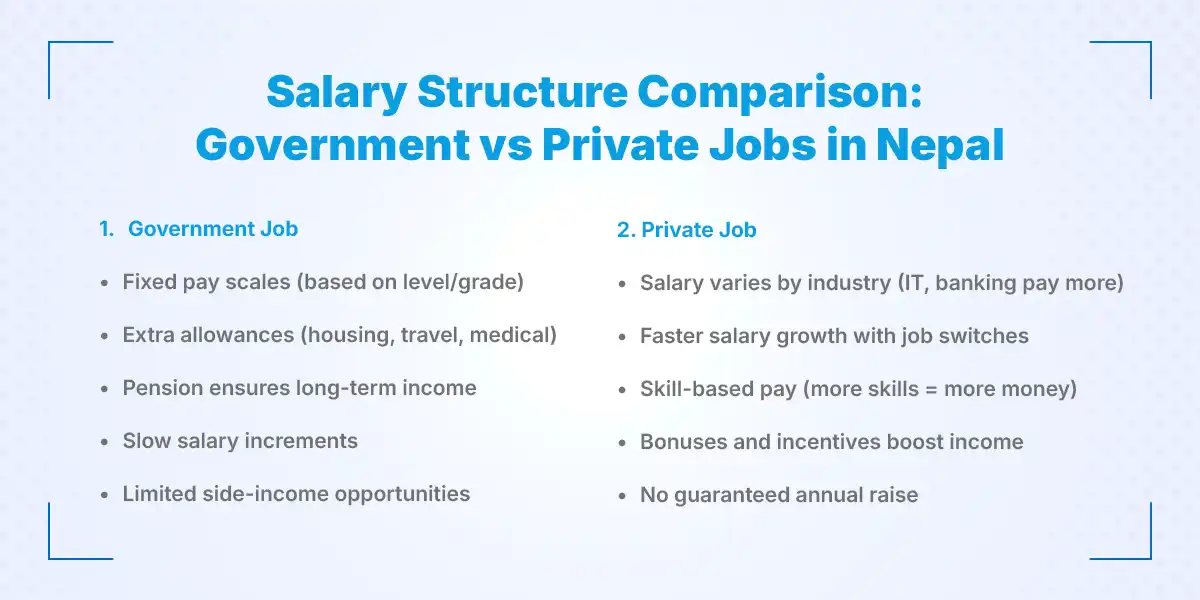
Salary is one of the first things people compare when choosing between government and private jobs, and rightly so. That said, the two sectors follow very different pay systems. Government salaries focus on stability and predictability, while private salaries are tied to performance and market demand. Think of it as a choice between a guaranteed monthly paycheck vs a growing income with bigger upside. The salary structure directly impacts your lifestyle, savings, and long-term financial security.
1. Government Job Salary Structure
Government jobs in Nepal follow a fixed pay scale that is determined by the national budget and is based on your rank or level. This means every person at the same grade earns the same basic salary, regardless of how hard they work or how talented they are.
On top of the basic salary, employees receive a range of allowances, including dearness allowance, housing allowance, travel allowance, and medical benefits. These add a meaningful boost to take-home pay.
One of the biggest financial advantages of a government job is the pension, a guaranteed monthly income even after you retire, which very few private sector jobs can offer.
That said, salary increments in the government sector are slow and not tied to individual performance. The last major pay revision was in FY 2079/80, when salaries increased by 15%, and since then, basic pay has remained unchanged for four consecutive years. There is also very limited scope for earning additional income outside the job.
2. Private Job Salary Trends
In contrast, private sector salaries are far more flexible and depend heavily on your industry, role, experience, and skills. Two people with the same degree can earn very different amounts depending on where they work and how well they perform.
Sectors like IT and banking tend to offer higher starting salaries. In tech companies, IT engineers in Nepal earn anywhere from NPR 30,000 to NPR 2,50,000+ per month depending on experience, while banking professionals typically start in the range of NPR 22,000 to NPR 30,000 and grow steadily from there.
Private sector salaries are largely performance-based, which means skilled and productive employees can see significant raises, especially by switching jobs or taking on new responsibilities.
Bonuses and incentives can further boost total earnings in the private sector, from the festival Dashain bonus (often one month's salary) to performance bonuses in banking and corporate roles. However, there's no guaranteed annual raise. If the company underperforms or the economy slows down, salary growth can stall, or even cause layoffs.
Overall, government jobs provide stable and secure income over the long term, while private jobs offer higher earning potential and faster salary growth for skilled professionals. If financial security matters more to you, government wins. If you want to grow your income faster, private is the better bet.
Which Job Has the Highest Salary in Nepal, Government or Private?
Generally, senior private sector professionals, especially in IT, banking, and multinational organizations earn significantly more than their government counterparts. Here's a quick comparison:
Note: Government figures include basic pay + standard allowances. Private figures vary by industry, company, and skill level.
At entry level, government jobs often pay more reliably due to structured allowances. But by mid-career and especially at the senior level, high-performing private sector employees tend to earn significantly more.
Job Stability & Security in Private vs Government Jobs in Nepal
Job stability is one of the biggest factors when choosing between government and private jobs in Nepal. While government roles are known for long-term security, private jobs depend more on performance and industry conditions. This difference is real, and it matters a lot, especially in a country where financial uncertainty can affect an entire family.
1. Government Job Stability
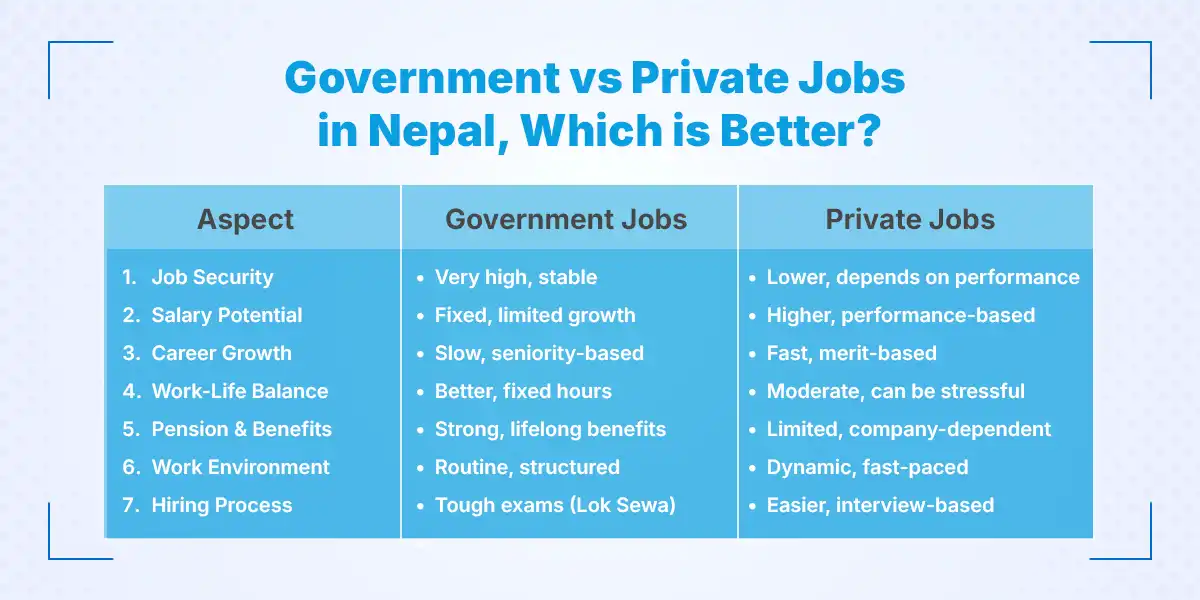
Government jobs in Nepal are widely recognized for offering some of the highest job security in the country. Once you clear the Lok Sewa exam and finish your probation period, your job becomes permanent, and it stays that way for the rest of your career.
Policies and government regulations protect civil servants from arbitrary dismissal, making layoffs virtually unheard of in the public sector. The service rules are clear, the rights of employees are protected, and the overall risk of losing your job is extremely low.
That said, government jobs are not entirely free from outside influence. Political changes or administrative reshuffling can sometimes affect transfers and promotions. But even then, job security itself remains intact, which is more than most private jobs can promise.
2. Private Job Stability
Private sector stability works quite differently. It is performance-driven rather than service-rule-driven. Employees are retained based on their contribution, skills, and the company's financial health. Perform well, and you'll likely keep growing. But if the company faces losses or the economy takes a hit, layoffs become a real possibility.
This was particularly visible during COVID-19, when many private companies in Nepal, especially in hospitality, retail, and small businesses had to let employees go. The risk is real, and it's something private sector workers have to be prepared for.
Stability also varies a lot depending on which private sector you're in. Employees at large commercial banks, multinational companies, and established IT firms tend to have more job security compared to those at small businesses or early-stage startups. Industry matters as much as the company itself.
Which Job Provides Better Security, Private or Government?
In simple terms, government jobs offer guaranteed long-term security, while private jobs provide conditional stability that depends on performance, industry, and market trends. If stability is your top priority, the choice is clear. But if you're confident in your skills and adaptable to change, the private sector is a perfectly viable path.
Career Growth & Promotion in Government vs Private Sectors in Nepal
Career growth in government jobs in Nepal is slow, structured, and mainly based on seniority and Lok Sewa Aayog exams, with promotions following a fixed hierarchy over time. This ensures stability but limits rapid advancement, as performance has less impact compared to years of service. In contrast, private sector careers grow much faster and are driven by skills, performance, and opportunities to switch roles or companies.
Now, let’s look at how these differences in growth patterns shape long-term career satisfaction and choices.
1. Career Growth in Government Jobs in Nepal
Career advancement in government jobs is largely seniority-based. Promotions follow a structured timeline and often require you to pass departmental exams conducted by the Lok Sewa Aayog. The path is predictable. You elevate from Kharidar to Nayab Subba, then Section Officer, and so on, but it moves slowly.
There is limited room for fast, merit-based growth. A brilliant young officer and an average one often move up the ladder at the same pace, simply because the system is built around time-in-service rather than performance. The career path is stable and well-defined, but don't expect to leapfrog levels because of exceptional work.
2. Promotion & Growth in Private Jobs
Private jobs are where career growth can happen fast. Sometimes, very fast. Strong performers can get promoted within a year or two, take on managerial roles early, and significantly increase their income through skill development and job switching.
The private sector also offers something the government largely doesn't. For instance, exposure to new skills, industries, and even international opportunities. Many INGO and multinational roles in Nepal involve international collaboration, regional projects, and global best practices, all of which build a much broader professional profile over time.
Work-Life Balance Comparison in Government vs Private Jobs in Nepal
Government jobs generally offer better work-life balance. Office hours are fixed, typically 9 AM to 5 PM, Monday through Friday, and there's rarely pressure to take work home. This structured routine makes it easier to plan family time, personal commitments, and rest.
Private jobs, on the other hand, can be more demanding. Longer hours are common, especially in banking (month-end closings), IT (project deadlines), and startups (where everyone wears multiple hats). That said, the private sector has also started embracing flexible work cultures, with remote work, hybrid arrangements, and flexible hours, especially in the tech and INGO sectors. However, most private businesses are still rigid and prefer a full 10 AM to 5 PM, starting from Sunday to Friday.
So if a stable routine and personal time matter deeply to you, government jobs have a clear edge here. But if you prefer a dynamic environment and can manage your time well, many private jobs offer more flexibility than people expect.
Skills Required: Government vs Private Sector in Nepal
The skills each sector values are quite different. Government jobs reward those who are disciplined, well-read, and great at written exams, while private jobs prioritize people who can do things quickly and adapt to change. Here's a side-by-side look at what each path actually demands:
Job Satisfaction & Work Environment in Government & Private Companies
Both sectors can offer meaningful job satisfaction, but what that looks satisfying is very different, and it really comes down to your personality. Government employees often find deep satisfaction in serving the public, having a structured role, and enjoying financial peace of mind, while private sector employees tend to thrive in fast-paced environments where their performance is noticed and rewarded. Ultimately, how satisfied you feel at work depends less on the sector and more on whether the environment matches who you are.
1. Government Work Environment
If you're someone who values peace of mind over pace, the government environment will likely suit you well. The work is structured, the hours are fixed, and there's a strong sense of community among colleagues, many of whom stay in the same office for years.
- Routine-based and predictable so you know what to expect every day
- Deep social respect from family, community, and society at large
- Low performance pressure because work is evaluated by seniority, not speed
- Collaborative but slow-moving; decisions take time and follow a hierarchy
2. Private Work Environment
Private sector workplaces move fast, and if that energy excites you, you'll fit right in. Performance gets noticed here, growth happens quickly, and the culture tends to push you to keep learning and improving.
Dynamic and ever-changing. No two weeks look exactly the same
Results-driven culture where strong work is recognized and rewarded
Collaborative teams, cross-functional projects, and exposure to new ideas
Can be high-pressure, especially in banking, sales, and startup settings
Pros and Cons of Government & Private Jobs in Nepal
Both sectors come with real advantages and real trade-offs. Government jobs offer security and peace of mind, while private jobs offer money and momentum. However, each path has a downside you'll need to be ready for. Here's a side-by-side breakdown:
1. Pros & Cons of Government Jobs in Nepal
Government jobs are the right choice for those who value long-term security, structured benefits, and social recognition. The pension system, job permanence, and fixed working hours make them a dream for many Nepali families. However, they come with real limitations that growth-oriented individuals often find frustrating.
2. Pros & Cons of Private Jobs in Nepal
Private sector jobs are ideal for ambitious, skilled individuals who want to grow fast and earn more. The opportunities for learning, advancement, and higher income are real, but so are the risks and pressures that come with it.
Which One Should You Choose in Nepal, Government or Private Job?
Choosing between a government or private job in Nepal depends mainly on your priorities, whether you value stability and long-term security or faster growth and income potential. Government jobs suit those focused on predictability, social respect, and structured career progression, while private jobs fit those who prefer performance-based rewards and faster advancement. Ultimately, the best choice becomes clearer when you understand your goals and how each path supports them.
1. Choose Government Jobs if:
Choosing a government job in Nepal is ideal for those who prioritize long-term financial security, stable income, and a predictable career path. It is also suitable if you are willing to prepare for Lok Sewa exams and value social respect and retirement-focused planning. The following factors make this option the right fit for certain individuals:
- Long-term financial security is your top priority
- You want a stable routine and predictable income
- You're willing to invest time in Lok Sewa preparation
- Social respect and family approval matter a lot to you
- You're planning for retirement early
Wondering how to get a government job in Nepal? Discover step-by-step guidance on how to get a government job in Nepal, covering eligibility, preparation tips, required documents, and application process.
2. Choose Private Jobs if:
Choosing private jobs in Nepal is ideal if you want faster career growth, higher income potential, and performance-based rewards. It suits individuals who are comfortable with some level of risk and enjoy a dynamic, fast-changing work environment. Now, let’s explore how these preferences translate into real career opportunities and experiences.
- You want faster income growth and career advancement
- You have strong practical skills and want to be rewarded for them
- You're comfortable with some level of risk
- You enjoy a dynamic, learning-focused work environment
- You want to build a diverse skill set over time
3. Hybrid Thinking — skills first, sector second
A more balanced way to see this is that career choices in Nepal are increasingly skill-driven rather than strictly sector-driven, with people moving between government, private, and INGO roles over time. Many professionals build strong skills and early experience in the private sector first, then shift to government or development organizations for stability and long-term roles. This flexible approach focuses on growth first and sector choice later.
Conclusion
At the end of the day, government jobs offer security, structure, and long-term benefits, while private jobs offer speed, higher income potential, and growth. The right choice depends entirely on what kind of future you're building for yourself.
We all feel it, the pressure of choosing the right path, the fear of picking wrong, the weight of family expectations. But here's the thing: there's no universally right answer. A Nayab Subba who loves their structured life and retires with a pension has made just as smart a decision as a software engineer who doubles their salary in five years.
What matters is whether your choice aligns with your goals, personality, and risk tolerance, not someone else's definition of success.
So take a moment, reflect on what you truly want from your career, and make your move. Explore the latest government and private job opportunities today and find the role that fits your future.
Frequently Asked Questions
Submit your comments

Get Our App On



What Does a Digital Marketing Course Syllabus in Nepal Cover?
VIEW DETAILS
How to Find Lab Assistant Jobs in Nepal?
VIEW DETAILS
How to Open a Company in Nepal: Guide to Start Your Own Business
VIEW DETAILS
How to Find One Cinema Vacancy in Nepal
VIEW DETAILS


Loading Comments...