



Finding a secure government job in Nepal’s financial sector isn’t easy especially when competition is high and vacancies like SEBON come with strict eligibility and limited seats. Many candidates miss out simply because they don’t clearly understand the process or requirements.
This guide breaks down everything about SEBON vacancy in Nepal, including eligibility, application steps, selection process, and salary details. You’ll get clear, practical insights to help you apply correctly and improve your chances of getting selected.
In this blog
What is SEBON? (Securities Board of Nepal Overview)
SEBON (Securities Board of Nepal) is the government regulatory authority responsible for supervising and regulating Nepal’s capital market to ensure transparency, fair trading, and investor protection.
It was established under the Securities Act and plays a key role in overseeing stock market activities, licensing brokers, monitoring financial operations, and creating policies. SEBON protects investors, works closely with NEPSE for market growth, and offers highly respected government jobs due to stability, authority, and career growth in the financial sector.
Latest SEBON Vacancy 2026
As of 2026, Securities Board of Nepal vacancies are announced periodically based on staffing needs, typically including officer and assistant-level positions through open competitive examinations.
Current openings generally include roles like Officer, Assistant, and Administrative/Technical positions, with limited seats per category, making competition high. The application window usually remains open for 2–3 weeks, followed by a written exam within 1–2 months, and final results after interviews and verification.
- Positions: Officer, Assistant, Finance/IT/Legal roles
- Vacancies: Varies (often limited seats per post)
- Application Timeline: Opens after official notice, ~15–20 days duration
- Exam Process: Written exam → Interview → Final merit list
- Result Timeline: Typically 2–3 months after application
- Official Updates: Published on SEBON’s official website and national newspapers
Who Can Apply for SEBON Vacancy?
Candidates who meet the required educational qualifications, age limits, skills, and nationality criteria set by the Securities Board of Nepal are eligible to apply for SEBON vacancies. These requirements vary depending on the position level and technical role.
1. Educational Qualifications
Applicants must have at least a Bachelor’s degree from a recognized university. For officer-level positions, a Master’s degree is often preferred or required. Common eligible fields include Finance, Management, Economics, Law, and IT. Higher academic qualifications can improve your chances due to high competition.
2. Age Limit Requirements
The minimum age requirement is generally 18 years for all applicants. The maximum age usually ranges up to 35 years for officer-level posts. Assistant-level roles may have slightly different upper age limits. Age relaxation is applicable for reserved categories as per government rules.
3. Field-Specific Eligibility
Candidates must apply based on their academic and professional background. Finance and Management graduates are typically preferred for general roles. Law graduates are required for legal and compliance-related positions. IT roles demand technical degrees along with practical knowledge in relevant systems.
4. Required Technical and Soft Skills
Basic computer knowledge is essential for all SEBON positions. Strong analytical thinking and problem-solving skills are highly valued in the selection process. Good communication and report-writing abilities are important for handling official tasks. Knowledge of Nepal’s capital market gives candidates a strong advantage.
5. Experience Requirements
Entry-level positions usually do not require prior work experience. However, officer or senior-level roles may demand relevant experience in finance, regulation, or administration. Internships or training in financial institutions can add value to your application. Experience is beneficial but not always mandatory.
6. Nationality and Government Criteria
Applicants must be Nepali citizens to apply for SEBON vacancies. They must fulfill all government job eligibility requirements. Required documents include citizenship certificate and academic credentials. Any legal disqualification or incomplete documentation may lead to rejection.
How to Apply for SEBON Vacancy?
To apply for a SEBON vacancy, candidates need to visit the official website, complete the application form, upload required documents, pay the fee, and submit the application within the deadline. Following the correct steps carefully ensures your application is accepted without errors or rejection.
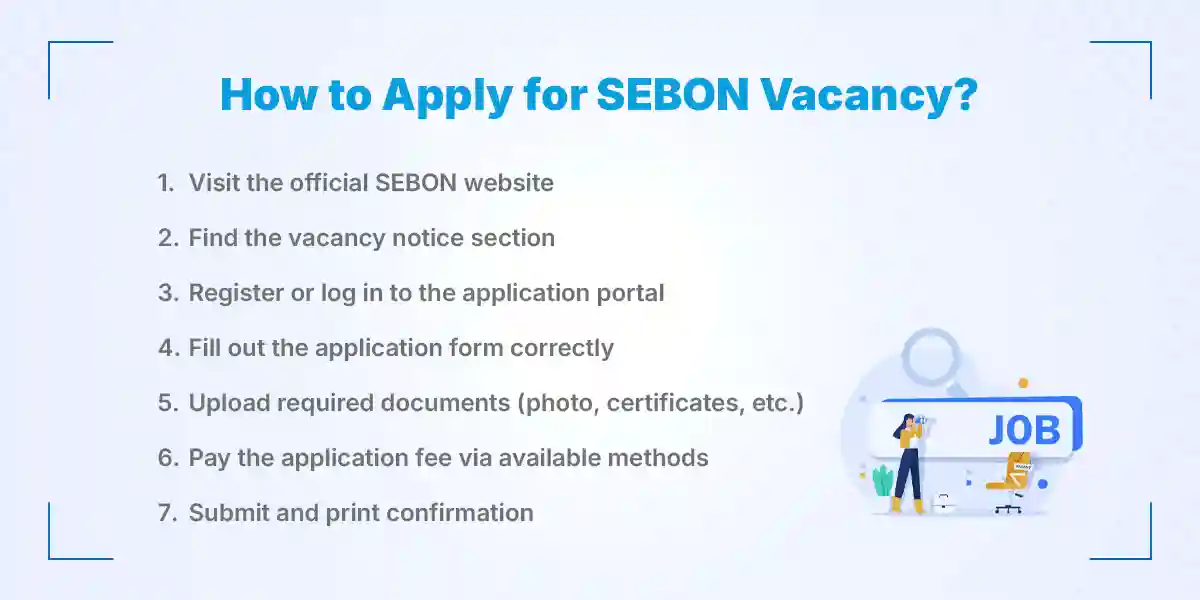
1. Visit the Official SEBON Website
Start by visiting the official website of the Securities Board of Nepal. This is where all official vacancy notices are published. Make sure you are accessing the correct and updated website to avoid misinformation. Regularly checking the site helps you stay updated on new openings. Always rely on official sources instead of third-party platforms.
2. Find the Vacancy Notice Section
Navigate to the “Careers” or “Vacancy” section on the website. Here, you will find detailed job announcements including eligibility, deadlines, and requirements. Carefully read the full notice before applying to avoid mistakes. Each vacancy may have slightly different instructions and criteria. Understanding the notice properly increases your chances of successful application.
3. Register or Log in to the Application Portal
If the application is online, you need to register with your basic details. Existing users can simply log in using their credentials. Make sure to use a valid email and phone number for communication. Keep your login details Secure for future access. This portal is where you will complete and track your application.
4. Fill Out the Application Form Correctly
Complete the application form with accurate personal, academic, and professional details. Double-check all information before submission to avoid errors. Any mismatch in details may lead to disqualification. Follow the format and instructions provided in the form. Accuracy and completeness are very important at this stage.
5. Upload Required Documents
Upload all necessary documents such as your photo, citizenship certificate, and academic certificates. Ensure that files are clear and meet the required size and format guidelines. Incorrect or blurred documents can lead to rejection. Always verify that each file is uploaded properly. Keep scanned copies ready before starting the process.
6. Pay the Application Fee
Pay the application fee through the available payment methods mentioned in the notice. This may include bank deposit, online payment, or voucher systems. Make sure the payment is successful and keep proof of payment. Without fee payment, your application will not be considered valid. Always follow the exact payment instructions given.
7. Submit and Print Confirmation
After completing all steps, submit your application form. Once submitted, download and print the confirmation page for future reference. This proof may be required during exams or interviews. Do not wait until the last day to submit your application. Early submission helps avoid technical issues or last-minute errors.
SEBON Vacancy Selection Process
The SEBON selection process includes a written examination, interview, document verification, and final merit-based selection of candidates. Candidates are evaluated based on their performance in exams and interviews, ensuring a fair and competitive recruitment system.
1. Written Examination Structure and Syllabus
The written examination is the first and most important stage of the SEBON selection process. It tests candidates on subjects related to their field such as Finance, Management, Law, or IT. The syllabus is officially published for each position on the SEBON website. Questions typically assess analytical ability, subject knowledge, and problem-solving skills. Only candidates who pass this stage move forward in the recruitment process.
2. Preliminary vs. Final Written Exam
For some positions, the written exam may be divided into preliminary and final stages. The preliminary exam is used to shortlist candidates for the main written exam. The final written exam is more detailed and determines qualification for the interview stage. Not all posts require two stages; it depends on the vacancy level. Higher-level positions are more likely to have multiple exam phases.
3. Interview Process and Evaluation Criteria
Candidates who pass the written exam are shortlisted for the interview. The interview evaluates communication skills, subject knowledge, and practical understanding of the role. In some cases, candidates may also be required to present ideas or solutions. The interview panel assesses confidence, decision-making ability, and professional attitude. This stage plays a crucial role in final selection.
4. Document Verification Stage
After the interview, shortlisted candidates must go through document verification. All submitted documents such as academic certificates, citizenship, and experience letters are checked. Any mismatch or false information can lead to disqualification. This stage ensures that only eligible candidates proceed further. It is a mandatory step before final selection.
5. Final Merit List Publication
The final merit list is prepared based on combined scores from the written exam and interview. Candidates with the highest total marks are selected for the available positions. SEBON officially publishes the final results and recommendation list. The selection process is strictly merit-based to ensure fairness.
6. Training or Probation Period
Selected candidates may be required to undergo a training or probation period after appointment. During this phase, they learn about SEBON’s operations, policies, and responsibilities. Performance during probation is monitored before permanent confirmation. This helps ensure candidates are fully prepared for their roles. Successful completion leads to full employment status.
Salary and Benefits in SEBON Jobs
SEBON jobs offer competitive salaries based on position level, along with government-level benefits and allowances. For officer-level positions, the estimated salary range can go from around NPR 60,000 to NPR 120,000+ per month, while higher-level roles (like senior officers or executives) can earn significantly more, with total annual compensation reaching around NPR 10–11 lakh or higher depending on grade and benefits. These salaries are structured as per board rules and government-approved pay systems, making them stable and consistent.
In addition to basic salary, employees receive allowances such as housing, travel, and communication, along with Dashain bonus, annual increments, and health/insurance benefits. SEBON jobs also provide retirement facilities like pension and provident fund, ensuring long-term financial security. The work environment is generally stable with a good work-life balance, as it is a regulatory government body, making it a highly attractive career option in Nepal’s financial sector.
Why Choose a Career at SEBON?
A career at SEBON offers strong job security, career growth, and the opportunity to work at the core of Nepal’s financial regulatory system. It is an ideal choice for candidates looking for stability, professional development, and long-term career value in the government sector.
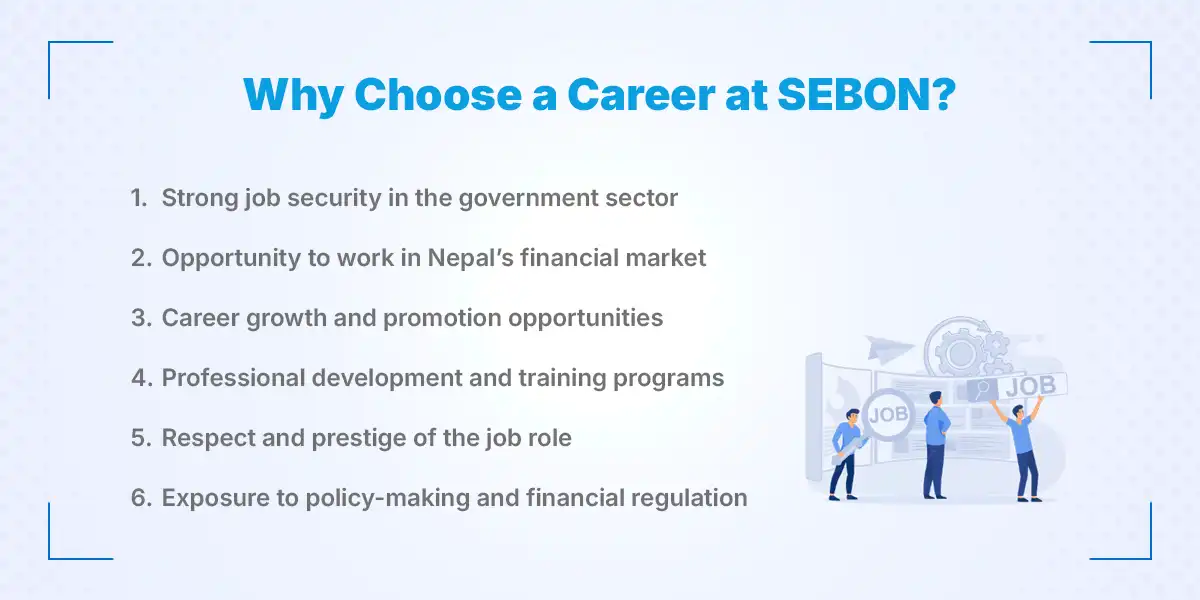
1. Strong Job Security in the Government Sector
SEBON is a government regulatory body, which ensures high job stability compared to private sector roles. Employees benefit from secure employment, regular salary structure, and long-term benefits. The risk of job loss is minimal, making it a reliable career option. This stability is one of the main reasons candidates prefer SEBON jobs.
2. Opportunity to Work in Nepal’s Financial Market
Working at SEBON allows you to be directly involved in Nepal’s capital market and financial system. Employees gain exposure to stock market operations, regulations, and financial institutions. This experience is valuable for building expertise in finance and economics. It also opens doors to future opportunities in the financial sector.
3. Career Growth and Promotion Opportunities
SEBON provides clear career progression through internal promotions and experience-based growth. Employees can move from assistant-level to officer and higher positions over time. Promotions are generally based on performance, experience, and internal evaluations. This structured growth path makes it attractive for long-term careers.
4. Professional Development and Training Programs
Employees at SEBON get access to training programs, workshops, and skill development initiatives. These programs help improve technical knowledge and professional skills. In some cases, employees may also get opportunities for international exposure or specialized training. Continuous learning is a key advantage of working at SEBON.
5. Respect and Prestige of the Job Role
SEBON jobs are considered prestigious due to their role in regulating Nepal’s financial system. Employees are seen as professionals contributing to national economic development. This adds social recognition and respect to the job role. It enhances both personal and professional reputation.
6. Exposure to Policy-Making and Financial Regulation
Working at SEBON provides direct exposure to policy-making and regulatory frameworks. Employees may be involved in drafting rules, monitoring compliance, and shaping financial policies. This gives deep insight into how the financial system operates at a national level. It is especially valuable for those interested in governance and regulation.
Common Mistakes to Avoid While Applying
While applying for SEBON vacancies, candidates should avoid common errors like incorrect details, document issues, or missing deadlines, as these can lead to rejection.
Carefully following instructions and double-checking every step can significantly improve your chances of successful application.
Filling incorrect personal details is one of the most common mistakes, and even small errors can cause disqualification during verification. Uploading wrong or unclear documents, such as blurred certificates or incorrect file formats, can also result in rejection. Missing the application deadline is another critical issue, as late submissions are not accepted under any circumstances.
Many candidates apply without fully meeting the eligibility criteria, which leads to automatic rejection during screening. Payment errors, such as incomplete fee submission or failed transactions, can make the application invalid. Ignoring official instructions mentioned in the vacancy notice can create unnecessary issues, so always read and follow guidelines carefully before submitting your application.
Conclusion
SEBON vacancies offer a strong career path for candidates looking to build a future in Nepal’s financial and regulatory sector. With competitive salaries, job security, career growth, and exposure to capital markets, it remains one of the most attractive government job opportunities in Nepal. However, due to high competition and limited seats, proper preparation, timely application, and careful attention to guidelines are essential for success.
If you want to stay updated with the latest SEBON vacancies, government jobs, and application deadlines, regularly check trusted platforms like Kumari Job. You can find verified job listings, updates, and career resources in one place, helping you never miss an important opportunity.
Frequently Asked Questions
Submit your comments

Get Our App On



SEO Training for Freshers in Nepal: Skills, Career & Job Opportunities
VIEW DETAILS
SEO Training vs. Self-Learning: Which Is Right for You?
VIEW DETAILS
How to Choose Between Two Job Offers
VIEW DETAILS
Digital Marketing Training Interview Questions and Answers for Freshers
VIEW DETAILS


Loading Comments...