



Let's be honest. Finding a good government job in Nepal that actually aligns with your degree feels like looking for a needle in a haystack. You scroll through vacancy notices, most of which are either too vague or simply not the right fit.
But if you have a background in economics, trade, management, or development work, there's one organization quietly doing some of the most important work in the country, and it opens up vacancies more often than people realize. That organization is NIDePT.
This guide breaks down everything you need to know: what NIDePT is, what roles it hires for, what qualifications you need, and exactly how to apply for NIDePT Vacancy in Nepal.
In this blog
Overview of NIDePT Nepal
NIDePT stands for Nepal Institute of Development and Promotion of Trade. It is a government-based institution at the centre of trade policy, promotion of exports and economic development; which are directly influential in how Nepal develops as a nation in the international market. Consider it to be the interface between the domestic producers in Nepal and the international trade system.
Its main functions involve carrying out research on matters relating to trade, assisting government decisions regarding trade policies, capacity building among traders and exporters, and liaising with foreign developmental agencies. In brief, NIDePT is a behind-the-scenes organization that aids the Nepali products to access international markets more readily.
NIDePT is a special place to work due to this positioning. It is not merely a desk job-it is policy and practice coming together, and your work can make a real, visible contribution to the economy of Nepal.
Why Working at NIDePT is a Good Career Option
NIDePT offers a strong career platform for development professionals, combining government job stability with meaningful policy work, international exposure, and solid growth opportunities. It is especially attractive for those with a background in trade, economics, or research who want to make a tangible difference. Before diving into the specific roles, here is why NIDePT stands out as a workplace:
- Government-backed job security
- International project exposure
- Policy-level impact
- Research and fieldwork mix
- Career progression built-in
- Networking with global agencies
What are the Frequently Announced Job Positions at NIDePT?
NIDePT most frequently hires for positions like Program Officer, Trade/Export Officer, Research Analyst, Administrative Officer, and Finance Officer. These roles reflect the organization's dual focus on technical development work and operational management. Here is a closer look at what each position actually involves:
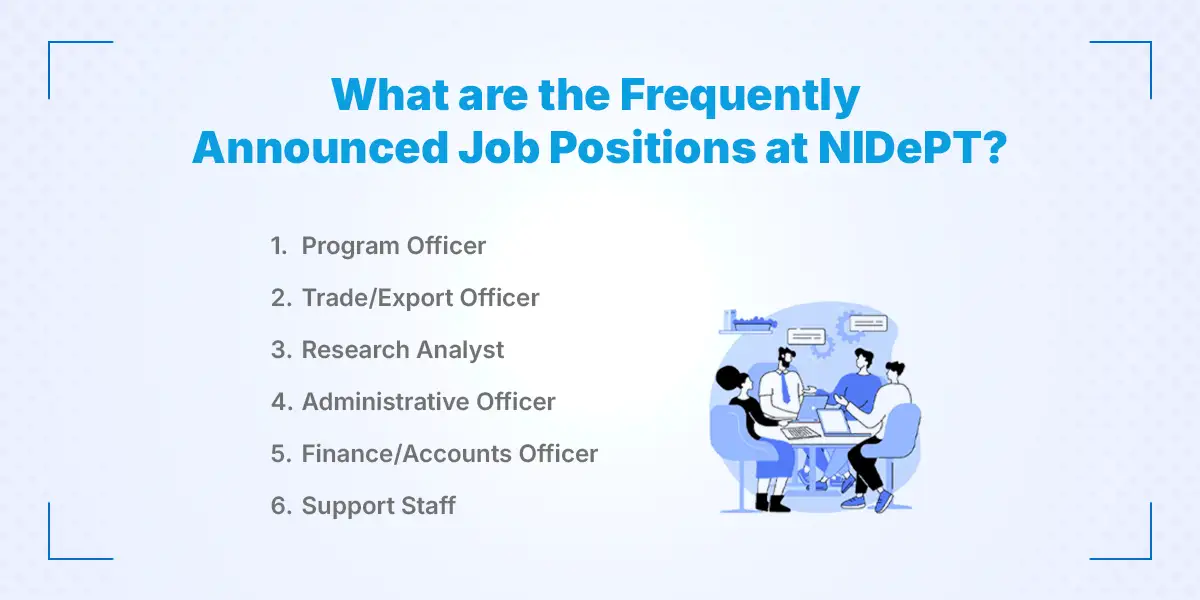
1. Program Officer
A Program Officer at NIDePT manages development programs from planning to execution. You will coordinate with government agencies, donor organizations, and field teams to ensure programs run on time and within budget. This role requires strong organizational skills combined with a solid understanding of Nepal's development landscape. Expect to write reports, prepare presentations, and represent NIDePT in coordination meetings regularly.
2. Trade/Export Officer
This role focuses directly on Nepal's trade and export ecosystem, researching market opportunities, supporting exporters with information, and working alongside the Ministry of Commerce and industry associations. You will analyze trade data, identify barriers that Nepali exporters face, and help design practical solutions. It is a hands-on, research-meets-fieldwork role where your output genuinely influences trade policy decisions.
3. Research Analyst
Research Analysts at NIDePT gather, organize, and interpret economic and trade data to support policy recommendations. You will prepare research briefs, situation analyses, and technical reports that feed directly into government planning. Strong analytical skills and comfort with data tools are a must. A Master's degree is often preferred here because the work demands a deeper level of technical writing and statistical interpretation.
4. Administrative Officer
The Administrative Officer keeps NIDePT's internal operations smooth and organized, handling documentation, record-keeping, correspondence, and procurement. While it may sound behind-the-scenes, this role is critical to how effectively the organization functions day-to-day. You should be detail-oriented, familiar with government administrative procedures, and comfortable managing multiple tasks simultaneously. Experience in a similar government or development office setting is a strong advantage.
5. Finance/Accounts Officer
Finance Officers manage NIDePT's financial records, budgets, and compliance with government accounting standards. You will handle fund tracking, prepare financial reports, support audits, and ensure expenditure aligns with approved budgets. Knowledge of the GoN financial management system and accounting software is important. This is a role where accuracy matters more than speed.
6. Support Staff
Support staff roles cover office assistants, data entry operators, drivers, and general service positions. While qualifications required are lower, typically SLC or +2 level, reliability and commitment are what NIDePT values most in these hires. These positions are a good entry point into the government-linked development sector for those early in their careers. Duties vary by specific role but generally involve assisting technical and administrative teams in day-to-day operations.
Required Qualifications & Skills to Work at NIDePT
Most NIDePT roles require at least a Bachelor's degree in fields like Economics, Management, Law, or International Trade, with preference given to candidates holding a Master's and relevant work experience. Beyond academic credentials, NIDePT looks for candidates who can think analytically, write clearly, and work well across teams and institutions. Let's go through the specific eligibility and skill expectations:
1. Academic and Professional Eligibility Requirements
In officer-level jobs, a Bachelor of Economics, Business Administration, Management, Law or International Trade is typically requested and a Master of Economics is desirable in a research-oriented job. Practice in the development sector of Nepal (NGOs, government, or international agencies) is a good plus, and some positions might also demand such qualifications as CA or CMA in case of a job in the financial sphere.
2. Core Competencies and Skill Sets Required
The candidates are supposed to possess good policy research and report writing abilities, and be able to interpret data and communicate their findings effectively. The understanding of trade systems and international frameworks such as SAFTA and WTO of Nepal is highly appreciated and good communication and stakeholder coordination skills. In dynamic work settings it is critical to identify problems and find practical solutions, which is only possible through critical thinking and problem solving.
What are the Salaries and Benefits at NIDePT?
Salaries at NIDePT are generally competitive within Nepal's government and development sector, with officer-level positions typically ranging from NPR 40,000 to NPR 80,000 per month depending on grade and experience. Beyond the base salary, employees benefit from allowances, professional development opportunities, and exposure to impactful national and international projects. Here is what you can expect in more detail:
1. Estimated Salary Range by Level
Entry-level support staff positions typically start around NPR 20,000–30,000 per month. Officer-level roles generally fall between NPR 40,000–80,000, with senior technical positions potentially going higher depending on funding source and project scope. Salaries align with the Government of Nepal pay scale for permanent positions, while project-based roles may offer slightly different structures. Always check the specific vacancy notice for the confirmed salary grade, as it varies by position.
2. Allowances and Perks
In addition to the base salary, NIDePT positions typically come with a range of allowances, including dearness allowance, festival allowance, medical allowance, and travel allowance for field work. Provident fund contributions and gratuity are standard for permanent government-linked roles. Some positions also include mobile and internet allowances, particularly for officers who coordinate frequently with external partners. These perks add meaningful value on top of the monthly salary figure.
3. Exposure to National/International Projects
One of NIDePT's most attractive benefits is the opportunity to work on projects funded or supported by international organizations like the World Bank, ITC, UNDP, and bilateral donors. This means you get hands-on experience with global development standards and international coordination, which is rare and valuable in the Nepali job market. Such exposure strengthens your professional profile significantly and opens doors to future opportunities both inside and outside Nepal.
4. Career Growth Opportunities
NIDePT offers structured career progression for high-performing employees, with scope for promotion, increased responsibility, and leadership roles in program or department management. Regular training programs, workshops, and conferences, both domestic and international, form part of the professional development package. For those in technical or research roles, there is also potential to publish work and contribute to national policy discourse, which adds long-term credibility to your career. Growth here is both vertical and horizontal.
How to Apply for NIDePT Vacancy in Nepal: Step-by-Step
Applying for a NIDePT vacancy involves checking the official notice, preparing your documents, submitting the application on time, and attending the written test or interview. The process follows Nepal's standard government recruitment procedure, so getting each step right matters. Here is the full walkthrough:
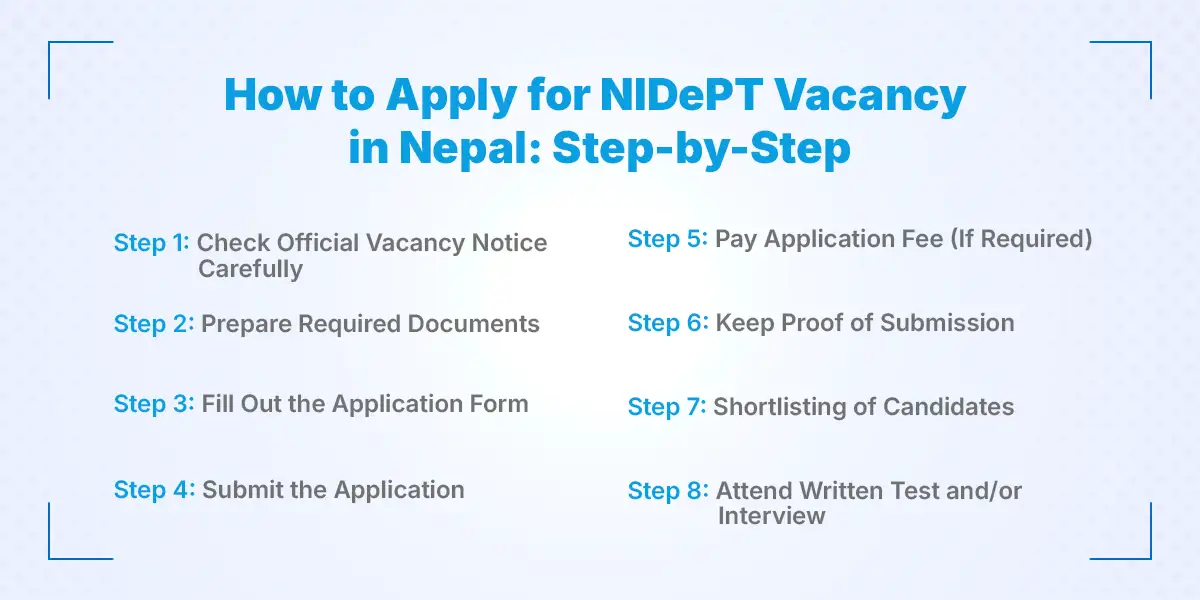
Step 1: Check Official Vacancy Notice Carefully
Before anything else, read the vacancy notice in full, not just the headline. Pay attention to the required qualifications, age limit, application deadline, submission method, and required documents. Missing even one small detail can get your application rejected. NIDePT notices are published on Kumari Job, the Government of Nepal's gazette, and sometimes major Nepali newspapers.
Step 2: Prepare Required Documents
Once you have confirmed your eligibility, start gathering your documents. You will typically need your updated CV, academic certificates (all levels), citizenship copy, and experience letters if applicable. Make sure all documents are legible, correctly organized, and, if required, attested by the relevant authority. Preparing these early saves you the last-minute scramble.
Step 3: Fill Out the Application Form
Some NIDePT vacancies use a specific application format, which is usually attached to or available alongside the official notice. Fill it out carefully, double-check all information for accuracy, and make sure your personal details match your official documents. Mistakes on the application form, even minor ones, can raise questions during shortlisting or the interview stage.
Step 4: Submit the Application
Submit your complete application package, including form, documents, and any other required materials before the stated deadline. Depending on the notice, submission may be in-person at NIDePT's office or through an online portal. Never submit an incomplete application hoping to follow up later. Late or incomplete submissions are typically disqualified without review.
Step 5: Pay Application Fee (If Required)
Some NIDePT vacancies require a nominal application fee, which must be paid through the specified channel, usually via bank voucher or online payment. Keep your payment receipt safe, as you will likely need to submit it with your application or present it during the process. Check the notice carefully for the fee amount and payment instructions.
Step 6: Keep Proof of Submission
Whether you submit in person or online, always get and retain proof of submission. This could be a stamped acknowledgment slip, a submission confirmation email, or a screenshot of the portal receipt. If any dispute arises about your application during shortlisting, your proof of submission is what protects you. Do not skip this step thinking it is optional.
Step 7: Shortlisting of Candidates
After the application deadline, NIDePT's selection committee reviews submissions and creates a shortlist based on eligibility and qualifications. Shortlisted candidates are typically notified through the official NIDePT website, job portals like Kumari Job, or newspapers. This process can take a few weeks, so be patient and check for updates regularly so you do not miss your call letter.
Step 8: Attend Written Test and/or Interview
Shortlisted candidates are called for a written exam and/or an interview, depending on the position. Written tests typically cover general knowledge, subject-specific knowledge, and situational reasoning. Interviews are often competency-based, focusing on your skills and how you handle real work scenarios.
Required Documents Checklist
- Updated CV (tailored to the position applied for)
- Academic certificates SLC/+2, Bachelor's, Master's (as applicable)
- Citizenship copy (attested if required by the notice)
- Experience letters from previous employers
- Application fee receipt (if applicable)
- Application form (filled and signed)
- Passport-size photographs (as specified)
Important Tips to Get Selected at NIDePT
To stand out at NIDePT, tailor your CV to the development and trade sector, highlight policy and research experience, and prepare well for competency-based interviews. The selection process is competitive, and generic applications rarely make it past the shortlisting stage. These specific, actionable tips can meaningfully improve your chances:
1. Tailor Your CV for the Development/Trade Sector
A general-purpose CV does not work well for NIDePT. Instead, highlight experience and skills that are directly relevant to trade, development, or policy work, even if some of it came from internships, thesis research, or volunteer work. Use clear, outcome-focused language: instead of "assisted with reports," write "contributed to a policy brief on Nepal's export competitiveness presented to the Ministry of Commerce." A good CV with specificity signals seriousness, and NIDePT's review panel notices the difference.
2. Highlight Research and Policy Experience
NIDePT places significant value on candidates who can research, analyze, and communicate findings clearly. So even if your experience is academic, make it visible. Mention your thesis topic if it is trade or economics-related, list any policy papers or reports you contributed to, and reference datasets or analytical tools you have worked with. This signals that you already understand the kind of work NIDePT does daily, which makes you a lower-risk hire in the eyes of the selection panel.
3. Get Ready to Interview based on Competencies.
The interviews of NIDePT are usually competency based - i.e. you will be asked questions such as: tell me how you solved a complicated situation or what would you do when two stakeholders are at cross purposes? Practice for your interview to answer based on the STAR method: Situation, Task, Action, Result. Gather at least three or four instances in your academic or professional experience that illustrate how you used your analysis, coordination and communication skills to solve a problem in real life.
4. Stay Updated on Trade Policies of Nepal.
It would be a missed opportunity to walk into an NIDePT interview without the slightest idea of the current trade priorities in Nepal. Take a look at the Trade Policy 2015 of Nepal, the Export Promotion Strategy, as well as recent announcements by the Ministry of Commerce and Supplies. Track developments related to the WTO obligations of Nepal, its engagement in SAFTA, and export issues in the major sectors of the Nepalese economy such as handicrafts, tea, and herbs. This prior knowledge will demonstrate that you are really interested in the field, not only the pay.
Conclusion
NIDePT is a very intentional employer of development professionals in Nepal - it provides a secure government-supported job, actual policy influence, global experience and real career development to those with qualifications and attitudes. Be you a new graduate with a Masters degree or even somebody with a couple of years experience in the development sector, this is a company that one should take seriously.
It requires the right information at the right time to find and land a job like this. It is precisely what this guide has been prepared to see to it that you will not be at the last minute scramble or miss notices because you were not looking where you should have looked. The possibility is actual. It only requires the preparation to be equivalent.
Be the first to know about all NIDePT vacancies and all other government and development sector vacancies in Nepal by following Kumari Job. View the most recent jobs, sign up to receive notifications, and ensure the next opening catches your eye.
Frequently Asked Questions
Submit your comments

Get Our App On



SEO Training for Freshers in Nepal: Skills, Career & Job Opportunities
VIEW DETAILS
SEO Training vs. Self-Learning: Which Is Right for You?
VIEW DETAILS
How to Choose Between Two Job Offers
VIEW DETAILS
Digital Marketing Training Interview Questions and Answers for Freshers
VIEW DETAILS


Loading Comments...