


You studied law for years. You sat through endless lectures, passed tough exams, and now you're ready to build a real career. But…finding the right legal officer job in Nepal can feel like searching for a needle in a haystack. Job postings are scattered, requirements are confusing, and nobody tells you exactly what to expect.
Whether you're a fresh LLB graduate or someone with a few years under your belt, this guide is for you. From the latest legal officer vacancies in Nepal and salary benchmarks to how to actually apply and get hired, we've put everything in one place. So, let's get right into it.
In this blog
Overview of Legal Officer Jobs in Nepal
A legal officer is the person who keeps an organization on the right side of the law. They draft contracts, review legal documents, handle disputes, advise management on risk, and make sure the company is following all applicable rules and regulations. In simple words, they protect the organization legally, every single day.
The demand for legal officers in Nepal is growing fast. You'll find these roles in commercial banks, development banks, microfinance companies, corporate houses, NGOs, INGOs, and even government bodies. Industries like hydropower, insurance, and manufacturing are also actively looking for legal professionals.
What makes this even better is that legal roles are no longer limited to big law firms. Today, even medium-sized companies and nonprofits are building in-house legal teams, which means more opportunities across more sectors than ever before.
Why the Demand for Legal Officer Roles is Growing
Legal officer roles in Nepal are growing because of stricter government regulations, rising corporate activity, and increased compliance requirements across banking, hydropower, and NGO sectors. As businesses expand and new laws come into force, every organization needs someone who can handle the legal side without missing a beat. Here's a closer look at what's actually driving this growth:
- Stricter financial and corporate regulations
- Nepal Rastra Bank compliance requirements
- Expansion of hydropower and infrastructure projects
- Growing NGO and INGO operations
- Rise in corporate mergers, acquisitions, and contracts
- Increased awareness of legal risk management
- More foreign investment requiring legal oversight
Latest Legal Officer Vacancy in Nepal (Updated Listings)
Legal Officer vacancies in Nepal are mainly available in institutions like Nepal Rastra Bank, commercial banks, corporate companies, and insurance sectors, with roles focusing on legal compliance, contracts, and regulatory advisory. These positions usually require an LLB degree with 1–3 years of experience and strong knowledge of Nepalese laws, especially in banking and corporate legal frameworks.
These recent legal openings show consistent demand for legal professionals in Nepal’s financial and corporate sectors, which we will explore in detail below:
1. Nepal Rastra Bank – Legal Officer (2026)
Nepal Rastra Bank in Kathmandu (Baluwatar) announced a Legal Officer position in March 2026 for its Legal Division. The role involves handling central banking laws, regulatory frameworks, compliance, and advising on financial regulations and policy-level legal matters. This is one of the highest-level legal roles in Nepal with a strong focus on banking law and regulatory compliance.
2. Legal Officer – Merchant Bank / Corporate (Kathmandu)
A Merchant Bank and corporate sector Legal Officer vacancy was published in Kathmandu in January 2026, requiring at least 2 years of experience. The role focuses on managing corporate legal and regulatory matters, ensuring compliance with company and securities laws, and advising management on legal issues. These roles are heavily focused on compliance, documentation, and risk advisory, making them ideal for candidates aiming for corporate legal and advisory careers.
3. Prime Commercial Bank – Legal Officer
Prime Commercial Bank’s Legal Officer position typically requires an LLB degree, preferably with a focus on commercial law, while an LLM is an added advantage. The role mainly involves drafting and reviewing loan agreements and contracts, along with handling banking compliance and legal documentation. Banking legal roles like this strongly prioritize commercial law knowledge and expertise in financial and legal documentation.
4. Legal Officer Roles in Banks & Insurance (2026 Cycle)
In 2026, continuous hiring for Legal Officer and related roles is seen across banks and financial institutions such as Nabil Bank, Citizens Bank International, Jyoti Bikash Bank, insurance companies, and microfinance institutions, with deadlines around April–May 2026. These positions are often titled Legal Officer, Legal/Compliance Officer, Corporate Legal Executive, or Risk and Compliance Officer, reflecting a broad demand in the financial sector.
Did you know? Kumari Job regularly updates verified Legal Officer vacancies in Nepal across banks, NGOs, and corporate houses, helping you apply to fresh listings without the risk of outdated or expired job posts.
What are the Key Responsibilities of a Legal Officer?
A legal officer handles everything from drafting contracts and ensuring compliance to managing disputes and advising leadership. It's a position that touches almost every department of an organization, which is exactly what makes it so important. Let's break down each core responsibility clearly.
1. Drafting and Reviewing Contracts
Drafting contracts is one of the most critical parts of a legal officer's job. You write agreements between the company and clients, vendors, employees, and partners. A poorly written clause can cost an organization millions. So you don't just write the contract, you review, revise, and finalize it to make sure it's legally sound, clear, and enforceable. Organizations depend on this skill to protect their business relationships and avoid future disputes.
2. Ensuring Regulatory Compliance
Regulatory compliance means making sure your organization follows all the laws that apply to it. For banks, that includes Nepal Rastra Bank directives. For NGOs, it includes Social Welfare Council rules. As a legal officer, you track new regulations, update internal policies, and guide departments to stay compliant. This isn't a once-a-year task, it's an ongoing responsibility that keeps the entire organization out of legal trouble.
3. Handling Legal Disputes and Documentation
When a dispute arises, whether it's with a client, employee, or government body, the legal officer steps in. You manage everything from initial notices and negotiations to court filings if it escalates. Along the way, you maintain all legal documentation accurately. This means keeping records organized, case files updated, and correspondence properly filed. Good documentation can make or break a case, so attention to detail here is non-negotiable.
4. Advising Management on Legal Risks
Senior management makes big decisions every day, and many of those decisions carry legal risk. Your job is to flag those risks before they become problems. You review business plans, new partnerships, policy changes, and financial decisions with a legal eye. Then you give clear, actionable advice in language that non-lawyers can understand. When leadership trusts your guidance, it shows in how confidently the organization moves forward.
Required Qualifications & Skills to Become a Legal Officer
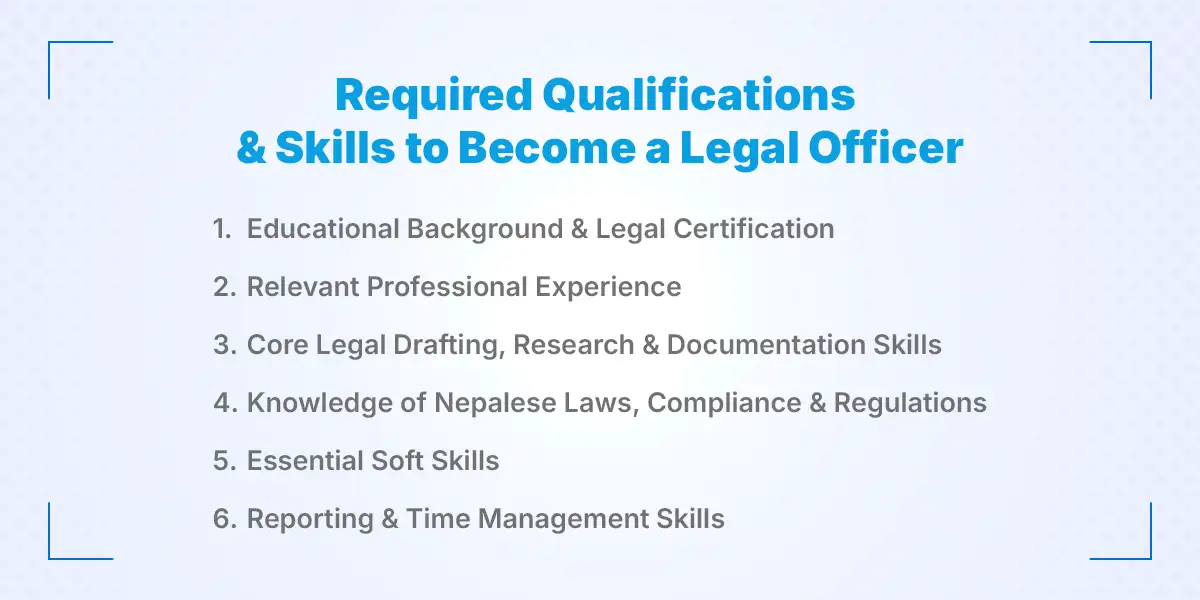
To become a legal officer in Nepal, you typically need an LLB degree, strong legal drafting skills, and good knowledge of Nepalese laws, with a Bar Council license being an added advantage for many roles. Experience in legal research, compliance, and documentation can set you apart from other candidates. Let's look at what each requirement actually means in practice.
1. Educational Background & Legal Certification
In Nepal, the education level needed to be a legal officer is a Bachelor of Laws (LLB) degree of a recognized university. Most positions on the senior level require an applicant to have an LLM (Master of Laws) or a similar postgraduate degree. In addition to your degree, it is a great benefit to you to register with the Nepal Bar Council, particularly in the jobs which require court representation or formal law practice. There are also employers in the banking and finance industry who prefer candidates who have a law and business or a finance background.
2. Relevant Professional Experience
The majority of legal officer positions demand 1-3 years of experience in the related field, which will depend on the grade of the position. Legal intern experience, experience as a junior advocate, compliance officer, or legal assistant count. Even internships in the course of your LLB can make you stand out above the crowd of applicants who have only classroom experience to draw on. And, the sooner you get your experience, the better.
3. Core Legal Drafting, Research & Documentation Skills
You must be capable of drafting clear, accurate, and legally valid documents; these include contracts, agreements, MoUs, notices and legal opinions. The importance of legal research is no less significant either, you ought to know how to locate applicable laws, judgments, and regulations in a short period of time. Documentation skills imply maintaining all the records systematized, available, and current.
4. Knowledge of Nepalese Laws, Compliance & Regulations
There should be a solid knowledge of the legal system of Nepal. This is the Companies Act, Labor Act, Contract Act, Foreign Employment Act, NRB directives (where applicable to financial institutions) as well as any industry-specific legislation applicable to the industry you are applying to. You must also keep abreast of changes in laws. Adherence is not a fixed area, new rules are regularly issued, and you are supposed to have all the new rules and apply them without being reminded twice.
5. Essential Soft Skills
Being a great legal officer does not require having legal knowledge. Good communication skills, both written and spoken, are also required of you as you will be required to explain complex legal matters to those who do not even know the law. It is important to pay attention to detail, as the misstep in a document can be disastrous. Problem-solving, negotiation, and having the capacity to remain calm when faced with pressure are also treasured.
6. Reporting & Time Management Skills.
The work of legal officers is usually multitasking. In the morning you could be looking over a contract, in the afternoon you could be at a compliance meeting and in the evening you could be preparing a legal opinion. It is all running smoothly because of good time management. You must also be capable of producing well-organized, concise reports to the management- summarizing the legal risks, the cases underway, or the level of compliance in a manner clearly comprehensible.
What is the Salary of Legal Officers in Nepal (2083 Overview)
Legal officer salaries in Nepal range from around NPR 25,000 per month at entry level to over NPR 1,50,000 at the senior level, with mid-level professionals typically earning between NPR 50,000 and NPR 1,00,000. The exact figure depends on your experience, the industry, and the size of the organization. Here's a quick overview to help you set realistic expectations:
| Level | Monthly Salary Range |
|---|---|
| Entry-Level | NPR 25,000 – 50,000 |
| Mid-Level | NPR 50,000 – 1,00,000+ |
| Senior-Level | NPR 1,50,000+ |
Beyond the base salary, many organizations, especially banks and corporate houses also offer benefits like provident fund contributions, festival bonuses, health insurance, and performance incentives. Legal positions in government bodies often come with additional allowances and job security that private sector roles may not offer. So when comparing salaries, always factor in the full compensation package, not just the monthly figure.
Factors Affecting Salary of a Legal Officer in Nepal
The biggest factors that affect a legal officer's salary in Nepal are experience, the industry they work in, and the size of the organization. Each of these can significantly change what you earn, even at the same job title. Let's look at each factor affecting a lawyer’s salary in Nepal one by one:
1. Experience
Experience is the biggest salary driver for legal officers. A fresh LLB graduate starting their first job can expect NPR 25,000–40,000, while someone with 5+ years of solid legal work can command NPR 80,000–1,20,000 or more. Every year of relevant experience adds negotiating power. So investing in internships and junior roles early on pays off significantly in the long run.
2. Industry (Banking vs NGO vs Corporate)
The sector you work in matters a lot when it comes to salary. Commercial banks and financial institutions generally offer the highest pay, followed by large corporate houses and hydropower companies. NGOs and INGOs tend to offer moderate salaries, though international NGOs can sometimes match corporate pay. Government positions may pay less monthly but offer stability, pension, and long-term benefits.
3. Organization Size
The salary in a big commercial bank or multinational company will nearly always be higher than that of a small trading company or local NGO. Larger organizations face greater legal risks and, thus, spend more on their legal teams. When salary is paramount, it is wiser to focus on large-sized organizations, both in the private and government sector, instead of going everywhere with the general without giving a thought on the size and financial ability of the employer.
Top Sectors Hiring Legal Officers in Nepal
Commercial banks, hydropower companies, NGOs, and corporate law firms are among the top employers of legal officers in Nepal right now. Each sector comes with its own legal needs, work culture, and growth opportunities. Here's what you need to know about each of them.
1. Commercial Banks & Financial Institutions
Banks are the most consistent and high-paying hirers of legal officers in Nepal. Nepal Rastra Bank's strict regulatory requirements mean banks need dedicated legal professionals to handle compliance, loan agreements, security documentation, and regulatory reporting. Development banks, microfinance companies, and insurance firms follow similar patterns. If you have a background in banking law or financial regulations, this is the sector where your skills are most valued and best compensated.
2. Hydropower & Infrastructure Companies
Nepal's hydropower sector is booming, and with it comes a huge demand for legal expertise. These companies deal with complex land acquisition, environmental law, government contracts, and international financing agreements. A legal officer in this sector needs to be comfortable working with large, multi-party contracts and navigating both local and international legal frameworks. It's a challenging space but also one with excellent compensation and long-term career growth.
3. NGOs & INGOs
NGOs and INGOs operating in Nepal need legal officers to manage registration compliance, donor agreements, employment contracts, and Social Welfare Council requirements. International NGOs in particular look for candidates who understand both Nepalese law and international legal standards. The work in NGOs/INGOs is more diverse and mission-driven, which appeals to many legal professionals who want their careers to have a social impact alongside professional development.
4. Corporate Houses & Law Firms
Large corporate houses in trading, manufacturing, real estate, and retail are building dedicated legal departments as their operations grow. Law firms, on the other hand, offer a different kind of experience. You work across multiple clients and sectors, which gives you broad exposure very quickly. Both paths offer strong career development. Corporate legal roles offer stability and specialization, while law firms offer speed, variety, and the chance to build a wide professional network.
How to Apply for Legal Officer Vacancy in Nepal?
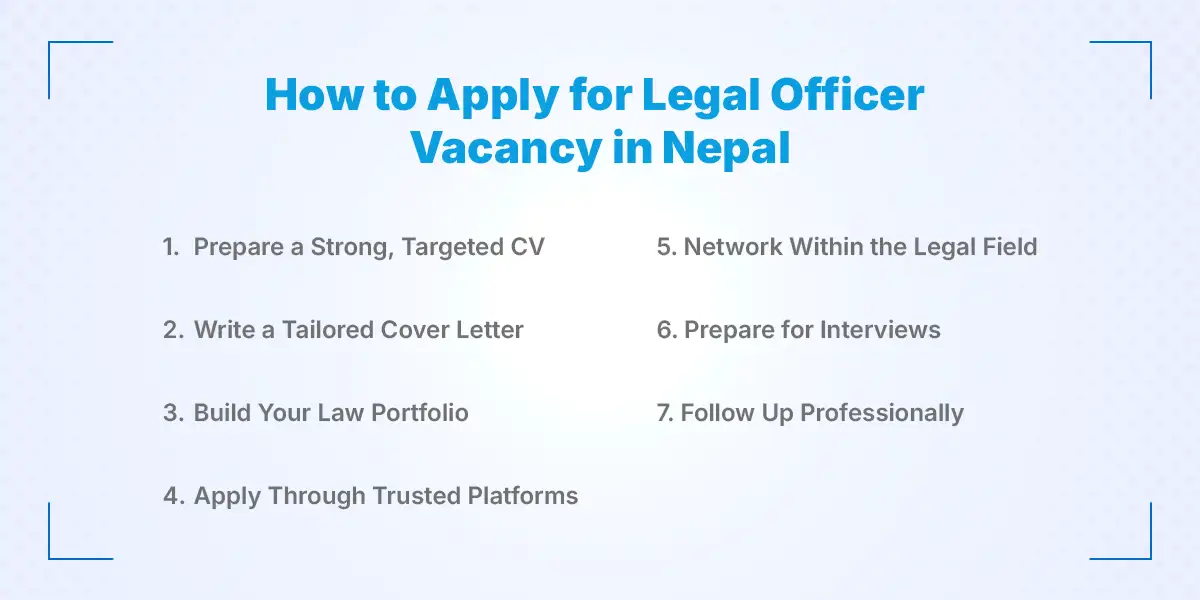
To apply for a legal officer vacancy in Nepal, start by building a strong CV, writing a targeted cover letter, and applying through trusted platforms like Kumari Job. The process is more competitive than most people realize, so small details, like customizing your application or following up professionally can make a real difference. Here's a step-by-step breakdown to guide you to find a law job in Nepal:
1. Prepare a Strong, Targeted CV
The initial impression is your CV and it should be responsive towards the job. Put your LLB degree, Bar Council enrolment and any other work experience at the top. Next enumerate particular legal competencies such as drafting of contracts, compliance management and legal research. A targeted, well-organized CV is shortlisted; a generic CV is not.
2. Write a Personalized Cover Letter.
The cover letter gives you an opportunity to tell them why you are the best candidate to fill this position. Do not simply copy your CV, take the cover letter and tell them about what interests you in the job, what your experience has in their needs and what you can offer them that they cannot get elsewhere. Make it brief two or three powerful paragraphs is a good idea. In Nepal, employers consider a well-written cover letter to be an examination of your professional communication abilities and thus it should be taken seriously.
3. Build Your Law Portfolio
Many applicants do not pay much attention to a legal portfolio and that is why you have one, you are ahead of the pack. Include the samples of contracts you have drafted, legal opinions you have written, and compliance checklists you have prepared or other legal documents you have worked on (with sensitive information deleted). When you are a fresher, you should include your work experience during internships or your course work in the LLB. Portfolio transforms your claims into evidence, which is much more likely to gain you trust in the employers than words themselves.
4. Apply Through Trusted Platforms
Do not waste time on unchecked job advertisements. Find job opportunities using websites such as Kumari Job which lists verified vacancies of legal officers regularly by banks, NGOs, corporate houses and government agencies. Apply promptly. Most of the legal jobs in Nepal are taken very fast, particularly at reputable organizations. Create job alerts to be informed as soon as a pertinent vacancy is advertised, and avoid letting the time run out on deadlines.
5. Network Within the Legal Field
The legal job market in Nepal underestimates networking - and that is a huge opportunity to those who are ready to do so. Get in contact with practicing lawyers, law officers in banks or NGO, and professors in your college of law. Participate in legal seminars, bar associations, and professional workshops. Referral is used to fill many positions in law in Nepal even prior to the advertisement of the position.
6. Prepare for Interviews
Legal officer interviews in Nepal typically cover your knowledge of relevant laws, practical scenarios involving contract drafting or dispute resolution, and your understanding of the sector's regulatory environment. Prepare by revisiting key Nepalese laws, practicing scenario-based questions, and researching the organization thoroughly. Confidence backed by preparation is what gets you hired.
7. Follow Up Professionally
After submitting your application or completing an interview, send a brief follow-up email within 24–48 hours. Thank the interviewer for their time, reaffirm your interest in the role, and mention one specific thing that stood out from your conversation. It's a small step, but it shows professionalism and genuine interest. These are the qualities that employers take note of. Most candidates skip this step, which means doing it puts you a step ahead.
Tips to Get Hired as a Legal Officer (and Mistakes to Avoid)
Getting hired as a legal officer in Nepal comes down to gaining real experience early, staying updated with changing laws, and customizing every application you send. It's not just about what you know, it's about how well you present it and how prepared you are when the opportunity comes. Here are the most important tips to help you get there.
1. Earn Legal Experience at an Early Age.
Do not delay getting experience after graduation. Complete internship in a law firm, NGO, or in-house law section during your LLB program. Even several months of practical work, such as writing a contract, attending a compliance meeting, or assisting in writing legal papers, imparts skills that cannot be acquired in the classroom. Work experience is always among the leading hiring factors by employers in every industry and those with experience are always shortlisted first.
2. Stay Updated with Nepalese Laws
The change in laws in Nepal is more frequent than some people think. New NRB circulars, new labor regulations, new company act provisions, it is all a part of interviews and work. Develop a habit of keeping track of legal news and official government gazettes and subscribe to legal discussion groups or updates of bar associations. Applicants that enter an interview with fresh regulatory developments right in front of the interviewer immediately contrast with those who continue to use their college-based textbook material.
3. Build a Strong Legal Drafting Portfolio
Employers are interested to ensure that you are capable of writing legal documents and not that you are aware of the theory underpinning the legal document. Begin to create a collection of real or practice-based documents: contracts, MoUs, legal notices, compliance checklists, and legal opinions. Label all documents, mention the circumstance in which it was written and show it in a professional way.
4. Customize Every Application
One of the most frequent mistakes that candidates make is to send the same CV and cover letter to ten employers. All organizations have varying legal requirements, a bank is concerned with regulatory compliance, an NGO is concerned with donor agreements, and a hydropower company is concerned with land acquisition law. Make your application (CV, cover letter, and even email) unique to each employer. It is more time consuming, however, it will raise your chances of receiving a response greatly.
5. Know Job Requirements.
Read the job description. Check the qualifications, duties, and desired experience needed. Emphasize on the keywords they employ and ensure your application reflects these words where necessary. In case of any requirement that you fail to satisfy then take the initiative in your cover letter rather than wishing that they may not notice. Demonstrating that you know what the job entails can give the employer the impression that you are taking the job seriously.
6. Connect with Legal Professionals.
One of the best career strategies in Nepal is to build a relationship with individuals who are already employed in a legal position. Become a member of Nepal Bar Association, participate in legal workshops, meet senior advocates, and add legal professionals on LinkedIn. Networking is not something to do when you are in need of a job. It is advisable to start your network earlier than you require it.
7. Get Ready for Interviews.
Interviews in law are not only personality-based but also they test your legal reasoning, knowledge, as well as ability to solve problems. Be ready to answer questions in the form of scenarios such as, “How would you go about resolving a contract dispute with a vendor?” or “What would you do in case a new NRB circular contradicts an existing company policy?” You will also be expected to speak about your previous work, so prepare well for your interview accordingly.
Conclusion
Legal officer careers in Nepal are growing across banks, NGOs, corporate houses, and international organizations. The opportunities are real, well-paying, and here right now. If you have the right degree, relevant skills, and a clear plan to apply, there is no reason to sit on the sidelines.
Whether you're a fresh graduate or someone ready for a step up, today is a good day to make your move. Stay updated with the latest Legal Officer vacancies in Nepal on Kumari Job. Create your job profile and apply before deadlines. The right opportunity might already be waiting for you.
Frequently Asked Questions
Submit your comments

Get Our App On



How to Register a Personal PAN Card in Nepal: Online & Offline Methods
VIEW DETAILS
What Is the Average JavaScript Developer Salary in Nepal?
VIEW DETAILS
Salary Tax Slab 2083/84 in Nepal: Latest Tax Rates & Calculation
VIEW DETAILS
What Is the Average Java Developer Salary in Nepal?
VIEW DETAILS


Loading Comments...