

Nepal's income tax system is getting one of its biggest updates in recent years. In the Budget for FY 2083/84, the government announced major changes to personal income tax slabs.
The headline change is hard to miss: the first tax slab has doubled from Rs. 5 lakh to Rs. 10 lakh. At the same time, the highest personal income tax rate has been reduced from 39% to 29%. For many employees, freelancers, and professionals, this could mean lower tax deductions and more money in their pockets.
But what do these changes actually mean for you? Will your salary be taxed differently? Is income up to Rs. 10 lakh now tax-free? And how much tax will you actually pay under the new system?
In this guide, we'll break down the new income tax slab rates for FY 2083/84, compare them with the previous year's structure, and explain everything in simple terms so you can understand exactly how the changes affect your income.
In this blog
New Income Tax Slab Rates in Nepal for FY 2083/84
The income tax slab rates in Nepal for FY 2083/84 range from 1% to 29%, depending on your annual taxable income. Under the new tax structure, the first tax slab has increased to Rs. 10 lakh, while the highest tax rate has been reduced to 29%. Here's a quick look at the updated tax slabs announced for the new fiscal year.
Quick Overview of the New Income Tax Rate FY 2083/84 (2026-27)
- Income up to Rs. 10 lakh falls under the 1% tax slab.
- Income from Rs. 10 lakh to Rs. 15 lakh is taxed at 10%.
- Income from Rs. 15 lakh to Rs. 25 lakh is taxed at 20%.
- Income from Rs. 25 lakh to Rs. 40 lakh is taxed at 27%.
- Income above Rs. 40 lakh is taxed at 29%.
The table below provides a complete breakdown of the revised income tax slab rates for FY 2083/84:
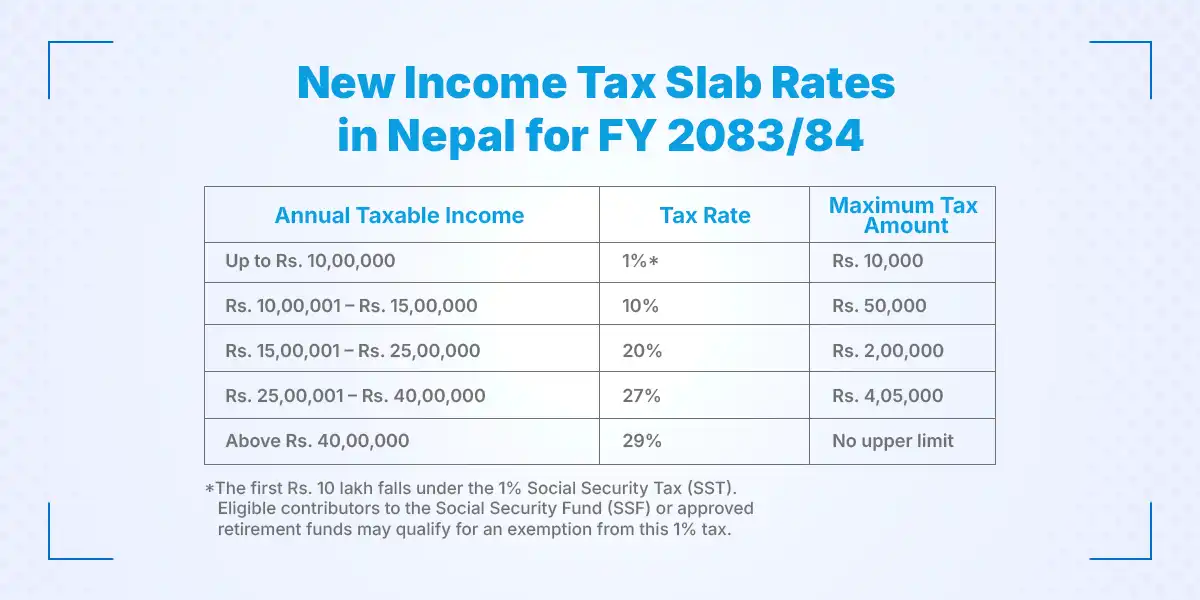
These revised income tax slab rates apply to resident individuals in Nepal and are expected to reduce the tax burden for many employees, professionals, and business owners compared to the previous fiscal year.
2. Key Highlights of the Updated Tax Slab
The Government of Nepal has introduced new income tax slab rates for FY 2083/84, bringing significant relief for many taxpayers. The biggest changes include increasing the first tax slab to Rs. 10 lakh and reducing the highest tax rate to 29%.
Several important changes have been made to Nepal's personal income tax structure for FY 2083/84:
- The first tax slab has increased from Rs. 5 lakh to Rs. 10 lakh.
- The highest personal income tax rate has been reduced from 39% to 29%.
- Separate tax slabs for single and married individuals have been merged into one structure.
- Nepal continues to follow a progressive tax system, where different portions of income are taxed at different rates.
Overall, these changes are expected to reduce the tax burden for many employees and make the tax system easier to understand.
3. When Do These New Tax Rates Take Effect?
The new tax rates will apply from 1 Shrawan 2083, which falls on July 16, 2026. This means they will be used for income earned during FY 2083/84, not for income earned in the previous fiscal year.
4. Income Tax for Freelancers and Self-Employed Professionals
Freelancers and self-employed individuals are taxed based on applicable income tax slabs depending on their total earnings.
If you earn from foreign clients (IT, digital services, or consultancy exports):
- A 5% final tax is deducted at the bank when receiving foreign currency
- A valid PAN is required for such transactions
Since freelance income is often irregular, maintaining proper income records is important for accurate tax calculation and compliance.
Old vs New Income Tax Slab (Quick Comparison)
The income tax structure for FY 2083/84 is much more taxpayer-friendly than the previous fiscal year. The first tax slab has doubled to Rs. 10 lakh, while the highest tax rate has been reduced by 10 percentage points. The government has also simplified the system by merging separate tax slabs for single and married individuals.
| Feature | FY 2082/83 | FY 2083/84 |
|---|---|---|
| First low-tax slab | Rs. 5 lakh (individual) | Rs. 10 lakh |
| Top tax rate | 39% | 29% |
| Number of slabs | 6 | 5 |
| Separate single/married slabs | Yes | No |
Why The Changes in Taxation Matters
These changes may look like small adjustments on paper, but they can make a noticeable difference in your monthly income.
Lower TDS deductions: Many employees may see less tax deducted from their salary each month.
Higher take-home pay: With lower tax rates and a larger low-tax slab, more of your earnings stay with you.
Simpler tax planning: A unified tax structure makes it easier to understand your tax liability and estimate how much tax you may need to pay.
In short, the new tax structure aims to reduce the tax burden for many taxpayers while making the system easier to understand and manage. Before looking at tax calculations, let's clear up one of the biggest misconceptions employees have about tax slabs.
The Biggest Tax Myth Most Employees Still Believe
Many employees think that once their income crosses a tax slab, their entire salary gets taxed at the higher rate. Fortunately, that's not how Nepal's tax system works. Understanding this one concept can save you a lot of confusion when calculating your taxes.
Myth: Crossing Rs. 10 Lakh Means All Your Income Is Taxed at 10%
Let's say your annual taxable income is Rs. 12 lakh. A common assumption is that because your income crossed Rs. 10 lakh, the entire Rs. 12 lakh will now be taxed at 10%.
That's simply not true.
If that were the case, many people would actually worry about getting a raise because they think they'll lose more money in taxes. Thankfully, Nepal's tax system doesn't work that way.
Enroll in Job-Oriented Accounting Training
How Nepal's Progressive Tax System Actually Works
Nepal follows a progressive tax system, which means different portions of your income are taxed at different rates.
Instead of applying one tax rate to your entire income, the government divides your income into different tax slabs. Each slab has its own tax rate, and you only pay that rate on the portion of income that falls within that slab.
Think of it like climbing stairs. As you move up, only the next step changes, not the steps you've already climbed.
Reality: Only the Income Within Each Slab Is Taxed at That Rate
When your income moves into a higher tax slab, only the amount above the previous slab limit is taxed at the higher rate.
For example, if your taxable income is Rs. 12 lakh:
- The first Rs. 10 lakh falls under the 1% tax slab.
- Only the remaining Rs. 2 lakh falls under the 10% tax slab.
So, crossing the Rs. 10 lakh mark does not suddenly make your entire income taxable at 10%.
Example: How to Calculate Tax on Rs. 12 Lakh Annual Income
Here's a simple breakdown:
| Income Portion | Tax Rate | Tax Amount |
|---|---|---|
| First Rs. 10,00,000 | 1% | Rs. 10,000 |
| Remaining Rs. 2,00,000 | 10% | Rs. 20,000 |
| Total Tax | Rs. 30,000 | |
As you can see, only the income above Rs. 10 lakh is taxed at 10%. The first Rs. 10 lakh continues to enjoy the lower tax rate.
Now that you understand how tax slabs work, let's look at another question many taxpayers are asking: Is income up to Rs. 10 lakh actually tax-free?
Is Income Up to Rs. 10 Lakh Tax-Free?
Not exactly. While the first tax slab has increased to Rs. 10 lakh, a 1% tax still applies in many cases. However, certain taxpayers may qualify for an exemption from this tax.
1. What is 1% Social Security Tax (SST) in Nepal?
In Nepal, the Social Security Tax generally refers to either the 1% Social Security Tax on individual income (for the lowest slab) or the broader 31% Social Security Fund (SSF) contribution. The application depends on whether you are contributing to the government's formal SSF system.
Under the new income tax structure for FY 2083/84, income up to Rs. 10 lakh falls under the 1% Social Security Tax (SST).
This means that if your annual taxable income is Rs. 10 lakh, the tax on that portion would generally be Rs. 10,000. So, while the tax rate is very low, it is not automatically zero for everyone.
2. Who Pays the 1% SST?
The 1% Social Security Tax generally applies to taxpayers whose income falls within the first tax slab and who do not qualify for any exemption.
For example, if you're a salaried employee or professional who is not covered by an eligible social security or retirement scheme, you may still need to pay the 1% SST on the first Rs. 10 lakh of your taxable income.
3. Who May Be Exempt?
Some taxpayers may not have to pay the 1% SST if they contribute to approved social security or retirement schemes.
This may include:
- Employees contributing to the Social Security Fund (SSF).
- Individuals contributing to an approved retirement or pension fund.
- Taxpayers covered by other eligible retirement schemes recognized under prevailing tax rules.
In simple terms, if you're already contributing to an approved social security or retirement program, you may receive relief from the 1% SST. However, it's always a good idea to check the latest tax provisions or consult your employer's payroll team to confirm your eligibility.
How the New Income Tax Rate FY 2083/84 Affects Salaried Employees?
For most employees, the new tax slab can directly affect how much money lands in your bank account every month. With a larger low-tax slab and a lower maximum tax rate, many taxpayers may notice a positive difference in their take-home income. Here's a closer look at what these changes could mean for salaried professionals.
1. Lower Monthly TDS
Employers deduct income tax from employee salaries through Tax Deducted at Source (TDS). Since the first tax slab has increased from Rs. 5 lakh to Rs. 10 lakh, many employees may now have a lower taxable amount falling under higher tax brackets.
As a result, monthly TDS deductions could decrease for a large number of salaried individuals.
2. Higher Take-Home Salary
When less tax is deducted from your salary, you get to keep more of your earnings.
While the exact increase will vary depending on your income level, many employees are likely to see a boost in their monthly take-home pay under the new tax structure. Even a small reduction in monthly deductions can add up to a meaningful amount over the course of a year.
3. Impact on Middle-Income Employees
Middle-income earners are among the biggest beneficiaries of the revised tax slabs.
Previously, income above Rs. 5 lakh started moving into higher tax brackets. Now, with the first slab extended to Rs. 10 lakh, a larger portion of income remains in the lowest tax bracket. This can help reduce the overall tax burden for many working professionals.
4. Impact on Senior Professionals and Executives
The reduction of the highest tax rate from 39% to 29% is particularly beneficial for high-income earners.
Senior managers, executives, consultants, and other professionals with higher annual income may see a noticeable reduction in their overall tax liability. This means they can retain a larger share of their earnings while still complying with tax regulations.
Of course, your actual tax amount will depend on factors such as deductions, exemptions, retirement fund contributions, and total taxable income.
What Counts as Taxable Salary in Nepal?
Before calculating income tax, it's important to understand what counts as taxable salary. Many employees assume that only their basic salary is taxed, but tax calculations are usually based on total taxable employment income.
This means several components of your compensation package may be included when determining your taxable income.
Common examples include:
Basic salary
Allowances (such as housing, transportation, or other taxable allowances)
Annual or Festival bonuses
Incentives and commissions
Overtime payments
Taxable benefits provided by the employer
Other employment-related income
Because taxable income can include more than just your monthly salary, it's always a good idea to review your payslip and compensation structure carefully. Understanding what forms part of your taxable income can help you estimate your tax liability more accurately and avoid surprises during tax calculations.
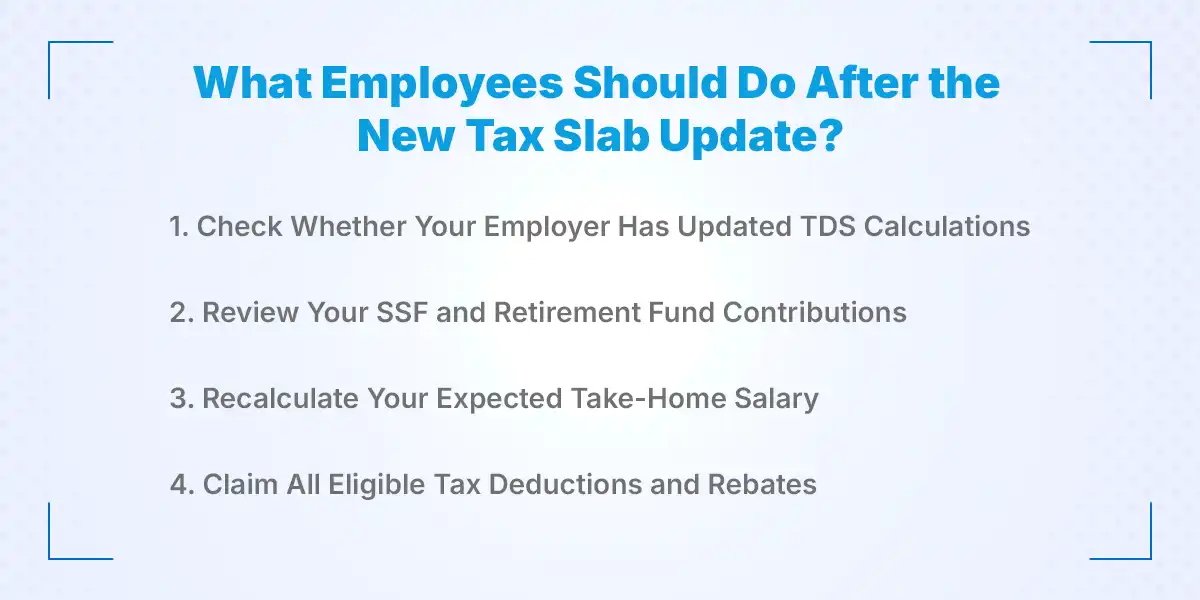
What Employees Should Do After the New Tax Slab Update?
The new tax slabs could reduce your tax burden, but that doesn't mean you should simply wait for the changes to take effect. Taking a few simple steps now can help you avoid mistakes, maximize available tax benefits, and understand exactly how the update affects your salary. Here's what every employee should do after the new tax slab announcement.
1. Check Whether Your Employer Has Updated TDS Calculations
Most employees rely on their employer to calculate and deduct tax through TDS (Tax Deducted at Source). Once the new tax rates become effective, employers should update their payroll and HR systems accordingly.
When you receive your first payslip for FY 2083/84, take a moment to review it. If the tax deduction seems unusually high or unchanged, don't hesitate to check with your HR or payroll team.
2. Review Your SSF and Retirement Fund Contributions
If you're contributing to the Social Security Fund (SSF), Provident Fund (PF) or an approved retirement fund, make sure your contributions are properly recorded.
These contributions can affect your tax liability and may also determine whether you qualify for relief from the 1% Social Security Tax (SST). A quick review now can save confusion later.
3. Recalculate Your Expected Take-Home Salary
Since the tax slabs have changed, your take-home pay may change as well.
Take a fresh look at your salary structure and estimate how much tax you may pay under the new rates. This can help you plan your monthly budget, savings goals, and other financial commitments more accurately.
4. Claim All Eligible Tax Deductions and Rebates
Many employees end up paying more tax than necessary simply because they don't claim available deductions and rebates.
Depending on your eligibility, you may be able to benefit from:
- SSF and approved retirement fund contributions
- Life insurance premium deductions
- Health insurance deductions
- Female taxpayer rebate
- Remote area tax benefits
- Other approved deductions under prevailing tax rules
A few minutes spent reviewing these benefits could help you reduce your overall tax liability legally and make the most of the new tax structure.
The new slabs are certainly good news for many taxpayers. However, understanding how they apply to your specific situation is the best way to ensure you receive the full benefit of the changes.
5. Practical Tips to Reduce Tax Liability Legally
- Contribute to SSF or approved retirement schemes to reduce taxable income.
- Claim eligible insurance deductions like life and health insurance.
- Keep your documents and records properly organized.
- Review your salary structure with HR to align with the new tax rules.
Conclusion
The updated income tax slabs for FY 2083/84 bring some relief for many employees, with lower tax rates across different income levels and a new structure that starts from 1% on the first NPR 10 lakh of taxable income. This means most people will see a smaller tax burden compared to before. However, it is important to understand that tax is not always zero at lower income levels, and it still depends on your total earnings and the rules that apply to you.
Because of these changes, employees should take a closer look at their SSF contributions and also confirm whether their employer has updated TDS in the payroll system. At the same time, it is a good idea to check and claim all eligible deductions so you do not pay extra tax.
For more practical insights on payroll processing and salary management, you can also read this guide on payroll management in Nepal.
Frequently Asked Questions
Submit your comments

Get Our App On



What Does a Digital Marketing Course Syllabus in Nepal Cover?
VIEW DETAILS
How to Find Lab Assistant Jobs in Nepal?
VIEW DETAILS
How to Open a Company in Nepal: Guide to Start Your Own Business
VIEW DETAILS
How to Find One Cinema Vacancy in Nepal
VIEW DETAILS


Loading Comments...