


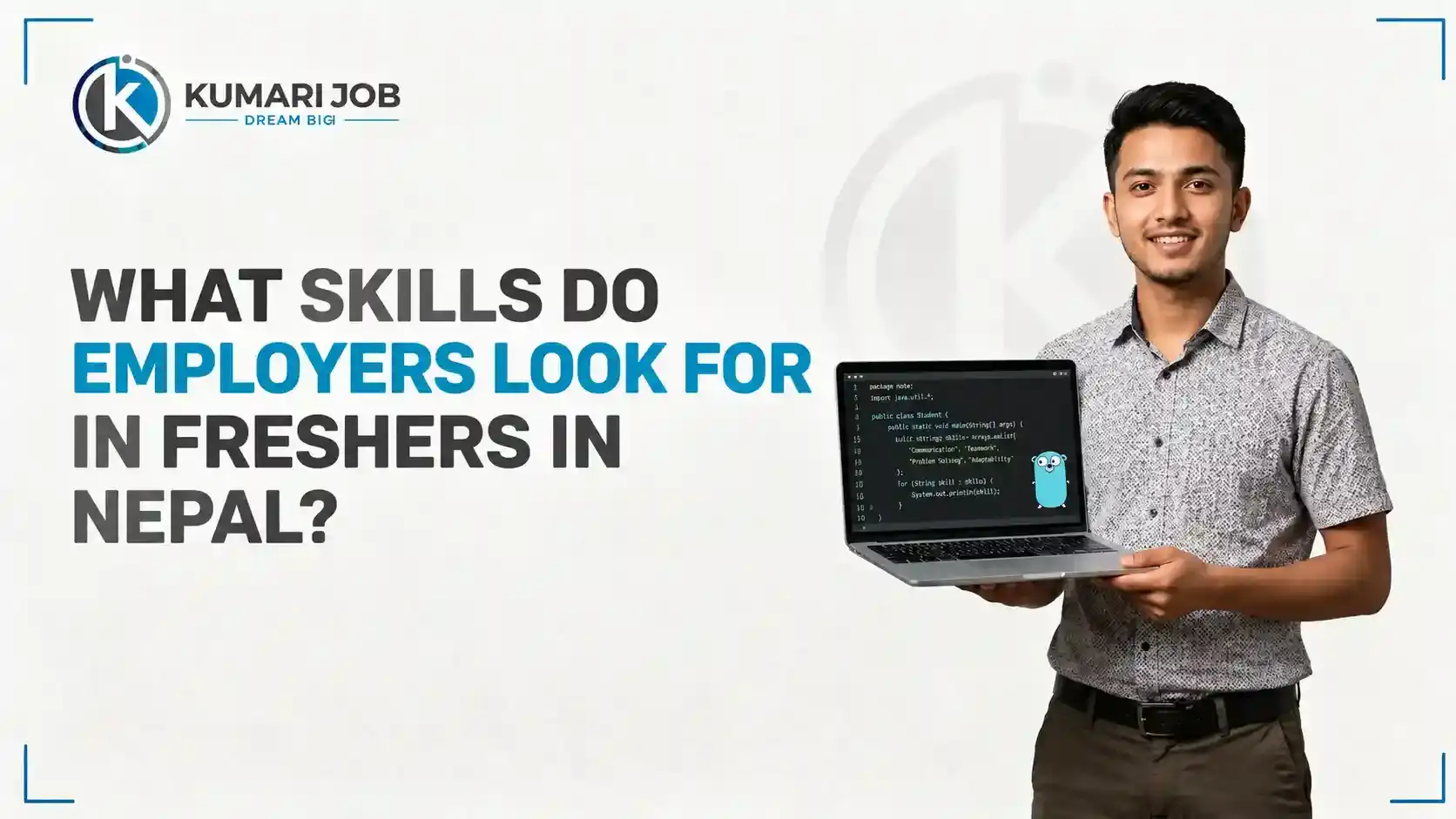

Starting the first job search can be difficult for freshers in Nepal, especially when many vacancies ask for experience even for entry-level roles. A degree or academic qualification provides a foundation, but employers also look for communication, technical knowledge, teamwork, problem-solving, and the ability to learn and work professionally.
The good news is that most job-ready skills can be developed with practice, training, internships, projects, and real workplace exposure. This guide explains the skills employers commonly look for in freshers in Nepal, how to develop them, and how to show those skills clearly on a CV and during an interview.
In this blog
What Skills Do Employers Look for in Freshers in Nepal?
Employers commonly look for communication, computer literacy, teamwork, problem-solving, adaptability, time management, professionalism, and job-specific technical skills in freshers. These skills help new employees complete daily tasks, communicate with colleagues, and adjust to workplace responsibilities. The exact skills vary by industry and position, so freshers should focus on skills that match the vacancy they want to pursue.
- Communication skills: Freshers should be able to communicate clearly through emails, messages, meetings, and conversations.
- Basic computer skills: Knowledge of Microsoft Office, Google Workspace, email, spreadsheets, and common digital tools is useful in many jobs.
- Teamwork: Employers need employees who can cooperate with colleagues and contribute to shared tasks.
- Problem-solving: Freshers should be able to understand a problem, consider possible solutions, and ask for help when necessary.
- Time management: Completing tasks within deadlines is important even for entry-level positions.
- Adaptability: New employees often need to learn unfamiliar systems, processes, and responsibilities.
- Critical thinking: Freshers should be able to understand information and make reasonable decisions instead of simply following instructions.
- Leadership and responsibility: Leadership does not always mean managing people; taking ownership of assigned work is also valuable.
- Professionalism and work ethics: Punctuality, honesty, reliability, respect, and a positive workplace attitude matter in almost every role.
- Job-specific technical skills: Employers may expect skills related to software, tools, processes, or knowledge required for a particular position.
Why Are Skills Important for Freshers in Nepal?
Skills are important because they show employers that freshers can apply their knowledge, learn workplace processes, and contribute to daily tasks. Academic qualifications demonstrate educational background, while practical and soft skills provide evidence of how a candidate may perform in a professional environment. For entry-level candidates with limited work experience, relevant skills, projects, internships, and training can help demonstrate job readiness.
Employers value skills because freshers often need to learn company-specific processes after joining.
Skills can help freshers:
- Perform routine workplace tasks with greater confidence.
- Communicate with managers, coworkers, customers, and clients.
- Work effectively as part of a team.
- Handle basic workplace problems independently.
- Learn new software and processes more easily.
- Meet deadlines and organize daily responsibilities.
- Adapt to changes in tasks or workplace procedures.
- Demonstrate potential for future career growth.
A fresher does not need to know everything before getting a first job. What matters is having a useful foundation and showing a willingness to learn the skills required for the position.
What Technical Skills Should Freshers Develop?
Freshers should develop basic digital skills and job-specific technical knowledge that directly match the requirements of their target career. Common examples include Microsoft Office, Google Workspace, spreadsheets, digital communication platforms, data handling, industry software, and AI productivity tools. Freshers should prioritize practical skills they can demonstrate through projects, assignments, internships, portfolios, or other examples.
Important technical skills include:
- Microsoft Word, Excel, and PowerPoint
- Google Docs, Sheets, and Slides
- Email and professional communication tools
- Basic spreadsheet and data management
- Online research and information handling
- Digital marketing fundamentals
- Industry-specific software
- Basic reporting and documentation
- AI-assisted productivity tools
- Job-specific technical knowledge
Learning every available tool is unnecessary for a fresher. The better approach is to identify the tools mentioned repeatedly in vacancies for the career field being targeted and learn those first.
1. IT and Technology Skills
Freshers targeting IT positions can benefit from programming, web development, database management, networking, cybersecurity, or software testing skills. The exact technical requirements depend on the role, so a web developer may need HTML, CSS, JavaScript, and frameworks while a database-focused position may require SQL and database concepts. Practical projects can provide stronger evidence of technical ability than simply listing programming languages on a CV. A fresher can create a small website, application, database project, or GitHub portfolio to demonstrate what they can actually build.
2. Marketing and Digital Marketing Skills
Marketing freshers can develop skills in SEO, social media, content creation, keyword research, analytics, email marketing, and basic advertising platforms. Understanding how to create content, analyze performance, and communicate with an audience can support entry-level marketing roles. A practical project such as optimizing a sample website, creating a content plan, or analyzing social media performance can make these skills easier to demonstrate. Freshers should also understand basic tools such as Google Search Console, Google Analytics, spreadsheet software, and commonly used content management systems where relevant.
3. Finance and Accounting Skills
Finance and accounting freshers can benefit from Excel, accounting software, financial reporting, data entry, bookkeeping, and basic knowledge of financial processes. Strong spreadsheet skills are particularly useful for organizing financial information, preparing calculations, and creating reports. Freshers can practice by creating sample budgets, expense reports, financial statements, or spreadsheet-based calculations. Familiarity with accounting software can also be useful when it appears as a requirement in vacancies for junior accounting or finance positions.
4. Administration, Sales, and Customer-Facing Skills
Administrative roles often require documentation, email communication, spreadsheets, scheduling, data entry, and general office software skills. Sales and customer service positions may additionally require CRM software, customer management, communication, follow up, and basic reporting skills. Freshers can practice these skills through simulated customer interactions, sample reports, spreadsheet exercises, or training projects. The most useful technical skills are usually those that directly support the daily responsibilities listed in the job description.
What Soft Skills Can Help Freshers Get a Job?
Soft skills help freshers communicate effectively, work with others, handle responsibilities, and respond to workplace challenges. Employers often look for these skills because technical knowledge alone does not cover teamwork, communication, reliability, or professional behavior. Freshers can demonstrate soft skills through examples from college projects, internships, volunteer work, training, part-time work, or group activities.
- Communication: Explain ideas clearly and listen carefully to instructions or feedback.
- Teamwork: Cooperate with colleagues and contribute to shared goals rather than focusing only on individual tasks.
- Problem-solving: Break a problem into smaller parts and identify practical next steps.
- Time management: Prioritize tasks and complete important work before deadlines.
- Adaptability: Stay open to new responsibilities, software, processes, and feedback.
- Critical thinking: Check information, compare options, and make decisions based on available evidence.
- Creativity: Suggest useful approaches when a task requires new ideas or better ways of working.
- Emotional awareness: Maintain respectful communication and respond appropriately to workplace situations.
- Leadership: Take responsibility for tasks, support team members, and show initiative when appropriate.
- Confidence: Communicate ideas and answer interview questions clearly without pretending to know something unfamiliar.
A strong fresher does not need to claim every soft skill on a CV. It is more effective to select a few relevant skills and support them with real examples.
How Can Freshers Improve Their Job Skills?
Freshers can improve job skills by identifying the requirements of their target roles, practicing relevant technical and soft skills, gaining practical experience, and using feedback to improve. Online courses, internships, projects, volunteer work, training programs, and interview practice can all help build job readiness. The most effective approach is to connect learning directly to the type of job the fresher wants to apply for.
- Identify the skills required for the target job: Review several vacancies for the same position and note the skills employers mention repeatedly.
- Take relevant practical training: Choose courses that include exercises, projects, assignments, or real-world applications rather than focusing only on theory.
- Work on personal or academic projects: Create projects that demonstrate the technical skills required for your target role.
- Complete internships and volunteer work: Practical exposure helps freshers understand workplace expectations and develop professional habits.
- Practice communication and interviews: Prepare answers, practice explaining your projects, and improve your ability to communicate clearly.
- Learn commonly used workplace software: Build practical ability with tools such as Excel, Google Workspace, communication platforms, CRM systems, or industry software.
- Build a professional CV and LinkedIn profile: Present relevant skills, projects, training, internships, and achievements in a clear format.
- Apply for entry-level jobs and learn from feedback: Each application and interview can help identify areas that need improvement.
- Keep updating skills: Job requirements change, so freshers should continue learning tools and knowledge relevant to their career field.
How Can Freshers Show Their Skills to Employers?
Freshers can show their skills by connecting each claimed ability with evidence from projects, internships, training, academic work, or other practical experiences. Instead of writing only “good communication skills” or “team player,” candidates should explain where and how they used those abilities. This gives employers a clearer picture of what the candidate can contribute.
1. Mention Relevant Skills Clearly on the CV
A CV should include skills that match the specific vacancy instead of presenting a long list of unrelated abilities. For example, a digital marketing fresher can mention SEO, keyword research, content optimization, analytics, and spreadsheet skills when those abilities match the job description. Technical skills should be specific enough for the employer to understand what the candidate knows. Soft skills can be supported through experience descriptions rather than appearing only as a keyword list.
2. Use Projects to Demonstrate Technical Ability
Projects give freshers a practical way to prove that they can apply what they have learned. A marketing candidate could show a sample SEO audit, while an IT candidate could present a website or programming project. Finance candidates can use sample financial reports or spreadsheet projects to demonstrate their abilities. Where appropriate, candidates can include portfolio links or project details on their CV.
3. Give Specific Examples During Interviews
Interview answers become stronger when candidates explain a real situation, the action they took, and the result. Instead of saying “I am good at teamwork,” a candidate can describe how they divided responsibilities during a college project and helped the team complete the work on time. This approach provides evidence rather than making a general claim. Freshers can use examples from education, internships, volunteer work, training, or personal projects when they do not have formal work experience.
4. Highlight Practical Experience
Internships, volunteer activities, freelance assignments, academic projects, and training can demonstrate skills even when a candidate has not held a full-time position. The experience section should explain the actual tasks completed rather than simply naming the organization or program. For example, prepared weekly Excel reports” gives more information than “completed an internship.Practical details help employers understand what the fresher has already practiced.
Common Skill Gaps Freshers Should Avoid
Freshers can improve their employability by identifying common skill gaps before applying for jobs. Many of these gaps are not related to academic performance but involve practical preparation, communication, digital skills, and understanding workplace expectations.
- Relying only on academic qualifications: A degree can establish educational background, but employers may also expect practical and workplace skills.
- Poor communication: Difficulty explaining ideas or responding clearly can affect both interviews and workplace performance.
- Lack of practical experience: Projects, internships, and training can help bridge the gap between academic learning and workplace tasks.
- Weak computer skills: Basic office software and digital communication are useful across many entry-level roles.
- Poor time management: Missing deadlines or failing to prioritize tasks can create problems in professional environments.
- Not researching the company: Candidates should understand the organization, role, and basic responsibilities before attending an interview.
- Listing skills without evidence: A CV becomes more convincing when skills connect to specific projects or achievements.
- Being unwilling to learn new tools: Entry-level employees often need to learn company-specific software and processes.
- Poor workplace etiquette: Punctuality, respectful communication, appropriate behavior, and professional presentation can affect how employers perceive a candidate.
How Can Freshers Become More Job-Ready?
Freshers become more job-ready by combining relevant technical skills, workplace skills, practical experience, and a clear understanding of their target career. Job readiness is not achieved by collecting certificates alone; candidates need to practice what they learn and demonstrate that knowledge through useful work. A focused approach can make the transition from education to employment easier.
- Choose a specific career direction: Decide whether you want to target areas such as IT, marketing, finance, administration, sales, customer service, or another field.
- Research relevant vacancies: Review current job descriptions to identify the qualifications, tools, and skills employers commonly request.
- Build technical and soft skills together: Technical ability helps with job tasks while communication, teamwork, and adaptability support workplace performance.
- Gain practical experience: Use internships, projects, volunteer work, freelance assignments, or training to apply your knowledge.
- Create a strong CV and portfolio: Present only relevant skills and support important claims with evidence.
- Practice interviews: Prepare for common questions and practice explaining your education, projects, skills, and career goals.
- Track job opportunities: Regularly review vacancies to understand changing employer requirements and identify suitable entry-level positions.
- Continue learning after getting a job: The first job is another learning stage, and developing new skills can support future career growth.
Conclusion
The biggest advantage a fresher can build is not simply having more certificates, but being able to show useful skills through real examples. A candidate who understands the target role, develops relevant technical knowledge, communicates clearly, and demonstrates practical experience can present a much stronger profile than someone who only lists academic qualifications.
Start by identifying the skills employers request for your target position, choose one or two areas to improve, and turn that learning into a project, portfolio item, internship experience, or measurable achievement. For freshers looking for relevant entry-level vacancies and career opportunities in Nepal, explore the latest job opportunities on KumariJob.
Frequently Asked Questions
Submit your comments

Get Our App On


How to Handle Your First Mistake at Work: A Step-by-Step Recovery Guide
VIEW DETAILS
Dashain Bonus in Nepal: Festival Allowance Rules, Calculation & Legal Rights (2026 Guide)
VIEW DETAILS
How to Become a Public Health Officer in Nepal?
VIEW DETAILS.webp)
What Is the Document Controller Salary in Nepal?
VIEW DETAILS


Loading Comments...