


Sociology is the study of society, human behaviour, social relationships, and cultural patterns. In Nepal, the importance of sociology is growing because the country is facing rapid social, economic, and cultural changes. Sociology helps people understand social issues such as poverty, education, unemployment, gender inequality, migration, and community development. As Nepal continues to develop, the demand for sociology graduates in research, NGOs, government organisations, and educational institutions is also increasing.
The scope of sociology in Nepal is becoming broader due to the rising need for social research and development work. Sociologists play an important role in analysing social problems, creating public awareness, and supporting policy-making processes. Many students are now choosing sociology as a career because it offers opportunities in social work, teaching, research, development projects, and international organisations. With growing focus on community development and social welfare, sociology has become an important academic and professional field in Nepal.
In this blog
What Is the Scope of Sociology in Nepal?
The scope of sociology in Nepal is broad and growing because the country needs professionals who can study social behaviour, community problems, and development issues. Sociology is mainly used in social research, policy-making, education, NGOs, INGOs, and government programs that focus on improving society.
In Nepal, sociologists have strong opportunities in urban and rural development projects, where they help understand issues like poverty, migration, education gaps, and inequality. Their role is important in designing effective social programs, solving real-world social problems, and supporting sustainable development across communities.
Why Sociology Is Important in Nepalese Society?
Sociology is important in Nepalese society because it helps people understand how society works, including social structures, culture, traditions, and human behaviour. It provides deep insight into social problems and helps identify the root causes of issues like inequality, poverty, and discrimination.
Sociology also contributes to social change and policy-making by guiding governments and organisations in creating better development plans. It plays a key role in community development and social awareness programs by educating people, improving decision-making, and supporting efforts to build a more equal and informed society.
Scope of Sociology in Nepal After +2
After completing +2 in Nepal, students can pursue a Bachelor’s degree in Sociology, which is one of the most popular choices for those interested in social science, development work, and human behaviour studies. This course builds a strong foundation in understanding society, culture, and social problems, making it suitable for careers in NGOs, research, teaching, and public service.
In Nepal, several colleges and universities offer sociology programs under humanities and social science faculties. Through this study, students gain important skills such as research ability, critical thinking, communication, and data analysis. After completing a bachelor’s degree, students can also go for higher studies in sociology, social work, anthropology, or development studies in Nepal and abroad for better career opportunities.
Career Opportunities in Sociology in Nepal
Sociology in Nepal offers a wide range of career opportunities in both public and private sectors because it focuses on understanding society, human behaviour, and development issues. A sociology graduate can work in NGOs, government offices, schools, research institutions, and international organisations, depending on their skills and specialisation. One real-world example is a sociology graduate working in a community development project in rural Nepal, where they helped identify education gaps and improved school enrollment programs through field research and local engagement.
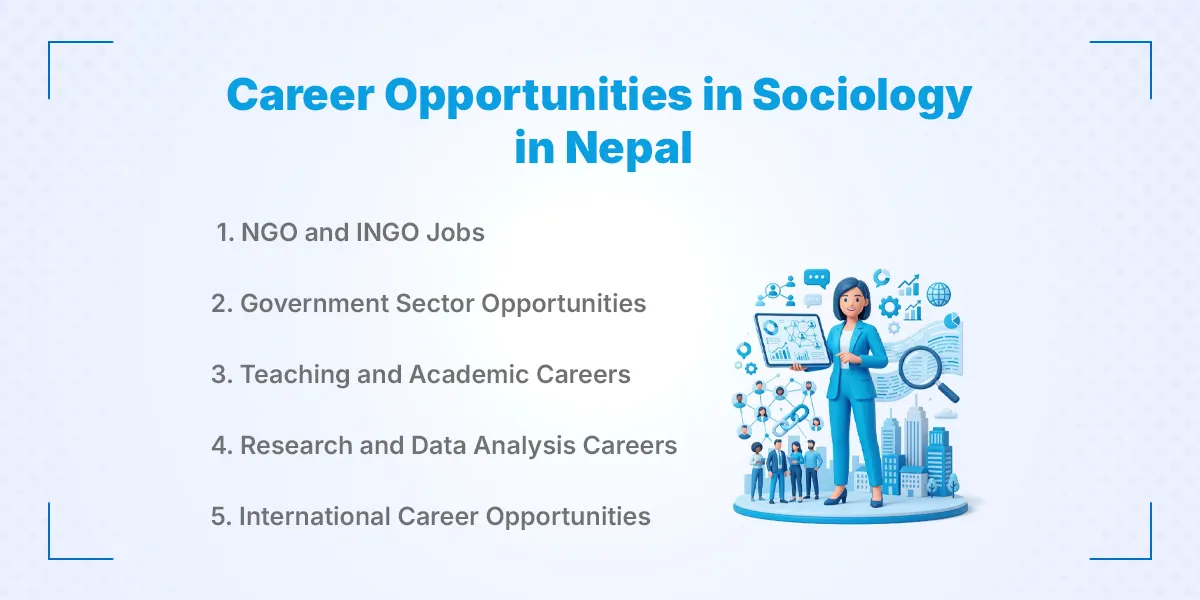
1. NGO and INGO Jobs
NGO and INGO jobs in sociology refer to roles in non-governmental and international organisations where professionals work on social development, research, and community support programs. These jobs are one of the most common career paths for sociology graduates in Nepal because development work is highly active. In NGOs and INGOs, sociology students help in planning and implementing community-based projects. They also work directly with local people to understand social problems like poverty, education gaps, and health issues. Common roles include community development officer, social mobilizer, program coordinator, and research assistant. These jobs require fieldwork, communication skills, and a strong understanding of society.
2. Government Sector Opportunities
Government sector opportunities in sociology involve working in public offices and national programs that focus on social welfare and development. Sociology graduates are needed in local governments, planning departments, and social welfare offices in Nepal. They help in designing and implementing policies that improve education, health, and community development. These roles also include working on population studies, social reports, and development plans. Public service jobs offer stability and the chance to contribute to national development. Sociology knowledge is useful in understanding real social issues at the policy level.
3. Teaching and Academic Careers
Teaching and academic careers in sociology involve educating students and conducting research in colleges and universities. Sociology graduates can become lecturers, professors, or academic researchers after higher studies. This field focuses on explaining social theories, human behaviour, and research methods to students. Teachers also guide students in understanding real social problems through academic learning. Academic careers require strong knowledge, communication skills, and advanced degrees. This path is suitable for those interested in education and research.
4. Research and Data Analysis Careers
Research and data analysis careers in sociology focus on studying social issues through surveys, fieldwork, and statistical analysis. Sociology graduates work in research organisations, think tanks, and development agencies. They collect data from communities to understand problems like migration, unemployment, and inequality. This information is used to create reports and support policy decisions. These jobs require analytical thinking, report writing, and attention to detail. It is a strong career path for those interested in data and social research.
5. International Career Opportunities
International career opportunities in sociology include working with global organisations that focus on social development and humanitarian work. Sociology graduates from Nepal can work with UN agencies, international NGOs, and foreign development projects. These roles involve global research, policy analysis, and community development programs. Some students also get foreign scholarships to study advanced sociology or related fields abroad. International jobs require strong communication skills and often advanced qualifications. This career path offers high exposure and better professional growth opportunities.
Scope of Sociology in Nepal in the NGO and Development Sector
The scope of sociology in Nepal’s NGO and development sector is very strong because most social programs depend on understanding communities, behaviour, and real-life social problems. Sociology graduates are widely used in this field to design, manage, and evaluate development projects. In Nepal, NGOs and INGOs often hire sociologists to work with rural communities to study needs, collect data, and support improvement programs in education, health, and livelihood sectors.
1. Demand for sociologists in NGOs and INGOs
Demand for sociologists in NGOs and INGOs refers to the growing need for professionals who can analyse social issues and support development work. In Nepal, many national and international organisations focus on poverty reduction, education, health, and human rights. Sociology graduates are preferred because they understand social structures and community behaviour. They help in project planning, fieldwork, and impact evaluation. This demand is increasing as development projects expand across the country.
2. Community-based project involvement
Community-based project involvement means directly working with local people to identify their problems and support development solutions. Sociology graduates play an important role in field surveys, interviews, and social research activities. They collect real data from communities to understand issues like unemployment, poor education, and health challenges. Based on this data, NGOs design better programs. This work requires strong communication and field experience.
3. Disaster management and social support programs
Disaster management and social support programs involve helping communities before, during, and after natural disasters. In Nepal, sociology professionals contribute during earthquakes, floods, and other emergencies. They assess affected populations and help distribute relief materials. They also support rehabilitation and mental health awareness programs. Their role is important in building strong and prepared communities.
4. Women empowerment and youth development projects
Women'sn empowerment and youth development projects focus on improving opportunities and equality for women and young people. Sociology graduates help organise awareness campaigns, training programs, and skill development activities. They work on issues like gender inequality, unemployment, and social exclusion. These projects aim to create a fair and inclusive society. Sociology helps in understanding and solving these social challenges.
Skills Needed for a Successful Sociology Career
A successful sociology career in Nepal requires a strong mix of academic knowledge and practical skills. Sociology is not only about studying society in theory but also about working with people, collecting data, and solving real social problems. Graduates who develop the right skills can easily find opportunities in NGOs, government offices, research organisations, and international agencies. For example, many sociology professionals in Nepal use field research and communication skills to understand rural community problems and design effective development programs.
1. Communication and interpersonal skills
Communication and interpersonal skills in sociology refer to the ability to interact effectively with individuals and communities. Sociology graduates often work directly with people in field research and development projects. They must ask questions clearly, listen carefully, and build trust with respondents. Strong communication helps in understanding real social issues. Interpersonal skills are also important for teamwork and collaboration in professional settings.
2. Research and analytical thinking
Research and analytical thinking mean the ability to collect, study, and interpret social data in a logical way. Sociology professionals use research methods like surveys, interviews, and observations. They analyse data to understand social problems such as poverty, education gaps, and inequality. Analytical thinking helps in identifying patterns and drawing meaningful conclusions. This skill is essential for policy-making and development work.
3. Report writing and presentation skills
Report writing and presentation skills refer to the ability to clearly document findings and share information with others. Sociology graduates often prepare research reports, project documents, and field study summaries. These reports are used by NGOs, INGOs, and government agencies for decision-making. Good writing skills make complex information easy to understand. Presentation skills help in explaining findings during meetings and workshops.
4. Leadership and teamwork abilities
Leadership and teamwork abilities in sociology involve working effectively in groups and guiding projects when needed. Many sociology jobs require collaboration with colleagues, field workers, and community members. Leadership skills help in managing small teams and organising development activities. Teamwork ensures that tasks are completed efficiently. These abilities are highly valued in the NGO and development sectors.
5. Problem-solving and critical thinking
Problem-solving and critical thinking mean the ability to understand social issues deeply and find practical solutions. Sociology graduates often deal with complex problems like inequality, unemployment, and social discrimination. Critical thinking helps them evaluate situations from different perspectives. Problem-solving skills allow them to suggest effective development strategies. These skills are essential for making a real impact in society.
Salary and Job Outlook for Sociology Graduates in Nepal
The salary and job outlook for sociology graduates in Nepal depend on experience, skills, sector, and type of organisation. Sociology is mainly linked with NGOs, INGOs, government offices, and research institutions, so income varies widely across these fields. With growing development projects and social research demand in Nepal, job opportunities for sociology graduates are gradually increasing, especially in urban centres and development-focused organisations.
1. Entry-level sociology salary in Nepal
Entry-level sociology salary in Nepal refers to the starting income earned by fresh graduates entering the job market. In Nepal, beginners in sociology usually start with modest salaries in NGOs, research projects, or private organisations. The average entry-level salary typically ranges from NPR 15,000 to NPR 30,000 per month, depending on the organisation. Fresh graduates often begin as interns, research assistants, or social mobilizers. At this stage, gaining experience is more important than high income.
2. Salary based on experience and sector
Salary based on experience and sector means income increases as professionals gain skills, knowledge, and work experience. In sociology, experienced professionals can earn significantly higher salaries, especially in INGOs and international projects. Mid-level professionals may earn NPR 40,000 to NPR 80,000 per month, while senior experts can earn even more. Government jobs may offer stable income with benefits, while NGOs often provide performance-based pay. Experience in fieldwork and research increases earning potential.
3. NGO vs government salary comparison
NGO vs government salary comparison highlights the difference in pay structure between development organisations and public sector jobs. NGOs and INGOs often provide higher salaries, flexible roles, and performance incentives. Government jobs, on the other hand, offer stable income, pensions, and long-term job security. Sociology graduates in NGOs may earn more initially, but government roles provide better stability over time. The choice depends on career goals and job preferences.
4. Future job growth and employment trends
Future job growth and employment trends for sociology in Nepal show increasing opportunities due to rising social development needs. More NGOs, INGOs, and government programs are focusing on education, health, gender equality, and rural development. This increases demand for sociology professionals in research and project management roles. Digital data analysis and social research fields are also expanding. Overall, the future job outlook for sociology graduates in Nepal is positive and steadily growing.
Challenges and Limitations of Studying Sociology in Nepal
The study of sociology in Nepal offers many opportunities, but it also comes with several challenges that students must understand before choosing this field. While demand is growing in NGOs, INGOs, and research sectors, competition and lack of awareness still affect career growth. Sociology graduates often need to build strong practical skills and networks to succeed in the job market.
1. Limited awareness about sociology careers
Limited awareness about sociology careers means many students and parents do not clearly understand job opportunities in this field. In Nepal, sociology is often seen as a general humanities subject rather than a professional career path. Because of this, students may hesitate to choose it after +2. Many people are unaware of its role in NGOs, research, and policy-making. This lack of awareness reduces early career interest and guidance.
2. Competitive job market
A competitive job market means there are more graduates than available suitable jobs in sociology-related fields. In Nepal, many students graduate in social sciences each year, but job openings remain limited in some sectors. NGOs and INGOs often select candidates with strong experience and skills. This makes it difficult for fresh graduates to get immediate employment. Competition is especially high in urban areas like Kathmandu.
3. Need for practical experience and networking
The need for practical experience and networking refers to the importance of fieldwork experience and professional connections for career success. Sociology is a practical subject, and employers prefer candidates who have real field experience. Internships, volunteer work, and research projects are often required. Networking with NGOs, researchers, and professionals helps in finding job opportunities. Without experience and connections, it becomes harder to enter the job market.
4. Higher education and specialisation requirements
Higher education and specialisation requirements mean that advanced qualifications are often needed for better career opportunities in sociology. A bachelor’s degree alone may not be enough for high-level jobs in research or international organisations. Many positions require a master’s degree or specialised training in areas like development studies or social research. Further education increases knowledge, skills, and job prospects. This can be a challenge for students who cannot continue higher studies easily.
How to Build a Successful Career in Sociology in Nepal?
Building a successful career in sociology in Nepal requires a mix of education, practical experience, and professional networking. Sociology is a field where real-world exposure matters as much as academic knowledge, especially in NGOs, INGOs, research organisations, and government projects. Students who actively develop their skills and gain field experience early are more likely to secure better job opportunities in this competitive sector.
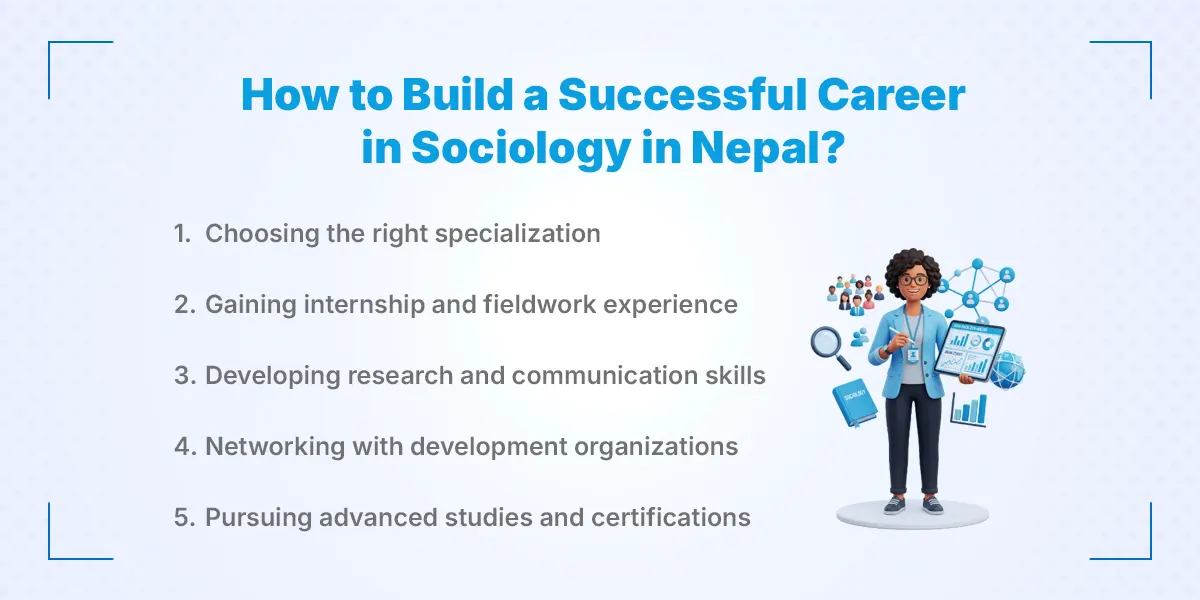
1. Choosing the right specialisation
Choosing the right specialisation in sociology means selecting a focused area of study that matches your career goals and interests. In Nepal, students can specialise in areas like rural development, gender studies, social work, or population studies. This helps build deeper knowledge and improves job opportunities in specific sectors. For example, a student interested in NGOs may focus on community development. A clear specialisation makes your profile more attractive to employers.
2. Gaining internship and fieldwork experience
Gaining internship and fieldwork experience refers to working in real social settings to understand how development projects operate. In sociology, practical exposure is very important because most jobs involve direct interaction with communities. Internships in NGOs or research organisations help students learn survey methods, data collection, and reporting. Fieldwork also improves communication and problem-solving skills. Employers in Nepal often prefer candidates with hands-on experience.
3. Developing research and communication skills
Developing research and communication skills means improving your ability to collect data, analyse information, and interact effectively with people. Sociology professionals often conduct surveys, interviews, and community studies. Strong communication helps in building trust with respondents. Research skills help in understanding social issues deeply. These skills are essential for jobs in NGOs, INGOs, and policy research organisations.
4. Networking with development organisations
Networking with development organisations refers to building professional relationships with NGOs, INGOs, and social research groups. In Nepal, many job opportunities are not widely advertised and are filled through connections. Attending workshops, seminars, and volunteering programs helps in meeting professionals in the field. Networking increases the chances of getting internships and jobs. It also helps in learning about current trends in development work.
5. Pursuing advanced studies and certifications
Pursuing advanced studies and certifications means continuing education after a bachelor’s degree to improve knowledge and career prospects. In sociology, a master’s degree or specialisation in social work or development studies can open better job opportunities. Advanced studies are often required for research, teaching, and international jobs. Short-term certifications in data analysis or project management also add value. Higher education improves both salary and career growth.
Best Fields and Specialisations Related to Sociology
The best fields and specialisations related to sociology in Nepal focus on understanding society, human behaviour, and development issues in a more detailed way. Choosing the right specialisation helps students build strong career opportunities in NGOs, INGOs, research organisations, and government sectors. Sociology also connects with several interdisciplinary fields that improve employability and professional growth.
1. Social work
Social work is a specialisation that focuses on helping individuals, families, and communities solve social problems and improve their quality of life. In Nepal, social work is closely linked with NGOs and community development programs. Professionals in this field work on issues like poverty, education, health, and child welfare. It involves direct interaction with people and field-based activities. Social work is one of the most practical and job-oriented areas related to sociology.
2. Anthropology
Anthropology is the study of human cultures, traditions, and social evolution across different societies. In Nepal, anthropology is important because of the country’s cultural diversity and ethnic communities. It helps researchers understand cultural practices, beliefs, and social systems. Anthropology professionals often work in research institutions, museums, and development projects. This field is useful for careers in cultural research and social analysis.
3. Rural development
Rural development is a specialisation that focuses on improving living standards in rural communities through social and economic development programs. In Nepal, most development work is centred in rural areas, making this field highly important. Professionals work on agriculture, education, infrastructure, and livelihood improvement. NGOs and government programs often hire rural development experts. It plays a key role in reducing poverty and inequality.
4. Gender studies
Gender studies is a field that examines gender roles, equality, and social issues affecting men, women, and other gender identities. In Nepal, this specialisation is important due to ongoing efforts to promote gender equality and women's empowerment. Professionals work on awareness programs, policy development, and advocacy campaigns. NGOs and INGOs actively hire gender specialists. It helps address social discrimination and promote equal opportunities.
5. Population studies
Population studies focus on analysing population trends such as birth rate, death rate, migration, and demographic changes. In Nepal, this field is important for planning national development policies and programs. Professionals work with government agencies and research organisations. They help in understanding population growth and its impact on resources. This field is useful for policy-making and statistical analysis.
6. Public policy and governance
Public policy and governance is a specialisation that focuses on how governments design and implement laws, policies, and development programs. In Nepal, this field is closely connected with sociology because it studies social issues and governance systems. Professionals work in policy research, administrative roles, and development planning. It helps improve public services and social welfare programs. This specialisation offers strong career opportunities in government and international organisations.
Future Scope of Sociology in Nepal
The future scope of sociology in Nepal is expanding as the country continues to develop socially, economically, and culturally. Sociology plays an important role in understanding social change, development challenges, and human behaviour, which makes it highly relevant for future job markets in Nepal and abroad. With increasing focus on data-driven policies and community development, sociology graduates are expected to have better opportunities in the coming years.
1. Growing demand in development sectors
Growing demand in development sectors means more job opportunities are being created in NGOs, INGOs, and government development programs. In Nepal, development projects focus on poverty reduction, education, health, and rural improvement. Sociology graduates are needed to study communities and support project planning. As development activities expand, the need for sociologists is also increasing. This creates stable long-term career opportunities.
2. Expansion of social research projects
Expansion of social research projects refers to the increasing number of studies conducted to understand social issues and improve policies. In Nepal, research organisations and universities are actively involved in studying migration, unemployment, gender equality, and education. Sociology professionals play a key role in collecting and analysing data. These findings help in making better government and organisational decisions. This trend is expected to grow further in the future.
3. Increasing focus on mental health and social welfare
Increasing focus on mental health and social welfare means more attention is being given to emotional well-being and social support systems. In Nepal, awareness about mental health is growing, especially among youth and rural communities. Sociology graduates contribute by studying social causes of mental health issues and supporting awareness programs. They also work in welfare projects that support vulnerable groups. This creates new career opportunities in social services.
4. Digital sociology and modern social studies
Digital sociology and modern social studies involve studying how technology and digital platforms influence society and human behaviour. In Nepal, the use of social media and digital communication is increasing rapidly. Sociology professionals analyse online behaviour, digital communities, and social trends. This helps organisations understand modern social changes. It is a new and emerging field with strong future potential.
5. Career growth in international organisations
Career growth in international organisations refers to job opportunities in global agencies that work on development and humanitarian programs. Sociology graduates from Nepal can work with UN agencies, international NGOs, and foreign research institutions. These organisations focus on global issues like poverty, climate change, and human rights. Strong skills and higher education increase the chances of international careers. This offers a better salary and global exposure.
Sociology vs Social Work in Nepal
Sociology and social work are closely related fields, but they have different goals, methods, and career paths in Nepal. Sociology focuses more on studying society, social behaviour, and research, while social work is more practical and involves directly helping individuals and communities solve problems. Both fields are important in Nepal’s development sector, especially in NGOs, INGOs, and government social programs.
1. Key differences between sociology and social work
Key differences between sociology and social work refer to the variation in purpose, approach, and job roles of both fields. Sociology mainly studies society, human behaviour, and social systems through research and analysis. It focuses on understanding social problems rather than directly solving them. Social work, on the other hand, is action-oriented and focuses on helping people in real-life situations such as poverty, abuse, or unemployment. Sociology is more theoretical, while social work is more practical and service-based.
2. Career opportunities comparison
Career opportunities comparison means analysing the job options available in sociology and social work in Nepal. Sociology graduates usually work in research organisations, NGOs, INGOs, government planning units, and academic institutions. Social work graduates often work in hospitals, community organisations, child welfare agencies, and rehabilitation centres. Both fields offer NGO jobs, but social work has more direct field-based roles. Sociology offers broader research and policy-related opportunities.
3. Salary and job demand comparison
Salary and job demand comparison refers to differences in income levels and employment opportunities between the two fields. In Nepal, both sociology and social work graduates often start with similar entry-level salaries in NGOs and development projects. However, experienced professionals in NGOs and INGOs may earn higher salaries depending on skills and roles. Job demand for both fields is increasing due to rising social development projects. Social work may have slightly more field-based job openings, while sociology has more research-based demand.
4. Which field is better for students in Nepal
Which field is better for students in Nepal depends on career goals, interests, and working style preferences. If a student is interested in research, analysis, and policy-making, sociology is a better choice. If a student prefers direct community service and helping people, social work is more suitable. Both fields offer good opportunities in Nepal’s development sector. The best choice depends on whether the student prefers theoretical or practical work.
Conclusion
The scope of sociology in Nepal is expanding as the country continues to grow in areas like education, health, governance, and social development. Sociology graduates can find career opportunities in NGOs, INGOs, government offices, research organisations, and academic institutions. The field helps students understand real social problems and prepares them for meaningful roles in society.
Sociology plays an important role in national development by helping policymakers and organisations understand community needs and design better programs. With increasing focus on social research, mental health, gender equality, and rural development, future opportunities for sociology graduates in Nepal are expected to grow further. Students who build strong skills in research, communication, and fieldwork can create a successful and impactful career in this field.
Ready to launch your career? Find the latest sociology and development jobs in Nepal on Kumari Job.
Frequently Asked Questions
Submit your comments

Get Our App On



How to Make a Police Report (Police Clearance Certificate) in Nepal?
VIEW DETAILS
Types of SEO and How They Work: Complete Beginner's Guide
VIEW DETAILS
Government Restricts New Lok Sewa Vacancy Requests 2083/84 — Or Not?
VIEW DETAILS
How to Apply for Tattoo Artist Jobs in Nepal?
VIEW DETAILS


Loading Comments...