



A bank job is still one of Nepal’s most chased career opportunities. And the competition tells you why. A Nepal Rastra Bank study found that its assistant-level vacancies attracted 1,479 applicants for every available seat in FY 2020/21. Officer-level positions also drew nearly 119 applicants per seat.
Now imagine competing for a job that offers good pay, benefits, stability, and a clear career path. It is no surprise that thousands of Nepali graduates keep their eyes on banking vacancies.
But getting the job is only one part of the story. Choosing the right bank can also shape how much you earn and how far your career can go.
So, which banks should you watch? This guide covers 10 commercial banks in Nepal with strong pay potential and career opportunities, along with high-paying banking positions and practical ways to prepare for them.
In this blog
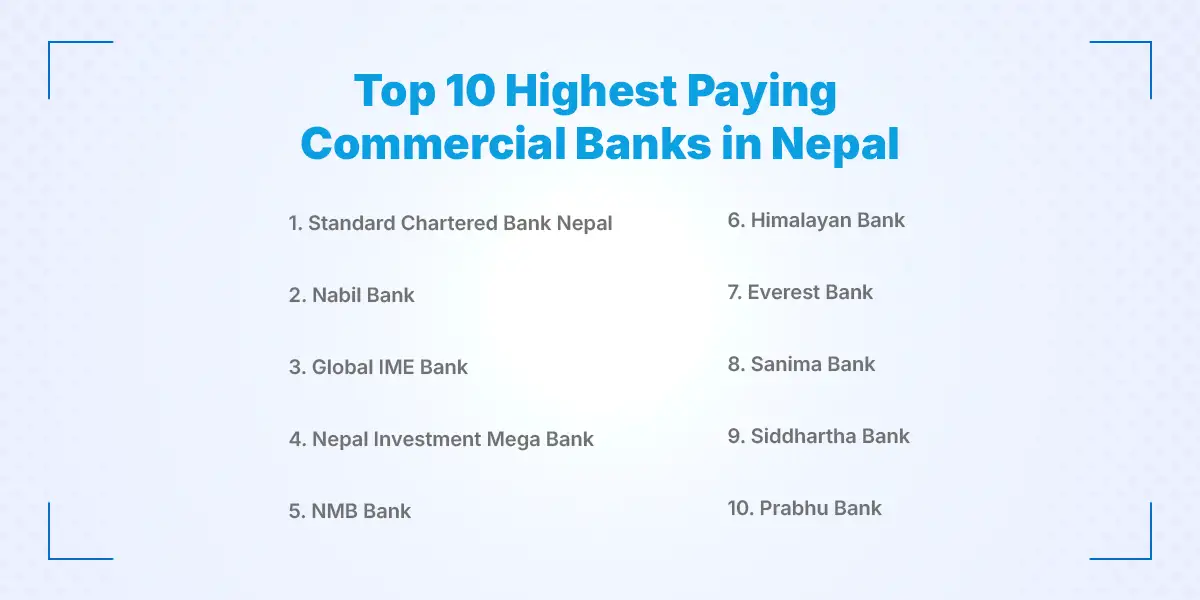
Top 10 Highest Paying Commercial Banks in Nepal
Banks such as Standard Chartered, Nabil, Global IME, NIMB, and NMB are renowned for strong pay potential and career opportunities. Himalayan bank, Everest, Sanima, Siddhartha, and Prabhu Bank also offer competitive pay, training, and room to grow. So, if you want a healthy bank balance and a strong professional career, these are the banks worth exploring.
1. Standard Chartered Bank Nepal
Standard Chartered has a different pay model from most local banks. For starters, its global system considers market rates, skills, experience, role, and performance when reviewing pay. Employees also receive benefits such as medical, insurance, and retirement support.
But the bigger draw is global exposure. Here, you receive professional exposure to build skills in corporate banking, digital banking, data, cyber, risk, and other specialist areas.
2. Nabil Bank
Nabil has one of the strongest private banking brands in Nepal. At the same time, its business covers retail, corporate, SME, investment, and digital banking, giving employees several paths to move forward. The bank also generously invests into employee development. In fact, its disclosures cover training and capacity-building programs. Such workforce development programs are also promoted by NRB rules that require commercial banks to invest in staff training and development.
3. Global IME Bank
Global IME's biggest strength is its size. Because of this, its large network gives employees exposure to different customers, branches, products, and banking needs. That matters when you want to move into better roles. Over time, experience in credit, corporate banking, relationship management, or operations can help you handle larger portfolios and take on more responsibility.
4. Nepal Investment Mega Bank
NIMB offers wide exposure across retail banking, corporate banking, lending, trade finance, and digital services. As a result, professionals gain several areas of experience for an overall professional and personal growth. For higher career growth, credit and corporate banking are worth considering. These roles, in particular, teach you financial analysis, lending, borrower assessment, and client management.
5. NMB Bank
NMB stands out for its focus on employee training. For example, its FY 2023/24 annual report recorded NPR 2.27 billion in staff expenses, excluding bonuses, along with 201 branches and 187 ATMs. Its training programs also cover credit, digital banking, IT, security, communication, and leadership. That makes NMB attractive if you want your skills and responsibilities to grow together.
6. Himalayan Bank
Himalayan Bank brings years of banking experience and an established market presence. Because of that, its operations give professionals opportunities in corporate banking, credit, trade finance, retail banking, and branch management. Moreover, a job that gives you lending, client, or business experience can create a stronger path to senior positions.
7. Everest Bank
Everest Bank offers opportunities across branch banking, lending, customer service, and corporate banking. More importantly, its established operations can help employees gain practical experience in different parts of commercial banking.
If you are applying for a job at Everest Bank, look closely at the responsibilities. For example, roles involving credit, customers, and business can prepare you better for officer and management positions than routine work.
8. Sanima Bank
Sanima Bank has built a strong presence in Nepal's private banking sector. Today, its career opportunities cover areas such as retail banking, corporate banking, credit, risk, operations, and digital banking. Don't rely on old salary figures when comparing the bank. Instead, check recent vacancies and reports. They can show which teams are hiring and which skills are currently in demand.
9. Siddhartha Bank
Siddhartha Bank places clear focus on employee training and career development. In particular, its HR disclosures highlight areas such as training, job rotation, and employee growth. That can help you build experience across different banking functions. So, if you want long-term growth, look for roles where you can learn new skills and take on bigger responsibilities.
10. Prabhu Bank
Prabhu Bank's wide banking network gives employees plenty of scope to gain hands-on experience. Its operations cover branch banking, lending, customer service, and relationship management. For fresh candidates, this practical exposure can be valuable. In the long run, roles involving credit, customers, and business development can help you build skills for better positions later.
Note: There is no official ranking of banks by average employee salary in Nepal. So, instead, this list looks at pay potential, staff investment, training, bank size, and career opportunities to highlight banks worth watching.
How to Find the Best Bank Jobs in Nepal?
The best bank jobs in Nepal are usually found through official bank career pages, job portals, vacancy notices, and professional networks. But finding a good vacancy is only half the job; you also need to check the role, pay, benefits, requirements, and growth path before applying. Here are the most useful ways to do it.
1. Check Bank Career Pages Regularly
Banks often post vacancies on their own websites before they appear elsewhere. Make a list of the banks you want to join and check their career pages every few days. This can help you spot new openings early.
2. Use Reputed Job Portals
Job portals let you check vacancies from several banks in one place. Create a complete profile, upload your latest CV, and check new listings regularly. Kumari Job is one option for finding banking vacancies along with jobs from other employers in Nepal.
3. Follow Official Vacancy Announcements
Always read the official vacancy notice before applying. Check the required degree, experience, age limit, documents, exam process, and deadline. These details can differ even between similar positions at different banks.
4. Build a Banking Network
Connect with bankers, recruiters, and other finance professionals on LinkedIn. Follow banking groups and attend career events or training programs. These connections can help you learn about hiring trends, useful skills, and career opportunities.
5. Compare the Job, Not Just the Pay
A high starting salary can look tempting, but don't stop there. Compare the benefits, workload, location, training, promotion path, and role responsibilities. A slightly lower-paying job may give you better skills and faster growth in the long run.
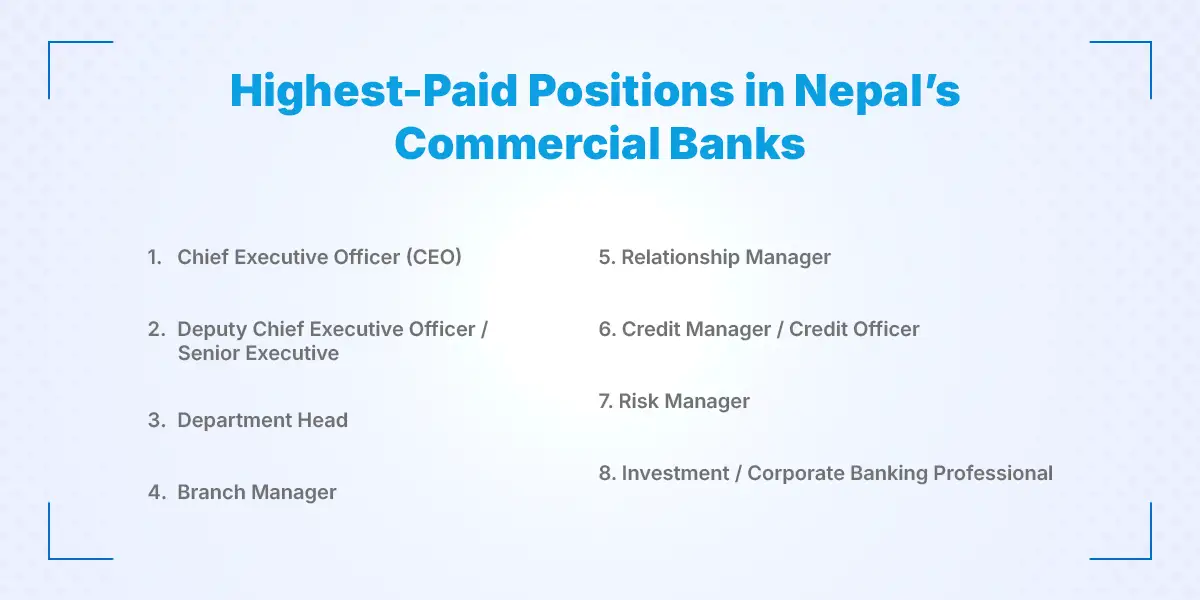
Highest-Paid Positions in Nepal’s Commercial Banks
The highest-paid banking positions in Nepal are usually senior leadership and specialist roles. CEO, department head, branch manager, credit, risk, and corporate banking roles can offer much higher earning potential as experience and responsibility increase.
1. Chief Executive Officer (CEO)
A bank CEO leads the entire institution. They make major decisions on business growth, risk, finance, and operations. Bank CEO salaries can reach very high levels, but the role also requires years of banking experience, strong leadership, and deep financial knowledge.
2. Deputy Chief Executive Officer / Senior Executive
A Deputy CEO or senior executive works closely with the top management team. They help manage major business areas and make key decisions. These roles usually come after years of experience across banking, finance, operations, or business management.
3. Department Head
Department heads lead important areas such as credit, finance, HR, risk, compliance, or IT. Their pay reflects the size of the team and the level of responsibility. Professionals with deep expertise can move into these roles after building strong experience in their field.
4. Branch Manager
Working as a branch manager means taking responsibility for almost everything happening at a bank branch. This includes customers, deposits, lending, staff, sales, and compliance. Strong performance in branch operations can open the door to larger branches and senior management roles.
5. Relationship Manager
Relationship managers handle key customers and business accounts. They build client relationships, bring in business, and help customers choose suitable banking products. Strong performers can move into senior relationship, corporate banking, or business development roles.
6. Credit Manager / Credit Officer
Credit professionals study loan applications, financial statements, repayment ability, and borrower risk. Credit manager roles can pay well because they involve major financial decisions. Building strong skills in financial analysis, lending, and risk assessment can lead to senior credit positions.
7. Risk Manager
Risk managers help banks identify and control financial and operational risks. Their work covers areas such as credit risk, market risk, compliance, and internal controls. As banking rules become more demanding, skilled risk professionals can move into senior and highly specialised positions.
8. Investment / Corporate Banking Professional
Corporate banking professionals work with large businesses and high-value financial needs. They may handle business loans, trade finance, cash management, and other complex deals. If you're searching for jobs as an investor or investment-focused banking roles, strong financial analysis and market knowledge are essential.
How to Prepare for a High-Paying Career in Banks?
A high-paying bank career takes more than a degree and a good exam score. You need the right knowledge, practical skills, and preparation for the role you want. Focus on these five areas to make yourself a stronger banking candidate.
1. Build Strong Banking Knowledge
Learn how commercial banks work before you start applying. Understand loans, deposits, interest rates, financial statements, risk, and basic banking operations. This knowledge will help you perform better in both recruitment exams and interviews.
2. Improve Your Numerical and Analytical Skills
Banking involves numbers almost every day. Practice calculations, logical reasoning, financial analysis, and data handling. Learning Excel well can also give you an advantage in credit, finance, operations, and other analytical roles.
3. Prepare for Banking Recruitment Exams
Start preparing before a vacancy appears. Focus on banking awareness, current affairs, quantitative aptitude, reasoning, English or Nepali, and role-specific subjects. Solve previous questions and take mock tests to improve your speed and accuracy.
4. Take Training for Your Target Position
Choose training based on the job you want. Finance and accounting training can help with credit and finance roles, while Excel, data, IT, or leadership training can support other banking careers. Focus on practical skills, not just certificates.
5. Gain Practical Experience
Look for internships, finance-related work, projects, or entry-level roles that give you real experience. Practical exposure helps you understand banking work better and gives you stronger examples to discuss during interviews.
Conclusion
The best bank for a high-paying career is not always the bank with the biggest starting pay. Standard Chartered, Nabil, Global IME, NIMB, NMB, and other leading banks offer different paths to grow your income, skills, and position. The right role, experience, training, and performance can matter just as much as the bank you join.
And yes, getting that first banking job can feel tough. Hundreds of candidates may be chasing the same seat. But that should not put you off. Build the right skills, prepare well, and keep looking for the right opening.
So, don't just wait for the perfect bank vacancy. Prepare for it, find it, and apply when you're ready. A better banking career could be one good opportunity away.
Need tips on preparing for a banking career? Explore our guide on applying for banking jobs in Nepal!
Frequently Asked Questions
Submit your comments

Get Our App On



SEO Training for Freshers in Nepal: Skills, Career & Job Opportunities
VIEW DETAILS
SEO Training vs. Self-Learning: Which Is Right for You?
VIEW DETAILS
How to Choose Between Two Job Offers
VIEW DETAILS
Digital Marketing Training Interview Questions and Answers for Freshers
VIEW DETAILS


Loading Comments...