



Ever wondered how much the CEOs of Nepal's banks are paid each year? There is so much talk of bank profits, loans, and interest rates, but rarely about those at the top who manage such big financial institutions. A CEO's work is vast. They make key decisions, decide the direction of the bank for years to come, and have responsibility for thousands of staff and customers.
In Nepal’s growing banking sector, the bank CEO's salaries have become a hot topic. Some earn figures that might surprise you, while others make far less depending on the type of bank they lead. In this blog, we’ll break down the real numbers, compare who earns the most, and explain what factors affect these high salaries.
In this blog
What is the Salary of Bank CEOs in Nepal?
Bank CEOs in Nepal earn between NPR 5 million and over NPR 85 million a year, depending on whether they work in government or private banks and the bank's size and profitability. The salary of bank CEOs in Nepal varies across all banks. It differs based on a number of factors, including the type of bank, whether the bank is very profitable, and how competitive the market is.
Let's start with government banks. Government-controlled bank CEOs, like Rastriya Banijya Bank, receive around NPR 5 million annually. That may sound a lot, but compare it with private banks and the difference is huge. Government banks normally follow fixed salary grades and are less generous when it comes to giving bonuses and other incentives.
But the case is different in the case of private banking. CEOs of top private banks receive between NPR 20 million and more than NPR 85 million a year. Gorakha Rana, the CEO of Standard Chartered Bank Nepal, for example, earned more than NPR 85 million in the last financial year. CEOs of other private banks also earn between NPR 20–40 million, depending on their bank's size or business performance.
The salary figure is not just the basic pay. It includes many add-ons contributing to the package. Allowances for residence, travel, and communications are most common. CEOs also get annual bonuses, performance-based incentives, and contributions to their provident fund. Even Dashain allowances are included as part of the package. In total, all these make the CEO's salary look highly inflated.
Thus, on average, working in a government, bank CEOs earn much less than private ones. Private bank CEOs may earn ten times or twenty times that. The reason is mainly that private banks are operating in a high-speed market and want to recruit the most capable with high pay.
Which Bank CEOs Earn the Highest Salaries in Nepal?
Among all the CEOs of banks in Nepal, Standard Chartered Bank Nepal CEO Gorakha Rana is the highest paid, with over NPR 85 million annually. Nepal Investment Mega Bank, Prabhu Bank, NIC Asia Bank, and NMB Bank CEOs are the other top earners, with annual salaries ranging from NPR 24 million to NPR 41 million. Let's discover each of their salary in detail:

1. Standard Chartered Bank Nepal
The highest-paid bank CEO in Nepal is Gorakha Rana, and he is the CEO of Standard Chartered Bank Nepal. He has a handsome salary of NPR 85.19 million per year. It is significantly higher than that of the other bank CEOs in Nepal. Apart from the basic salary, this amount includes allowances, benefits, and performance bonuses. The reason his salary is this high is that Standard Chartered is an international brand with decent profits in Nepal. Clearly, Rana's package demonstrates how international banks reward top leadership.
2. Nepal Investment Mega Bank
Jyoti Prakash Pandey, CEO of Nepal Investment Mega Bank, is another big earner. His annual salary is around NPR 41.25 million. This package includes the basic salary, different allowances, yearly bonuses, and provident fund contributions. His salary is on the higher side in comparison to the majority of other banks, indicating the size of Nepal Investment Mega Bank. Since this bank is one of the largest private banks in the country, it is natural that the CEO receives a competitive salary. His salary reflects how private banks pay leadership in the form of both bank growth and competition in the overall market.
3. Prabhu Bank
At Prabhu Bank, CEO Ashok Sherchan earns around NPR 39.43 million per year. The basic salary, other allowances, and bonuses make up the amount. Dashain allowances are also part of the figure, which plays a significant role in deciding the final amount. His salary places him in the list of the highest-paid bank CEOs in Nepal. Prabhu Bank is a growing private bank with wide coverage, and Sherchan's salary reflects his contribution towards advancing the bank's position. A notch below the top two, his salary still suggests how profitable the banking sector can be for high-level executives.
4. NIC Asia Bank
Roshan Kumar Neupane, the CEO of NIC Asia Bank, earns around NPR 29.86 million. The salary package includes the basic pay, different allowances, and different benefits. NIC Asia is a highly competitive and aggressive bank in Nepal, renowned for its rapid growth and large customer base. The CEO's salary here is lower than Prabhu's or Nepal Investment Mega's, but still relatively high compared to most other banks. His salary demonstrates how private banks reward CEOs not only for experience but also for performance, drive, and innovation. This reward positions him as one of the highest names in Nepal's banking industry.
5. NMB Bank
CEO Sunil KC of NMB Bank earns around NPR 24.16 million per year. His salary is a mix of basic salary, provident fund, allowances, and yearly bonuses. Though his salary is lower compared to other top CEOs, it is still a very high salary in the Nepalese context. NMB Bank is a private bank that is stable and growing, and the CEO's salary reflects both performance and market conventions. His salary shows that even middle-tier private banks pay their top executives very well. Not leading the list, but also one of the highest-paid executives in the sector is Sunil KC.
Bank CEOs Salary Comparison Table
| Bank | CEO Name | Annual Salary (NPR) |
|---|---|---|
| Standard Chartered Bank Nepal | Gorakha Rana | 85.19 million |
| Nepal Investment Mega Bank | Jyoti Prakash Pandey | 41.25 million |
| Prabhu Bank | Ashok Sherchan | 39.43 million |
| NIC Asia Bank | Roshan Kumar Neupane | 29.86 million |
| NMB Bank | Sunil KC | 24.16 million |
What Factors Influence Bank CEO Salaries in Nepal?
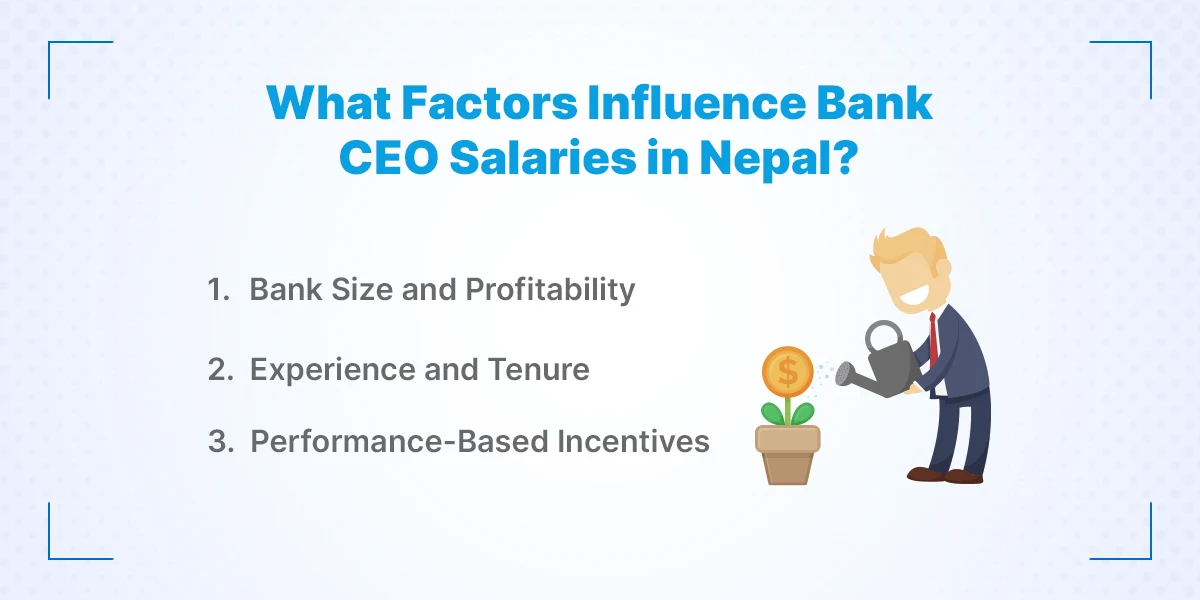
The salary of a bank CEO in Nepal mainly depends on the size of the bank, the CEO’s experience, and performance-based incentives like bonuses and allowances. Not all CEOs in Nepal earn the same. Some take home many times more than others, and there are clear reasons behind it. Let’s look at the main factors that decide how much a bank CEO gets paid.
1. Bank Size and Profitability
The size of a bank plays a big role in how much the CEO earns. Larger banks usually handle more deposits, loans, and customers, which means more responsibility for the leader. When a bank is profitable, the board is more willing to pay the CEO a higher salary. This is why CEOs of big banks like Standard Chartered or Nepal Investment Mega earn much more compared to smaller or government banks. A strong balance sheet allows banks to set aside more money for executive pay. On the other hand, smaller banks with limited profits cannot afford very high compensation packages. So, bigger and more profitable banks almost always offer their CEOs better pay.
2. Experience and Tenure
Experience matters a lot when it comes to CEO pay. A leader who has worked in banking for decades is likely to earn more than someone who is new to the role. Boards value experience because it reduces risk and brings stability to the bank. CEOs who have a long track record of success also gain higher trust from shareholders. In many cases, a CEO who has stayed with the same bank for many years receives steady salary hikes over time. The longer the tenure, the bigger the pay package often becomes. In short, banks reward knowledge, proven results, and loyalty with higher salaries.
3. Performance-Based Incentives
Apart from the fixed salary, performance incentives make up a big part of a CEO’s earnings. These can include annual bonuses, allowances, or special rewards linked to the bank’s profits. If a bank performs well, the CEO often receives a large bonus at the end of the year. This system motivates leaders to work harder for growth and success. Allowances for housing, travel, and even festival bonuses like Dashain also add to the total package. In fact, for many CEOs, these incentives make a big difference, sometimes even doubling their income. So, performance plays a direct role in how much money they finally take home.
Government vs Private Bank CEO Salaries
The pay of CEOs of government-owned banks and private banks in Nepal is quite different. Government banks have set rules in place for pay, and hence, the pay is lower. Private banks, however, are in the market and hence offer greater pay to attract and keep the best minds.
1. Government-Owned Banks
CEOs of government banks receive much lower compensation compared to those of private ones. For example, the CEO of Rastriya Banijya Bank earns around NPR 4.06 million every year. Although that may look enormous as a figure, in the banking industry, it is actually quite small. The reason lies in the fact that state government banks are bound to follow fixed salaries set by the state. They even have very little room for imposing bonuses or special allowances. Their bulk of earnings is in fixed salary and minimum benefits. It brings down their total package to a significantly lower scale than that of their private bank CEOs.
2. Private Sector Banks
Private banks pay their CEOs much more. For example, the CEO of Nepal Investment Bank earns approximately NPR 23.6 million per year. The difference is huge compared to that of a government bank CEO. Private banks compete in the marketplace, hence they give better pay to get good leadership. Along with minimum wage, they also include big bonuses, allowances, and provident fund contributions. The offer is for the reward of performance and appreciation of value. That is why private bank CEOs get five to six times more than government-owned bank CEOs.
Conclusion
The salary of bank CEOs in Nepal shows just how wide the gap can be between government and private institutions. While government bank CEOs earn around a few million rupees a year, private bank CEOs take home tens of millions, with some crossing 80 million annually. This difference is mainly because private banks compete in a fast-moving market and reward leadership with high pay, bonuses, and benefits.
At the same time, factors like bank size, profitability, and the CEO’s experience play a big role in deciding how much they earn. Looking at the numbers, it’s clear that being a CEO in a top private bank is one of the highest-paid jobs in the world. These salaries also reflect the growing importance of strong leadership in the country’s financial sector.
Looking for the best banking jobs in Nepal? Explore top vacancies and apply today to build your career in leading banks!
Frequently Asked Questions
Submit your comments

Get Our App On



SEO Training for Freshers in Nepal: Skills, Career & Job Opportunities
VIEW DETAILS
SEO Training vs. Self-Learning: Which Is Right for You?
VIEW DETAILS
How to Choose Between Two Job Offers
VIEW DETAILS
Digital Marketing Training Interview Questions and Answers for Freshers
VIEW DETAILS


Loading Comments...