


Employees need the right skills to complete their work effectively, but many organizations face challenges such as low productivity, workplace mistakes, and poor communication. Without proper training, employees may struggle to meet business goals and handle new workplace challenges.
Corporate training helps employees improve their skills, work more efficiently, and grow professionally. In this article, we will explore the 10 key benefits of corporate training for employees and businesses.
In this blog
What Are the 10 Benefits of Corporate Training for Employees and Organizations?
The 10 major benefits of corporate training include improved employee skills, increased productivity, stronger confidence, better employee retention, and effective leadership development. It also encourages innovation, improves teamwork, reduces operational errors, and helps businesses adapt to industry changes. Together, these improvements support long-term organizational growth and competitiveness.
Corporate training creates value for both employees and employers by connecting individual development with business objectives. The following benefits explain how structured workplace learning can improve everyday operations and professional growth.
1. Improves Employee Skills and Knowledge
Corporate training improves employee skills by providing practical knowledge and job-related learning. It helps employees develop technical, communication, and industry-specific skills to perform their tasks effectively.
2. Increases Workplace Productivity
Corporate training increases workplace productivity by helping employees complete tasks efficiently. It improves time management, work processes, and the effective use of workplace tools.
3. Boosts Employee Confidence and Motivation
Corporate training boosts employee confidence by improving their knowledge and abilities. Skilled employees feel more motivated to take responsibility, make decisions, and handle workplace challenges.
4. Improves Employee Retention
Corporate training improves employee retention by providing career development opportunities. Employees are more likely to stay with organizations that invest in their skills and professional growth.
5. Develops Leadership and Management Skills
Corporate training develops leadership skills such as decision-making, team management, and problem-solving. It prepares employees to handle managerial responsibilities and lead teams effectively.
6. Encourages Innovation and Creativity
Corporate training encourages innovation by introducing employees to new ideas, technologies, and problem-solving techniques. This helps businesses improve processes and develop creative solutions.
7. Improves Teamwork and Communication
Corporate training improves teamwork and workplace communication through collaboration and soft skills development. It helps employees share ideas, resolve conflicts, and achieve common business goals.
8. Reduces Workplace Errors and Operational Costs
Corporate training reduces workplace errors by teaching employees proper procedures and safety practices. Fewer mistakes help businesses minimize waste, avoid rework, and control operational costs.
9. Helps Organizations Adapt to Industry Changes
Corporate training helps organizations adapt to new technologies, market trends, and changing customer needs. Regular employee training keeps teams updated and prepared for workplace changes.
10. Supports Long-Term Business Growth and Competitiveness
Corporate training supports business growth by building a skilled and productive workforce. It improves service quality, customer satisfaction, and organizational performance, helping businesses remain competitive.
How Does Corporate Training Benefit Both Employees and Employers?
Corporate training benefits employees by improving their professional skills, confidence, and career opportunities while helping employers build a productive and capable workforce. It connects individual learning with organizational goals and creates value for both sides. When employees perform better, organizations can improve service quality, teamwork, and overall business performance.
The benefits can be understood from two perspectives:
| Benefits for Employees | Benefits for Organizations |
|---|---|
| Improved professional skills | Increased productivity |
| Better career opportunities | Stronger workforce |
| Increased confidence | Improved employee retention |
| Better communication | Effective teamwork |
| Leadership development | Better management |
| Opportunities for professional growth | Improved operational efficiency |
Employee development and organizational success are closely connected because skilled employees can contribute more effectively to business objectives. Organizations that support continuous learning can also build stronger relationships with their workforce.
What Are the Different Types of Corporate Training Programs?
Corporate training programs are structured learning activities designed to improve employees' technical, professional, managerial, and workplace skills. Organizations can select training based on job responsibilities, employee experience, and business requirements. The right combination helps employees perform their current roles while preparing for future responsibilities.
Common types of corporate training programs include:
- Technical Skills Training: Develops job-specific knowledge and practical abilities, such as accounting software, data analysis, equipment operation, and technical problem-solving.
- Soft Skills Training: Improves communication, teamwork, adaptability, time management, and interpersonal relationships.
- Leadership Training: Prepares employees to manage teams, make decisions, resolve conflicts, and guide organizational activities.
- Digital Skills Training: Helps employees understand digital tools, workplace software, online platforms, and modern technologies.
- Compliance Training: Educates employees about workplace policies, safety standards, professional ethics, and applicable legal requirements.
- Sales and Customer Service Training: Improves customer communication, sales techniques, product knowledge, and customer relationship management.
For example, a financial institution may prioritize compliance and customer service training, while a technology company may focus on digital skills and technical development. Selecting programs according to actual workplace needs makes training more relevant and useful.
How Can Organizations Make Corporate Training More Effective?
Organizations can make corporate training more effective by identifying employee skill gaps, setting clear learning objectives, selecting relevant programs, and measuring employee progress. Training should connect directly with workplace responsibilities rather than focus only on theoretical knowledge. Regular feedback and practical activities help employees apply what they learn to their daily work.
The following steps can help organizations plan and deliver successful training programs:
- Identify Employee Skill Gaps: Assess employee performance, workplace challenges, and existing skill levels to identify areas that require improvement.
- Set Clear Training Goals: Define what employees should learn and establish measurable objectives that support organizational priorities.
- Choose Relevant Training Programs: Select technical, leadership, communication, or other programs according to employees' responsibilities and identified learning needs.
- Select Experienced Trainers: Work with qualified trainers who understand the subject and can explain concepts through practical workplace examples.
- Use Practical Learning Methods: Include group activities, demonstrations, case studies, role-playing, and workplace exercises to encourage active participation.
- Encourage Employee Participation: Explain the purpose of training and create an environment where employees feel comfortable asking questions and sharing ideas.
- Evaluate Training Outcomes: Compare employee knowledge, skills, and work performance before and after training to identify improvements.
- Collect Feedback and Improve: Ask employees and managers about the training experience and use their feedback to improve future sessions.
A well-planned training program should not end when the session finishes. Managers should give employees opportunities to apply new skills, receive guidance, and demonstrate their progress through actual workplace responsibilities.
How Can Organizations Measure the Effectiveness of Corporate Training?
Organizations can measure corporate training effectiveness by comparing employee performance before and after training and evaluating changes in workplace productivity, work quality, and employee satisfaction. They should also track training objectives, operational errors, and employee retention. Combining these measurements helps employers understand whether training creates meaningful workplace improvements.
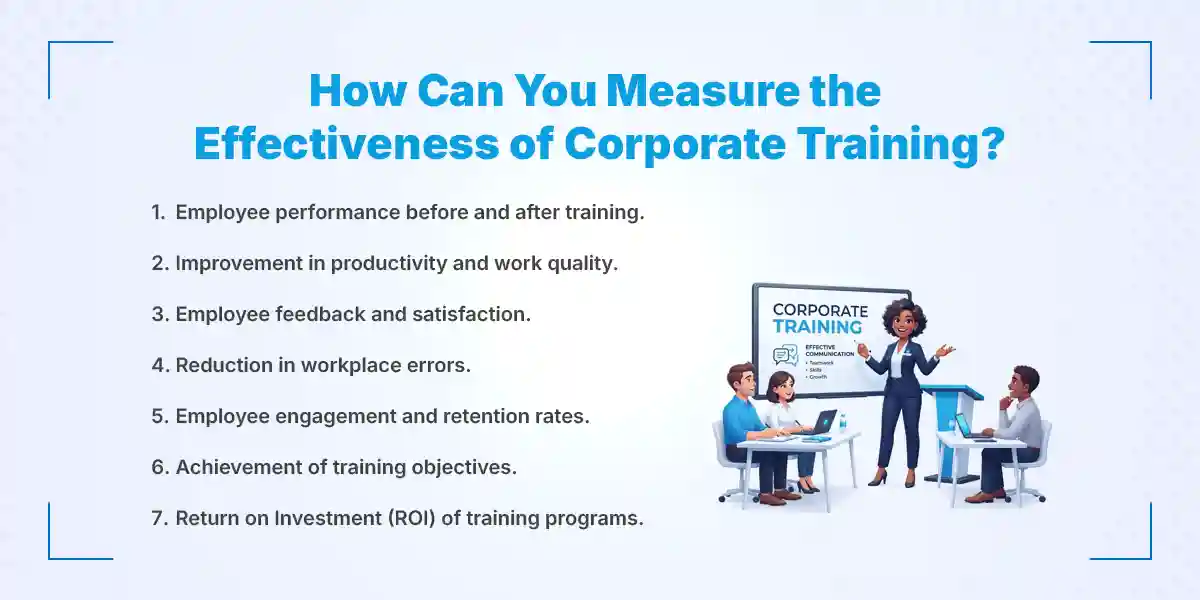
The following indicators can help organizations evaluate training results:
- Employee Performance: Compare individual performance before and after training to identify improvements in job-related skills.
- Workplace Productivity: Measure changes in task completion time, output, and the ability to meet work targets.
- Work Quality: Evaluate whether employees complete responsibilities more accurately and follow the correct procedures.
- Employee Feedback and Satisfaction: Collect feedback through surveys, discussions, and training evaluations to understand employee experiences.
- Reduction in Workplace Errors: Track mistakes, customer complaints, rework, and operational problems before and after training.
- Employee Engagement and Retention: Monitor employee participation, workplace satisfaction, and turnover trends over time.
- Achievement of Training Objectives: Check whether employees have gained the specific knowledge and abilities established before the program.
- Return on Investment (ROI): Compare the financial benefits of improved performance with the total cost of training.
For example, if a company provides customer service training, it can measure customer feedback, complaint rates, and service response times before and after the program. Organizations should evaluate both immediate learning outcomes and long-term workplace improvements to understand the actual value of corporate training
Conclusion
A skilled workforce is an important part of building a productive and sustainable organization. Corporate training should be connected with real workplace needs, employee development goals, and measurable business outcomes rather than treated as a routine company activity. When organizations provide relevant learning opportunities, they create an environment where employees can improve their abilities and contribute more effectively to business success.
Businesses looking to strengthen their workforce can explore KumariJob's Corporate Training Services for practical, customized programs covering HR and recruitment, leadership and people management, workplace skills, communication, and employee development.
Frequently Asked Questions
Submit your comments

Get Our App On



What Is Corporate Training in Nepal?
VIEW DETAILS
How to Become a Media Buyer in Nepal: Skills, Qualifications & Career Path
VIEW DETAILS
How to Create a Digital Marketing Content Calendar for Beginners
VIEW DETAILS
Digital Marketing Mistakes Beginners Should Avoid in Nepal
VIEW DETAILS


Loading Comments...