



Starting your first SQL Developer job can be confusing when companies rarely publish clear salary ranges and different employers value SQL skills differently. A fresher may receive a modest offer, while a developer with strong database optimization, SQL Server, PostgreSQL, or Oracle experience can command considerably more.
In 2026, a practical estimate for SQL Developer salaries in Nepal is around NPR 25,000–45,000 per month for freshers, NPR 50,000–90,000 for mid-level professionals, and NPR 100,000–200,000+ for senior professionals. Your experience, database specialization, location, employer, project complexity, and ability to work with modern data technologies can significantly change the final package.
In this blog
What Is the Average SQL Developer Salary in Nepal in 2026?
The average SQL Developer salary in Nepal generally falls between NPR 25,000 and NPR 200,000+ per month, depending mainly on experience, technical specialization, and employer. This means an annual salary can range from roughly NPR 3 lakh to NPR 24 lakh or more. These figures are practical market estimates rather than a fixed national salary scale, because SQL Developer compensation varies substantially between companies and job responsibilities.
1. SQL Developer Salary for Freshers in Nepal
Freshers and candidates with up to one year of experience can generally expect around NPR 25,000–45,000 per month in entry-level SQL or database-related roles. Employers usually look for SQL fundamentals, database concepts, joins, filtering, aggregation, and basic troubleshooting rather than advanced architecture skills. Internship or trainee experience can help candidates move into junior database roles more quickly.
2. Mid-Level SQL Developer Salary in Nepal
SQL Developers with around 2–5 years of experience can commonly target approximately NPR 50,000–90,000 per month, although specialized professionals may earn more. At this stage, companies expect developers to independently write complex queries, optimize database performance, create stored procedures, and troubleshoot production issues. Strong SQL Server, PostgreSQL, Oracle, reporting, ETL, or data integration experience can improve salary negotiations.
3. Senior SQL Developer Salary in Nepal
Senior SQL Developers with five or more years of relevant experience can earn around NPR 100,000–200,000+ per month, particularly when they handle complex databases or technical leadership responsibilities. Senior roles can include database architecture, performance tuning, security, high-volume data processing, system integration, and mentoring junior developers. Professionals who combine SQL with cloud, data engineering, business intelligence, or international project experience may reach the higher end of the range.
SQL Developer Salary in Nepal Based on Experience
| Experience Level | Estimated Monthly Salary | Key Focus |
|---|---|---|
| Fresher / Trainee | NPR 25,000–45,000 | SQL fundamentals, queries, database basics |
| Junior | NPR 40,000–60,000 | Database development, reporting, troubleshooting |
| Mid-Level | NPR 50,000–90,000 | Optimization, stored procedures, database management |
| Senior | NPR 100,000–200,000+ | Architecture, performance, leadership |
Experience matters because employers pay for the ability to solve increasingly complex database problems with less supervision. Current Nepal IT salary references also show a substantial difference between entry-level, mid-level, and senior technical roles, while database-focused positions can reach higher salary levels in stronger organizations.
A current SQL Developer vacancy in Kathmandu, for example, asks for 3–5 years of experience along with complex joins, aggregations, subqueries, query optimization, data validation, and problem-solving skills, showing how employers connect experience with advanced SQL responsibilities.
What Factors Affect SQL Developer Salary in Nepal?
Several factors determine how much an SQL Developer can earn in Nepal, and job title alone does not determine compensation. Technical depth, industry, location, company size, project complexity, and international exposure can all influence the final offer.
- Experience: More production experience usually gives you stronger salary negotiation power.
- SQL expertise: Advanced queries, indexing, optimization, stored procedures, and database design increase your value.
- Database specialization: SQL Server, PostgreSQL, Oracle, and MySQL experience can open different job opportunities.
- Education: A degree in computer science, IT, software engineering, or a related field can help with eligibility, although practical skills remain important.
- Company type: Product companies, established IT firms, banks, fintech companies, and international outsourcing companies may offer different packages.
- Location: Kathmandu generally provides more IT and database-related opportunities than smaller markets.
- Project complexity: Working with large databases, high transaction volumes, or business-critical systems can support higher compensation.
- Communication: SQL Developers often work with developers, analysts, clients, and business teams, so clear communication matters.
- Remote work: International remote opportunities can provide earning potential above many local salary bands.
SQL Developer Salary Based on Skills and Technologies
SQL is the foundation of the role, but higher-paying SQL Developer positions often require a broader database and data-engineering skill set. Employers may value professionals who can not only write queries but also understand performance, data quality, integration, reporting, and production systems.
1. SQL and Database Management Skills
Strong SQL skills include complex joins, subqueries, aggregations, common table expressions, window functions, views, indexes, constraints, and transactions. Database design and normalization help developers create reliable systems instead of simply writing queries that return results. These skills become particularly valuable when a database grows and poorly written queries begin affecting application performance.
2. Advanced Technical Skills
Advanced SQL Developers can improve their earning potential by learning query optimization, database security, backup and recovery, ETL, data warehousing, and cloud databases. Knowledge of platforms such as Microsoft SQL Server, PostgreSQL, Oracle Database, and MySQL can make a candidate suitable for a wider range of projects. Combining SQL with Python, Power BI, cloud platforms, or data engineering can also create a pathway into broader technical roles.
What Skills Do You Need to Become a SQL Developer in Nepal?
You need strong SQL fundamentals, database knowledge, analytical thinking, and practical project experience to start a SQL Developer career in Nepal. Employers increasingly value candidates who can connect database work to real business requirements rather than simply memorize SQL syntax. A current Kathmandu SQL Developer vacancy, for instance, emphasizes complex joins, aggregations, subqueries, query optimization, data validation, and problem-solving.
- SQL fundamentals: SELECT, INSERT, UPDATE, DELETE, filtering, sorting, grouping, and joins.
- Relational databases: Tables, relationships, primary keys, foreign keys, constraints, and normalization.
- Advanced SQL: CTEs, window functions, subqueries, stored procedures, functions, and triggers.
- Database design: Creating efficient and maintainable database structures.
- Query optimization: Understanding indexes, execution plans, and inefficient queries.
- Programming: Python, Java, or C# can help when SQL connects with application development.
- Data analysis: Reporting and business intelligence skills can expand career options.
- Version control: Git knowledge helps developers manage database-related code and project changes.
- Cloud knowledge: Familiarity with cloud databases can prepare you for modern development environments.
- Problem-solving: The ability to investigate incorrect, slow, or inconsistent database results is essential.
How Can You Become a SQL Developer in Nepal?
You can become a SQL Developer in Nepal by learning SQL systematically, practicing with real databases, building projects, and applying for entry-level database or software roles. The most effective path is to combine theoretical database knowledge with projects that demonstrate how you solve practical data problems. You do not need to master every database platform before applying for your first job.
- Learn SQL fundamentals: Start with queries, filtering, sorting, grouping, joins, and data manipulation.
- Practice database queries: Use sample datasets to solve increasingly complex problems.
- Learn a database management system: Choose MySQL, PostgreSQL, SQL Server, or Oracle and gain hands-on experience.
- Build practical projects: Create systems such as an employee database, inventory system, banking database, or e-commerce database.
- Learn advanced SQL: Add CTEs, window functions, stored procedures, indexing, and query optimization.
- Create a strong CV and portfolio: Showcase projects, technologies, GitHub work, internships, and measurable results.
- Apply for database-related jobs: Search for SQL Developer, Database Developer, Junior Database Developer, and Data Analyst positions.
- Continue developing your skills: Add Python, Power BI, cloud databases, ETL, or data engineering skills as your career progresses.
SQL Developer Career Opportunities in Nepal
SQL skills can lead to several careers beyond the exact title of SQL Developer. As your experience grows, you can move toward database engineering, business intelligence, data analytics, database administration, or data engineering.
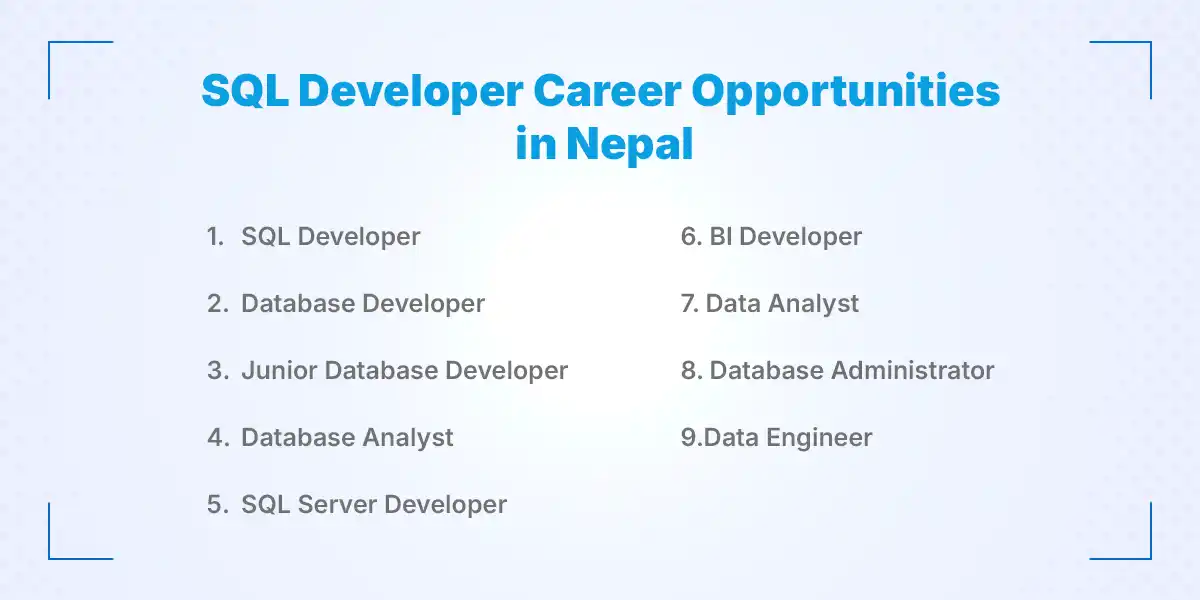
- SQL Developer
- Database Developer
- Junior Database Developer
- Database Analyst
- SQL Server Developer
- BI Developer
- Data Analyst
- Database Administrator
- Data Engineer
This flexibility is one of the strongest reasons to develop SQL as a career skill. A developer who starts with database queries can later specialize in performance engineering, analytics, cloud databases, business intelligence, or broader data engineering.
Where Can SQL Developers Find Jobs in Nepal?
SQL Developers can find opportunities through job portals, IT companies, banks, fintech organizations, software companies, e-commerce businesses, telecommunications companies, and remote employers. Database skills are useful anywhere an organization stores and processes structured business data, so candidates should search beyond vacancies that use only the exact title SQL Developer.”
- Job portals: Search SQL Developer, Database Developer, Data Analyst, and Database Administrator vacancies.
- IT companies: Software companies frequently need database professionals to support applications and backend systems.
- Banks and financial institutions: Banking systems depend heavily on structured databases, reporting, and data validation.
- Software development companies: SQL Developers support application databases, reporting systems, and integrations.
- E-commerce companies: Transactional systems require reliable databases for products, customers, orders, and payments.
- Telecommunications: Large customer and transaction datasets create demand for database and data professionals.
- Government and private organizations: Digital systems require database development, reporting, and maintenance.
- Remote platforms: International companies can provide opportunities for experienced Nepali professionals.
For local opportunities, candidates can monitor KumariJob for relevant IT and database vacancies.
How Can SQL Developers Increase Their Salary in Nepal?
SQL Developers can increase their salary by moving beyond basic query writing and developing specialized skills that solve expensive or technically difficult business problems. The biggest improvement usually comes when a developer can demonstrate measurable value through performance optimization, reliable data systems, automation, cloud technologies, or ownership of production databases.
- Master advanced SQL: Learn CTEs, window functions, complex joins, execution plans, and optimization.
- Specialize in databases: Develop deeper expertise in SQL Server, PostgreSQL, Oracle, or MySQL.
- Learn performance tuning: Understand indexes, query plans, locking, transactions, and bottlenecks.
- Learn cloud databases: Add practical knowledge of modern cloud database services.
- Build real-world projects: Demonstrate production-style database design rather than basic classroom exercises.
- Learn ETL and data warehousing: These skills can help you transition toward data engineering.
- Add BI skills: Power BI and reporting can make SQL skills useful for analytics-focused positions.
- Develop communication skills: Senior professionals need to explain technical database problems to non-technical stakeholders.
- Explore international work: Remote projects can expand your potential employer and salary pool.
SQL Developer Career Growth and Salary Progression
SQL Developer career growth typically progresses from Junior SQL Developer to SQL Developer, Senior SQL Developer, Database Architect, Data Engineer, or Database/Technical Lead, with salary increasing as experience, technical expertise, and responsibility grow.
- Junior SQL Developer: Focuses on basic SQL queries, database maintenance, reports, and troubleshooting.
- SQL Developer: Handles complex queries, stored procedures, database development, and data management.
- Senior SQL Developer: Works on query optimization, database performance, security, and complex database systems.
- Database Architect: Designs scalable database structures, data models, and overall database architecture.
- Data Engineer: Works with large datasets, ETL pipelines, data warehouses, cloud platforms, and data processing systems.
- Database/Technical Lead: Leads database projects, guides developers, makes technical decisions, and manages complex database solutions.
Experience, advanced SQL skills, database specialization, cloud knowledge, and leadership responsibilities are the main factors that can increase long-term earning potential.
Is SQL Development a Good Career in Nepal in 2026?
Yes, SQL development remains a strong career option in Nepal because databases support software applications, banking systems, e-commerce platforms, reporting systems, and data-driven business operations. The long-term opportunity becomes stronger when SQL Developers combine database expertise with data analytics, cloud, automation, or data engineering skills. Current Nepal IT salary references show continued demand across software, data, and specialized technical roles, with compensation increasing significantly as experience and specialization grow.
- Strong foundation: SQL applies across many industries.
- Multiple career paths: You can move into database administration, BI, analytics, or data engineering.
- Transferable skills: SQL knowledge works across several database platforms.
- Remote potential: Database and data skills can support international work.
- Career progression: Advanced database expertise can lead to senior and architecture-level positions.
- Industry demand: Organizations continue to depend on structured data for operations and decision-making.
Conclusion
The most important point is that the SQL Developer salary in Nepal is driven less by the SQL title and more by the problems you can solve. A fresher who knows basic queries may start around NPR 25,000–45,000 per month, while professionals who can optimize production databases, design reliable systems, work with cloud or data platforms, and take ownership of complex projects can move well beyond NPR 100,000 per month.
If you are starting your SQL career, focus first on practical database skills, build projects that prove your ability, and use relevant job listings to understand what employers actually request. For finding SQL Developer, database, and other IT opportunities in Nepal, explore Kumari Job.
Frequently Asked Questions
Submit your comments

Get Our App On



SEO Training for Freshers in Nepal: Skills, Career & Job Opportunities
VIEW DETAILS
SEO Training vs. Self-Learning: Which Is Right for You?
VIEW DETAILS
How to Choose Between Two Job Offers
VIEW DETAILS
Digital Marketing Training Interview Questions and Answers for Freshers
VIEW DETAILS


Loading Comments...