


Many job seekers in Nepal want to enter tech, but they often feel confused about where to start, what skills matter most, and how to stand out in a competitive market. As more companies build web platforms, SaaS products, dashboards, and custom business tools, the demand for frontend and JavaScript developers is growing, making React.js developer jobs in Nepal more attractive for both freshers and experienced candidates.
This guide explains how to get React.js developer jobs in Nepal, what skills employers usually expect, where to look for opportunities, and how to improve your chances of getting hired. You will also learn about qualifications, portfolio building, job application methods, and long-term career growth so you can move forward with a clear and practical plan.
In this blog
What do React JS Developers do?
A React JS developer builds the user-facing part of websites and web applications using React, JavaScript, and related frontend tools. They mainly create fast, interactive, and responsive interfaces that users click, scroll, fill out, and use every day. In Nepal, React JS developers are often hired to build business websites, admin panels, eCommerce pages, dashboards, portals, and startup products.
A React JS developer usually does the following:
- Builds UI components such as buttons, forms, cards, menus, and dashboards
- Converts design files into working web pages and application screens
- Uses React components, props, state, and hooks to manage frontend behavior
- Connects the frontend with APIs to show real data
- Improves website speed, responsiveness, and user experience
- Fixes frontend bugs and updates existing features
- Works with backend developers, designers, and project managers
- Uses Git and GitHub to manage code and team collaboration
In simple words, a React JS developer makes sure a website or web app looks good, works smoothly, and gives users a better experience.
Why Are React JS Developer Jobs in Nepal in High Demand?
React JS developer jobs in Nepal are in high demand because more companies now need fast, modern, and user-friendly web applications. As Nepal’s digital market grows, businesses are investing more in websites, dashboards, portals, SaaS products, and mobile-friendly platforms. This has increased the need for frontend developers who can build smooth user interfaces with React JS.
- Growing digital businesses and startups: Many startups and online businesses in Nepal need modern web platforms to serve customers, manage operations, and grow faster.
- More demand for modern web applications: Companies now want more than basic websites. They need interactive systems such as booking platforms, admin panels, eCommerce sites, learning portals, and customer dashboards.
- Increased use of JavaScript frameworks in Nepal’s tech sector: React JS has become one of the most preferred frontend libraries for building scalable and maintainable applications, so employers often look for developers with React skills.
- Remote work and outsourcing opportunities: Many Nepali developers now work with outsourcing companies or remote international teams, and React JS is widely used in global projects, which increases local demand as well.
Skills Needed to Get React JS Developer Jobs in Nepal
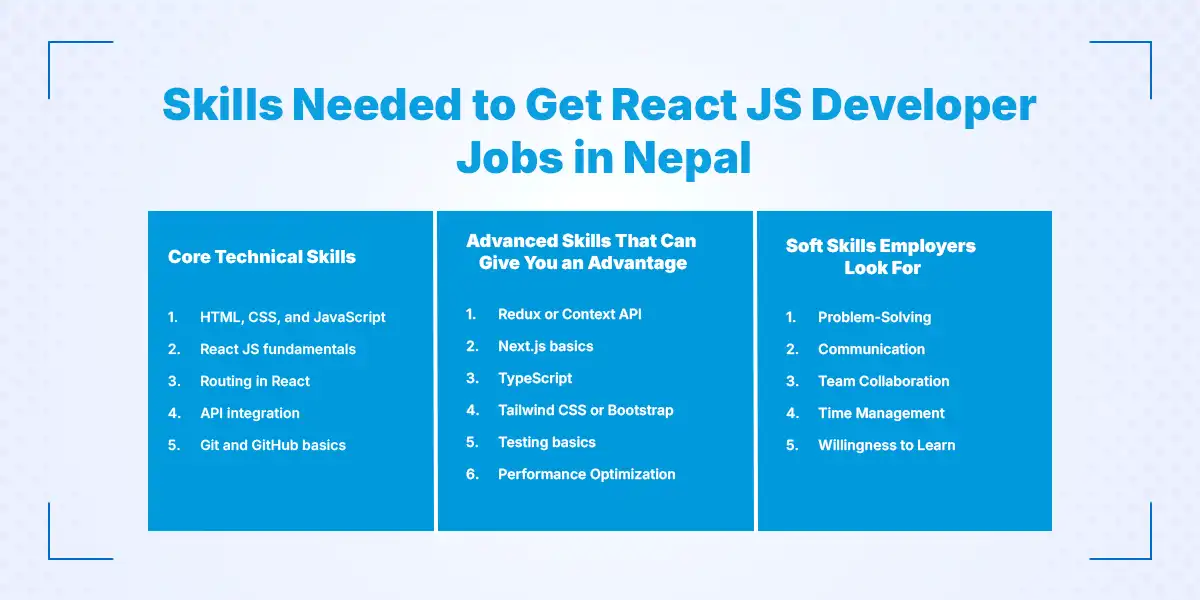
To land a React JS developer job in Nepal, you'll need solid frontend skills, hands-on React experience, and professional soft skills. Companies want people who can build good UIs, connect to APIs, keep code tidy, and work well with others. Newcomers should focus on learning the core skills in a logical order. Experienced developers should sharpen advanced techniques for better roles and salaries.
1. Core Technical Skills
Core technical skills are the absolute must-haves for any aspiring React developer before they even start applying for jobs. These are the building blocks that let you construct websites properly, grasp the mechanics of frontend development, and confidently create applications using React. In Nepal, many employers will usually check these fundamental skills first before moving on to more specialized tools. If you don't have a solid foundation, you're going to struggle with real-world projects, technical challenges, and interviews.
You need to be completely comfortable with HTML, CSS, and JavaScript because React itself is built right on top of these essential frontend technologies. Beyond that, you absolutely must understand the core React JS concepts: components, JSX, props, state management, and hooks. Employers also expect you to know how to handle routing in React, which is how you create that multi-page feel within a single-page application. Finally, you should know how to integrate with APIs (since real projects use live data) and have a good handle on the basics of Git and GitHub for team collaboration.
2. Advanced Skills That Can Give You an Advantage
Advanced skills are essential for distinguishing yourself from other applicants and demonstrating your ability to handle complex projects. While these abilities aren't always mandatory for entry-level positions, they significantly increase your chances of being shortlisted. In a competitive hiring landscape, companies often favor candidates who are already familiar with modern frontend workflows. Acquiring a few advanced tools can also prepare you for future mid-level React opportunities.
For instance, proficiency in Redux or the Context API can help you manage state more effectively in larger applications. Understanding the basics of Next.js is valuable because many organizations now use it for better performance and to create SEO-friendly React projects. Skills such as TypeScript, Tailwind CSS, or Bootstrap, fundamental testing knowledge, and performance optimization offer a distinct advantage, as they demonstrate your commitment to code quality, speed, and scalability. These competencies can enhance your portfolio and improve your performance during technical interviews.
3. Soft Skills Employers Look For
Soft skills are crucial because a React developer's role involves more than just coding. In almost all positions, you'll need to interact with designers, backend developers, managers, and occasionally clients. A developer who is technically brilliant but can't clearly articulate their ideas or work effectively within a group will struggle in the workplace. This is why employers in Nepal prioritize both technical proficiency and professional conduct.
The most essential soft skills include problem-solving, clear communication, teamwork, organization (time management), and a strong eagerness to learn. Since React and frontend development evolve rapidly, companies highly value candidates who are adaptable to new tools and willing to refine their workflow. Effective communication is key to asking better questions, explaining your work, and avoiding mistakes on projects. Strong collaboration and time management skills also significantly boost your reliability, which is a major asset in both traditional office and remote roles.
How to Become Eligible for React JS Developer Jobs in Nepal?
To become eligible for React.js developer jobs in Nepal, you need to follow a practical path that builds your skills, project experience, and job readiness step by step. Many beginners make the mistake of jumping directly into React without understanding frontend basics first. That often creates confusion and weakens their long-term growth. A better approach is to build a strong foundation, practice with real projects, and gradually prepare yourself for internships, junior roles, and entry-level developer jobs.
1. Learn Frontend Development Basics First
You should start with HTML, CSS, and JavaScript before learning React JS. These are the core building blocks of frontend development, and React becomes much easier once you understand them properly. HTML helps you structure web pages, CSS helps you style them, and JavaScript makes them interactive. Before moving to React, try building simple websites such as a personal portfolio, a landing page, a login form, or a small business website. This will help you understand layout, responsiveness, DOM behavior, and basic frontend logic in a practical way.
2. Master React JS Step by Step
Once your basics are clear, you can begin learning React JS in a structured way. Start with components and JSX, then move into props, state, event handling, hooks, and routing. After that, learn how to manage data flow and understand basic state management concepts so your applications become more organized. Do not only watch tutorials. Build small projects such as a to-do app, weather app, blog UI, or product listing page to apply what you learn. Step-by-step practice is what turns React knowledge into actual job-ready skills.
3. Build a Strong Portfolio
A strong portfolio often matters more than certificates because employers want proof that you can actually build working applications. Many candidates list skills on their CV, but a portfolio shows your real ability through code, design structure, and project thinking. Your portfolio should include real React projects that solve simple problems and show different skills such as API integration, routing, responsive design, and reusable components. Try to add live demo links and GitHub repositories for each project so recruiters can review your work easily. Even 3 to 5 well-made projects can make a big difference when applying for React developer jobs in Nepal.
4. Gain Practical Experience
Practical experience helps you move from learning to employability. You can gain experience through internships, freelance work, personal projects, or even open-source contributions if you do not have a full-time job yet. Internships help you understand teamwork and real company workflows, while freelance work teaches you how to deliver results for actual client needs. Personal projects show initiative, and open-source work can improve your coding habits, Git usage, and collaboration skills. Even small practical experience can strengthen your CV and make you more confident in interviews.
Why Do Some Candidates Struggle to Get React JS Developer Jobs in Nepal?
Many candidates struggle to get React.js developer jobs in Nepal because they apply before they are fully prepared for what employers actually expect. Learning React from tutorials is not enough if you cannot build projects, explain your code, or show practical skills during the hiring process. In many cases, the problem is not a lack of interest but a lack of job-ready preparation. Understanding these common mistakes can help you avoid them and improve your chances of getting hired faster.
1. Lack of Real Projects
Many job seekers say they know React JS, but they cannot show real projects that prove their skills. Employers usually want to see whether you can build something practical, not just whether you completed a course or watched tutorials. If your CV only lists technologies without project examples, it becomes harder for recruiters to trust your ability. Even simple projects like a task manager, blog app, admin dashboard, or eCommerce frontend can make your profile much stronger. Real projects show your coding ability, problem-solving approach, and understanding of frontend development in action.
2. Weak JavaScript Fundamentals
A lot of candidates focus too much on React and ignore core JavaScript concepts. This becomes a big problem because React itself depends on strong JavaScript knowledge, especially when working with arrays, objects, functions, promises, DOM logic, and ES6 features. If your basics are weak, you may struggle with components, state updates, API calls, and debugging. Employers often notice this during technical interviews or coding tests. That is why improving JavaScript fundamentals is one of the smartest ways to become more confident and job-ready.
3. Applying Without a Tailored CV
Some candidates apply for every job using the same generic CV, and that reduces their chances of getting shortlisted. A React developer CV should clearly highlight relevant skills, projects, tools, and experience related to frontend development. If your CV is too general or includes too many unrelated details, recruiters may not quickly understand your value. You should adjust your CV based on the role and make sure React, JavaScript, projects, GitHub, and frontend tools are easy to see. A tailored CV creates a stronger first impression and helps your application look more relevant.
4. No GitHub or Portfolio Website
Many employers prefer candidates who have a GitHub profile or a simple portfolio website because these give direct proof of practical work. Without them, your application may feel incomplete, especially for frontend and React JS roles. A portfolio helps recruiters see your live projects, design approach, and technical ability, while GitHub shows your code quality, project structure, and consistency. Even if you are a fresher, having these platforms can make you look more serious and prepared. In a competitive job market, this can be a major advantage.
5. Poor Interview Preparation
Some candidates have decent skills but still fail because they do not prepare properly for interviews. React JS interviews often include questions about components, props, state, hooks, routing, API handling, and basic JavaScript logic. Employers may also ask about your projects, how you solved problems, and how you work in a team. If you cannot explain your work clearly, you may lose opportunities even if you know the technical side. Good interview preparation helps you answer with more confidence, avoid simple mistakes, and present yourself as a stronger candidate.
Where to Find React JS Developer Jobs in Nepal?
You can find React.js developer jobs in Nepal on job portals like Kumari Job, LinkedIn, company career pages, and internship listings. These are the most common places where employers post openings for frontend developers, junior React developers, and trainee web development roles.
If you want better results, do not depend on only one platform. Many candidates apply only through one website and miss good opportunities posted elsewhere. A smart job search means checking multiple sources regularly, keeping your profile updated, and applying quickly when relevant roles appear. This increases your visibility and gives you more chances to get shortlisted.
1. Job Portals in Nepal
Job portals are one of the easiest and most practical ways to find React JS developer jobs in Nepal. Platforms such as Kumari Job and other general job websites often list openings for frontend developers, web developers, JavaScript developers, and React-related roles. These portals help job seekers filter vacancies by experience level, location, industry, and job type. You should also check company career pages because some businesses post vacancies directly on their own websites instead of relying only on third-party platforms. Searching these portals regularly can help you catch new openings before they become too competitive.
2. LinkedIn and Professional Networking
LinkedIn is a really great place to look for React developer jobs and boost your professional profile. Recruiters and companies often post job openings there, and sometimes they even actively search for people with React skills, GitHub links, and solid project experience. If your LinkedIn profile is well-optimized, you'll come across as more trustworthy, and it will be easier for hiring managers to quickly understand your technical background. Networking also plays a huge role because a lot of positions are filled through referrals, direct messages, or people you know in the industry. By connecting with recruiters, other developers, company founders, and hiring managers, you can uncover opportunities that aren't always posted on public job boards.
3. Internship and Entry-Level Opportunities
If you are a beginner, an internship and entry-level roles can be one of the best ways to enter the tech industry. You should search for junior React developer jobs, frontend internships, and trainee developer roles, because these positions are often more suitable for freshers who are still building experience. These opportunities help you understand real project workflows, teamwork, deadlines, and professional coding standards. Even if the role is not fully focused on React at the beginning, it can still help you gain valuable frontend experience. Starting with smaller opportunities can often lead to stronger long-term growth in the React JS career path.
How to Apply for React JS Developer Jobs in Nepal?
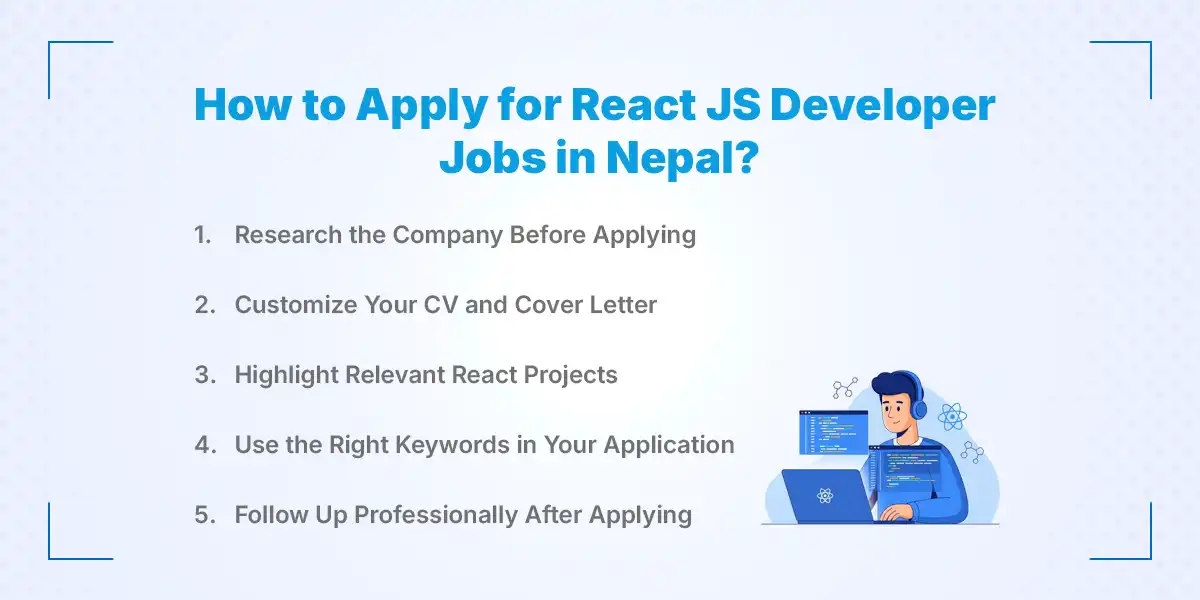
To apply for React.js developer jobs in Nepal successfully, you need more than just sending your CV to multiple companies. A strong application should show that you understand the job, match the required skills, and can prove your ability with relevant projects. Many candidates apply in a hurry and miss small details that could improve their chances. A more focused and professional approach can help you stand out in a competitive job market.
1. Research the Company Before Applying
You should learn about the company before sending your application. Check what kind of products or services they offer, what technologies they may be using, and what type of developer they seem to need. This helps you understand whether the role matches your current skills and career goals. It also prepares you to write a more relevant application and answer interview questions better. Even five to ten minutes of research can make your application look more thoughtful and serious.
2. Customize Your CV and Cover Letter
A customized CV and cover letter can improve your chances of getting shortlisted. Instead of sending the same generic CV everywhere, adjust it to match the job description and highlight the skills the employer is asking for. Your React-related projects, frontend tools, JavaScript knowledge, and GitHub links should be easy to notice. In the cover letter, briefly explain why you are a good fit for that specific role and company. A tailored application shows effort and helps recruiters quickly understand your value.
3. Highlight Relevant React Projects
Your projects are often one of the strongest parts of your application. Recruiters want to see proof that you can build interfaces, manage components, handle state, and work with APIs in a practical way. Add your best React JS projects to your CV, portfolio, and cover letter, especially those with live demos and GitHub repositories. Focus on projects that show real frontend skills instead of only basic tutorial copies. A few strong projects can create a much better impression than a long list of weak or unfinished work.
4. Use the Right Keywords in Your Application
Using the right keywords can help your application look more relevant to both recruiters and hiring systems. Try to include terms that match the role, such as React JS, frontend developer, JavaScript, API integration, GitHub, responsive design, or state management, depending on the job description. These keywords should appear naturally in your CV, cover letter, and LinkedIn profile. This makes it easier for employers to see that your experience matches what they need. It also helps your profile appear stronger during shortlisting.
5. Follow Up Professionally After Applying
Following up professionally can show interest and maturity, especially if you do it politely. If you do not hear back after a reasonable period, you can send a short message or email asking whether the application has been reviewed. Keep your tone respectful, simple, and professional. Do not send repeated messages or sound demanding, because that can create a negative impression. A good follow-up can sometimes bring attention back to your application and improve your chances of getting a response.
Salary and Career Growth for React JS Developers in Nepal
React JS developers in Nepal usually grow their salary as they gain better skills, stronger projects, and more real-world experience. Your income can also depend on whether you work for a local company, an outsourcing agency, a startup, or a remote international team.
In most cases, beginners start with lower salaries, then move up as they become more confident with React, JavaScript, APIs, state management, and team collaboration. Developers who can build real projects and solve practical problems usually grow faster in both salary and job title.
A simple career progression looks like this:
- Entry-level React developer: around NPR 20,000 to 40,000 per month
- Mid-level React developer: around NPR 50,000 to 90,000 per month
- Senior React developer: around NPR 100,000+ per month, depending on company and experience
- Remote React roles: can offer higher income than many local jobs
React JS Developer Career Paths You Can Explore
A React JS developer can grow into several career paths depending on skills, experience, and the type of projects they work on. React is not limited to one job title, so learning it can open opportunities in frontend, full-stack, UI-focused, and remote development roles. This is one reason many job seekers choose React as a long-term career skill. As your knowledge grows, you can move into broader and better-paying roles beyond just entry-level React jobs.
1. Frontend Developer
A Frontend Developer focuses on building the visual and interactive parts of websites and web applications. This is one of the most common career paths for React developers because React is mainly used for frontend work. In this role, you usually work with HTML, CSS, JavaScript, React, APIs, and responsive design to create smooth user experiences. Many companies in Nepal hire frontend developers for websites, dashboards, portals, and web-based business systems. If you enjoy turning designs into working interfaces, this path can be a strong fit.
2. MERN Stack Developer
A MERN Stack Developer works on both frontend and backend using MongoDB, Express.js, React, and Node.js. This path is useful for React developers who want to expand beyond UI work and build complete web applications. In Nepal, many startups and smaller software companies prefer developers who can handle multiple parts of a project. Learning the MERN stack can make you more flexible, more employable, and often more valuable in smaller teams. It is a smart next step if you want to grow from frontend development into full product development.
3. Full Stack JavaScript Developer
A Full Stack JavaScript Developer uses JavaScript for both client-side and server-side development. This role is similar to MERN stack development, but it can also include different databases, frameworks, and tools depending on the company. React developers often move into this path after gaining confidence in backend basics, API creation, authentication, and database handling. It gives you wider career options because many employers prefer developers who understand the full application flow. This path is especially useful if you want to work on larger systems or build your own products in the future.
4. UI Developer
A UI Developer focuses more on the look, feel, and usability of digital products. This role suits React developers who enjoy working closely with design systems, layouts, components, animations, and user interface details. In many projects, UI developers turn design files into clean, responsive, and user-friendly frontend pages. Strong knowledge of CSS, component structure, spacing, accessibility, and design consistency is very important in this path. If you like making interfaces visually polished and easy to use, UI development can be a valuable direction.
5. Remote React Developer Jobs
Remote React Developer jobs are another strong career path for skilled developers in Nepal. Many international companies and outsourcing teams hire React developers remotely because React is widely used across global web projects. These roles often require strong technical skills, good communication, and the ability to work independently without close supervision. Remote work can give you access to better income, more diverse projects, and international experience. For many developers in Nepal, this becomes one of the most attractive long-term career goals.
Conclusion
Getting React.js developer jobs in Nepal becomes much easier when you follow the right path step by step. Focus on learning HTML, CSS, JavaScript, and React, build real projects, create a strong portfolio, improve your CV, and apply smartly through the right platforms.
The right mix of skills, practical work, project quality, and consistent job searching can greatly improve your chances of getting hired. Keep learning, keep building, and keep applying regularly because steady effort often leads to better opportunities over time.
Looking for IT jobs in Nepal or the latest React developer opportunities? Explore Kumari Job to find relevant openings, internships, and career opportunities that match your skills and goals.
Frequently Asked Questions
Submit your comments

Get Our App On



SEO Training for Freshers in Nepal: Skills, Career & Job Opportunities
VIEW DETAILS
SEO Training vs. Self-Learning: Which Is Right for You?
VIEW DETAILS
How to Choose Between Two Job Offers
VIEW DETAILS
Digital Marketing Training Interview Questions and Answers for Freshers
VIEW DETAILS


Loading Comments...