



Getting noticed in Kathmandu’s IT job market is not always easy, especially when many candidates apply with similar degrees but weak practical skills, no portfolio, and a generic CV. That is why many freshers and even experienced professionals struggle to turn their technical knowledge into real job offers, even though Kathmandu continues to attract software companies, startups, outsourcing firms, and digital employers.
This guide explains how to get IT jobs in Kathmandu, what skills employers look for, where to apply, and how to grow your career step by step. It matters because Kathmandu is one of Nepal’s main tech hiring centers, with active demand across software development, IT support, networking, digital roles, and startup-driven positions.
In this blog
What are IT Jobs?
IT jobs are technology-related roles focused on creating, managing, supporting, testing, or improving software, systems, networks, websites, apps, and digital platforms. These jobs cover a wide range of work, including software development, web development, UI/UX design, QA testing, IT support, networking, cybersecurity, data analysis, and digital system management. In Kathmandu, these roles are common because many tech companies, startups, outsourcing firms, and digital businesses need skilled professionals to handle their technical operations.
In simple terms, IT jobs are careers where people use technical knowledge and digital tools to solve business problems, build products, and support online services. They are important in Nepal because more companies now depend on websites, apps, cloud tools, software systems, and digital communication to grow.
Why are IT Jobs in Kathmandu in High Demand?
IT jobs in Kathmandu are in high demand because more businesses now need software, websites, apps, digital systems, and technical support to operate and grow. The growth of software companies, tech startups, and digital service providers has created more job opportunities in development, design, support, testing, and online business operations. Kathmandu has become one of the main centers for these opportunities because many companies choose to set up their offices, teams, and technical departments there.
Demand is also rising because web development, app development, digital marketing, outsourcing, remote services, and global support work are expanding fast. Many businesses in Nepal and abroad now hire IT professionals in Kathmandu to manage projects, build products, support clients, and handle technical tasks more efficiently.
Types of IT Jobs in Kathmandu
Kathmandu offers many types of IT jobs for freshers, graduates, and experienced professionals. The right role depends on your technical skills, career goals, and the kind of work you want to do in the long term.
1. Software Developer Jobs in Kathmandu
Software developer jobs focus on building desktop, mobile, or web-based software for businesses and users. This is one of the most common IT career paths in Kathmandu because many companies need custom systems, business software, and digital products. Software developers usually work with programming languages such as Python, Java, JavaScript, PHP, or C#. They are expected to understand coding logic, debugging, database handling, and system functionality. For job seekers who enjoy problem-solving and building real products, this role offers strong long-term growth.
2. Web Developer Jobs in Kathmandu
Web developer jobs involve creating and maintaining websites that are functional, fast, and user-friendly. Many businesses in Kathmandu need websites for branding, sales, lead generation, and customer communication, which keeps demand high for this role. Web developers may work on company websites, e-commerce platforms, landing pages, or custom web applications. They often use HTML, CSS, JavaScript, WordPress, React, PHP, or other web technologies. This role is a good option for people who want a practical IT career with freelance, agency, and full-time job opportunities.
3. Frontend and Backend Developer Jobs
Frontend developers work on the visual part of a website or application that users can see and interact with. Backend developers handle the server-side, database, business logic, and technical processes that make the system work properly. In Kathmandu, many companies hire separately for these roles based on project size and technical needs. Frontend jobs usually require strong knowledge of design structure, responsiveness, and user interaction, while backend jobs need database, API, and server-side development skills. If you want to specialize early, this is one of the best ways to build a focused IT career.
4. Full-Stack Developer Jobs in Kathmandu
Full-stack developer jobs involve handling both frontend and backend development, which makes these professionals valuable in startups and fast-growing companies. This role is popular in Kathmandu because many businesses prefer hiring one person who can manage multiple parts of a web project. A full-stack developer needs a balanced understanding of interface design, databases, server logic, APIs, and deployment basics. Full-stack developer jobs in Kathmandu are a strong career choice for people who want wider technical exposure and better flexibility in the job market. However, this field also requires regular learning because the skill range is broader than in sing
5. Graphic Designer and UI/UX Designer Jobs
Graphic designer jobs and UI/UX designer jobs help companies improve visual communication and digital user experience. In Kathmandu, graphic designer jobs and UI/UX designer jobs are in demand in IT companies, marketing agencies, startups, software firms, and e-commerce businesses. Graphic designers usually create branding materials, social media designs, banners, and promotional visuals. UI/UX designers focus more on app layout, website flow, wireframes, prototypes, and user behavior. This field is ideal for people who are creative but also want to build a career in the tech and digital industry.
6. Digital Marketing and SEO Jobs in Kathmandu
Digital marketing and SEO jobs are often grouped with IT and digital roles because they support online business growth through search, content, paid ads, and data-driven campaigns. Many companies in Kathmandu need professionals who can improve website visibility, generate leads, and grow online traffic. SEO specialists work on ranking websites, fixing on-page issues, improving content, and building search presence. Digital marketers may also handle social media, Google Ads, email marketing, and campaign reporting. This is a strong option for people who want a tech-related career without focusing only on programming.
7. IT Support and Network Administrator Jobs
IT support and network administrator jobs focus on maintaining systems, solving technical issues, and keeping business operations running smoothly. These roles are common in offices, schools, banks, hospitals, software companies, and service-based organizations in Kathmandu. IT support staff help users fix hardware, software, internet, login, and device-related issues. Network administrators manage servers, routers, security settings, and internal technical infrastructure. This career path is suitable for people who enjoy practical problem-solving and system management.
8. Data Analyst and Database Administrator Jobs
Data analyst jobs involve collecting, organizing, and interpreting data to help businesses make better decisions. Database administrator jobs focus on storing, managing, securing, and maintaining structured data systems. In Kathmandu, these roles are becoming more important as companies rely more on reports, dashboards, customer data, and operational insights. Data analysts may use Excel, SQL, Power BI, or Python to find patterns and present useful information. These jobs are a good fit for people who are detail-oriented, analytical, and comfortable working with numbers and systems.
9. QA Tester and Software Testing Jobs
QA testers help companies find bugs, errors, and usability problems before software is launched to users. This role is important because businesses want their websites, apps, and systems to work properly without major issues. In Kathmandu, many software companies hire QA staff to improve product quality and reduce technical problems. QA professionals may do manual testing, write test cases, report bugs, and sometimes work with automation tools. This is a smart career choice for people who want to enter the IT field with strong attention to detail and process-based work.
10. Cybersecurity and Cloud Computing Jobs
Cybersecurity and cloud computing jobs are growing as companies become more dependent on online systems, digital storage, and remote access tools. Cybersecurity professionals protect systems, networks, and data from threats, attacks, and unauthorized access. Cloud professionals help businesses manage services, storage, deployment, and infrastructure on platforms such as AWS, Azure, or Google Cloud. In Kathmandu, these roles are becoming more relevant as companies focus more on digital security and scalable systems. This field is a strong choice for people who want to work in a specialized and future-focused area of IT.
What Qualifications Do You Need for IT Jobs?
The qualifications needed for IT jobs depend on the field, but most employers look for a mix of education, practical skills, and proof that you can do the work. For many IT careers, a degree can help you get shortlisted, especially in structured companies and corporate roles. Common study options include BSc CSIT, BIT, BIM, BCA, computer engineering, and other IT or computer-related courses. These programs build your foundation in programming, databases, networking, software development, and system concepts. However, not every IT job requires the same academic path. A developer, designer, SEO specialist, data analyst, and network administrator may all need different types of knowledge.
Certifications can also improve your chances, especially when they match the role you want. For example, certifications in Python, web development, UI/UX, networking, cloud, cybersecurity, data analysis, SEO, or digital marketing can make your profile stronger. They show that you have taken extra steps to learn practical tools and current industry skills. This is useful for freshers who do not have much job experience yet.
In many IT roles, practical skills matter more than academic qualifications alone. Employers often care more about your projects, portfolio, GitHub profile, internship experience, freelancing work, and problem-solving ability than just your degree name. That is why someone with strong real-world skills can sometimes get hired faster than someone with only academic knowledge. So, the best approach is to build both a solid educational base and practical experience that proves your value.
Essential Skills Required for IT Jobs
To get IT jobs, you need both technical skills and workplace skills. Employers usually look for candidates who can handle tools, solve problems, work with teams, and complete tasks on time.
1. Programming Languages and Technical Knowledge
Programming languages are one of the core skills required for many IT jobs. The exact language depends on the role, but common ones include JavaScript, Python, Java, PHP, C++, and SQL. For web development, employers may also expect knowledge of HTML, CSS, React, Node.js, Laravel, or WordPress. If you are applying for support, networking, or database roles, technical system knowledge becomes just as important as coding. A strong foundation in your chosen field makes it easier to perform well in interviews and real projects.
2. Communication and Teamwork Skills
Good communication is important because IT professionals often work with developers, designers, managers, clients, and support teams. You need to explain ideas clearly, ask the right questions, and understand project requirements properly. In many companies, technical skill alone is not enough if you cannot work well with others. Teamwork also matters because most projects are completed through collaboration, not individual effort. A candidate who communicates clearly often stands out more during hiring and workplace evaluations.
3. Problem-Solving and Logical Thinking
IT work is built around solving problems, fixing issues, and finding practical solutions. Whether you are debugging code, improving website performance, testing software, or handling system errors, logical thinking plays a big role. Employers want people who can break down a problem, understand the cause, and choose the best way to solve it. This skill becomes even more important in fast-paced roles where issues need quick and accurate decisions. Strong problem-solving ability also helps you grow faster in technical careers.
4. Project Handling and Time Management
Many IT jobs require you to manage multiple tasks, deadlines, and updates at the same time. That is why project handling and time management are important for both freshers and experienced professionals. You should know how to prioritize work, complete tasks on schedule, and stay organized during ongoing projects. In startups and agencies, this skill is especially important because the work environment is usually fast and deadline-focused. A person who manages time well is often seen as more reliable and professional.
5. Knowledge of Tools, Frameworks, and Software Platforms
Employers also expect candidates to understand the tools used in real work environments. These may include Git, GitHub, Figma, VS Code, Docker, cPanel, Postman, Jira, Google Analytics, Power BI, or cloud platforms, depending on the role. Framework knowledge is also valuable because many companies build projects using modern development systems instead of basic coding only. The more familiar you are with practical tools and platforms, the easier it becomes to contribute in a job setting. This is why learning tools are just as important as learning theory.
How to Get IT Jobs in Kathmandu: Step by Step
To get IT jobs in Kathmandu, you need to build relevant skills, show proof of your work, gain practical experience, apply through the right channels, and prepare well for interviews. Getting hired is not only about having a degree or completing a course. Most employers want candidates who can solve real problems, work on tools, and show practical ability through projects, internships, freelancing, or a strong portfolio.
1. Learn the Right Technical Skills
Start by choosing the IT field you want to enter, because every role requires a different skill set. A web developer needs coding skills, a UI/UX designer needs design tools, and an SEO specialist needs digital marketing knowledge. You do not need to learn everything at once. Focus first on the core skills that match your target job. Once your basics are strong, it becomes much easier to build confidence and apply for jobs.
2. Build a Strong CV and Portfolio
Your CV should clearly show your technical skills, education, projects, certifications, and any experience that supports your job goal. A strong portfolio is equally important because it gives employers direct proof of what you can do. Developers can share GitHub projects, designers can show design samples, and digital professionals can present case studies or campaign work. Even if you are a fresher, a few good projects can make your profile much stronger. A clear CV and a practical portfolio often increase your chances of getting shortlisted.
3. Gain Practical Experience Through Internships and Freelance Work
Practical experience helps you understand how real projects work and how teams solve technical problems. Internships are a good way to learn workplace systems, improve communication, and build confidence before applying for full-time jobs. Freelance work can also help you gain hands-on experience, especially if you do not have formal job experience yet. Small paid projects, unpaid internships, or personal client work can still add strong value to your profile. Employers usually trust candidates more when they can see real work behind the skills listed on a CV.
4. Apply Through Trusted Job Portals and Company Websites
Many candidates miss opportunities because they apply randomly instead of using trusted platforms and official career pages. You should regularly check reliable job portals, company websites, LinkedIn jobs, and startup hiring pages. It is also important to apply early and tailor your CV based on the role. Sending the same generic application everywhere usually gives weak results. A focused job search strategy helps you find better opportunities and improves your response rate.
5. Prepare for Technical Interviews and Coding Tests
Many IT hiring processes include technical interviews, practical tasks, or coding tests. That is why preparation is very important, even if your CV is strong. You should revise your core concepts, practice common interview questions, and be ready to explain your projects clearly. For coding roles, solving basic and intermediate problems can help you perform better in tests. Good interview preparation shows employers that you are serious, skilled, and ready for real work.
6. Improve Your LinkedIn and Professional Network
LinkedIn can help you find jobs, connect with recruiters, and build a stronger professional presence. Your profile should include a clear headline, updated skills, project work, certifications, and a short summary about your career focus. Networking also matters because many IT jobs are shared through referrals, communities, friends, and industry connections. Joining tech events, online groups, and professional communities can help you discover opportunities earlier. A strong network can support your growth even after you get your first job.
Where to Find IT Jobs in Kathmandu?
You can find IT jobs in Kathmandu through job portals like Kumari Job, company career pages, LinkedIn, professional communities, and platforms that post internship and fresher-level opportunities. Using only one source is usually not enough because many companies post openings in different places. A smart job search means checking multiple platforms regularly, applying early, and staying active in professional communities where new opportunities are often shared.
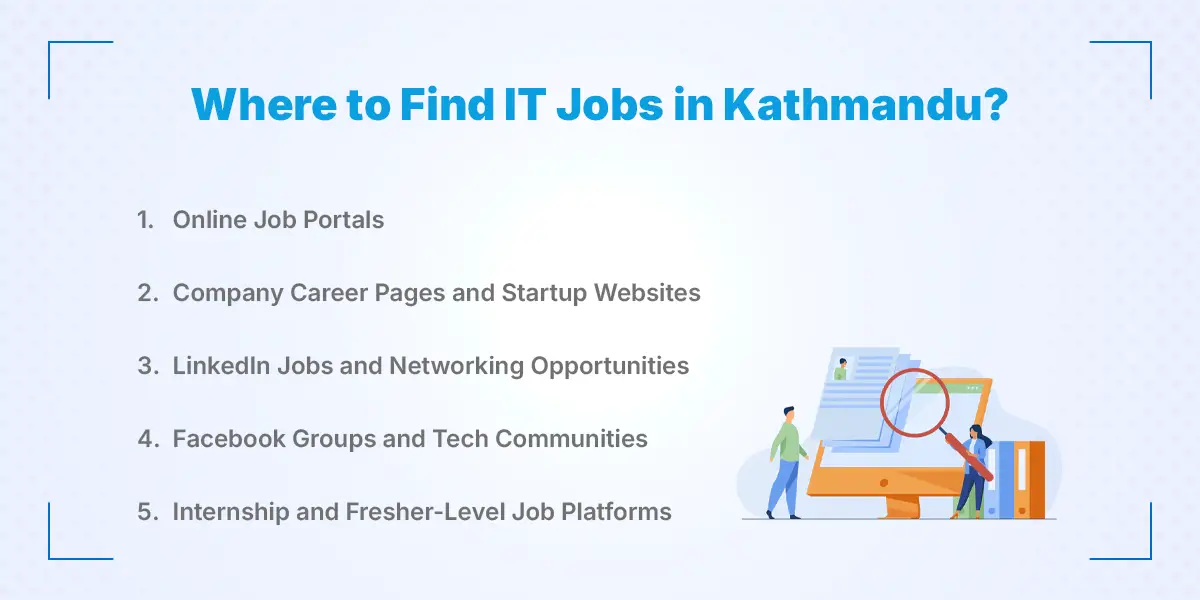
1. Online Job Portals
Online job portals are one of the easiest ways to find IT jobs in Kathmandu. They help you search by role, experience level, industry, and location, which saves time during the job hunt. You can find openings for developers, designers, support staff, digital marketers, QA testers, and many other roles. Trusted platforms like Kumari Job can be useful for checking updated IT vacancies, internship opportunities, and fresher-level openings in one place. The key is to check portals regularly and apply with a tailored CV instead of sending the same application everywhere.
2. Company Career Pages and Startup Websites
Many companies prefer to post jobs on their own websites before sharing them widely on other platforms. That is why checking company career pages can help you find opportunities earlier and apply directly. This is especially useful for software companies, startups, digital agencies, and outsourcing firms that hire for technical roles throughout the year. Startup websites can also be a good source for finding flexible and fast-growing work environments. If you have a list of target companies, visit their websites often and watch for hiring updates.
3. LinkedIn Jobs and Networking Opportunities
LinkedIn is now one of the most important platforms for IT job seekers. You can use it to search for jobs, connect with recruiters, follow companies, and build a strong professional profile. Many employers review LinkedIn before calling candidates for interviews, so your profile should match your CV and show your skills clearly. It is also a good place to discover hidden opportunities through connections, referrals, and professional posts. A strong LinkedIn presence can improve both visibility and trust.
4. Facebook Groups and Tech Communities
Facebook groups and tech communities can also help you find IT job openings, especially local opportunities. Many recruiters, company staff, and community admins share vacancies in these groups before they appear on large platforms. You may also find freelance work, internships, event updates, and skill-building communities that help with networking. These groups are useful if you stay active and respond quickly to good opportunities. However, you should always verify the company and role before applying.
5. Internship and Fresher-Level Job Platforms
If you are just starting your career, internship and fresher-level platforms are very important. These opportunities help you gain experience, improve your portfolio, and understand real workplace expectations. Many freshers do not get hired because they only search for full-time roles and ignore entry-level openings that could help them grow faster. Internship listings, trainee roles, and junior-level positions can be the best starting points for entering the IT field. Once you gain practical experience, moving into better roles becomes much easier.
How to Make Your CV Stronger for IT Jobs?
To make your CV stronger for IT jobs, clearly show your relevant technical skills, practical projects, experience, certifications, and portfolio proof in a simple and focused format. A strong IT CV should quickly tell the employer what you can do and why you fit the role. That means listing technical skills clearly, adding projects, internships, freelance work, and certifications that match the job, and including portfolio links such as GitHub, Behance, personal website, or live project URLs where relevant. Even if you are a fresher, a few solid projects can make your CV much stronger than a degree-only application.
You should also avoid common CV mistakes such as using a generic format for every job, adding too much unnecessary information, writing vague skill lists, or forgetting to include proof of work. Keep your CV clean, relevant, and easy to scan, because employers usually review it quickly before deciding whether to shortlist you.
Salary and Career Scope of IT Jobs in Kathmandu
The salary of IT jobs in Kathmandu usually depends on the role, experience, skills, company type, and whether you work in local service teams, outsourcing, or higher-paying product and global support roles. A practical market reference for Nepal shows many entry-level IT roles around NPR 25,000–45,000 per month, mid-level roles around NPR 50,000–90,000, and senior roles around NPR 1,00,000–2,50,000+. Broader Nepal IT salary data also shows that monthly gross pay in the IT category commonly falls between about NPR 20,163 and NPR 131,899, with higher ceilings for specialized roles.
For role-based examples, the pay range changes a lot by specialization. Frontend developers in Nepal are listed around NPR 23,067–265,682 per month, database administrators around NPR 36,570–236,209, IT technical support specialists around NPR 25,399–154,520, network administrators around NPR 25,883–95,999, and UX-related roles can reach roughly NPR 40,624–138,854 per month. These are broad market ranges, so entry-level pay is usually lower, while people with stronger portfolios, niche skills, or international project exposure often earn more.
In career growth terms, IT has a strong future scope because companies in Nepal continue hiring for software, web, data, support, and cloud-related work, while outsourcing and remote service models keep expanding. Salary usually increases faster when you move from basic execution roles into specialized or high-impact areas such as backend development, cloud, cybersecurity, data, DevOps, product engineering, or technical leadership. In simple terms, for junior roles expect lower but growing pay, for mid-level roles expect better stability and negotiation power, and for senior or specialized roles expect the biggest jump in income.
You can also understand it like this:
- For freshers, around NPR 25,000–45,000/month is a common starting range.
- For 2–5 years of experience, around NPR 50,000–90,000/month is a practical mid-level range.
- For senior professionals: around NPR 1,00,000–2,50,000+/month is possible, especially in specialized or leadership roles.
- For database-focused roles, market ranges can go above NPR 2 lakh/month in stronger positions.
- For frontend and specialized product work, pay can rise sharply with stronger frameworks, portfolio quality, and real project experience.
Why Do Some People Struggle to Get IT Jobs in Kathmandu?
Many people struggle to get IT jobs in Kathmandu because they apply without strong practical skills, a clear portfolio, a tailored CV, or a job search strategy that matches current market demand. A common problem is that candidates focus only on degrees or course certificates but do not build real projects that show what they can do. Many also send the same CV to every company, even when the job role, required skills, and employer expectations are different. Weak interview preparation makes the problem worse, especially when candidates cannot explain their projects, tools, or problem-solving process clearly.
Another reason is that some job seekers do not understand what employers are hiring for right now. For example, companies often want role-specific skills, practical tools, and proof of work, but many applicants rely only on theory. Some people also limit themselves to one platform, which reduces their chances of finding good opportunities. A better approach is to improve practical skills, build a portfolio, tailor each application, and search across multiple trusted platforms consistently.
What are the Best IT Skills to Learn for Jobs in 2026?
The best IT skills to learn for jobs in 2026 are the ones employers are actively hiring for now: web development, app development, UI/UX design, SEO and digital marketing, data skills, cybersecurity, and cloud computing. In Nepal, recent career guidance and hiring-focused content point to these areas as some of the strongest opportunities for both local jobs and remote work.
These skills matter because they match real business needs. Companies need websites, apps, better user experience, stronger online visibility, safer systems, and better use of data, while newer demand is also pushing cloud, DevOps, and AI-related capabilities higher.
1. Web Development Skills
Web development is still one of the best skills to learn because almost every business needs a website, web app, dashboard, or online platform. This field includes frontend, backend, and full-stack development, so it gives you several career paths under one area. Common skills include HTML, CSS, JavaScript, React, Node.js, PHP, Laravel, WordPress, and database basics. In Nepal, web development remains one of the most in-demand IT skill areas because businesses continue moving online and need developers to build and maintain digital platforms.
2. App Development Skills
App development is a strong skill because mobile usage keeps growing, and companies want Android, iOS, and cross-platform applications for users and internal operations. This area includes native app development and frameworks such as Flutter or React Native. Businesses value app developers who can build smooth, useful, and scalable mobile experiences. In Nepal, mobile app development is repeatedly listed among the top skills for 2026 because startups, service businesses, and digital products continue expanding.
3. UI/UX Design Skills
UI/UX design is important because companies do not only want working products; they want products that are easy, clear, and enjoyable to use. This skill involves wireframing, user research, interface design, prototyping, and improving user flow. Tools such as Figma, Adobe XD, and design systems are commonly used in this field. UI/UX remains one of the most useful digital skills because a better user experience directly supports product quality, customer satisfaction, and conversion.
4. SEO and Digital Marketing Skills
SEO and digital marketing jobs are valuable because companies need traffic, leads, visibility, and online growth, not just websites. This area includes SEO, content strategy, paid advertising, analytics, social media, and conversion-focused marketing. It is a good option for people who want a tech-related career without becoming full-time programmers. In Nepal’s 2026 skill trend discussions, digital marketing continues to appear as a strong job and freelancing skill because businesses want measurable online growth. For beginners who want to enter this field, Kumari Job’s beginner-level digital marketing training can be a useful starting point to learn practical skills and understand how real digital campaigns work.
5. Data, Cybersecurity, and Cloud-Related Skills
Data, cybersecurity, and cloud skills are some of the strongest future-focused IT skills because companies increasingly depend on data-driven decisions, secure systems, and scalable cloud infrastructure. Data roles often use Excel, SQL, Python, Power BI, or analytics tools. Cybersecurity roles focus on protecting systems, networks, and digital assets, while cloud roles involve platforms such as AWS, Azure, and Google Cloud. Multiple recent sources point to these areas as high-growth skill categories for 2026, both globally and in Nepal, especially for people aiming for specialized, better-paid, or remote-friendly roles.
Conclusion
Getting IT jobs in Kathmandu becomes much easier when you focus on the right skills, build a strong portfolio, improve your CV, and apply consistently through trusted platforms. In this field, practical skills, real projects, and steady learning often matter more than theory alone.
If you are looking for verified IT jobs, fresher openings, or internship opportunities in Kathmandu, Kumari Job can be a useful platform to explore current vacancies and take the next step in your career.
Frequently Asked Questions
Submit your comments

Get Our App On



SEO Training for Freshers in Nepal: Skills, Career & Job Opportunities
VIEW DETAILS
SEO Training vs. Self-Learning: Which Is Right for You?
VIEW DETAILS
How to Choose Between Two Job Offers
VIEW DETAILS
Digital Marketing Training Interview Questions and Answers for Freshers
VIEW DETAILS


Loading Comments...