




A fresher in Nepal finishes a bachelor's degree, opens a job portal, and sees vacancies asking for specific tools, portfolios, and prior experience. The degree took years to earn, yet the first ten applications go unanswered. The obvious question follows: "Do I really need a degree to get a good job, or are practical skills more important?"
The honest answer is that employers weigh education, skills, experience, and communication together, and the balance changes by industry, role, employer, and career stage. This article explains where degrees matter, where skills matter, and how to combine both into a profile that gets shortlisted.
In this blog
What Is the Difference Between a Degree and Practical Skills?
A degree is a formal academic qualification that proves foundational knowledge, while practical skills are the abilities a person uses to perform real job tasks. Employers read a degree as evidence of education and skills as evidence of capability. Both count, but they answer different hiring questions.
1. Degree
A degree is a formal academic qualification awarded after structured study. It provides theoretical and foundational knowledge in a subject. Some professions and job roles require it by rule. It also shows employers a candidate's educational background.
2. Practical Skills
Practical skills are the ability to perform specific tasks, and they include both technical and soft skills. They grow through projects, internships, training, and work. Examples include using accounting software, writing clearly, or presenting to a client. They show what a candidate can actually do.
3. Experience and Certifications
Experience shows how a person applied knowledge in a real workplace. Certifications show specialized learning in a narrow topic, such as a software tool or a safety standard. Neither replaces a degree or a skill, but each adds a different type of evidence. Employers read all four together to judge readiness.
Why Does a Degree Still Matter in the Job Market?
A degree still matters because many employers and regulators treat it as proof of formal training. It works as an early filter when many applications arrive for one vacancy. It also stays mandatory in professions where a law or council sets minimum qualifications.
1. Foundational Knowledge and Screening
Employers use a degree to confirm that a candidate studied the core concepts of a field. That theory gives graduates a base for learning new tools faster later. A hiring team with limited time often screens by education first and skills second. When a job post says "bachelor's degree required," the filter is usually real.
2. Regulated and Formal Careers
Government service, teaching, healthcare, engineering, legal work, and specialized technical careers usually set educational requirements through law or a professional body. Examples include Public Service Commission vacancy notices, Nepal Medical Council and Nepal Engineering Council registration, and teacher licensing. In these fields, a strong skill set cannot replace a missing qualification. Check the exact requirement on the official notice before spending time on an application.
3. Long-Term Career Progression
Some employers set degree requirements for senior and management positions even when entry roles are flexible. A degree also supports postgraduate study and overseas opportunities, where formal credentials get checked. Later promotions usually depend on credentials and proven results together. Treat the degree as a base that supports growth, not as the finish line.
Why Are Skills Important for Getting a Job?
Skills matter because they show an employer that a candidate can do the work from the first week. Technical ability, communication, and digital literacy reduce training time and hiring risk. For freshers with similar degrees, demonstrated skills often separate one CV from another.
Skills employers commonly look for in freshers:
- Communication
- Problem-solving
- Teamwork
- Time management
- Digital literacy
- Industry-specific technical skills
- Adaptability
- Basic workplace professionalism
Read KumariJob's guide to skills employers look for in freshers for a deeper list.
Degree vs Skills: Which One Is More Important for Getting a Job?
Neither is universally more important, because the answer depends on the role, industry, employer, and career stage. A licensed profession treats the degree as non-negotiable, while a portfolio-based role often weighs proof of work more heavily. The table below shows how the two compare across common hiring factors.
| Factor | Degree | Skills |
|---|---|---|
| Academic qualification | Strong | Limited |
| Practical ability | May vary | Strong |
| Required professions | Often essential | Also important |
| Entry-level hiring | Can be a requirement | Can differentiate candidates |
| Career switching | May help establish credibility | Transferable skills can help |
| Portfolio-based careers | Sometimes less central | Often highly relevant |
| Long-term career | Can support progression | Supports performance and growth |
When Is a Degree More Important Than Skills?
A degree is more important when a law, license, or employer explicitly requires it. In those cases, skills cannot substitute for the credential. The clearest examples share one feature: someone outside the company sets the rule.
- Jobs legally requiring specific educational qualifications
- Professional careers requiring licenses or formal credentials
- Government jobs with prescribed educational requirements
- Academic and research careers
- Specialized technical professions
- Jobs where the employer names a particular degree
When Can Skills Matter More Than a Degree?
Skills matter more when employers judge candidates by finished work rather than certificates. This is common in creative, sales, and project-based fields. A strong sample or a proven result can outweigh the name of a degree.
- Creative and portfolio-based jobs
- Digital marketing
- Graphic design
- Content creation
- Web development
- Video editing
- Sales
- Some customer-service roles
- Freelance and project-based work
Can You Get a Job Without a Degree in Nepal?
Yes, jobs in Nepal are available without a degree, mainly in skill-based, sales, customer service, freelance, and vocational roles. Employers in these areas usually care more about proof of ability than a certificate. Regulated professions and many government posts still require specific qualifications, so each job description needs a careful read.
- Skill-based and portfolio-based opportunities
- Entry-level roles that train new hires
- Vocational and technical training, such as programs offered through CTEVT-affiliated institutions
- Freelance and project-based work
- Vacancies that list a degree as "preferred" rather than "required"
How Can Freshers Combine Their Degree and Skills?
Freshers combine a degree and skills by turning classroom knowledge into visible, job-specific proof. The process starts with real vacancies and ends with targeted applications. Each step below builds on the one before it.
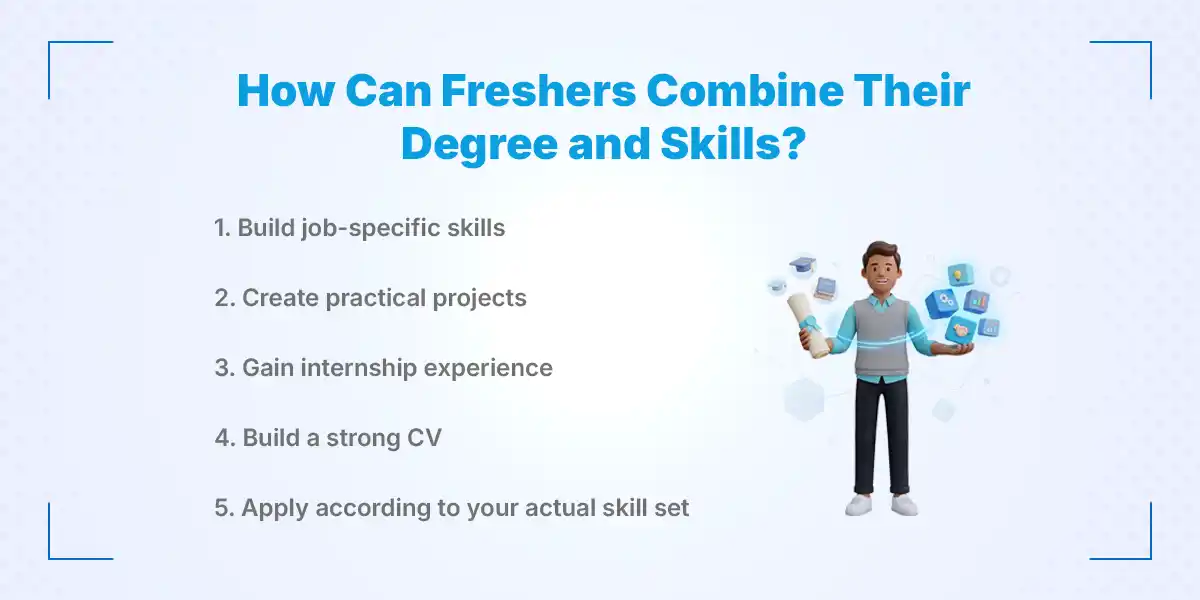
1. Build Job-Specific Skills
Job-specific skills come from the vacancies a fresher actually wants to win. Save 10 relevant job posts and mark the tools and tasks that appear in most of them. Then learn those tools through free courses, practice files, or short training programs. This approach targets employer demand instead of guessing what might be useful.
2. Create Practical Projects
Projects turn claimed skills into visible proof. Academic assignments, personal builds, freelance gigs, volunteer work, and portfolio pieces all count. Pick one project per target skill and describe the problem, the tools used, and the result. Keep the work easy to share through a folder link or a simple page.
3. Gain Internship Experience
An internship gives a fresher real workplace context that classrooms rarely provide. Search for relevant internships, record responsibilities and achievements weekly, and ask supervisors for feedback. Convert each task into a CV line with a result, such as reports completed or posts scheduled. A short recommendation from a supervisor adds further credibility.
4. Build a Strong CV
A strong CV matches the language of the vacancy and proves each claim. Place relevant skills near the top and connect academic projects to job requirements. Add measurable achievements and certifications only where they support the role. Keep it to one or two clean pages, since recruiters scan quickly.
5. Apply According to Your Skill Set
Targeted applications succeed more often than mass applications. Match your skills against each job description before applying, and note the gaps. Avoid applying only because a job title sounds attractive. Treat each gap as a learning task for the next few weeks.
What Skills Should Students Learn Alongside Their Degree?
Students should learn the skills that appear most often in vacancies for their target career. Most fields share a common core of communication and digital skills, plus a few role-specific tools. Building these during the degree shortens the gap between graduation and the first job.
- Communication skills
- Digital skills
- Technical skills
- Problem-solving
- Time management
- Teamwork
- Presentation skills
- Research skills
- Industry-specific software and tools
- AI literacy and responsible use of AI tools
How Can You Decide Whether to Focus on a Degree or Skills?
Decide by working backward from the career you want and the requirements its vacancies actually list. Requirements differ by profession, so the answer for a nurse differs from the answer for a video editor. A short set of questions makes the choice practical.
- What career do I want?
- Does the profession require a formal degree?
- What qualifications do current vacancies require?
- What skills appear repeatedly in job descriptions?
- Do I already have practical experience?
- Can I demonstrate my skills through projects?
- What skill gaps do I currently have?
- What should I learn within the next 3 to 6 months?
Simple framework: Target career → Check qualification requirements → Identify required skills → Build skills → Gain experience → Create evidence → Apply for jobs
What Should Nepali Freshers Do If They Have a Degree but No Skills?
Graduates with no job-ready skills can close the gap by choosing one target career, identifying the skills its vacancies repeat, and learning those tools. Practical projects and internships then turn learning into proof. A focused CV and portfolio present that proof to employers.
- Choose one target career.
- Analyze 10 to 20 relevant vacancies.
- Identify repeated skill requirements.
- Prioritize 2 or 3 skills.
- Complete practical projects.
- Seek internship or entry-level experience.
- Update your CV and LinkedIn profile.
- Start applying while you continue to learn.
Degree vs Skills for Different Career Paths
Degree requirements vary by employer and role, so treat this table as a general guide and confirm details in each vacancy.
| Career Area | Degree Importance | Skill Importance | Practical Evidence |
|---|---|---|---|
| Engineering | High | High | Projects, internships |
| Healthcare | High | High | Clinical and practical training |
| Digital Marketing | Varies by employer | High | Campaigns, portfolio |
| Graphic Design | Varies by employer | High | Portfolio |
| Software Development | Varies by role | High | Projects, GitHub |
| Accounting | High | High | Accounting software, practical work |
| Sales | Varies by employer | High | Communication, results |
| Teaching | Often important | High | Teaching ability |
| Content Writing | Varies by employer | High | Published samples |
| Human Resources | Often relevant | High | HR knowledge and tools |
How Can KumariJob Help You Build a Career?
KumariJob helps job seekers find vacancies, internships, and entry-level roles that match their qualifications and skills. The platform lets readers search by role and read requirements before applying, which makes skill-gap checks faster. Its career resources support job readiness while candidates keep learning.
- Search for relevant jobs
- Find internships and entry-level opportunities
- Explore vacancies based on skills and qualifications
- Use career resources to improve job readiness
Conclusion
The degree vs skills debate matters less than the evidence you can show for the job you want. A degree opens doors that a policy or license has closed to others, and skills prove you can do the work once inside. Whichever one feels weaker today, the fix is the same: read real vacancies, find what they repeat, and build visible proof against it.
Start with one target role this week and list what its job posts ask for. Explore relevant jobs and internships on KumariJob and match your degree and skills to real vacancies today.
Frequently Asked Questions
Submit your comments

Get Our App On


Should I Accept a Job With Low Salary for Experience?
VIEW DETAILS
Should I Accept a Job With Low Salary for Experience?
VIEW DETAILS
How to Identify Fake Job Offers in Nepal: Signs to Watch For
VIEW DETAILS
What Should I Do After Being Rejected for a Job?
VIEW DETAILS


Loading Comments...